
While looking for Transmission Electron Microscope imaging of the insoluble Iron Oxide precipitates found in various Human Tissue biopsies, I stumbled across an interesting 1998 paper1 that included Gold crystals inside a single cell of Pseudomonas aeruginosa.
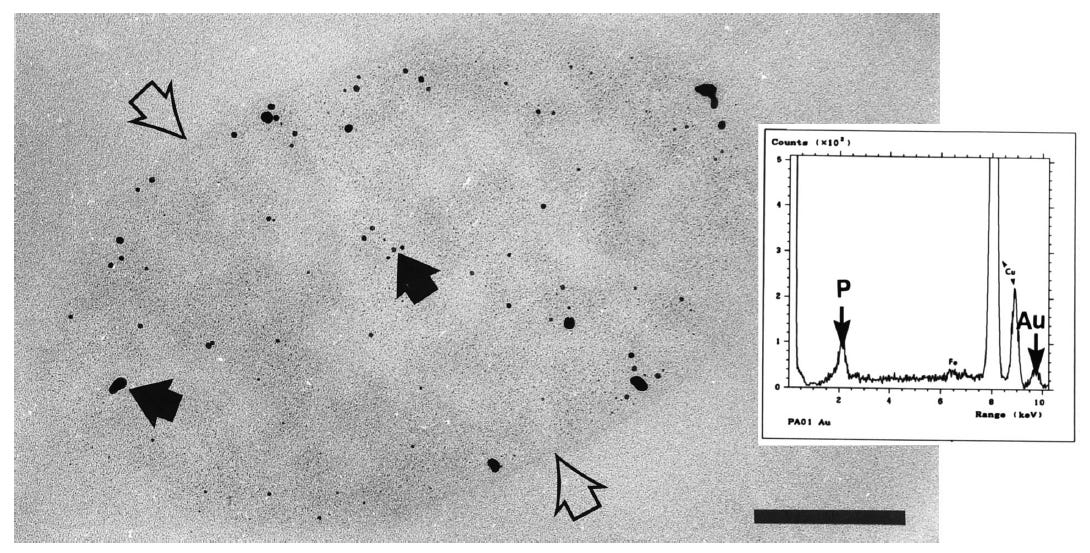
FIG. 6. Thin section of a Gold-treated strain PAO1 cell.
The cell (whose surface is indicated by open arrows) is filled with numerous electron-dense precipitates of different sizes (solid arrows). Bar = 200 nm.
(Inset) EDS analysis of the electron-dense precipitates produced only a peak for Gold and a broadening of the Phosphorus peak (which overlapped a secondary Gold peak). Similar results were obtained for all four strains.
Note the overlapping peaks for Phosphorus and Gold, sorted out by the experts in EDS.
In 2016 Priyanka A. Oroskar (later married Sharma) earned her PhD and published with others on Flip-Flops and Damaging Effects of some Gold nanoparticle formulatons.2 The work was funded by the US National Science Foundation.
Abstract
PEGylated Gold nanoparticles are considered suitable nanocarriers for use in biomedical applications and targeted drug delivery systems.
In our previous investigation with the alkanethiol-functionalized Gold nanoparticle, we found that permeation across a protein-free phospholipid membrane resulted in damaging effects of lipid displacement and water and ion leakage. In the present study, we carry out a series of coarse-grained molecular simulations to explore permeation of lipid bilayer systems by a PEGylated gold nanoparticle, especially at the bulk-liquid-lipid interface as well as the interface between the two lipid leaflets. Initially, we examine molecular-level details of a PEGylated gold nanoparticle (constructed from cycled annealing) in water and find a distribution of ligand configurations (from mushroom to brush states) present in nanoparticles with medium to high surface coverage. We also find that the characteristic properties of the PEGylated gold nanoparticle do not change when it is placed in a salt solution. In our permeation studies, we investigate events of water and ion penetration as well as lipid translocation while varying the ligand length, nanoparticle surface coverage, and ion concentration gradient of our system. Results from our studies show the following: (1) The number of water molecules in the interior of the membrane during ligand-coated nanoparticle permeation increases with PEGn-SH surface coverage, ligand length, and permeation velocity but is not sensitive to the ion concentration gradient. (2) Lipid molecules do not leave the membrane; instead they complete trans-bilayer lipid flip-flop with longer ligands and higher surface coverages. (3) The lack of formation of stable water pores prevents ion translocation. (4) The PEGylated nanoparticle causes less damage to the membrane overall due to favorable interactions with the lipid headgroups which may explain why experimentalists observe endocytosis of PEGylated nanocarriers in vivo.
In 2017 Priyanka A. Oroskar (later married Sharma), Cynthia J. Jameson, and Sohail Murad on simulation .3
In 2019 an interesting further study and review by Priyanka A. Oroskar (later married Sharma), Cynthia J. Jameson, and Sohail Murad, funded by a grant from the US National Science Foundation.4 They performed simulation studies of spherical and nanorod Gold colloids interacting with Lipids used in Jabs.
Abstract
We use coarse-grained molecular dynamics simulations to “observe” details of interactions between ligand-covered Gold nanoparticles and a lipid bilayer model membrane.
In molecular dynamics simulations, one puts the individual atoms and groups of atoms of the physical system to be “observed” into a simulation box, specifies the forms of the potential energies of interactions between them (ultimately quantum based), and lets them individually move classically according to Newton’s equations of motion, based on the forces arising from the assumed potential energy forms. The atoms that are chemically bonded to each other stay chemically bonded, following known potentials (force fields) that permit internal degrees of freedom (internal rotation, torsion, vibrations), and the interactions between nonbonded atoms are simplified to Lennard-Jones forms (in our case) and coulombic (where electrical charges are present) in which the parameters are previously optimized to reproduce thermodynamic properties or are based on quantum electronic calculations.
The system is started out at a reasonable set of coordinates for all atoms or groups of atoms, and then permitted to develop according to the equations of motion, one small step (usually 10 fs time step) at a time, for millions of steps until the system is at a quasi-equilibrium (usually reached after hundreds of nanoseconds).
We then let the system play out its motions further for many nanoseconds to observe the behavior, periodically taking snapshots (saving all positions and energies), and post-processing the snapshots to obtain various average descriptions of the system.
Alkanethiols of various lengths serve as examples of hydrophobic ligands and methyl-terminated PEG with various numbers of monomer units serve as examples of hydrophilic ligands.
Spherical Gold particles of various diameters as well as Gold nanorods form the core to which ligands are attached. The nanoparticles are characterized at the molecular level, especially the distributions of ligand configurations and their dependence on ligand length, and surface coverage.
Self-assembly of the bilayer from an isotropic solution and observation of membrane properties that correspond well to experimental values validate the simulations. The mechanism of permeation of a Gold NP coated with either a hydrophobic or a hydrophilic ligand, and its dependence on surface coverage, ligand length, core diameter, and core shape, is investigated.
Lipid response such as lipid flip-flops, lipid extraction, and changes in order parameter of the lipid tails are examined in detail.
The mechanism of permeation of a PEGylated nanorod is shown to occur by tilting, lying down, rotating, and straightening up.
The nature of the information provided by molecular dynamics simulations permits understanding of the detailed behavior of Gold nanoparticles interacting with lipid membranes which in turn helps to understand why some known systems work better than others and aids the design of new particles and improvement of methods for preparing existing ones.
Then in 2021, Gold Nanoparticles were proposed by Egyptian researchers as treatment to reduce Quorum Sensing of Pseudomonas aeruginosa bacteria.5
Subscribers might have heard of Purple of Cassius that is a non-settling suspension of colloidal Gold.6
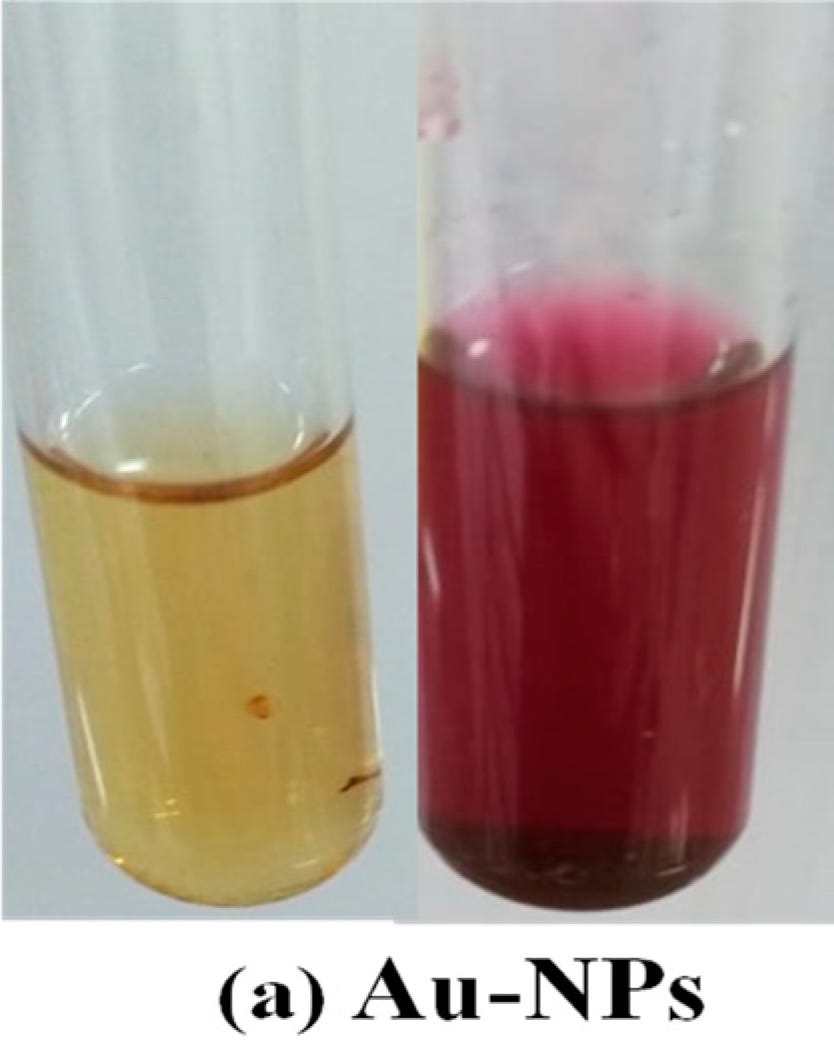
Here is part of Figure 1 from Elshaer and Shaaban showing the reduction of Chloroauric Acid (HAuCl4) to the metal when mixed with bacteria.
In earlier posts I mentioned that Gold nanocrystals were used in sensors using Localized Surface Plasmon Resonances iin miniaturized Lab-On-a-Chip with a detection limit down to 5 ng/mL, but that was not sensitive enough to detect damaging levels of Endotoxin.7
Ferrocene Gold sensors however were highly selective, allowing detection limit of 0.001 Endotoxin Units (EU) per millilitre.8
S Langley and TJ Beveridge. 1998. Effect of O-side-chain-lipopolysaccharide chemistry on metal binding. Applied and Environmental Biology. 65(2):489-498. doi: 10.1128/AEM.65.2.489-498.1999.
Priyanka A Oroskar, Cynthia J Jameson, Sohail Murad. 2016. Simulated Permeation and Characterization of PEGylated Gold Nanoparticles in a Lipid Bilayer System. Langmuir 32(30):7541-55. doi: 10.1021/acs.langmuir.6b01740.
Priyanka Oroskar, Cynthia J. Jameson & Sohail Murad. 2017. Molecular dynamics simulations reveal how characteristics of surface and permeant affect permeation events at the surface of soft matter. Molecular Simulation, 43:5-6:439-466, DOI: 10.1080/08927022.2016.1268259
Priyanka A. Oroskar, Cynthia J. Jameson, and Sohail Murad. 2019. Molecular-Level “Observations” of the Behavior of Gold Nanoparticles in Aqueous Solution and Interacting with a Lipid Bilayer Membrane. Pharmaceutical Nanotechology in: Weissig, V., Elbayoumi, T. (eds). Methods in Molecular Biology. 2000:303-359. doi: 10.1007/978-1-4939-9516-5_21. https://link.springer.com/protocol/10.1007/978-1-4939-9516-5_21
Soha Lotfy Elshaer, Mona I Shaaban. 2021. Inhibition of Quorum Sensing and Virulence Factors of Pseudomonas aeruginosa by Biologically Synthesized Gold and Selenium Nanoparticles. Antibiotics (Basel).
https://en.wikipedia.org/wiki/Purple_of_Cassius
Graphene Oxide, Gold and Organometallic Ferrocene make sensitive Endotoxin Detector
·
March 12, 2023
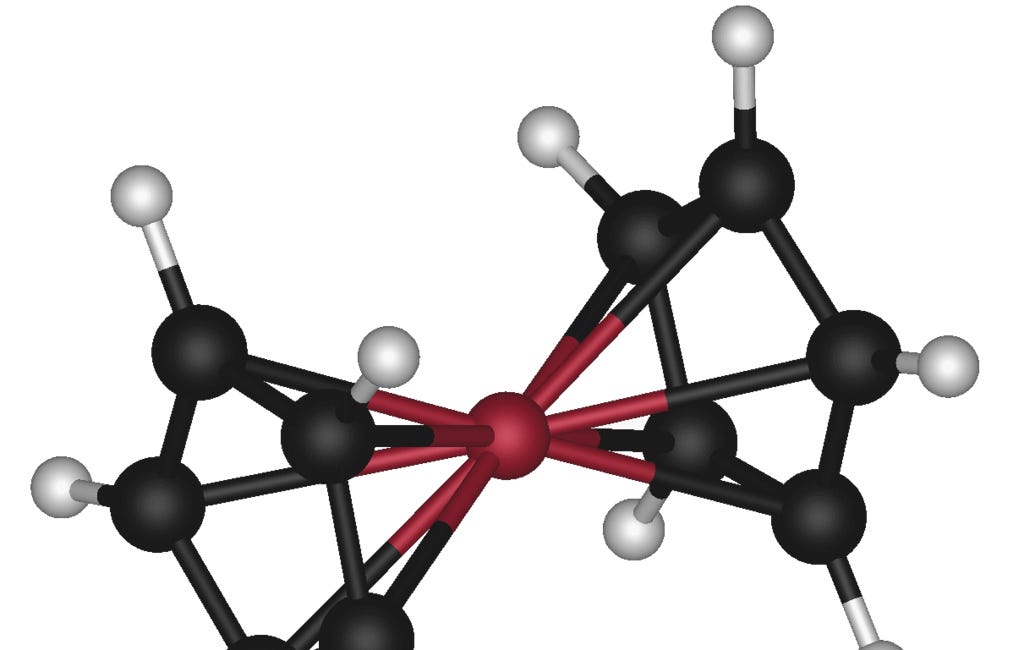
In 1980 I had the pleasure of meeting Nobel Prize winner Professor Sir Geoffrey Wilkinson who made Ferrocene, a “sandwich molecule”, where two carbon pentagons bond to an Iron atom. Wilkinson was a supervisor of my PhD supervisor Ron Dickson. I had made Ferrocene as an undergraduate experiment and went on to make new similar molecules of the Platinum Gr…
No posts
Comments
Nothing yet. Say the first thing.
Sign in to join the conversation.