
“How did you go bankrupt?”
“Two ways. Gradually, then suddenly.”
— Ernest Hemingway, The Sun Also Rises
In 1982, the median first-time homebuyer in America was 29 years old.
Today he is 40. And he did everything his mom and dad told him to. It worked for them so it would work for him too!
Or so he was told.
He got the degree (up in cost roughly 500% since his dad bought one).
He got the job.
He saved.
But the entire time he was saving, the finish line was moving away from him faster than he could run toward it, because the dollars he was saving were draining out of the bottom of a bucket at the Federal Reserve.
That drain has a name. Inflation. And the reason I keep writing about it is that almost nobody seems to understand how much it’s actually costing us. I imagine future societies will look back upon this ugly system of money printing and fiat currencies the same disgusted way we look back on slavery, torture, and the practice of burning books.
One day, inflation will be an anachronism. But until that day, it is imperative we understand what it is and how to safeguard ourselves from its more insidious consequences.
So today: the math, who benefits, and the four assets that have protected the people who hold them:
Land, gold, Bitcoin, and ammunition. The Crazy Uncle Portfolio, laughed at for decades by every responsible adult with a 401(k).
Then I’ll give you the exact plan I’d hand to someone starting from zero.
In real terms, inflation is the value of your hard earned money going down. If you don’t live under a rock, you’ve felt its poison sting significantly in the last handful of years.
It happens for a variety of reasons, most notably money printing, and almost all are connected to policy decisions made by the controllers of the fiat currency. Some examples outside the printing of money include:
Fiscal deficits (spending more than you take in)
Tariffs (import taxes are passed on to the consumer)
A shrinking labor supply
Energy costs
A massive housing shortage
Deglobalization
The T-Bone steak didn’t get more valuable. In fact, it’s probably worse quality than you’re used to because the restaurant you’re purchasing it from is also trying to combat the negative effects of inflation. What really happened is that the dollars in your hand got weaker, and your medium-rare steak is just the messenger.
The Federal Reserve targets 2% inflation per year, on purpose, forever. That’s the goal, at least as they state it. The delivery since 2019 has been just under 4% per year, which compounds like this: the dollar you held in the summer of 2019 buys about 77 cents worth of stuff today. The ten-year version buys about 72 cents.
Concretely: if you parked $10,000 in a savings account in 2019 and never touched it, it now buys $7,700 worth of groceries, gas, and rent. You didn’t spend a dime.
You lost $2,300 anyway.
Nobody voted on that. Even worse, it’s a tax on money you already paid taxes on, collected silently by the suits who can’t keep their grubby little hands out of your pockets or off the money printer.

What they say: “We are committed to our 2% target.”
What they’ve done: roughly 4% a year for seven years running, about 30% cumulative.
June’s inflation report came in at 3.5%, down from 4.2%, and the financial press celebrated. Cooling! Progress! Except the victory lap is that your money now loses value at 3.5% a year instead of 4.2%. The arsonist switched to a smaller can of gasoline and expects you to thank him.
Meanwhile, the hands tell the real story. In December 2025 the Fed sneakily stopped shrinking its balance sheet (a deflationary act) and started buying Treasury bills again, every month, with money that did not exist the moment before they bought them. The official term is “reserve management purchases” (that’s a nice way of saying printing dollars to buy government IOUs).
More dollars chasing the same shit. Every new dollar is a small theft from every existing one.
That is simple arithmetic, not conspiracy.
The federal government owes $39 trillion. The interest alone is on pace for a trillion dollars this year. Interest is now the second-largest expense in the federal budget: bigger than national defense, bigger than Medicare, behind only Social Security. The Congressional Budget Office says the cost doubles to $2.1 trillion within ten years.
So what exits do our esteemed politicians that care so much about the common man have?
Raise rates to kill inflation. Can’t do that because the already colossal interest bill detonates their budget.
Cut spending. Can’t do that. That would be committing political suicide.
Default on the debt. Can’t do that because it would end the global financial system.
Or (drumroll, ladies and gentlemen) keep inflation running hot, call it 2%-ish, and shrink the debt by shrinking the dollar it’s owed in.
Door number four. It’s always door number four. It’s the only exit that never requires a single politician to cast a hard vote, and the cost lands on whoever holds dollars and earns wages aka the middle-class American. Particularly the young middle-class American.
Maybe you’re getting sick of all the Boomer hate online. I’m not. In my opinion, there should be more of it because they’ve built a system entirely focused on the yield of crops in the ground with absolutely zero thought put toward the damage they’re doing to the ground, itself.

The Boomer generation bought houses for two years’ salary and college degrees for a summer job’s wages, then spent fifty years financializing everything they’d already climbed and mailing the bill forward to their kids and grandkids.
Johann Kurtz put it perfectly in a recent essay called “Young Adults Are Poor Despite Every Metric Which Suggests Otherwise”: the young must now buy back, item by item and at retail prices, what their grandparents received as a bounty. At age 30, 55% of the Silent Generation owned a home. Boomers: 48%. Millennials: 33%.
Childcare now costs more per year than college tuition.
I don’t think most of them were villains, nor do I think there is some dark cabal of puppet masters pulling four dimensional puppet strings. People simply responded to the incentives in front of them. But those incentives built a machine with one function: move wealth from people who hold dollars to people who hold assets.
The Extraction Economy doesn’t give a shit about your work ethic or your savings rate.
It just runs.
And that’s why your landlord keeps raising rent. He’s not twisting his mustache with his feet up in front of sixty security cameras; his taxes, insurance, and replacement costs are inflating too, and raising rent is how a person holding an asset keeps pace.
There’s a 300-year-old name for the whole dynamic that is famous in the Bitcoin space: the Cantillon Effect, after the banker Richard Cantillon, who noticed that new money enters the economy at the top (banks, governments, asset markets) and the people standing closest to the spigot get to spend it before prices adjust. By the time it reaches wages, the prices already moved.
Asset holders surf the wave. Wage earners get hit by it.
So unless he’s a total dick, don’t hate the landlord. Get on the right side of the wave.
July 2016 to July 2026, with the dollar’s ~28% purchasing-power loss baked into the “real” column. The S&P 500 is included because that’s the respectable-adult benchmark.
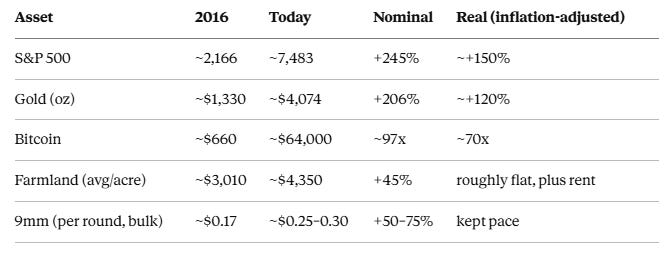
(Farmland figures are USDA’s 2016 and 2025 numbers; the 2026 survey lands in August.)
Stocks did great. No cooked numbers here: +245% beat inflation handily. But notice what you “own:” a claim, inside an account, at a custodian, on an exchange, every layer requiring permission and functioning institutions. A fine asset that assumes the good times.
Gold tripled. It’s at all-time highs above $4,000 while central banks (the people who print money) buy it by the ton. This is important information.
Bitcoin did 97x, including the crash we’re in now. It peaked above $126,000 last October and has been nearly cut in half since. It’s in a full bear market as I write this, and the ten-year number is still 97x. The volatility is the tuition cost.
Land roughly paced inflation on price, and that undersells it. Land pays rent, grows food, holds your house, and runs your farming operation (big or small) while it sits there. Most importantly: nobody has figured out how to print more of it.
Ammunition kept pace, until it didn’t. FOR EXAMPLE: in spring 2020, bulk 9mm went from under 20 cents a round to over 70 cents in months. Same box, same shelf, 4x overnight, because a crisis hit and everyone did the same math they did on toilet paper at Costco. It’s back near pre-crisis prices today, which means the one asset with proven panic-convexity is currently on sale. Do yourself a favor and stop waiting to stock up. Apply the same buyer’s discipline you would to any other asset. You’ll thank me later.
These aren’t four bets on the same idea.
Land is your sanctuary and your home front.
Gold is the savings they can’t debase.
Bitcoin is the tech-heavy asymmetric upside.
Ammo is the insurance you pray stays boring.
Infantry guys will recognize the design: interlocking fields of fire. No single position has to be perfect because no approach angle is uncovered.
That’s the difference between financial sovereignty and being rich. We aren’t all going to be rich. But we can become a hell of a lot harder to kill.
(Author’s Note: I am a layman, not a financial advisor, and this is me thinking out loud on the internet, not investment advice. My credentials are that I’ve been poor, I’ve been broke, I read obsessively, and I’ve been shot at, which is exactly one more credential than most advisors I’ve met.)
Assume you have nothing. No stocks, no crypto, no metals, no dirt, no ammo. You can carve out $300 a month. If your number is $150, halve everything. If you can afford $900 a month, triple everything. The percentages are the plan.
Months 1–3: build the buffer. First three months of savings goes to cash. This isn’t investment; it’s a firewall. The number one destroyer of asset builders is being forced to sell at the worst moment because the transmission blew.
Crazy Uncle Rule #1: Never be a forced seller.
Months 4 and forever: run the 40/30/20/10 split.
40% Bitcoin ($120/mo). Automatic weekly buys. Once the stack passes ~$500, move it to a hardware wallet and learn self-custody. If you have no idea what I’m talking about, check out my resource Bitcoin and the Long Walk out the Cage, which has everything you need to begin understanding Bitcoin as well as learning to self-custody.
30% Gold ($90/mo). Fractional gold: one-gram bars, Goldbacks, or save five months for a 1/10 oz coin from a reputable dealer. Small-gold premiums are annoying. Pay them anyway.
20% Land fund ($60/mo). A separate savings account labeled LAND that you do not touch.
10% Ammunition ($30/mo). Bulk 9mm at ~25 cents a round is 100+ rounds a month, shelf-stable for decades. Some of those rounds are for the range: an asset you can’t competently use is gear, not an asset.
Crazy Uncle Rule #2: Buy on schedule, not on feelings.
This is dollar cost averaging, and it’s worth understanding why it works. You invest the same dollar amount every month no matter the price, which means your fixed $120 automatically buys more Bitcoin when it’s cheap and less when it’s expensive. Over time your average cost per unit lands below the average price, and you never once had to pretend you’re smart enough to guess a top or a bottom. The schedule removes the two things that destroy small investors: emotion and timing. The schedule is smarter than you. It buys the dips you’d be too scared to buy.
Years 2–3: buy dirt. Around month 30 the land fund crosses ~$1,800, which sounds too small to matter until you look at actual rural listings. You don’t need $100,000 to own land in America. Acreage in Oklahoma, the Ozarks, west Texas, and the high desert still sells at $3,000–8,000 for one to ten acres, much of it owner-financed: $500–1,000 down, $100–200 a month, no bank, no credit check. Sign, then redirect the 20% to the land note. Three years in, on $300 a month, you’re a landowner.
Crazy Uncle Rule #3: Custody is the point. Held in your hand, buried on your land, secured by your keys.
The scorecards. At just $300/month, here’s what the plan builds, with the realized values calculated two ways:
if each asset simply repeats its last ten years, and
a conservative case where Bitcoin stops being Bitcoin and merely grows at gold’s rate (~12%/yr) from here.
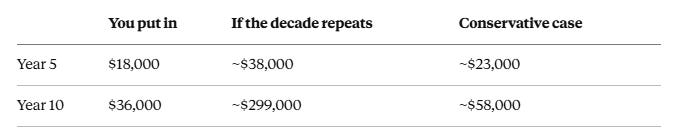
The Year 10 trend number breaks down like this: ~$266,000 in Bitcoin (that’s what 58% a year does to a $120 monthly buy), ~$19,000 in gold, ~$8,500 in land, ~$4,500 in ammo, plus your buffer. Yes, the Bitcoin line is doing the heavy lifting, and no, I can’t promise the next decade repeats the last one. Nobody can, which is exactly why the plan owns four things instead of one. Look at the conservative line: even if Bitcoin never outperforms gold again, you turned $36,000 into ~$58,000 of real assets.
Now run the same ten years for the person who put that $300 a month into a plain cash account instead. At the 4% inflation we’ve actually been running since 2019, their $36,000 is still $36,000 on the statement, and it buys about $30,000 worth of today’s goods. The year-one deposits lost nearly a third of their purchasing power; the later ones lost less; blended, the invisible tax of inflation stole roughly $6,000. They saved with perfect discipline for a decade and got charged six grand for it.
Same $300. Same ten years. One of them ends up holding somewhere between $58,000 and $299,000. The other ends up losing $6,000 of buying power.
Crazy Uncle Rule #4: Never trade assets back into dollars except to climb the ladder. Selling gold to pay off the land is climbing. Selling Bitcoin to buy a new truck is not.
Crazy Uncle Rule #5: the portfolio is defense; your income is offense. Run both.
Thirty-six thousand dollars over ten years. Roughly the price of a mid-trim pickup, spread across a decade, in exchange for feeling the one thing almost nobody in this economy gets to feel.
Calm.
They can print more dollars. In fact, they will print more dollars. They cannot print more acres of land, more ounces of gold, more of the 21 million Bitcoin, or more brass sitting undisturbed in your gun safe.
Start with the buffer. Run the split. Thank yourself later.
With gratitude and curiosity,
-Rich
Bitcoin and the Long Walk out of the Cage — my primer on understanding Bitcoin and learning self-custody
Young Adults Are Poor Despite Every Metric Which Suggests Otherwise — Johann Kurtz’s essay on the generational wealth transfer
Consumer Price Index, June 2026 — Bureau of Labor Statistics
Interest Costs on the National Debt — Peterson Foundation tracker ($39T debt, ~$1T annual interest)
Recent balance sheet trends — the Federal Reserve’s own charts, if you want to watch the hands yourself
Why the Fed Began a New Phase of Balance-Sheet Expansion in December — the “reserve management purchases” story
Current price of gold — Fortune
Bitcoin hits all-time high above $125,000 — US News, October 2025 (the peak we’ve since been cut in half from)
Farmland values hit record high — American Farm Bureau on the USDA numbers
9mm price history — Black Basin’s chart, including the 2020 spike to $0.71/round
Comments
Nothing yet. Say the first thing.
Sign in to join the conversation.