
Jobpocalype Not Now. The Economist reports that AI is not yet deeply reducing employment in the Indian IT outsourcing industry, which is one of the first places we’d expect any great AI-driven displacement of labor to show up. As I’ve written here before, there are indications that AI is weakening demand for some kinds of labor. But massive technological unemployment ain’t here yet.
Our weird new AI colleagues. Clive Thompson has a great article in the NYT about how coders are working with the latest AI models, which have recently become extraordinarily good at writing code. Extraordinary, but also strange and tempramental. Throughout the computer era so far, computers did what we told them, often to an annoying degree.1 But not these models. As Thompson puts it
When you behold the prompt file of a coder using A.I., you are viewing a record of the developer’s attempts to restrain the agents’ generally competent, but unpredictably deviant, actions
I looked at [one coder’s] prompt file. It included a prompt telling the agents that any new code had to pass every single test before it got pushed into Hyperspell’s real-world product. One such test for Python code, called a pytest, had its own specific prompt that caught my eye: “Pushing code that fails pytest is unacceptable and embarrassing.”
Embarrassing? Did that actually help, I wondered, telling the A.I. not to “embarrass” you? Ebert grinned sheepishly. He couldn’t prove it, but prompts like that seem to have slightly improved Claude’s performance.
Some of my colleagues’ prompt files look like instructions given to a exuberant 12 year-old savant with ADHD. I have no idea how long this situation will persist, but I find it weird and wonderful.
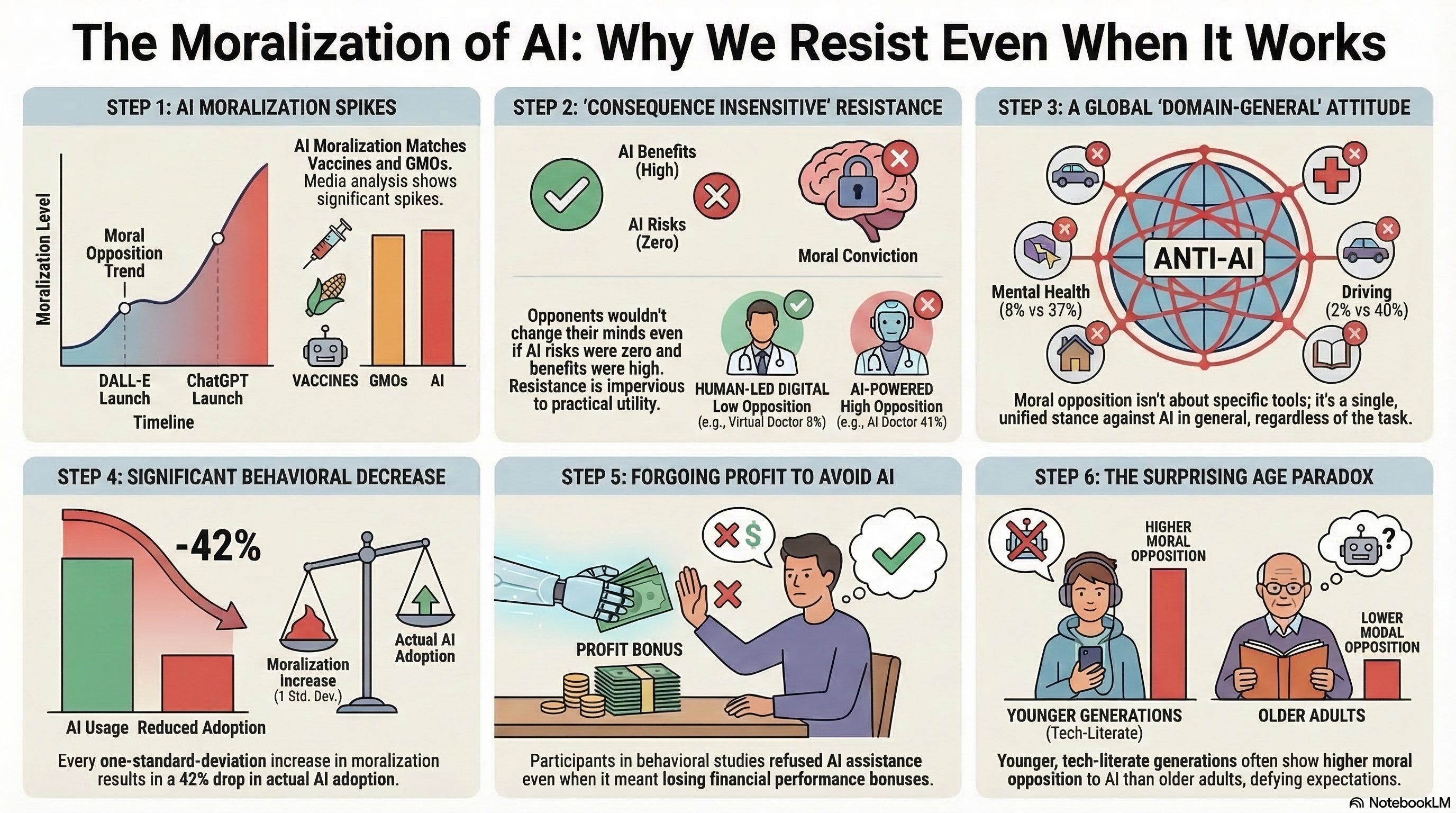
How we feel about machines that think. People put AI into the same category as GMOs and vaccines. Great, right? GMOs and vaccines are objectively safe and effective, so AI should be thrilled to be associated with them, right? No, because we often don’t think objectively about GMOs and vaccines. Instead, we moralize them. For whatever set of reasons many of us have become convinced that they’re morally bad, and reject evidence about their benefits. A new paper reveals that we’re also now moralizing about AI. As a writeup from psychologist Michael Inzlicht puts it:
The behavioral data make this concrete: a one standard deviation increase in moralization scores predicted a 42% drop in actual AI usage, even when it would have benefited that person personally. The conviction preceded the behavior by up to 573 days.
The next time someone gives you three different reasons to oppose AI, each one dissolving under mild scrutiny, you're probably not watching someone think. You're watching someone feel.
This moralization feels like a big barrier to actual AI use within companies. In general, the AI ecosystem needs to fire its PR and Comms team2 I like this comparison from Derek Thompson
I've been thinking about the right historical analogy for the way AI leaders talk about their project.
It's somewhere between
a) Henry Ford promising that if his mass manufactured automobile thing really gets going maybe 100s of thousands of ppl will die every decade in car accidents ... and
b) Farnsworth promising that if his little invention becomes a big thing, middle-aged and older Americans will spend so much time sitting on their couches looking at TVs that it will have a material effect on declining cardiovascular health.Like, this is genuinely strange way for chief executives and founder to discuss their work, to say nothing of whether these warnings are accurate or helpful.
Economists aren’t just studying automation via AI. They’re doing it. Like coders, academic economists are already enthusiastic AI adopters, as this column from Soumaya Keynes in the FT makes clear. But why should the business world care how a bunch of pointy-headed economists are using AI? Because one of those uses is automating the process for submitting a paper for publication. That process is a LOT like the process of submitting an insurance claim for reimbursement, or a mortgage application for approval, or any of the thousands of complex, high-stakes processes executed all day, every day throughout our big economy. And one thing economists are learning is how helpful AI is in the submission process. As Keynes puts it,
Eager to embrace the new technology, several of the top five economics journals are already experimenting with Refine, an impressive AI-powered reviewing tool that scours economics papers for errors. Ben Golub, one of its creators, shared that even with papers that had been through referees at top journals, Refine was picking up problems in at least a third of cases.
But Keynes brings up a problem:
So peer review is porous and AI is already helping to plug the holes. Which is great! But the risks are obvious. If humans were already missing major mistakes as part of a task that isn’t very highly rewarded, count me sceptical that they’re going to make even more effort now an AI agent is offering to do part of the job for them. I’ve already heard stories of academics submitting shamefully sloppy AI-generated referee reports. So economists face a question: can AI get better at finding errors faster than humans will stop looking for them?
Golub makes many of the same points here. The academic review process shows us how AI can improve both speed and quality in key processes, but there’s a lot of work ahead to optimally combine human and AI capabilities and get incentives right.
New technology, same old policies. This dispatch is about putting AI to work. But let’s end this week’s edition by pointing to a great discussion of what to do if and when AI puts lots of people out of work (which, see above, is not yet happening). Writing in The Argument, Matt Bruenig makes an excellent argument that whatever changes/disruptions are brought by AI to capital and labor, wealth and income, they’re not going to require strange new policies. We already have a useful and full toolkit for supporting workers through periods of unemployment, topping up incomes, redistributing wealth, broadly sharing corporate abundance (think of the Alaska Permanent Fund) and accomplishing other similar goals. Economics nerds and policy wonks have been working on these issues for a long time, and have done good work on them. Erik Brynjolfsson and I made similar points long ago in 2014’s The Second Machine Age, and it’s great to see Breunig expand on them.
As always, this dispatch is brought to you by Workhelix. If you want to know and grow the AI of your AI, get in touch!
As the anonymous, undated doggerel goes:
I really hate this damn machine,
I wish that they would sell it.
It never does what I want it to,
but only what I tell it.
Conspiracy theorists, please note that “AI” does in fact not have PR or Comms teams. Those are hired by companies, not ecosystems.
No posts
Comments
Nothing yet. Say the first thing.
Sign in to join the conversation.