
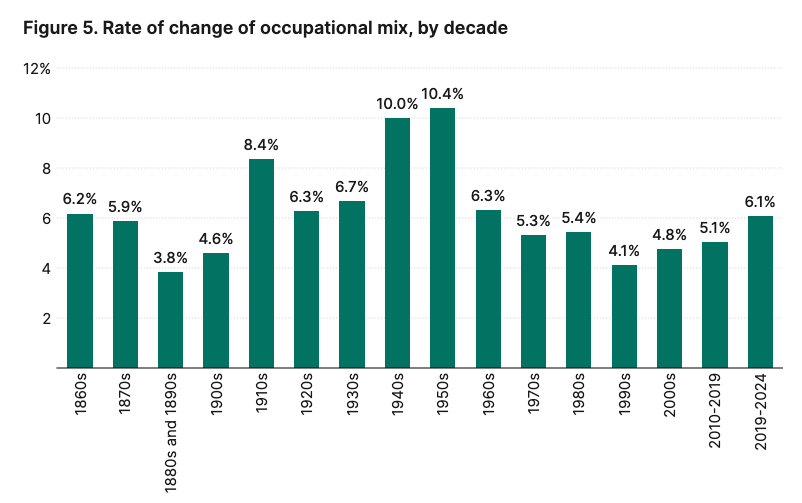
The Frontier is Advancing Quickly. As Ethan Mollick writes in his latest Substack post:
We are already starting to see the first appearances of new approaches to organizing that take advantage of the new abilities of AI agents…
A few weeks ago, a three-person team at StrongDM, a security software company focusing on access control, announced they had built a Software Factory — a way of working with AI agents that relied entirely on the AI to write, test, and ship production software without human involvement. The process included two (quite radical) rules: “Code must not be written by humans” and “Code must not be reviewed by humans.” To power the factory, each human engineer is expected to spend amounts equivalent to their salary on AI tokens, at least $1,000 a day.
Mollick writes that “we are past the point where recursive self-improvement [via AI] is science fiction.” Stripe cofounder Patrick Collison goes a good deal further; he thinks it’s already here. On X, Collison wrote:
Two weekends ago, I asked Claude to train a weather forecasting model on 6+ years of historical data I had. After training initial model, I had it generate hypotheses for how to improve the architecture, test them, and then integrate learnings. Worked great. RSI is totally here.
Coding Is Over. Get Over It. In conversation with veteran early signal-detector Tim O’Reilly, legendary engineer/ranter Steve Yegge let slip what he thinks of humans continuing to write code:
If you’re looking at your code, then you’re in a Formula One race and you’ve parked your car and opened the hood and you’re looking at the engine. You’ve slowed time to the point where everyone is racing past you and you’re a frozen statue. Code is a liquid. You spray it through hoses. You don’t freaking look at it….
But spraying all that code around is draining. O’Reilly relates that “Steve told us he naps every day now, sometimes twice a day, feeling drained by the relentless cognitive intensity. These agents don’t just help you work faster; they fundamentally change what kind of work reaches your desk.”
LLM Groupspeak? A new paper says that LLMs give largely similar replies to a wide range of prompts. But Mollick says that “prompting can generate pools of good ideas that are almost as diverse as from a group of humans” and has a paper to prove it.
And anyway, people seem to prefer AI-generated writing. Even poetry, as found by research written up in a Nature paper with an admirably informative title: “AI-generated poetry is indistinguishable from human-written poetry and is rated more favorably”
Labor Becomes Capital, As It Always Does. A story in New York Magazine with a somewhat alarmist title explores how “Laid-off scientists and lawyers [are] training AI to steal their careers” by generating and grading rubrics related to their former jobs. Of course, versions of this story is as old as automation itself — Marx wrote about it in Foundations… — but it does feel like it’s picking up in the age of A.I. If we really are not going to be writing code anymore, it’s largely because enough people have written enough code previously to train models.
Stop Telling Me What To Do. My former MIT colleague (and current friend) Matt Beane and colleagues explored an underappreciated (by me, anyway) aspect of working with LLM chatbots: they often suggest what to do next. The researchers found that following these suggestions often caused people trying to get work done to switch the task they were working on, and that this “model-initiated task switching is the strongest predictor of [quality] decline” in the work. More experienced people are better at dealing with AI’s interruptions suggestions.
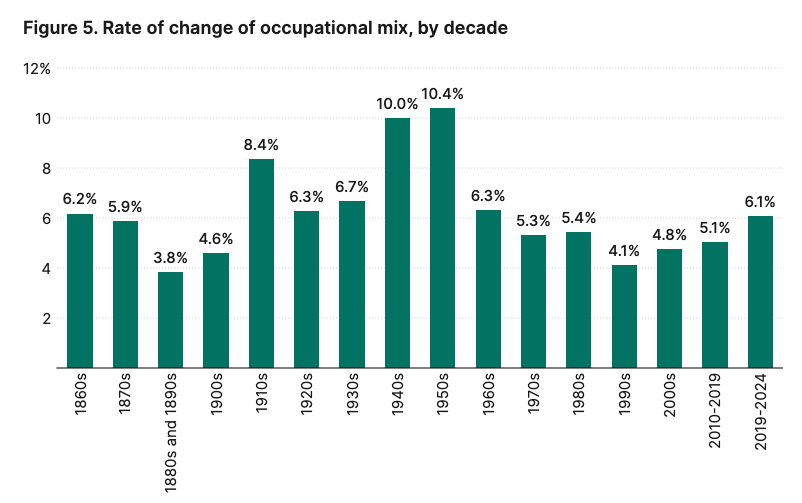
Big Changes Ahead, but Also Behind. It’s still early innings for the changes A.I. will bring to the labor force, and this valuable essay by Jed Kolko cautions about over-extrapolating from current findings. It also includes this chart, which I hadn’t seen before, showing that while the rate of occupational change is on the rise in recent years, it’s still well below the levels of the ‘40s and ‘50s. AI is an astonishing and novel technology, but it doesn’t automatically teleport us into unprecedented times
What He Said. For what it’s worth, this from philosoopher Dan Williams is a pretty good summary of my high-level beliefs about AI. I’m more confident than Dan seems to be here that the history of previous general-purpose technologies helps us think through the consequences of AI. But that’s a quibble; I am highly aligned with Dan.
This series is brought to you by Workhelix.1 We help organizations know and grow the ROI of their AI by tracking progress and identifying opportunities to do more and move faster.
Of which I am a cofounder.
No posts
Comments
Nothing yet. Say the first thing.
Sign in to join the conversation.