
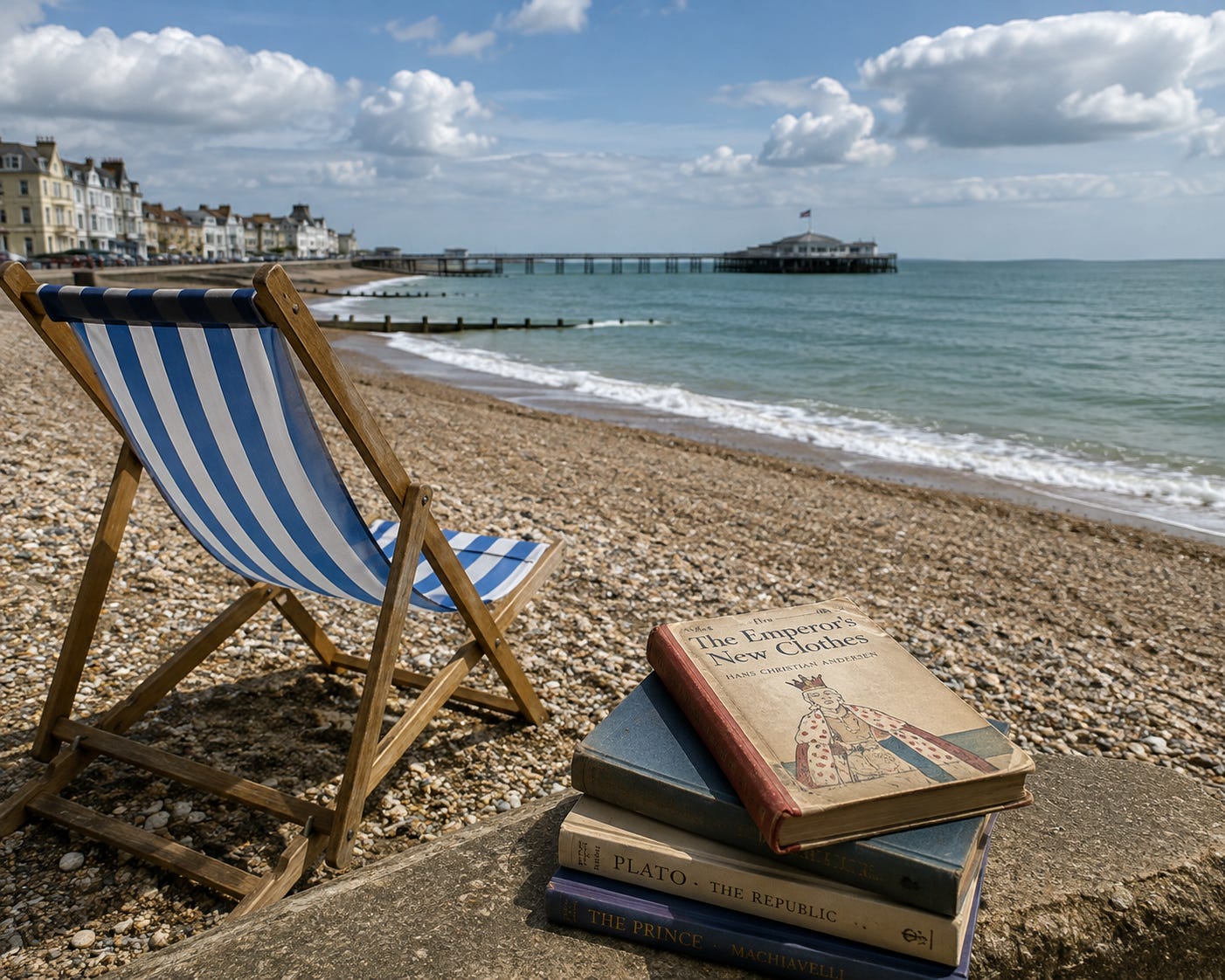
Parliament has risen, which is more than can be said for anything else in the country. Our leaders are heading for the beaches, or in one case being sent to them as a penance, and it seems only decent to help with the packing. Sun cream and dignity they must supply themselves, and at least two of them will be travelling light on the second. The books I can do.
The Prime Minister returns from his own holiday shortly and embarks on a tour of England’s seaside resorts, a sort of Radio 1 Roadshow for a man of exactly the vintage to remember them fondly. He never went. His parents wouldn’t take him, so he listened at home on a small radio, batteries not included, and he has spent the forty years since inventing the youth he wishes he’d had. He would like you to believe he was raving in the Haçienda. He was in his bedroom with the Top 40 and a glass of squash, and the tragedy is not the lie, it is how badly he needs you to swallow it.
The resorts on his itinerary are, almost to a deckchair, planning to vote Reform. The man arriving with the microphone is the one who last used it to scream at them. Some grass and a couple of houses caught fire near Stourbridge. An incident that in any serious country means a fire engine and a front page splash in the Express & Star. Instead our Prime Minister reached for the national emergency alert and banned Barbeques. Every phone in the kingdom shrieking at once, pensioners’ hearts in their mouths, so that one man could be seen to care at maximum volume. Millions have since worked out how to switch the alerts off, which stands as the single measurable achievement of this premiership. The boy who cried wolf at least thought that there was a wolf. The people of Kent could use a real warning, when the next mega boat to ground on their beaches. To discharge a company-strength crowd of young men wading ashore like latter-day Vikings, though this time the longships are dinghies and the monastery is a four-star hotel. But Kent turned its alerts off with the rest of us. When something real comes, the country will sleep through it. At which point the PM will give us the wet-eyed statement about lessons learned that he keeps pressed and hanging for the consequences of himself.
Glyndebourne received the full performance. Not the picnics, though he managed to spoil those too, but an hour of emergency alerts detonating through the auditorium one phone at a time, staggered like mortar fire, while the singers tried to hold a line against the British state’s incontinent need to be noticed. The next alert will no doubt remind us to carry sufficient water with us for hydration resilience. The motorway signs already hector us the length of the M1 like a mother who never wanted us to leave. This is government now, a man with access to every phone in the country and nothing to say into any of them.
For the train down, then, Brighton Rock. Greene knew the English seaside is not cheerful but menacing, vinegar and unfinished business, and Pinkie Brown emerges as the most honest figure on this page, a performer who at least understood he was damned.
Then The Entertainer. Archie Rice, dying twice nightly in a fading resort, still telling himself the old material works, dead behind the eyes just as Osborne’s stage direction demands. The Prime Minister should read it on the promenade and recognise the part, though Archie carries the excuse of once having been good.
And The Road to Wigan Pier, the second half only, where Orwell rounds on his own side and skewers the sort of socialist who loves the working class as an idea and recoils from it as a smell, who burns to improve people who never asked. Written in 1937, about men he had met. It has been waiting for this Prime Minister ever since.
Is the Leader of the Opposition going on holiday? How would anyone tell? Her leadership is conducted entirely from behind glass, a stream of portentous pronouncements on social media, each delivered as though from Sinai and landing like a beach ball in an empty pool. She has an opinion on everything, a plan for nothing, and the unshakable confidence of a woman who has mistaken being certain for being right. Her party is polling somewhere behind the memory of itself. She posts on.
She should pack The Invisible Man. Wells’s hero achieves the feat of being unseen while making an enormous amount of noise, and learns too late that invisibility is not power, it is absence with extra steps. He also comes to a bad end at the hands of the ordinary people he considered beneath his notice, a plot development her remaining strategists should at least skim.
Then The Leopard. Lampedusa’s aristocrats understood that everything must change so that everything can remain the same, the only strategy the Conservative Party has ever had and the first one it has ever failed to execute. It is also a masterpiece about a governing class watching its world end with perfect manners and no intention of lifting a finger, so it will read to her less like a novel than a shadow cabinet meeting.
And How to Win Friends and Influence People. Carnegie asks his reader never to tell people they are wrong and to take a genuine interest in someone other than themsleves. She will manage two pages, declare the book mistaken, and post about it.
Nobody knows what Sir Ed Davey is up to and nobody has ever needed to. He has replaced politics with content. The conference is a bouncy castle, the manifesto is a cream tea, and the electoral strategy is to be photographed falling into water near a marginal seat. It keeps working, which is the cruellest thing anyone has yet said about the British electorate.
He should take Five on a Treasure Island, which is the Liberal Democrat manifesto with better plotting and a firmer grasp of economics, and The Wind in the Willows, because Ratty’s creed, that there is nothing half so much worth doing as simply messing about in boats, is the only political philosophy he has ever held sincerely. He should not skip the Toad chapters either. A wealthy attention-seeker lurching from craze to craze while the stoats take the house is not a subplot, it is a mirror.
His third book is the sting in the sandcastle. The Strange Death of Liberal England, Dangerfield’s account of a governing liberal tradition that collapsed in four short years while assuring itself such things could never happen. Sir Ed should read it in the ice cream queue and grasp that he is not the warning in that story, he is the punchline, the heir of Gladstone and Asquith in a wetsuit, waving from a paddleboard while the inheritance sinks.
The others are packing to escape their circumstances. He is packing between engagements. Fresh from his Clacton vindication, with the acreage of newsprint written against him lying on the beach like dead seaweed. He is the only politician whose autumn anyone fears, though he would be a fool to fear nothing himself. The standards committee has yet to pass judgement, and its verdict will be drafted by people who do not wish him well. Burnham is a slicker opponent than anything Labour has fielded against him since Blair, a man who at least knows what a camera is for. Badenoch, despite the party hanging off her like wet clothing, has begun to cut through. Ed Davey is still Ed Davey, which is its own kind of invulnerability. Last summer Farage owned every Monday in London while the government hid behind its own grid. This summer the question has stopped being whether he can win and become what he does when he has, and nobody else on this list is carrying anything that heavy in their luggage.
So, first, Marlborough: His Life and Times. Churchill’s life of his ancestor is English military history on the grandest scale, and it is the study of an outsider the establishment never trusted, who was mocked, exiled and written off, and who then won every battle he fought. Ten volumes worth of company for a man who likes his history with gun smoke on it.
Then Robert Blake’s Disraeli. The definitive account of the greatest outsider in British politics, who scandalised the respectable, climbed to the top of the greasy pole and remade a party in his own image because the party had run out of images of its own.
And third, Citizen Clem. John Bew’s Attlee is the story of the most underestimated man in the room, and of what it takes to turn insurgency into a government that actually functions. Winning arguments is one trade. Running the country is another. The reading list should get there before the removal vans do.
Finally, a book they should all pack, and it fits in a pocket. Hans Christian Andersen’s The Emperor’s New Clothes. The original, mind, not the summary.
Because everyone remembers the child who says the emperor has nothing on. Almost nobody remembers what happens next. The crowd takes up the cry, the emperor realises they are right, and he decides the procession must go on regardless. He walks on, more stiffly than ever, while his chamberlains follow behind holding up the train that does not exist.
That is the bit our politicians should read twice, on a deckchair, with the tide coming in. The lie was not the tailors’ triumph. The procession was. And note who keeps it moving. The emperor, who at least walks in his own goose skin, the tailors took the gold and left town, and the chamberlains who stoop behind every leader in this piece, hands cupped around a train that was never there, murmuring that ‘the crowd is wrong’, ‘the child is a plant’, and ‘the cloth polled beautifully with the focus groups’. Every beach bag on this list was packed by one of them.
No posts
Comments
Nothing yet. Say the first thing.
Sign in to join the conversation.