
If you read or listen to the news, you will not have missed the announcement from Moderna and Merck about their successful Phase 3 trial (INTerpath-001) that is evaluating the combination of their personalised vaccine, intismeran, and Merck’s immunotherapy drug, pembrolizumab (Keytruda). The trial involved over 1,100 high-risk melanoma patients who had previously undergone surgery to remove localised tumours. At its interim analysis, the combination therapy met its primary endpoints, showing statistically significant reductions in the risk of cancer recurrence or death compared with pembrolizumab (Keytruda) alone.
Unlike traditional therapies, intismeran is tailored to the molecular “fingerprint” of an individual’s disease. Scientists analyse a biopsy of the patient’s surgically removed tumour to decode its unique genetic mutations. A custom mRNA vaccine is manufactured to encode up to 34 neoantigens unique to that specific tumour. Once injected, the vaccine trains the patient’s immune system to recognise and hunt down remaining cancer cells. When paired with pembrolizumab (a checkpoint inhibitor), the brakes on T-cell activation are released, allowing the immune system to attack cancer markers more effectively.
Moderna aims to bring the vaccine to the market by 2027. This is a proof-of-principle milestone validating mRNA technology for oncology. Moderna is now actively expanding trials to evaluate the intismeran combination against non-small cell lung cancer, kidney, bladder, pancreatic, and stomach cancers. This breakthrough has accelerated the field broadly, with competitors like Roche and BioNTech also developing rival personalised mRNA vaccines for colorectal and pancreatic cancers.
I have a vested interest in this trial. Firstly, having had two melanomas excised, one of which was invasive, I may need this treatment in the future.
Secondly, when I was a medical student, house officer, and medical registrar, I trained under Dr Roy Baynes, the now-retired CMO of Merck, who developed pembrolizumab (Keytruda). Roy was an extraordinary clinician and researcher and would appreciate being called “maestro” (ward 596 & 597 joke). Roy was the brains and driving force behind the programme that got pembrolizumab licensed for multiple tissue-agnostic cancers. This means pembrolizumab is licensed based on specific genetic features inside a tumour, such as Microsatellite Instability-High (MSI-H), mismatch repair deficiency (dMMR), or High Tumour Mutational Burden (TMB-H), rather than where the cancer originated in the body. Any solid tumour carrying these specific genetic instability markers tends to generate enough abnormal proteins (neoantigens) to trigger a strong immune attack once the PD-1 checkpoint is lifted.

A Nobel Prize has already been awarded for discovering checkpoint inhibitors, but I think Roy Baynes needs his own prize for taking these discoveries forward and setting the scene for next-generation vaccine trials. Showing that pembrolizumab (Keytruda) can be used as a generic T-cell stimulating therapy underpins these results.
My final conflict of interest is that I have been trying to convince the EBV therapeutic vaccine developers of the need to do the same with their EBV therapeutic vaccines. People with MS have an exhausted EBV-specific T-cell response, so simply vaccinating them against EBV will not work. The MS immune system sees EBV all the time in both its latent and lytic states. This is why the therapeutic EBV vaccines have to be combined with a checkpoint inhibitor. My pleas seem to have fallen on deaf ears, which is why I have predicted that Moderna’s therapeutic EBV vaccine trial is likely to fail. The only thing in its favour is that it is recruiting subjects with very early MS, which could be at a time when EBV-specific T-cell responses are not yet exhausted.
I hope these new trial results will change things and that EBV vaccine developers, who want to target advanced or progressive MS, will listen to me and include checkpoint inhibitors as part of their development programme.
In parallel, I have been arguing that AHSCT and alemtuzumab are working as an auto-EBV vaccine. Almost all pwMS who have AHSCT get EBV reactivation and because the treatments reboot the T-cell compartment (depletion followed by reconstitution) the new EBV specific T-cells are competent and then control the virus. Interestingly, AHSCT protocols that use rituximab, which prevents EBV reactivation, are inferior to those that don’t. This is an important corollary that may yet support the hypothesis. If you are a pwMS considering AHSCT, I would not recommend units that use rituximab as part of their ablation protocols.
In parallel, other chronic viral infections with evidence of T-cell exhaustion may benefit from the same therapeutic approach. In PML associated with chronic immunosuppression, we have relatively good data showing that pembrolizumab, as monotherapy or in combination with IL-2, a T-cell growth factor, is effective at regenerating JCV-specific T-cell responses, with most patients with PML now surviving.
Getting back to the main story, you have to simply look at the market response to this data to appreciate how important this trial is. I don’t personally invest in Pharma shares, but those who have invested in Moderna must be smiling this morning.
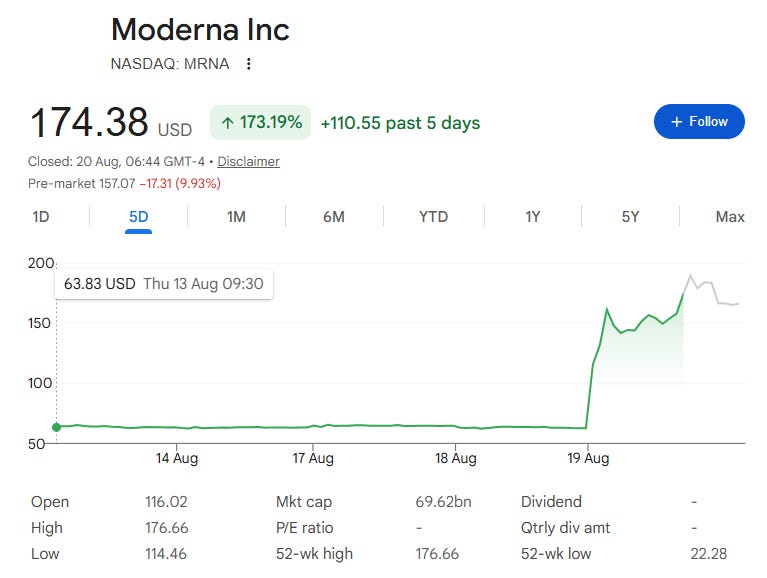
Don’t you simply love science and how rapidly it is evolving? I really hope we can use insights from cancer research to develop treatments for MS.
If you have been forwarded this email and are not an MS-Selfie subscriber, please consider subscribing and helping MS-Selfie expand its resources for the broader MS community. MS-Selfie relies on subscriptions to fund its curated MS-Selfie microsite, MS-Selfie books, MS-Selfie Infocards, and other activities that extend beyond the MS-Selfie Substack newsletters.
MS-Selfie newsletters and access to the MS-Selfie microsite are free. In comparison, off-topic Q&A sessions are restricted to paying subscribers. Subscriptions fund the MS-Selfie microsite and other related activities, as I don’t have time to do this myself. You must be a paying subscriber to ask questions unrelated to the newsletters or podcasts. If you can’t afford to become a paying subscriber, please email a request for a complimentary subscription (ms-selfie@giovannoni.net).
Get 20% off a group subscription
If you have questions unrelated to the newsletters or podcasts, please email them to ms-selfie@giovannoni.net. Prof. G will try to answer them as quickly as possible.
🖋 Medium
Please note that the opinions expressed here are those of Professor Giovannoni and do not necessarily reflect the positions of Queen Mary University of London or Barts Health NHS Trust. This advice is general and should not be interpreted as personal clinical advice. If you have problems, please tell your healthcare professional, who can help you.
No posts
Comments
Nothing yet. Say the first thing.
Sign in to join the conversation.