
I recently watched Eden, a film based on the true story of a group of Europeans in the 1930’s who flee to a deserted island in hopes of creating a utopia, only for it to descend into paranoia and death. The reviews were decent, the cast superb, and there was a link to multiple sclerosis (MS).
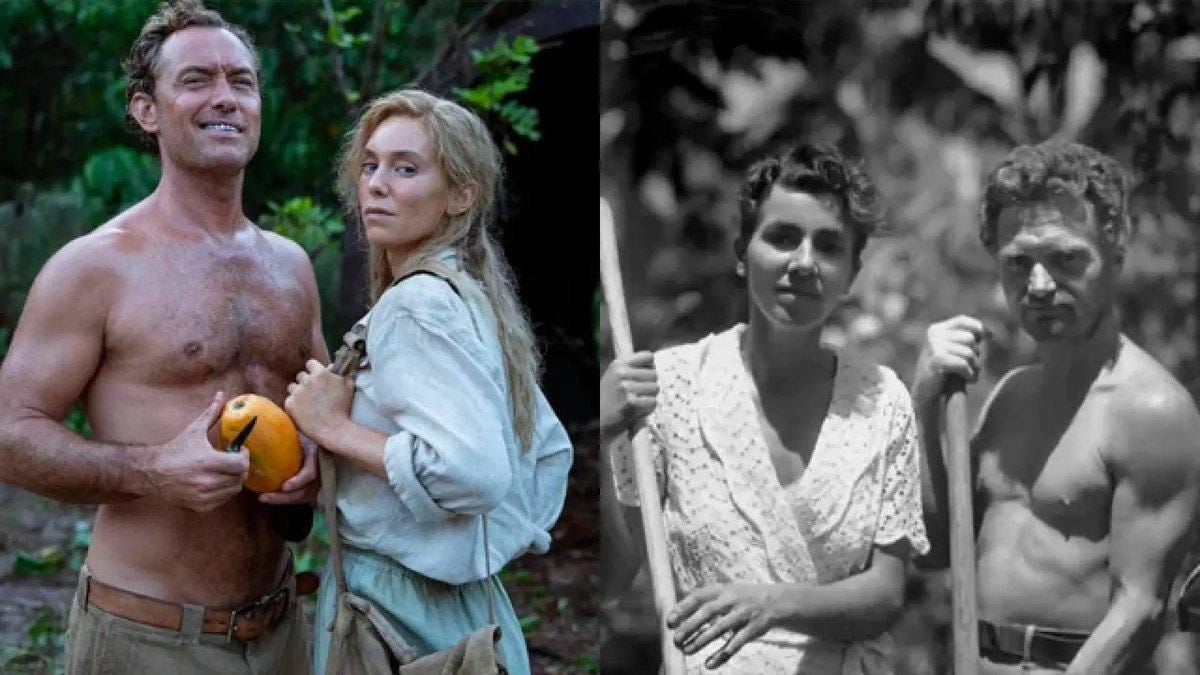
Jude Law as Friedrich Ritter and Vanessa Kirby as Dore Strauch in Eden – and the real couple
First to arrive on the Galapagos island are German doctor Friedrich Ritter and his patient-turned-lover Dore Strauch, who has MS. Ritter intends to write his manifesto while Strauch will cure her MS through meditation. Shattering their isolation is the arrival of the Wittmers, followed by a flamboyant Baroness and her two lovers.
Within two years, the Baroness and one lover have mysteriously vanished while the other lover’s body is found mummified. Then Ritter dies in agony after eating contaminated chicken. Rumours circulate that Strauch deliberately poisoned him.
The last we see of Strauch is her limping forlornly to a boat that will take her back to Germany. The Wittmers stay.
Even before the credits had finished rolling, I was determined to find out more. What led a young woman weakened by MS to leave everything to start a new life on an uninhabited island? Why did Strauch place her faith in a doctor who didn’t believe in medicine? As for Ritter’s death, did she really kill him?
The truth was stranger-than-fiction.
Strauch was 23 years old and unhappily married in Berlin when she was diagnosed with MS. Her disease, the doctors told her, was incurable, her ‘lameness’ likely to return and she must undergo a hysterectomy.* It was this that nearly destroyed her: “…I do know when I learned I could never become a mother, something inside me broke and gave up hope,” she wrote.
Then hope - in her eyes - arrived in the form of Ritter, an intense physician with a love of Nietzsche. While receiving treatment at the Hydrotherapeutic Institute in Berlin, he examined her. His diagnosis: “You are not ill, but you desire to be ill.”
Ritter insists she “need not submit to illness” but can cure her MS through meditation and positive thought. They become confidants, then lovers. Ritter persuades her it is necessary to quit the civilised world and create their own self-sufficient Eden thousands of miles away.
She, his devoted acolyte, agrees. They say goodbye to their families, spouses and their possessions and set sail for Floreana.
It’s easy for us to dismiss, even inwardly roll our eyes, at Strauch’s decision. Yet a part of me understands.
Strauch was a vulnerable young woman with a life-limiting disease facing a future of loneliness and disability in a country facing rising fascism. Her lover doctor was offering her hope: a chance to heal her MS and live happily ever. Small wonder she snatches at the chance.
Life on the island is harsh and unrelenting. Ritter insists Strauch carry out hard physical labour and ignores her pleas for help. As her MS worsens, he begins hitting her. “I must frequently remind Dore that life is to suffer,” he writes.
Tension also grows with their neighbours. The Baroness announces she wants to build a hotel on the island. Soon after she disappears with her lover. Her other lover flees. Then in a final twist Ritter eats contaminated chicken – an odd choice for a strict vegetarian – and dies.
Accident or intentional? I believe Strauch poisoned Ritter. Passion had turned to hate. The abuse was escalating and I suspect Strauch realised the hope of living a life free from MS was nothing but a mirage, an illusion perpetuated by Ritter.
Despite being questioned by Ecuadorian officials, Strauch was never charged. She returned to Berlin and died of complications linked to her MS in 1943.
It’s exactly one hundred years since Strauch met Ritter. Thankfully, much has changed. MS is now treatable – with more than 20 therapies available. Women and girls are no longer forcibly sterilised when diagnosed.
But some things, I would argue, remain the same. Women with MS continue to be victims of medical misogyny and are still told our illnesses are – to paraphrase Ritter - ‘all in our heads.’ We are also are much more likely to be victims of violence and abuse by our intimate partners as Strauch was.**
And there are still, I believe, doctors who peddle false hope. Dr Terry Wahls claims she used lifestyle changes, including daily meditation, to reverse her MS. Dr Joe Dispenza maintains individuals can heal their MS using the power of the mind.
But unlike Ritter, it’s money they are after. They claim their books, supplements, courses and retreats are ways to help you ‘regain “and ‘transform’ your health (their words, not mine). They also have large and devoted followings.
Make no mistake, I believe meditation can help you manage your MS symptoms. But cure it? The film Eden is a reminder that the line between hope and false hope when it comes to MS remains blurry even to this day.
*At the peak of the Western eugenics movement (1920s-40s) women with MS were routinely sterilised as they were deemed ‘unfit’ to reproduce.
** to read more about why women with MS are much more likely to be victims of domestic violence, see my article on the MS-Selfie:
Documentary: The Galapagos Affair: Satan Came to Eden
Strauch’s memoir: Satan Came to Eden: A Survivor’s Account of the “Galapagos Affair“
Eden Undone: A True Story of Sex, Murder, and Utopia at the Dawn of World War II by Abbott Kahler
Rachel Horne

Rachel Horne is a journalist with MS. She is also the founder of the Rachel Horne Prize for Women’s Research in MS.
No posts
Comments
Nothing yet. Say the first thing.
Sign in to join the conversation.