
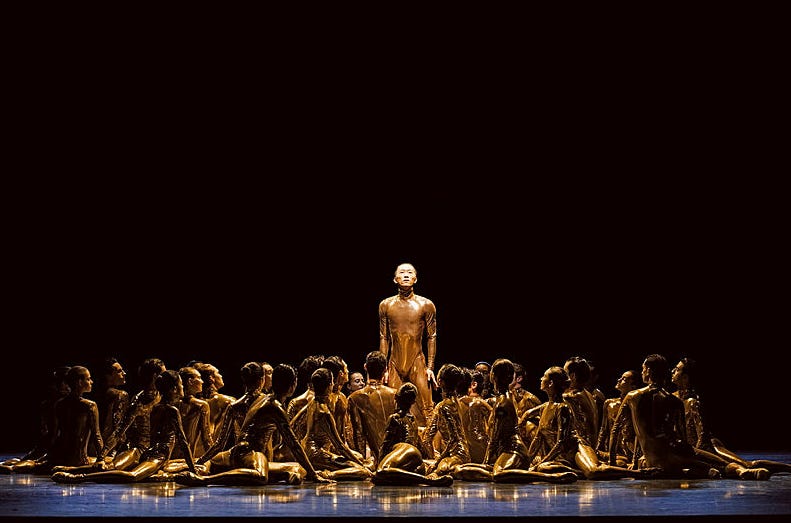
Wei Wang in the climactic scene of “Mere Mortals.”
Mere Mortals, which opened last night as the final show in the SF Ballet’s 2025-2026 season, is a dazzling, supercharged machine. That’s its strength, but it’s also its weakness.
The innovative work, created by choreographer Aszure Barton, composer Floating Points (Sam Shepherd) and visual designers Hamill Industries, uses the Greek myths of Prometheus and Pandora to explore an urgent contemporary issue: the perils and promises of artificial intelligence. It’s an important subject, and all three of the creative elements are brilliantly realized. The dancing is superb, the music is sophisticated, and the visual design is breathtaking. The problem is foundational: an inhuman quality suffuses the entire show. Aesthetically, it feels like the machines have already won. This undermines the entire point of the ballet: If we’re all machines to begin with, or if we’re all just human cogs in a dystopian machine, a Promethean rebellion or a Pandoran box-opening doesn’t matter that much.
That doesn’t mean Mere Mortals is not worth watching: the “point” of a ballet is often not that important. And the show’s soaring climax, featuring inspired choreography and the breathtaking dancing of Wei Wang in the allegorical character of Hope, is nothing short of sublime, and goes a long way to redeeming the entire piece.
All three creative elements contribute to the pervasive feeling of inhumanity in Mere Mortals. Floating Points has written a fine modernist score, which hovers on a fruitful edge between tonality and dissonance and blends electronic elements with the ballet’s live orchestra in a highly creative way. But in the context of this work, the score’s artificial strain dominates. The visuals by Barcelona-based duo Hamill Industries are state of the art: one section, when enormous clouds billowed out and turned into fist-like forms, was at once beautiful and terrifying, simultaneously evoking the destruction of Gaza and the birth of a universe. But again, the very cutting-edge techniques that make astonishing effects like this possible inscribe the entire work in a technological frame. Finally, the staging and costuming, particularly of the ensemble but also of the four principal dancers, enhanced the sense of an inhuman or perhaps trans-human universe, and also one that is already dystopian. The ensemble, all garbed in black, move in dazzling unison, like a finely-tuned machine or a colony of ants: in their utter lack of individuality, they evoked the societal herd in George Orwell’s 1984. If that was the point, it’s an odd one in a show about the ambiguous consequences of embracing technology, especially because it isn’t clear that either Prometheus or Pandora’s interventions, whatever they are (it’s a bit hard to know), have any effect on the herd. Pandora, Prometheus, Epimetheus (Prometheus’s brother) and Hope are all costumed in shiny, skin-tight, latex-like outfits that make them seem extraterrestrial, or science fiction-y. And their relation to the ensemble is murky (Hope, who is clearly delineated as coming from another reality, is the exception).
But if you forget the incongruities and foundational issues with the story, and you can, Mere Mortals (which premiered here in 2024) is an exciting and beautifully-executed piece. A lot of the choreography takes ballet as close to gymnastic floor exercise as it can get: this is some of the most wiry, muscular, on-the-ground, slow-motion dancing you’ll ever see. Nikisha Fogo, as Pandora, was marvelous and mysterious and seemingly possessed of exoskeleton-like strength, and her pas de deux with Epimetheus (danced beautifully by Parker Garrison) was a sensuous, interwoven, and yes, very human highlight. Joseph Walsh was a fiery and flamboyant Prometheus. But the show-stopper was Wei Wang’s dancing in the show’s climax. Dressed in gold, he displayed a wondrous blend of grace, strength and passion, providing the perfect and (literally) uplifting climax to this flawed but memorable piece.
No posts
Comments
Nothing yet. Say the first thing.
Sign in to join the conversation.