
My social media feeds have been full of the news all morning: the brilliant, prolific artist David Hockney died yesterday. He was 88. He lived an extraordinary life, having found success and enormous fame very young, still in his twenties; somehow he managed to keep doing new things, exploring new technologies, finding new media. With his iPad paintings, he humanized technology that often threatens to alienate us from humanness. I’m teaching a class on style right now, and one of the deep questions of style is how an artist can maintain a signature, a sense of identity, a deep style, across works that are radically different from one another, that can have radically opposed surface styles. I tried to think about this some time ago after seeing a show of Picasso paintings, all from the summer of 1921, in both Cubist and neoclassical styles, radically different and somehow all unmistakably Picasso. I don’t know how one achieves that; I don’t even have language to describe the phenomenon, beyond the vaguest notions of “personhood.” However it’s done, Hockney managed it, too. Whatever you think of it—and Hockney can be polarizing, he sets some people’s teeth on edge—he had one of the most recognizable signatures of the past seventy years.
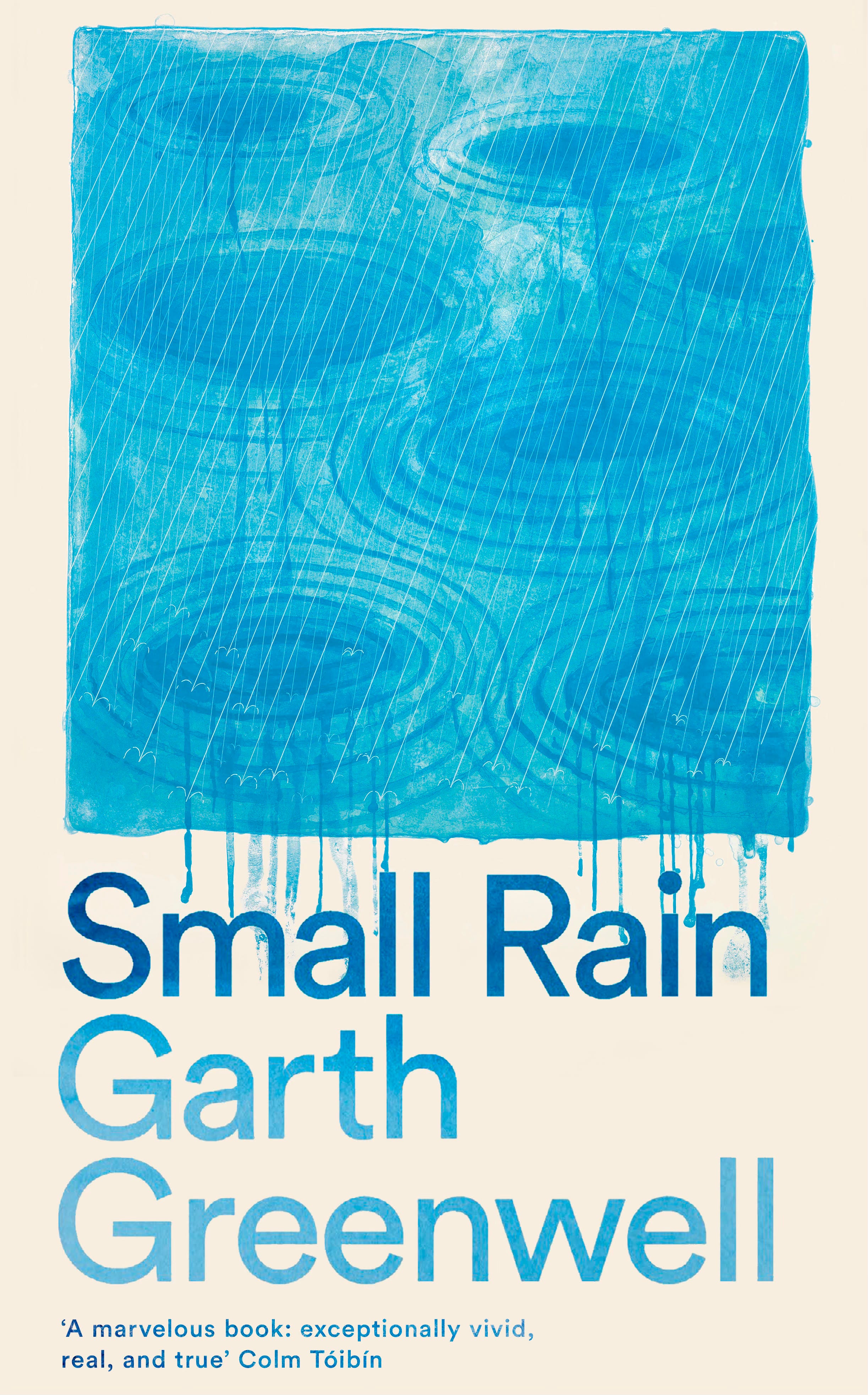
I never met Hockney or interacted with him in any way. The closest I came was a few years ago, when my UK publisher sought permission to use one of his works on the cover of Small Rain. Apparently those requests are taken one by one, and the rumor was Hockney himself had to approve them. I have no idea if that’s true, but when permission was granted, in addition to gratitude for the beautiful cover I also felt a ghostly thrill, as if we had brushed fingertips.
I’ve always known his work, which has entered the culture in a remarkable way; is that so true of any other artist of our time? A Bigger Splash is just part of our shared image repertoire, I think; and a poster of Mount Fuji with Flowers, acquired I’m not sure where or when, but before I knew anything about art, hung on my wall for years. When I teach workshop, I like to start each class by sharing things we find beautiful, “aesthetic experiences”; I’ve often had my students watch this six minute video of Hockney flipping through his sketchbook, which is one of the most inspiring things I’ve ever seen, a document of constant, undramatic industry and inspiration. You get the sense, watching Hockney’s (beautiful!) hands flip the pages, a pack of cigarettes (Smoking kills) on the table, of how much he thought in image-making, how much of his life he invested in color and line. It’s a great, unpretentious demonstration of what it means to live in art.
Hockney’s aesthetic permeates the larger culture, not just as an influence on other painters but in the color palettes of advertising and the texture of cinema. We all know him, whether we’re aware of it or not. He was an extraordinary ambassador for art, in books and interviews and documentaries; and he could be extraordinarily generous to other artists. Nearly a decade ago, after stumbling on a retrospective in Stuttgart while on book tour for my first novel, I became obsessed with the wonderful artist Patrick Angus, a brilliant painter who died tragically young of AIDS, and whose paintings of 1980s and 90s New York gay life received almost no recognition while he was alive. Angus was himself obsessed with Hockney, an influence you see everywhere in his work; and probably the greatest affirmation he received while alive was the chance to meet Hockney and show him his paintings. Hockney, bless him, bought two of them.
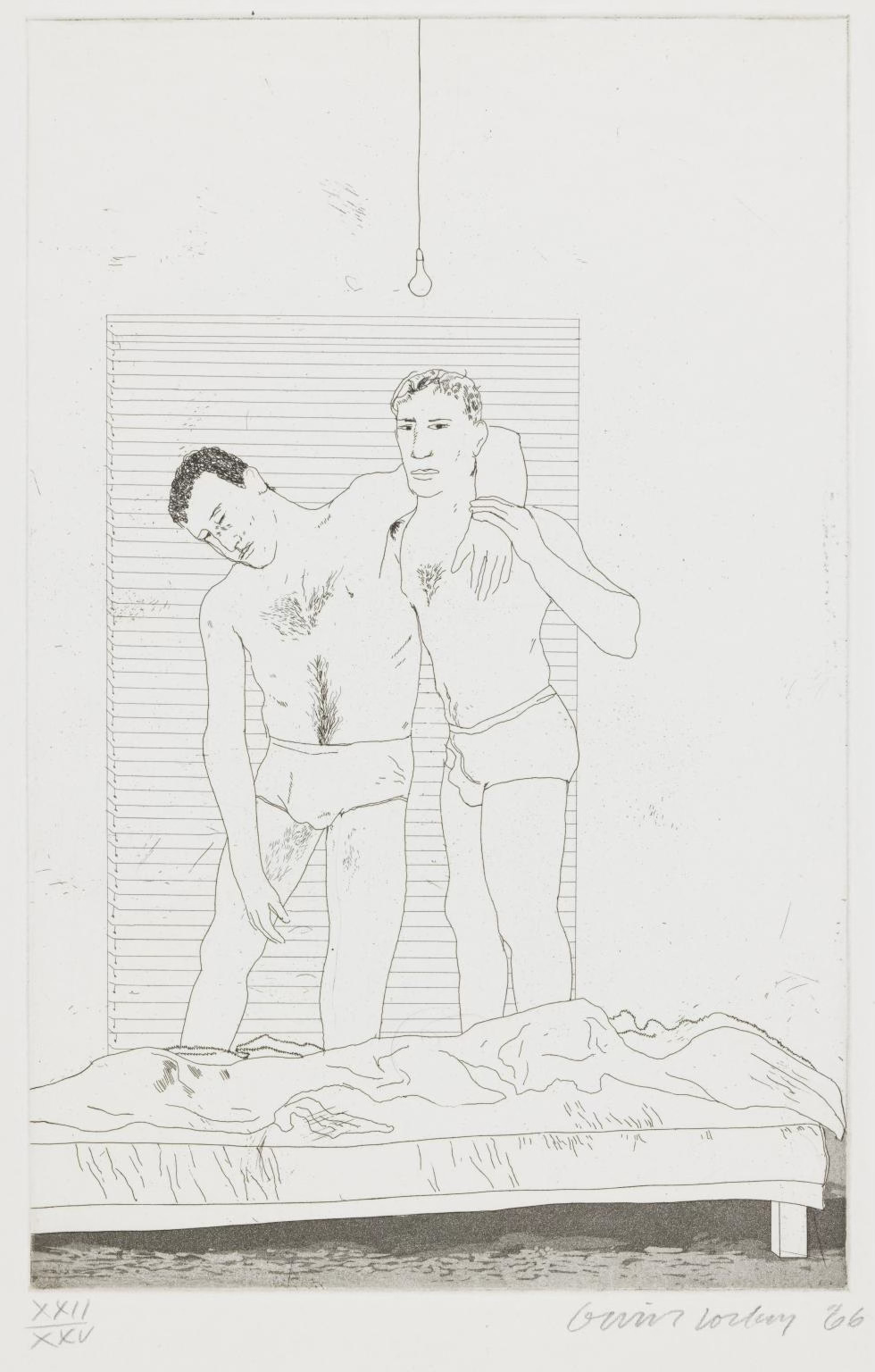
Luis loves Hockney, too; he remembers an exhibition at the Tate, which he saw when he was young, as one of his earliest important experiences of art. Luis has known artists all his life, and is disdainful of the whole idea of an art market—you don’t buy paintings, he has said to me many times; you get them as gifts. Well, maybe he does; but I grew up in Kentucky, not Granada, and I wasn’t being a hip poet and editing literary magazines in the 1990s, I was cruising public bathrooms and parks. Anyway, Luis was especially moved by the series of etchings Hockney made in 1966 to accompany Cavafy poems, and in his apartment in Madrid he has one of these, which he actually paid money for. Not a lot of money—in an act of generosity (also though I hope he made a pile of cash), Hockney, in addition to the signed edition of 25 (which are immensely valuable), made a large unsigned edition of these prints—five hundred copies or so, I think. Those are not all that expensive, or weren’t a few years ago; as they become scarcer I’m sure the price goes up. Luis’s, which is still in Madrid, is “The Shop Window of a Tobacco Store”; several years ago I found another one, “One Night,” which hangs in our living room here in Iowa.
I guess I have become someone who buys art, in a minor way; paintings and books are the only things I ever unresentfully spend money on. (Well, and once I was surprised to find myself excited to buy a house, which turned into a nightmare I’m not eager to repeat.) When a friend of mine here in Iowa City, after retiring and selling most of his possessions, spent 70k on a car, I remember telling Luis about it, incredulous: even if I had millions of dollars, I can’t imagine spending 70k on a car, I said. Then, after a minute, a little guiltily: But I could definitely spend 70k on a painting. (Luis said he could spend that much on clothes, which I’m sure he could; the real joy of being rich would be watching Luis exercise his full genius for style, like Charlotte in The Golden Bowl.)
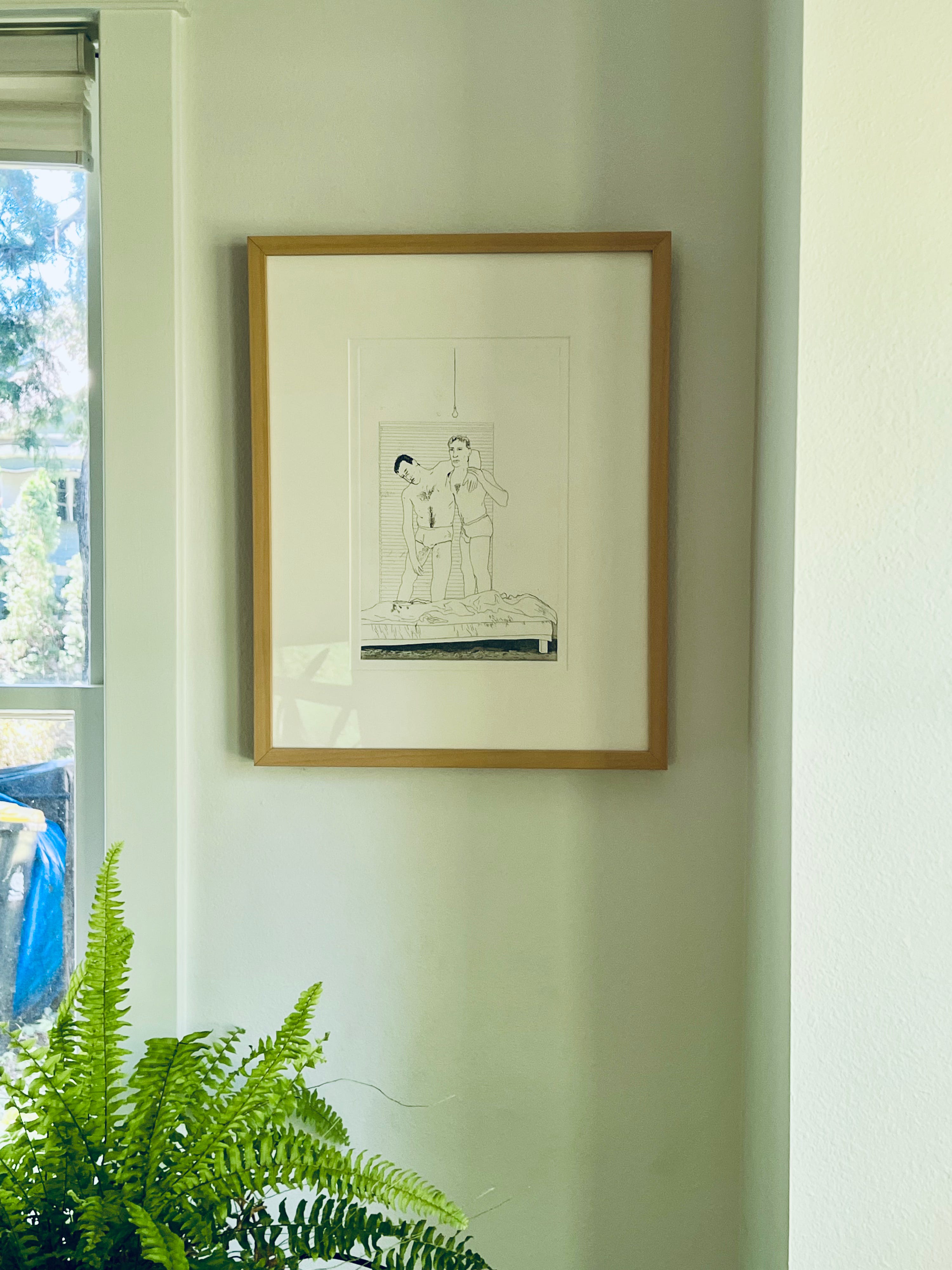
Anyway, luckily the Hockney etching wasn’t anything like that much, it was a few hundred bucks, which I’ve never regretted spending. Talk about style: the image is an ideal for me, sexy and tender and spare. It gives the pleasure of different textures rubbing together: the orderly slats of the blinds, the disorder of the bed, the organic forms of the men, one upright, the other slouched over, barely conscious. Above them, a bare lightbulb, a motif I associate with Guston, though this series predates Guston’s return to figuration; they both snatched it from Picasso, I guess. Also wonderful is how much space there is, the perfectly asymmetrical composition. There’s a marvelous short documentary on YouTube about the making of the series, with delicious close-up shots of a very young, very adorable Hockney drawing on the plates.
Someday I hope to write about what it means to live with art like this, why every once in a while I see something and feel that I want to see it every day, that there’s something in it I need, a reminder of some value. I need it enough to rearrange my life sometimes to try to make living with it possible: I take on extra teaching, I demote some other priority. (A more recent purchase is part of the reason I’m spending the summer in Iowa this year, and not in Spain with Luis.) That’s always the test: is it something that feels like it points me somewhere, will it help me in my own work. The Hockney has helped me, in the years we’ve had it; it helps to visit its clarity of line, its openness, uncrampedness, the elusiveness of its narrative. It was one of the very few pieces I carried with me to New York for the two years I lived there full-time.
It hangs in our living room now, beside a window, with a beautiful small drawing by Erickson Díaz-Cortés on one side and, on the other, two of Allen Frame’s photographs of Darrel Ellis. Luis generally takes charge of where art goes in the house, and how it’s arranged; he has strong feelings about which artworks are “friends,” as he says, with which others. On the wall facing the Hockney is one of my greatest loves (and biggest stretches, financially): a work on paper by Patrick Angus, a page taken from one of his sketchbooks.
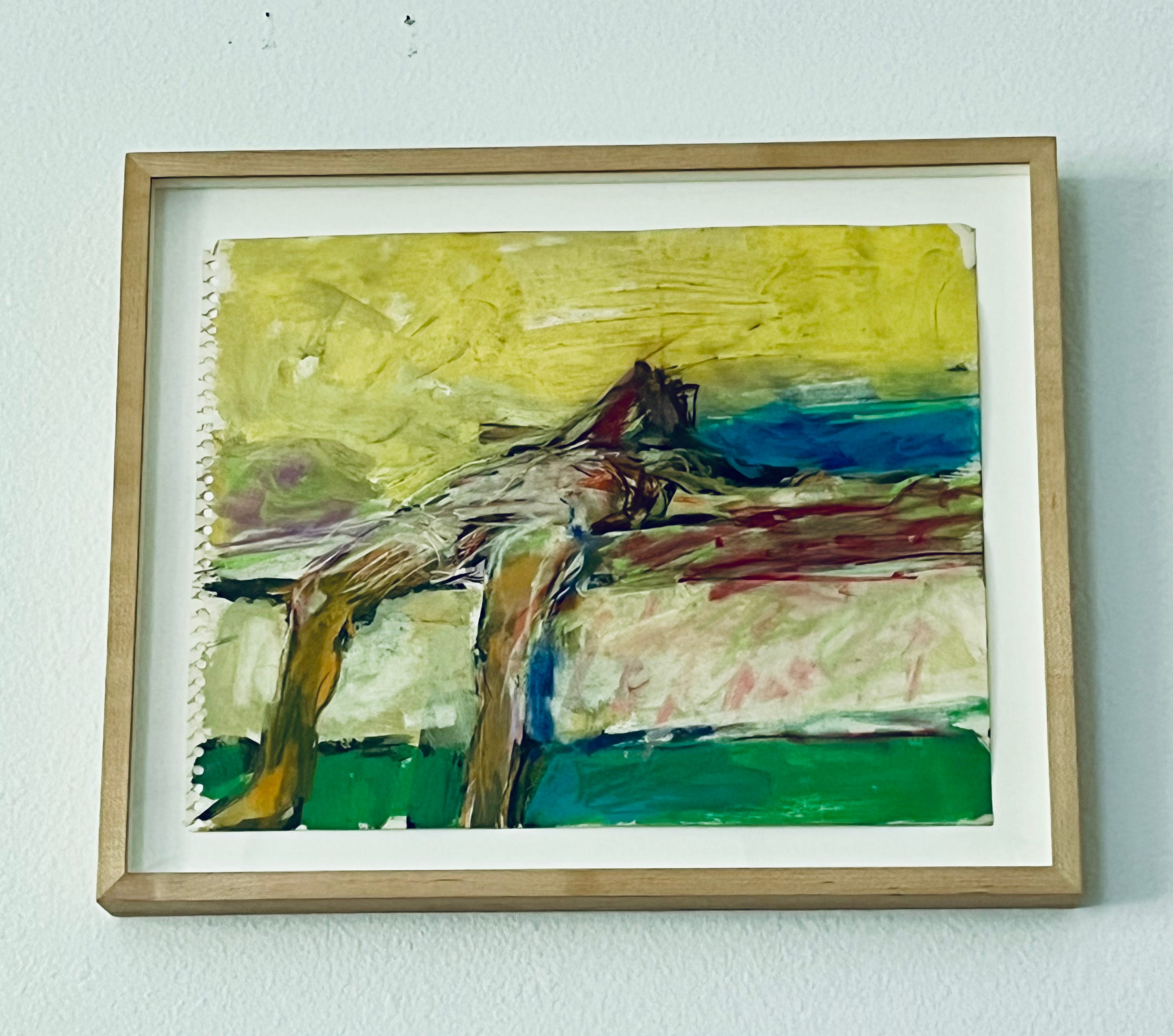
They’re definitely good friends. I love having them in conversation, as curators sometimes say, something that seems true here, and not even metaphorical, really—they’re both sexy in similar ways, and both somehow radically simplified, pared down, though Angus’s mark making is so different from Hockney’s, and blazes with color where Hockney restricts himself to line. (That color, as always in Angus, owes a great deal to Hockney’s paintings.) Angus’s piece points in a slightly different direction from Hockney’s, it expresses a different ideal, or a different aspect of that ideal; but they’re consonant with each other, coherent; they both point in directions I want to follow.
Angus had a short life, Hockney a long one. Angus is still, despite posthumous recognition, neglected; whereas we’ll be a long time learning to see Hockney through his fame, separating our ideas about him and his place in the culture from the work itself. There’s so much of that work to see, enough work to fill two long lives, or three. How much he worked! In the documentary about the Cavafy etchings he’s practically bouncing on his toes, vibrating with creative energy. It’s sad news, of course, that that vibration is stilled; it’s always sad to learn that an icon has passed. But more than sadness I feel how lucky we are that he got so much time for making, and that he used that time so well.
As always, thanks for reading—
G.
Comments
Nothing yet. Say the first thing.
Sign in to join the conversation.