
Why We Love Henry James. Starting this September, I would love for you to join me for this year-long series of classes exploring some of the greatest fiction in English. We’ll start with James’s first masterpiece, Portrait of a Lady—which, if you’ve never read James before, is the best place to start. You can take any of the classes individually, but they’re designed as a sequence; if you sign up for all six you get a discount (one class is free), as well as a one-on-one conference with me before the final class. An option to pay in three installments is available, and scholarship applications for the Portrait class are open now. All the information you need is on the course page.
TAGT Book Club. Our next Book Club pick is Mohamed Mbougar Sarr’s Pure Men, tr. Lara Vergnaud. Join us as we discuss this fascinating novel about queer life and homophobia in Senegal by (amazingly) the first winner of the Prix Goncourt to hail from sub-Saharan Africa. Sunday, August 16 at 3pm ET. Book Club meets six times a year and is open to all Founding Members of the newsletter. To join, just click the button below.
*
I was sitting where I always sit, in a back corner, and it was still early, the rest of the row was empty; and so there was no reason for this older lady to shuffle past all the other folding chairs (white, padded, ready for a wedding tent) to ask if anybody was sitting in the seat next to me. No reason except midwestern loquaciousness, I mean; my heart sank. She was pushing seventy maybe, with curled gray hair, wearing a Sunday best pantsuit, friendly and a little formal; she reminded me of my grandmother. Curled over my book, I looked up and quickly back down, murmuring that I thought the seat was free; I didn’t mean to be rude but wasn’t being friendly. But New York noncommittal doesn’t fly in Iowa, and she stayed on her feet. “Do you mind if I sit here,” she asked, just a little pointedly, and I looked up again, noticing that two other people, a younger man and woman, had followed her, maybe a little sheepishly. Oh sure, I said, please do.
We were in the Blank Performing Arts Center in Indianola, Iowa, a tiny college town about thirty miles outside of Des Moines, a two-hour drive from Iowa City. When you first get off the expressway it seems all strip malls and chain stores, but soon enough you find yourself in a kind of adorable downtown, maybe four or five blocks square, where I was very happy to spend three days a couple of weeks ago. These little Iowa towns hidden away among farmland and rolling hills will break your heart, with their human-scaled architecture and old-timey charm; and then they surprise you with fancy boutiques and Brooklyn-style cafes. I was in Indianola for the Des Moines Metro Opera, which stages three operas over a month each summer on the Simpson College campus. It has a very good reputation (Alex Ross wrote warmly about it a couple of years ago for The New Yorker); this summer was my first time seeing it for myself.
My seatmate and I were settling in for a pre-show talk on the season’s most challenging opera, Karol Szymanowski’s King Roger. If you know it, there’s a good chance it’s because of the good 2015 production on the big Royal Opera box set Luis and I worked our way through in lock-down, with Mariusz Kwiecien in the title role; or maybe you saw the 2009 Paris Opera production on YouTube, also starring Kwiecien, in which case I’m sorry: what a mess. This year marks a century since the work’s debut in Warsaw. There have been a few productions in Poland to mark the occasion, which makes sense, and also at least one in Germany. The only other place it’s being presented, so far as I can tell, is Indianola. Wild.
Nothing could have been clearer than that I wasn’t interested in talking, but my neighbor, bless her, wasn’t deterred. She asked what I was reading, and I flipped over the cover so she could see: Alistair Wightman’s 2015 volume on Szymanowski’s opera, mostly slightly beefed-up excerpts from his better 1999 biography and study of the composer. “I just did a Google search and read a little bit online,” she said, “I didn’t read the whole book.” I said I thought that was ok, before reopening the book, resolutely, I thought. But she wasn’t having it, she leaned in: “Are you one of the singers?” she asked. And then, after just the slightest hesitation: “You’re built like a singer.”
That made me laugh, and I decided she had won; I put my book away. Not a singer, no, I said, not wanting to get into it; just a lover of opera. But what about you, I asked. Are you a singer? She lifted her eyebrows: I’m not a singer either, she replied, but I am a music teacher. Or had been, a middle school music teacher in a tiny town in northwest Iowa. She was just in Des Moines for the day. I asked her if she was seeing the other shows on offer that season: Tosca, which I had seen the night before, and Carlisle Floyd’s Of Mice and Men, which I would see the following night. No, she said; King Roger was it.
I lost my husband not too long ago, she went on, and he didn’t like any of this stuff, so I only ever got to come for one opera a year. Twenty years I’ve been coming, I guess, and now I’m here with my daughter, she turned a little to her left, toward the sheepish couple, and my son-in-law. They live here in Des Moines. She told me what the husband did for a living but I’ve forgotten; he was an attorney maybe, some kind of businessman. But I love it, she said, it’s my chance to get some culture, I’m starved for it up there. I told her it was my first time, that I had driven in from Iowa City. Oh, we’re so proud of it, she said; it’s wonderful that we have opera in Iowa. She went on about the benefits, all the musicians the company supported, not just the singers; and the people who worked behind the scenes, the directors and designers and carpenters, dozens and dozens of people, she said, hundreds, maybe. Like somebody to teach the singers Polish, I offered, since I had just seen the name of the language coach in the season brochure. She laughed.
The lecture started up then, and she didn’t say much more than goodbye when it was over, but I kept thinking about her, about her sense of ownership in the Des Moines company, the pride she took in it. It suggested a relationship to an arts organization radically different from what I (or anybody else I know) feel about the Met, say, or the NY Phil. Maybe something like what my mom felt, throughout my childhood, for Actors Theater in Louisville; she held onto her season tickets even through the hardest years. (I often went with her, and saw great things: I’ll remember Mercedes Ruehl as Cleopatra until the day I die.)
The room had filled up while we talked, more than filled up, and that too suggested something unusual. King Roger is a challenging opera for a number of reasons, including its musical language, its philosophy, its queerness; and it’s certainly not well-known. But every seat in the large room was taken; people were standing along the walls. The performance space at Blank Performing Arts Center seats just under five hundred people. I’m bad at estimating crowds, but I would guess about half that number were there, forty-five minutes before curtain, to hear the company’s dramaturg, Joshua Borths, talk about it. In Indianola, Iowa. Maybe America’s not quite all the way cooked.
It was a good talk; it covered the main points—Borths had clearly read his Wightman (there’s not much else to read in English); it was provocative. He played up the opera’s queerness and underscored its difficulties in a way that felt welcoming, not forbidding; he made a case for its importance. At the end of the lecture, Borths noted that this was the first Polish opera Des Moines had presented, and offered some context for understanding Szymanowski’s place in the repertoire. As people started to file out into the hall, there was a buzz of excitement; everybody had bought in, everybody was game. I felt something I haven’t felt in an opera house for a while: hopeful, even inspired. The Met has seemed to be in something like a death spiral of late—I don’t mean to sound glib, I think it’s a tragedy; here was a small company that clearly thought of itself, in its 50-somethingth year, as being on the rise, having built an audience, a culture, willing to take a risk and eager for a challenge. The Met has responded to its crisis by disastrous pandering. In Indianola, I saw a company thriving by having made a different choice. Which is to say I was excited even before the performance, which would prove to be one of the most thrilling evenings I’ve ever spent at the opera.
*
King Roger wasn’t the only Szymanowski on offer in Iowa this season. Back in November, Luis and I heard one of his most celebrated pieces, the first violin concerto, at the University of Iowa’s Hancher Auditorium, performed by the excellent Minnesota Orchestra with Benjamin Beilman as the violin soloist. It was a good performance, and the concerto is great, don’t get me wrong, full of life and color. But I have a hard time hearing it somehow, as I do a lot of Szymanowski. His middle period works, which I think generally have the most prestige, are full of boneless late-Romantic chromaticism and orientalist exoticism, erotic swells and dying gasps (or “massive climax and plangent detumescence,” as Wightman puts it—the sexiest phrase in his book, unfortunately), spiky experiments in bitonality and obsessive pedal tones. At his best he’s a composer of affect and remarkable color, but a lot of it seems over-ripe to me, a little soft in the middle, like Aschenbach’s strawberries. His hero for much of this period was Strauss, but amid all the melting gorgeousness in Strauss there’s an iron ironic core, a ferocious intelligence, that I don’t hear so much in Szymanowski. He just misses being a great composer, if you think that matters.
There are good reasons to think it doesn’t. He wasn’t a Strauss or a Stravinsky (hero of his later period), but who was? He came awfully close. If it does matter, blame history, which battered him fairly brutally about—though that was pretty much true of all of Europe. Maybe better to say that he was, as he knew, singularly unsuited to his times. (As I suggested a while back in a piece on Ruth Asawa, an important aspect of genius, and one Szymanowski seems to have lacked, is the ability to metabolize history.) He was a Polish composer who came of age at a time when Poland didn’t exist as a sovereign state, which meant artists were pressured to keep a national identity alive, a pressure Szymanowski rejected (“I don’t give a damn for this taste for commonplace patriotism,” he wrote); when Poland did exist again, after WWI, the pressure only increased. He longed to be a cosmopolitan aesthete in a period that demanded a nationalist self-assertion he could only see as blinkered and provincial. “I understand one thing as profoundly as is possible,” he wrote: “that in the present period of our history and culture, that type of artistic breed which I represent is not only superfluous but positively injurious.” His one practical service to the nation was to renovate hidebound musical pedagogy as Director of the Warsaw Conservatory, a post that lasted a year and a half and was, though Wightman claims some beneficial consequences for the Conservatory, a disaster for the composer. “They have used a machine of such delicacy and complexity to knock down mouldy walls, where any strong hammer would have sufficed,” Szymanowski wrote, “and later they will perhaps be surprised and put out that the machine has broken down.”
He had a privileged childhood. Born in 1882, he grew up on his family’s estate in Tymoszówka, in Ukraine, in an atmosphere that was at once provincial and rarefied. As a musical family, the Szymanowskis were extraordinary: all of the children played instruments, and Karol’s sister Stanislawa would have a career as a soprano, premiering many of her brother’s works. Karol studied first with his father, and then with his uncle Gustav Neuhaus (there’s a whirlwind of names in the opening pages of Wightman’s biography, and the relations are a little hard to track; but “uncle” is the word Wightman uses), who had a music school in nearby Elizavetgrad. “My dear Marta,” Szymanowski’s mother, who seems to have been amazing, said to Gustav’s wife, “how fortunate you are only to have ordinary children.” Those children included Henryk (aka Heinrich, aka Harry), a gifted pianist who would later count among his students at the Moscow Conservatory Sviatoslav Richter (!!) and Radu Lupu (!!). Which isn’t to say that Karol’s mom was wrong: after hearing Arthur Rubinstein (a friend and frequent guest at Tymoszówka) premiere Karol’s second piano sonata, Henryk tried to kill himself, affronted by both men’s genius, convinced that he would never be a pianist or a composer. Imagine what Thomas Bernhard could have made of that.
Szymanowski went to school in Warsaw, and made important starts on an international career in Berlin and Vienna, but Tymoszówka remained both his home and his haven, the place where he worked best. So it was devastating for him to have to abandon it in the Bolshevik Revolution of 1917. From this point on, and especially after losing another family property in Elizavetgrad, Szymanowski lived more or less hand to mouth, even as his international stature grew. In 1923, at 41, he wrote of standing
continually on the black abyss of the morrow (notabene with Mama), when I live from day to day, from one miserable concert to the next, from one article in a periodical to the next, finally from one loan to the next (not paid back or only rarely) – then truly a terror seizes me about what will happen next!? … Creative work becomes a torture … because with every note I write I ask myself: is it worth it in general?
He leaned increasingly on alcohol and spent a great deal of time not composing—though a late burst of creativity, after he withdrew from the directorship of the conservatory, resulted in some of the music I like best, invigorated by his encounters with the Goral folk music of the Polish highlands. His happiest later years would be spent in a rented house in Zakopane, and his greatest work for the stage, after King Roger, is a highlands-inspired ballet, Harnasie. I’m afraid I may be in the minority in my love for pieces like the Second Violin Concerto and his Fourth Symphony, which is basically a piano concerto; they’ve never had the prestige of the middle-period works. The composer Witold Lutoslawski, who described feeling drugged for weeks after hearing, as an 11-year-old (!), the first Warsaw performance of Szymanowski’s Third Symphony, spoke for a whole generation’s response to this later music. Of the Fourth Symphony, he said:
The very fact that the pioneer of modern music in Poland began his piece with a long lasting chord in F major and a very beautiful melody played on the piano in the same key was for us, twenty-year-old musicians, a shock. We thought Szymanowski betrayed himself and his own ideas.
I get where this is coming from, but I think it’s pretty great. Call me basic, I guess. Listen for yourself, there are two recordings I love: Rubinstein in 1952, with the LA Philharmonic, and a more recent recording by the City of Birmingham Symphony Orchestra under Simon Rattle, who championed Szymanowski, with Leif Ove Andsnes at the piano.
Never robust—a childhood accident that shattered a knee left him permanently disabled—he developed tuberculosis, exacerbated by his drinking and smoking; in his final years he spent a lot of time in sanatoria. At least one of his friends was horrified by his visit, having just read Thomas Mann’s hot-off-the-presses Magic Mountain. Szymanowski was often penniless, kept afloat by the largesse of American benefactresses, though eventually that too—this was the Great Depression—gave out. The final pages of a biography are always melancholy, but Szymanowski’s more than most, with their sense of so much loss, of a great artist wrecked by his century. Though that’s the wrong way to put it: really it’s amazing that he made so much.
*
One thing Szymanowski doesn’t seem to have suffered from, at least not much, is homophobia, internalized or otherwise. Wightman’s biography is maddening about the composer’s sexuality, bizarrely coded and euphemistic. The book was first published in 1999, which seems late for tortured formulations like “he also pondered sadly over other matters, perhaps those which were to find full expression in his novel Efebos”; or this insane obfuscation concerning one of Szymanowski’s important collaborators and friends, Grzegorz Fitelberg: “Szymanowski demanded a completely frank, unambiguous statement about the basis upon which their future relationship was to rest. The price seems to have been too high…” Wightman has the correspondence right in front of him; what can be the justification for this vagueness? (The only thing I can imagine is that access to the archive came with conditions, though this doesn’t explain similar obfuscation about other figures in the book.) The word “homosexual” (in all its variants) appears on five of the more than 400 pages of Wightman’s text, and one of those pages is concerned with a bizarre apology for a bit of misogyny from a character in Szymanowski’s gay novel:
It should be stated immediately that though Efebos was a homosexual ‘opus militans’, such statements do not square with Szymanowski’s personal ‘real life’ attitudes. He was, properly speaking, bisexual rather than homosexual in inclination, readily mixed with leading women intellectuals of the day, enjoyed female company, and even in matters of ‘form’, did not share the views of the fictional Charles de Villiers whose opinions are quoted above.
There’s so much objectionable here it would be difficult to catalogue: the label “homosexual ‘opus militans’”; the idea that an author must be defended from the views of his characters; the suggestion that bisexual men are less likely to be misogynistic than gay men (not to mention the straights!), etc. It also strikes me as odd to insist, even if it’s technically accurate, on the mitigating bisexuality of a man who, dying of tuberculosis, referred to himself as “Old Traviata” as he ogled the boys in the gay cafés.
Szymanowski was a queen, and even with Wightman’s bizarre obfuscation his book offers tantalizing glimpses of 1910s and 20s queer Mitteleuropa—each glimpse a rabbit hole to tumble down. For a time Fitelberg and Szymanowski lived in what was a clearly (despite Wightman’s attempts to obscure it) some kind of queer bohemian ménage à trois with their rich friend Stefan Spiess. When Szymanowski met with Diaghilev, whose Ballets Russes had been a revelation (a character in Efebos marvels that Diaghilev managed to “introduce on stage that most beautiful of all things, namely a genuine youth”), he was disconcerted to find that Diaghilev’s current “assistant and companion” (Wightman’s phrase) was one of Szymanowski’s former lovers. This man, Borys Kochno, who would go on to have an important career with Diaghilev (and an important affair with Cole Porter [!]), is Szymanowski’s only named lover in Wightman’s book. This for a man who, at the end of his life, claimed “that the one thing in life he did not regret was that he had loved so much.”
The bits of Efebos that survived the century’s cataclysms are tantalizing; I wish we could read the whole thing. Szymanowski didn’t seek to publish it during his lifetime because of concern for his mother, who outlived him; he entrusted the manuscript to his cousin, the poet and novelist Jaroslaw Iwaszkiewicz, and it was destroyed in WWII. (The biography’s catalogue of things lost to WWII is devastating; it includes, in addition to Efebos, various scores, some of them unique copies, and the composer’s heart, which was intended for interment next to Chopin’s and had been stashed away for safekeeping in a chapel that was destroyed in the Warsaw Uprising.) You also wouldn’t know from Wightman’s biography that Iwaszkiewicz, whose memoirs are a primary source for Wightman and whose name gets the second longest entry in the index after Szymanowski’s own, was also a raging queen. You can learn more from Andrzej Franaszek’s biography of the poet and Nobel laureate Czeslaw Milosz, which is much franker, stating clearly that Iwaszkiewicz had an “only part-covert relationship with his chauffeur.” Speaking of rabbit holes: Iwaszkiewicz met Milosz after the younger poet sent him what reads today like an utterly unhinged fan letter. It began “I adore you” and pledged undying devotion; Iwaszkiewicz found it “interesting, intense and intelligent.” This kicked off a mentorship of several years, which included more overheated letters from the heterosexual Milosz (“If I could, I would write a book about you and entitle it J’adore”; “correspondence between us gives meaning to my existence”). For his part, in a diary entry written two decades later, Iwaszkiewicz claimed that “In May 1936 I could have had Czesio Milosz in the Basilian monastery cell.”
These Polish homosexuals! Somebody should write a novel. Actually somebody already did, though I haven’t read it yet. In his novel Insatiability, which Milosz discusses at the beginning of The Captive Mind, the important painter and writer Witkacy (Stanislaw Ignacy Witkiewicz) presents Szymanowski, in Wightman’s words, as “Putrycydes Tengier, an anti-Semitic homosexual with a withered leg.” Wightman records only the vaguest reaction (“a sense of slight and mystification”) on the part of Szymanowski to this book, which was published in 1930, according to Wikipedia, or 1932, according to Milosz. (In either case, well before Szymanowski’s death in 1937.) The two men had had a long friendship, though it was interrupted for many years after an incident in 1914 when Witkacy’s fiancée, Jadwiga Janczewska, killed herself, apparently after declaring her love for Szymanowski. Witkacy held Szymanowski responsible, at least for a while, though other accounts insist the composer did everything he could to avoid encouraging Janczewska’s passion.
You see what I mean? The rabbit holes have rabbit holes.
*
Iwaszkiewicz collaborated with Szymanowski on the libretto of King Roger, though he would distance himself from the project. In an essay he wrote just before the work’s premiere, he insisted he was “only the executor of plans which had originated totally within the mind of Szymanowski. I dressed his ideas in words.” He was upset that the composer had basically rewritten the third act from scratch, but really he seems never to have been very enthusiastic about the collaboration. It’s not hard to imagine why. The libretto is dead on the page: there’s no credible drama, no credible characters; the vague and overheated poetry reads like third-class Maeterlinck. The subject is historical, at least nominally: King Roger is Roger II of Sicily, though the operatic character has little to do with the historical king. Szymanowski was drawn to what he saw as Roger’s tolerance and syncretism. It’s true that he surrounded himself with advisors of different cultures—Arab, Byzantine; Edrisi, an important character in the opera, is based on Roger’s advisor, the geographer Mohammed Al-Idrisi. Roger built the Cappella Palatina, where the first act of the opera is set, which has Norman, Saracenic, Byzantine, and Arabic elements.
Szymanowski took Roger as an emblem, then, of the highly evolved, refined, hybrid culture he longed for, one that would transcend narrow nationalisms. Szymanowski’s name for his ideal was “Pan-Europeanism,” which he saw not as a phenomenon of peoples (after the Bolsheviks, masses could only ever be hordes for Szymanowski) but, as one character in Efebos puts it, exceptional individuals of “unparalleled subtlety,” whose culture would result in “the obliteration and minimizing of differences which exist today, reducing them to the level of mere ‘provincialisms.’”
There’s no historical basis for the opera’s action, such as it is; its starting point seems to be, instead, Euripides’s The Bacchae. We begin in the Cappella, where church officials complain to Roger about a mysterious Shepherd, who has been “teaching strangely and singing strange hymns.” He’s summoned into Roger’s presence, where the king first sentences him to death but then, persuaded by Edrisi and Roxana, Roger’s wife, orders that he be released. Roger is disturbed by Roxana’s increasing fascination with the Shepherd, as evidenced in wan poetry like this:
Why does a secret thrill
Shepherd lie in wait in your eyes,
like the reflection of stars on the crest of a wave?
And on your lips, Shepherd
like on the edge of a fragrant crown of scarlet roses
poised like a shimmering butterfly,
the serene smile of your God!
Then, in a final stroke of irresoluteness (none of these changes of spirit seem motivated on the page, or in either of the productions I had seen before Des Moines), he tells the Shepherd to return that evening to stand trial. He gives him a password for the palace guards: his own name, “Roger,” the only point of which is to provide an excuse for the Shepherd to keeningly, longfully call out the king’s name. Which is hot, who can deny.
The second act takes place at Roger’s palace, where the Shepherd arrives for what is less a trial than a bacchanale. (“The secret depths of life’s passion / I kindle with my omnipotent hand!” he sings.) The Shepherd wins over not just Roxana (who gets the opera’s most famous music) but also the rest of the palace; Roger tries to have him imprisoned but he breaks his chains and leads everyone off to (presumably) Dionysian delights. The third and final act (one of the opera’s many virtues is that it’s short, just eighty minutes or so) takes place in the ruins of a Greek theater, where Roger despondently searches for Roxana. She calls his name, offstage; then her voice is replaced by the Shepherd’s. (Again: hot.) It’s hard to say what else, if anything, happens in this act. Both Roxana and the Shepherd try to seduce Roger to join their rites; he resists and makes it through till morning, when Edrisi announces the danger has passed. Roger sings a thrilling hymn to the sun. The end.
What does it amount to? Very little, it seems to me, and what little there is is ideological: Christian moralism clashes with pagan sensualism; then Roger, bathed in sunlight, forges some nebulous third way. What that third way is seems impossible to say, beyond some kind of renewal. It’s all vaguely Nietzschean, vaguely 19th-century cultural stereotype. The acts are often identified, in order, as Byzantine, “Oriental,” and Greco-Roman, which gives you some idea of the libretto’s subtlety.
The opera survives because of the music, which is terrific, with all the sophistication the ideas lack. It’s the best thing Szymanowski did, certainly the most ambitious, and makes virtues of what sometimes seem to me his weaknesses; the dumb ideological dialectic, if that’s what it is, drove Szymanowski to pit sound worlds against each other, the chromaticism of his middle period cutting against absolutely fantastic “Byzantine” church sounds in the first act (organ pedal tones, open fifths, rhythmically driving chorus, in general impressive walls of sound) and the otherworldly, exotic sounds of the bacchanales. (Roxana’s Act II aria, for all its fame, seems to me less successful in its orientalism than the Shepherd’s genuinely haunting, disconcerting idiom.)
There’s also just the sexiness of the music, especially in the exchanges between Roger and the Shepherd; the boneless chromaticism that sometimes loses me in the orchestral works becomes a kind of sonic polymorphic perversion. It’s all impossibly charged; at its best it sounds like eros itself. (It resembles Tristan in this, which isn’t to say it’s anywhere near as great.) But as a theater piece it has always been problematic. Antonio Pappano, a recent champion, denies that it matters whether we call it an opera or an oratorio, and probably he’s right. Iwaszkiewicz disavowed operatic pretentions altogether, calling it instead a “mysterium,” a kind of mystery play, a term that Joshua Borths offered in his pre-opera lecture. Best to stage it as ritual, I’ve always thought, best not to try for anything actually dramatic.
Then I saw the Des Moines production, and was surprised to find my heart in my throat.
*
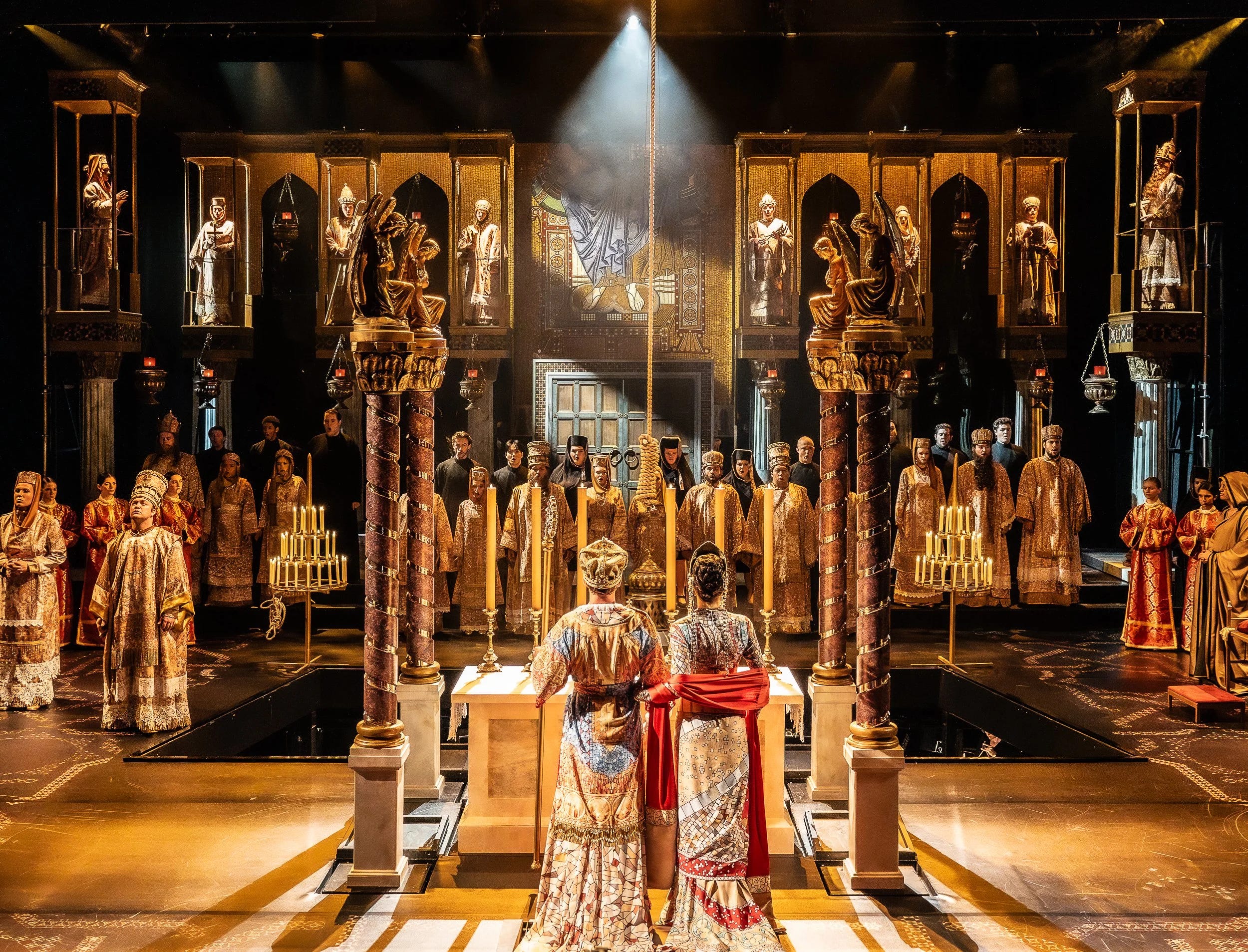
The set was sparse at the start of the show, with four candelabra and, its most striking feature, a large censer hanging over the orchestra pit. The orchestra sits under the stage in the Pote Theatre, with the pit opening in the middle of the performance space; in all three shows, I kept waiting for somebody to fall in. The conductor (David Neely, the company’s musical director) took the podium in silence, without a bow; lavishly costumed church officiants processed on stage in silence; the downbeat arrived when the archbishop (Ben Strong, terrific in the small role), in an exciting gesture, set the censer swinging over the orchestra. Szymanowski’s score calls for huge forces: choir, children’s choir, soloists; soon the stage was full. Roger and Roxana, in ceremonial robes, entered from the house, processing as the officiants had; a lush altar suddenly rose from beneath the stage, in front of the orchestra pit, flanked by four angel-topped pillars. More of the back of the stage became visible (was a curtain lifted? was it just a matter of lights?), revealing an elaborate Byzantine church, true to Szymanowski’s intentions, with a huge doorway, above it a mosaic-like image of Christ. Atop pillars, members of the chorus stood in what seemed almost like vitrines, like life-sized statues of saints. It was a stunning effect, to move from the stark opening to the opulent full set. The scenic design, by Jimmy Stubbs, was superb throughout the opera, triumphant: a brilliant, maximalist use of a very limited space. The lighting design by Connie Yun was equally stunning.
The musical values were very high. I came in a little worried about the orchestra, which had struggled the night before in Tosca (which was, I should be quick to say, excellently sung); if Puccini gave them problems, I thought, how would they manage Szymanowski? But they played very well. Maybe the difference was Neely, who hadn’t conducted the night before; whatever the reason, it didn’t sound like the same band. There were things to nitpick, if you were so minded, but I was happy throughout. (A special shout-out to the brass, which handled Szymanowski’s walls of sound with aplomb.) The choruses were superb, secure in their very difficult harmonies and rhythms; given the limited space onstage, the choice to choreograph Robert Wilson-like stylized gestures was an effective one.
Of the four principals, all were remarkable. The Roxana, soprano Lydia Katarina, is a major talent, with a big, dark-hued sound; one wished the role gave her more to do. The sole misstep in the staging, I thought, was keeping her off-stage for so much of her Act II aria; the off-stage acoustics in the space are not great. (This was also annoying in Act II of Tosca.) But that wasn’t her fault, and she sang beautifully throughout, with top notes that both pierced and bloomed, a rare combination. Lucas van Lierop was a better Edrisi than those on any of the recordings (even better than Philip Langridge on the Rattle disc); again, I wished he had more to do. I would love to hear his Shepherd. Alexander Birch Elliott was a terrific Roger, declamatory in the first act but capable of real vulnerability in the second and third; it’s a beautiful, mellow-dark sound, solid throughout the range, with a secure top, capable of both subtlety and big effects.
That leaves the Shepherd, Christopher Sokolowski. He’s on the brink of what promises to be a major career: he’ll be sharing the title role in Parsifal with Piotr Beczala at Bayreuth next summer. (Beczala, by the by, is the best Shepherd on record, in the 2010 recording from Warsaw that is the best all around, I think—though the Rattle has a lot to recommend it, not least Thomas Hampson in the title role.) But the Shepherd, though he decidedly looked the part, didn’t always seem the most natural vocal fit for Sokolowski. He seemed to struggle in the first act, especially early on, when a very vulnerable, otherworldly sound is called for, with a lot of high, piano singing. By the second and third acts, when the Shepherd has stepped into his godhead, Sokolowski sounded much more at ease, with an excitingly baritonal middle voice and ringing helden tones up top. By the end I was more than convinced; I’ll be eager to hear him in other things. (He could pass for twenty-three but is actually in his mid-thirties—which means just hitting vocal maturity. I wish I could hear his Parsifal next year.)
Like all of the principals, theatrically Sokolowski was superb. I have seldom seen an opera so beautifully acted; and this was the real surprise, and the real triumph of the Des Moines production. It seems to me little less than miraculous, given the material, that they made King Roger dramatically compelling—not just credible, but moving, edge-of-your-seat exciting; at least once in each act I had literal gooseflesh. Somehow the stage director, Chas Rader-Shieber, made Iwaszkiewicz’s dumb poetry come alive; Szymanowski’s abstractions were made full, flesh-and-blood human beings. Sokolowski entered, in Act I, in a white tunic, holding a black sheepskin like a security blanket; he seemed lost, absolutely vulnerable, lovable. When Roger threatened him with death he curled up under the altar like a frightened child—which made Roger’s quick turnaround, his sudden clemency, dramatically credible. And then, when he returned in Act II, he entered in a costume that made my jaw drop, a barely-there assemblage of woven chains, a dramatic red mantle draped across his arms. He soon let the mantle fall. He wasn’t exactly exposed—his pelvis was covered—but he was the nearest thing to it: half high priestess, half high stripper. It was the sexiest and the queerest costume I’ve ever seen in a theater. (All of the costumes in the show, by Robert Perdziola, were fantastic.) Nor was it just the costume that was transformed: gone was the hapless shepherd boy; he entered now as a god. I couldn’t help but think of Szymanowski’s line about Nijinsky: “that most beautiful of all things, namely a genuine youth.”
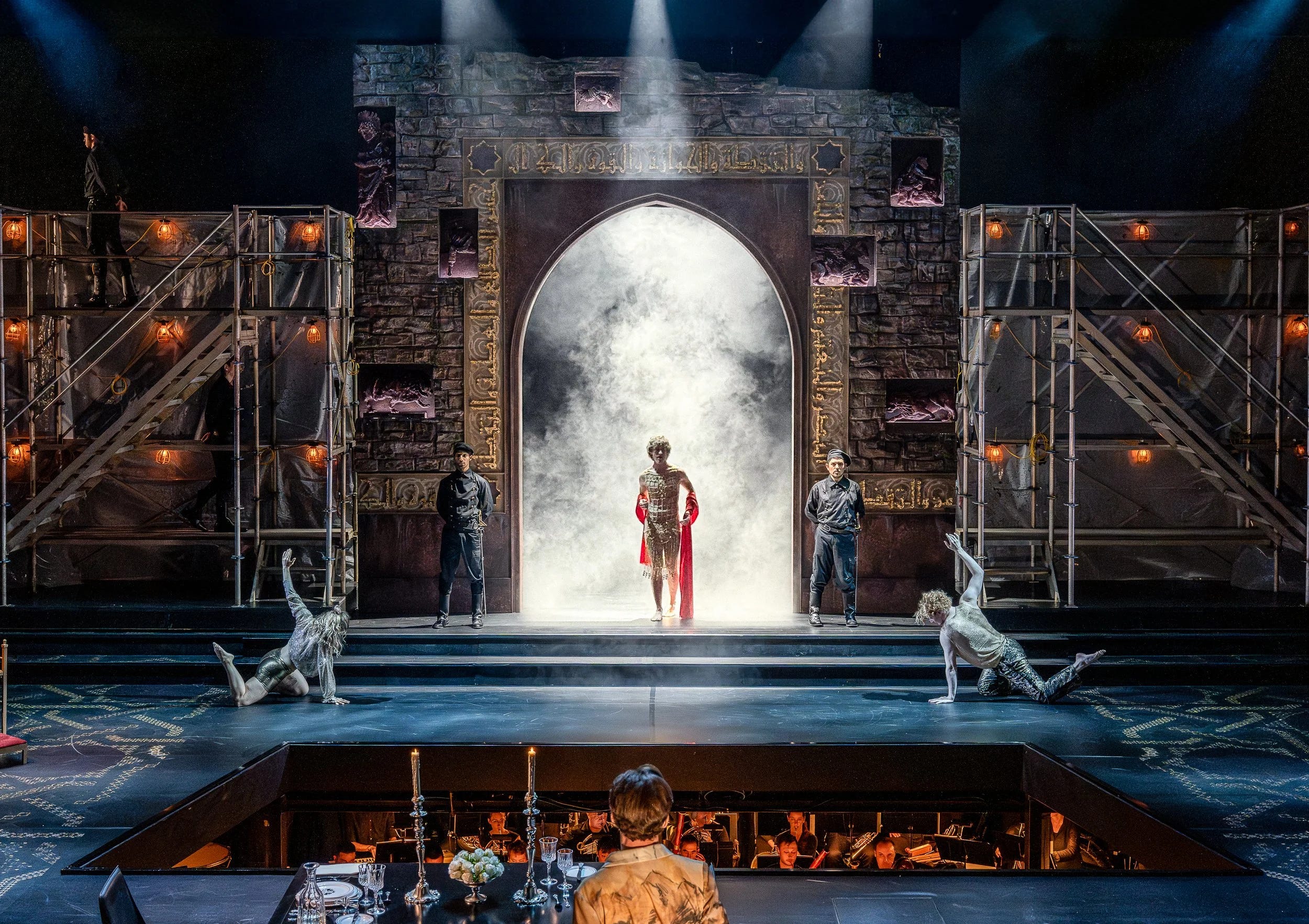
Having established the musical and theatrical excellence of the production, let me say that it is not irrelevant to the evening’s success that all four of the principals were disarmingly beautiful, and that they all had remarkable chemistry with one another. It’s to their credit, to the director’s credit, to the company’s credit, that they were all willing to risk so much, to put something on stage that felt genuinely transgressive. It is daring to invite your audience to be so turned on. Toward the end of the first act, when Roger commanded the Shepherd to return, one felt that it wasn’t exactly a trial that was in question. When he sang the line, “I’ll come to you and bow at your feet,” the Shepherd got on his knees before Roger, intimately close. It was the sexiest thing I have ever seen; I was absolutely not alone in finding it uncomfortably hot. (This is not a complaint!) Sokolowski was a genuinely pansexual Dionysus; in the second-act bacchanal erotic energy shot off in all directions, as the dancers, provoked and guided by the Shepherd, shed their clothing and paired up (tripled up, quadrupled up) in all permutations. They ended in a literal orgiastic pile of bodies. The sexiness, the believability of the sexiness, made everything else make sense: the Shepherd’s dual personalities, Roxana’s enchantment, Roger’s bewilderment. You believed Roger was being shaken to his core, that new possibilities of existence were opening up for him, that he was undergoing a kind of desire he hadn’t experienced before, not just queer desire but desire as a threat—of transformation, of perdition, of apotheosis.
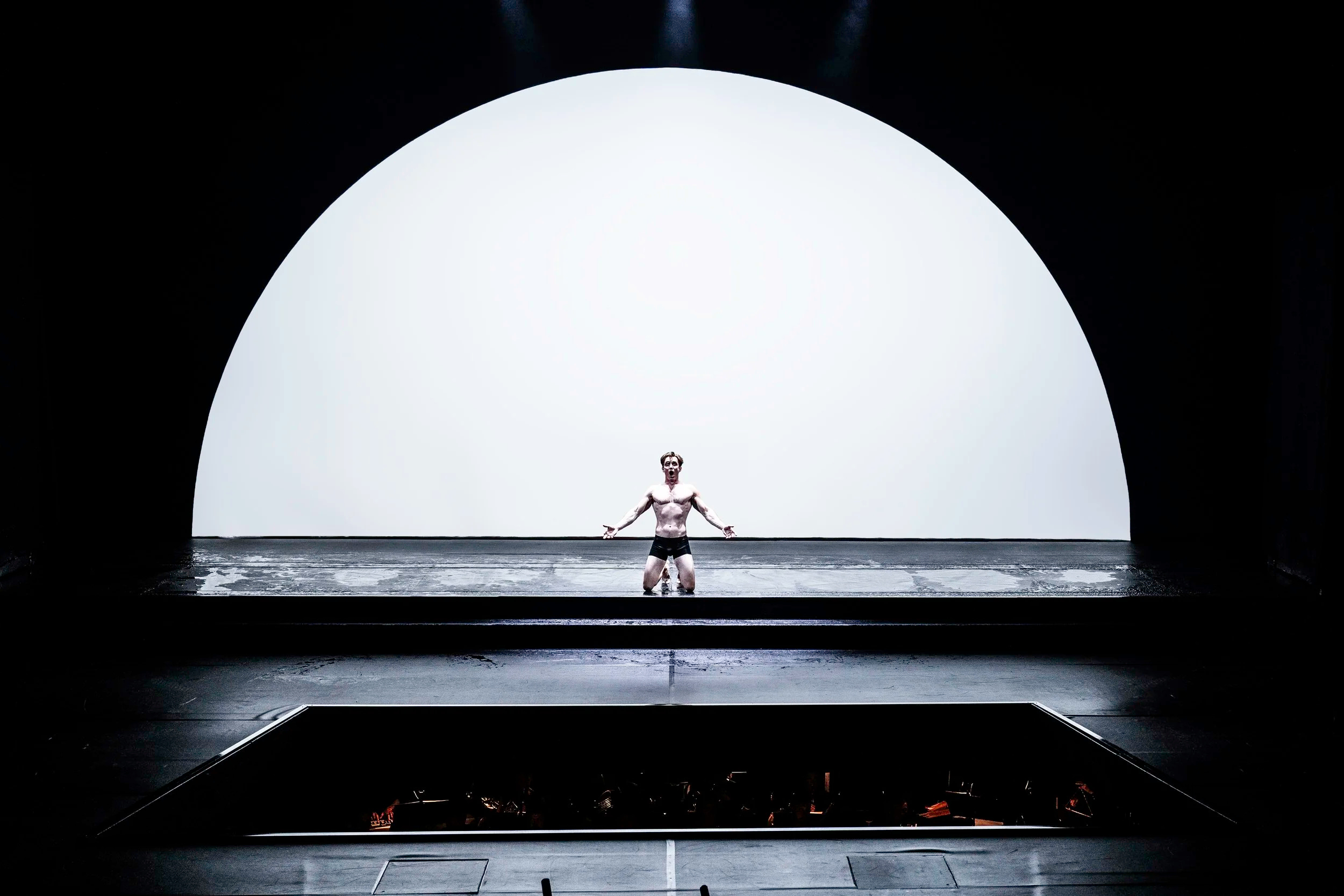
In the final act, Alexander Birch Elliott’s performance became something really remarkable; I admired more than I can say his willingness to assume an extraordinary vulnerability in every aspect: emotional, vocal, physical. He sang Roger’s final hymn to the sun with a commitment I can only call, oxymoronically, controlled abandon; the phrase I scribbled in my notebook in the theater was he’s singing his heart out, and for once the absurd cliché felt precise. This was especially impressive because he was doing so almost naked, having stripped to his underwear, and also soaked through, thanks to a very exciting, very surprising water effect near the opera’s end. I still don’t know what Szymanowski is after at the end of the opera, but I believed something, in part because Elliott made such a striking figure, with his absolute commitment and his Greek statue physique. “A pure heart I will pluck, and offer it to the blazing sun,” he sings; and one felt that he was vulnerable, human, a sacrifice, and also—vocally, physically—himself a blazing sun.
Often during the evening I thought to myself The Met could never. Could never commit so much to a niche, risky, unapologetically queer opera; could never be so transgressive; could never dare to bring its audience to such uncomfortable, exciting, transformative places. Could never trust its audience so much, could never—and this is the saddest thing I feel too often about the Met these days—trust theater enough. One of the remarkable things about the Des Moines production was how absolutely committed it was to opera as a theatrical experience; you never felt, as you feel almost always at the Met in recent seasons, that it was aspiring to be something else, something Hollywood, something IMAX. Take the extraordinary final image of the production. The Met would have drowned the moment in dumb projections, putting us in some idiotic planetarium show of stars and sunrises. Des Moines took a different tack, infinitely more effective. As Roger sang his hymn to the sun, behind him an old theatrical technology worked its absolute, perfect magic. Very slowly, from the water-covered stage, a backdrop ascended, on it the brilliantly lit half circle of a rising sun. I will never forget it.
As always, thank you for reading—
G.
Comments
Nothing yet. Say the first thing.
Sign in to join the conversation.