
New to Tidelands? Start at the Beginning

“Where?” I asked.
“The old folks home.”
Four more portentous words would I never come to hear.
“The one down by the beach?” she said, slowing to a stop before a pelican crossing so that a granny with a tartan trolley (10 points) could snail her way across. “Siobhán at work says they’re looking for casual help.”
“Work” was the hospital, where – fittingly enough – my matronly mum was a matron in Maternity.
“What sort of … help?”
“Dishwashing? Making beds? General gopher work?” Reassuring my knee with two pats of her free, gear-changing hand, she set off again. “Don’t worry, darling, I don’t think they’ll have you emptying bedpans.”
Small mercies.
I grunted to show her that I’d heard (and to give nods and shrugs a break), and turned my head away. The sun-baked town limped weakly by. Hopefully she would forget, or – more likely – something would distract her. A spate of teenage pregnancies, an epidemic of whooping cough – who cared? Adolescent monster that I was, I’d throw anyone under the bus just to free up more time to map the key locations in Atic Atac (Ultimate Play The Game, 1983).
“Right, be back by …” She checked her watch.
“Three?” I ventured forlornly.
“Two. No later. Once I’ve done the shopping, I’ve got Old Mrs David to call in on before my shift.”
God only knew why. From my mother’s own report, OMD was never grateful, never had a kind word for anyone, and her chief contribution to village life was eviscerating the various foot-, tennis, and rugby balls that had the misfortune to find their way into her rank unweeded garden (an image that, now I come to think of it, may have played some part in my ball-related nocturnal anxieties…).
“Two!” my mother shouted after me as I all but ran out of the carpark. Jam-i-Soft was 15 minutes’ trek out of the town centre, and I’d need to double-time it if I was to get in my full quota of free gaming, cheat-sharing and general shit-talking.
Breathless and sweaty at the corner of Jubilee Road and Queen Street, I composed myself a moment before the establishment’s grubby windows, its glories dubiously veiled behind sun-blanched posters promising ludic delights from last year and beyond. Like a sex shop, almost, tantalising and intriguing you: if you wanted to sample its hidden treasures, you had to step inside.
The door gave with customary stiffness and the muffled clank of its little rusted bell. Assorted computers, monitors and small TV sets adorned an array of camp tables fringing the room. A gaggle of boys played Chuckie Egg (A&F Software, 1983) on a Commodore 64, while a young girl looked on joylessly as her responsible adult poked suspiciously at the tombstone keyboard of a BBC Micro. Two heads at the counter swivelled briefly in desultory acknowledgement of my entrance, before returning to their conversation.
“The graphics are shit. They don’t even look like camels.”
“You little prick. What do you know about camels? Or graphics.”
The latter speaker was slouched behind the counter like a sultan, sporting the sort of physique that awaited me ten years from then if I didn’t discover better forms of exercise and nutrition. He was the eponymous Jam in Jam-i-Soft, deliberately mispronounced by us as in “fruit preserve” – and the i, now I come to think of it, somewhat ahead of the curve, prefiguring the slew of wondrous offerings (-Pads, -Pods, -Phones and -Macs) that Mr Jobs would later foist upon us all. There was also, aptly, something soft about Jam himself, an androgynous, unformed quality, like half-moulded plasticine, as if the Creator had set the task aside unfinished, intending to come back to it, but never did. Tall, pale and pudgy, his freckled, boyish complexion vied with a sparse and wispy beard (which oversold it, as it more resembled old women’s facial hair), and in all the time I knew him it never grew any fuller. The overall picture was of someone in developmental limbo, at once too old for spiteful squabbles with boys ten years his junior, and too immature to be entrusted with the steerage of any serious commercial endeavour, soft or not. That Jam-i-Soft existed at all was therefore a wonder; that it persisted under his sardonic and petty proprietorship, even more so.
“I know the hind legs of a dromedary have backward joined knees,” Jam’s debating opponent countered. “Looks like something out of a Christmas panto.” This was Morely, a boy my own age, but in attitude and spirit far older. He had what you might now call a Harry Potter vibe – if, that is, the boy wizard had failed to make the cut at Hogwarts, but retreated back into the cupboard under the stairs, there to stew in his own bile while writing poison pen letters to Crash magazine about people of minor note in the Spectrum gaming community.
“Well, I’m sure its graphical glories would show to much greater effect on your shitty little sponge box.”
In Jam’s parlance, ZX Spectrums were “sponge boxes” and their owners “sponge monkeys”, in reference to the squidgy little rubber keys – affectionately known by owners as “dead flesh” – with which Sir Clive of Sinclair had kept the computer’s price tag to a very affordable £125 on release, or an actually quire reasonable £175 for the 48k (“Jesus, Freddy. Santa’s also got bills to pay, you know.”).
In contrast, Jam himself favoured the “vastly superior graphical capabilities, sound quality, memory capacity and physical build” of the Commodore 64, and was thereby in our terms a “llama fucker” – not any sort of racial slur, thank God, but referencing his dedication to anything put out by Jeff Minter’s Llamasoft, and the latter’s obsession with all things camelid. There were a few outliers, of course – owners of BBCs (poor bastards), Amstrads or Ataris – but this was mostly the binary schoolyard divide among home computer owners of our age, and we lined up like Mods and Rockers, Capulets and Montagues, opposing partisans eager for the fray at the slightest slight. As a sponge monkey myself, I should really have weighed in to back up Morley’s point. But, to be fair, the Spectrum’s inability to host more than two colours in any 8x8 square of pixels was a well-known Achilles heel, which meant that, like a badly executed paint-by-numbers, they often bled into areas they weren’t supposed to.
“Graphical glories?” Morely attempted rebuttal. “More like … like …”
“Well put.”
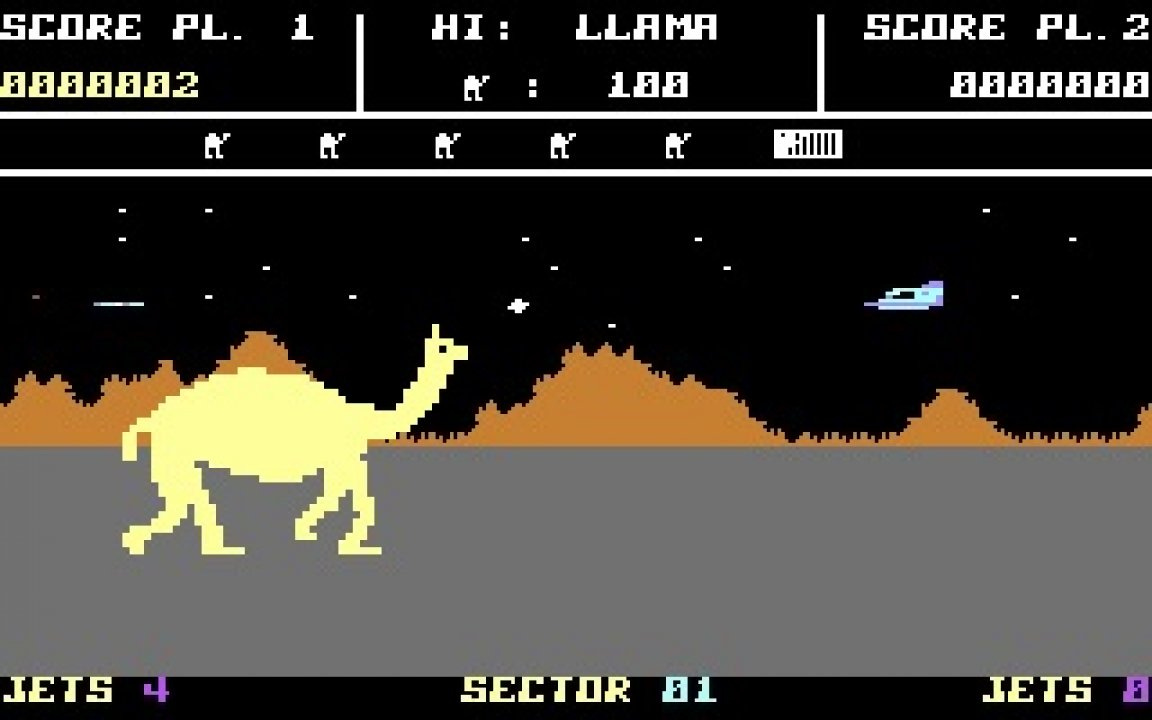
But maybe it was a class thing: the pocket-friendly Speccy had broader appeal than the C64, so perhaps at the root of all Jam’s snobbery was envy at the greater number of games this proletarian popularity facilitated. The envy also went the other way, of course, and many a sponge monkey secretly coveted the superior graphics, sound, memory and build quality of C64s, and would gladly have been llama fuckers ourselves – Attack of the Mutant Camels (Llamasoft, 1983) looked great, to be fair, and hadn’t yet (and sadly never would be) ported to the Speccy – were not matters of tribal loyalty already firmly entrenched.
Besides, I had other, bigger fish to fry.
“Any news on Sabotage?”
Jam afforded me a look of humorous disdain.
“Yes,” he said. “Yes there is.”
“Really?”
“No.”
And he laughed cruelly, returning once more to tormenting Morley.
I left them to it and took a turn of the room – which didn’t take long. Jam-i-Soft was a microshop in both senses: one of the dedicated independent retail outlets that sprang up to cater to the early ’80s boom in micro-computer gaming, and also so small you felt you were intruding, as if you’d stumbled into someone’s front room (which, historically speaking, was probably true).
It also just felt … unhealthy: the tepid, torpid air, choked with static, dirt and dust; the harsh glare of the flickering strip lights; the dearth of naturally occurring ions.
And the games. Meagre offerings, stationed beyond the reach of larcenous fingers on shelves set high behind the counter, so you had to ask to see a particular title, which would then be grudgingly offered up for you briefly to peruse (“You going to buy it, then, or what?”), and swiftly snatched back when nine times out of ten Jam decided the answer was going to be no.
Most of all I remember the cover art – or actually, the disparity: between the graphical promise of the full-colour illustrations that, when you got the game home – almost a bait-and-switch – could only ever oversell the pedestrian 8-bit reality.
Nothing like the games the kids have now. Not a patch.
I loved them all to death.
Ultimate Play the Game were perhaps my favourite games company, and Atic Atac was I think the first of their games that blew me away. It was the graphics, primarily – the superbly designed little sprites – that definitely played an influential role in my own burgeoning artistic ambitions.
OMD – not to be confused with the other OMD!
Chuckie Egg was an ingenious and addictive platformer game, not dissimilar to Manic Miner, and was written by Nigel Alderton when he was only 16. Actually, if we take two screenshots of the BBC and Spectrum versions, it perfectly illustrates the Spectrum’s “graphical issues”.
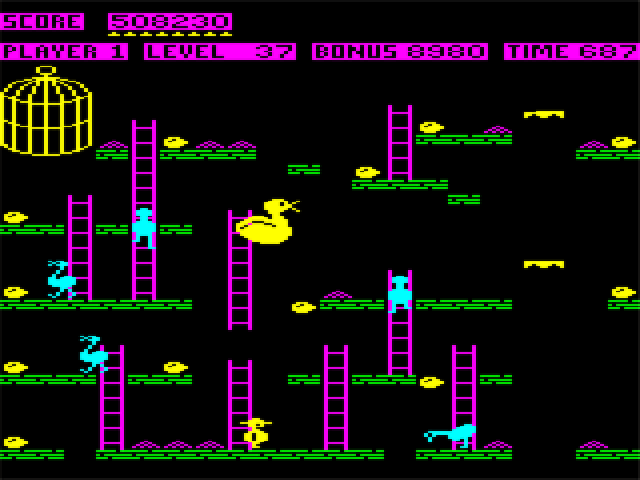
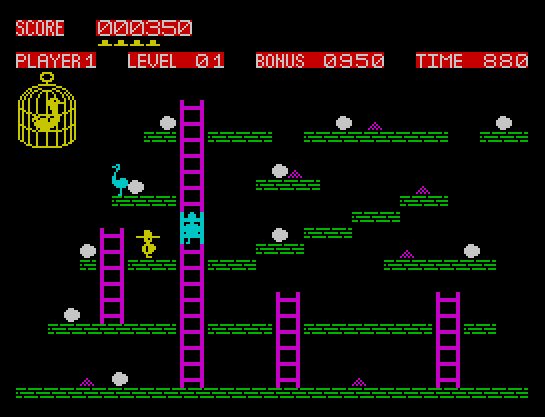
As you can see, on the left, the characters and background are all clearly defined; on the right, the character colours sometimes “bleed” into the background. This is because the Spectrum couldn’t host more than two colours in any single character square.
By the way, I’m not digging at the BBC Micro here - it was a decent machine - but it just didn’t have the games that were available to the Spectrum or Commodore 64 – maybe because it was much more expensive, and primarily pitched as an “educational” machine (every school in the UK probably had one). Overall (though I feel like a traitor in saying so), the C64 was the best all-round machine
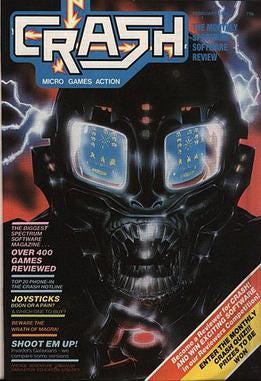
Crash magazine was the best computer magazine ever. It combined a genuine fan’s enthusiasm and was pitched at the level of a teenage boy, and I loved it. It was sort of like NME for gamers. I was particularly enamoured of the wonderful covers by brilliant artist Oliver Frey, who wikipedia now informs me had a secret life illustrating gay erotica! There was also a sister magazine called Zzap!64 (for the C64), which we didn’t talk about…
Llamasoft was the brainchild of English game designer Jeff Minter, who did indeed have an obsession with all things camelid.
Jam-i-soft is loosely based on various “micro-shops” I remember from the mid 80s (though none of the characters are). There were a few of these at the time, and it was sad to see them gradually replaced by the big franchise stores.
No posts
Comments
Nothing yet. Say the first thing.
Sign in to join the conversation.