
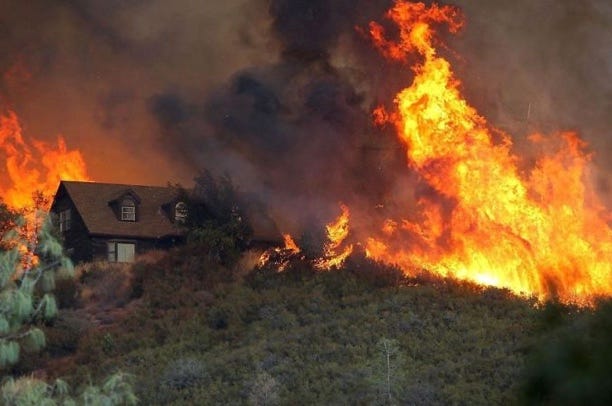
Today’s podcast and newsletter of Beyond the Garden Basics is something a bit different, but very important: what to do around your home, both inside and outside, if a wildfire is in the area, and you have a few hours before an evacuation becomes mandatory.
That was the topic in a Youtube video presented by Todd Lando, a battalion chief and wildfire mitigation specialist for the Central Marin Fire District. Marin County is in Northern California, just north of San Francisco, a bucolic area with hills, mountains and forests abutting the Pacific Ocean. As you might imagine, especially with its proximity to San Francisco, it is one of the more heavily populated areas that can be described as the urban-wildland interface, where suburbia meets a very fire prone area. More information can be found at the website, firesafemarin.org.
Among the practical tips that Lando discusses in the video include what should be done to prepare if a wildfire is getting to be an imminent situation. Of course, if you hear the order to evacuate immediately, you do want to leave immediately. Here’s a summary of his advice:
- Only work through this checklist if you have real lead time, roughly two or more hours before a fire could arrive. That might mean a red flag warning, or a fire burning elsewhere in the region. If embers are already falling, the sky has turned black, or you’ve gotten an evacuation order, skip all of this and leave. These steps add to the home hardening and defensible space work you should already have done, they don’t replace it.
- Shut every window and door in the house.
- Unlock all doors and windows, front, back, every entrance, even though they’re closed. This lets you escape and lets firefighters check the house without breaking anything down.
- Close all interior bedroom and hallway doors. This creates compartments that slow a fire down if it gets inside.
- Turn on every light, inside and out, day or night. It helps firefighters find your house and helps you see well enough to evacuate.
- Turn off the air conditioning, heat, and all fans so embers and smoke aren’t pulled through the house or circulated around.
- Move patio furniture cushions at least 30 feet from the house. Synthetic fabrics ignite easily from embers.
- Move wicker or other flammable furniture away from the house. Heavy metal or solid wood/teak furniture is safer to leave where it is.
- No 30 feet of clearance in your yard? Bring flammable outdoor items inside instead. Stack them in the middle of the living room, away from windows.
- Don’t move combustible items closer to a neighbor’s house. Find a safe spot on your own property or bring items indoors.
- Bring in kids’ outdoor toys and anything else combustible sitting in the yard.
- Remove natural fiber doormats. They collect embers right at your front door.
- Move plastic trash and recycling cans away from the house, or bring them indoors.
- Move firewood piles at least 30 feet from any structure, or bring them indoors if you can’t.
- Shut off your home’s gas meter. Learn how to do this ahead of time, it’s good earthquake prep too.
- Shut off and close the valves on any propane tanks.
- Move small propane tanks 30 feet or more from structures with nothing combustible nearby, or bring them indoors if there’s no safe outdoor spot.
- Connect every garden hose you have, attach a spray nozzle (with an on-off control), and turn the water on. Leave hoses out where firefighters can find and use them for spot fires.
- Fill buckets with water and place them outside. This gives you a backup source if the municipal water system fails.
- If it’s safe and you have time, clean the rain gutters of leaf litter.
- Clear any leaf litter or debris off the roof entirely (with a cordless leaf blower).
- Back your car into the driveway, or if it’s parked on the street, point it toward your evacuation route.
- Leave your car doors unlocked.
- Load valuables and your evacuation checklist items into the car.
- Keep the car ready so you can leave at a moment’s notice.
- Prop open driveway fences and side gates. This creates a break between a burning fence and your home, since fences are usually attached directly to the house.
- Place ladders where firefighters can see them, ideally near the corners of the house. It helps them get onto your roof quickly to handle small spot fires.
- Cover crawl space vents if you have time.
- Cover attic vents too, if you have a tall enough ladder and the means.
- Use pre cut plywood or metal vent covers made and stored in advance, screwed onto the siding.
- No pre cut covers ready? Heavy aluminized duct tape works as a stopgap to seal vents.
- Once you’ve finished prep steps, patrol your property and look for hazards.
- Keep an eye on the sky for signs conditions are changing.
- Make sure your cell phone has reception and is set up to receive alerts, like Nixle or Alert Marin (or your local alert system).
- Keep a NOAA weather radio on hand as backup in case cell alerts aren’t reliable.
- Evacuate immediately, and stop doing prep steps, if you get an evacuation order, see embers falling, or the sky turns black.
- It’s worth running through this checklist any time a wildfire is burning in your community, even if your home isn’t directly threatened yet.
Farmer Fred:
Today’s podcast and newsletter of Beyond the Garden Basics is something a little bit different, but it’s very important. What to do around your home, both inside and outside, if a wildfire is in the area and you have a few hours before an evacuation becomes mandatory. That was the topic in a recent YouTube video presented by Todd Lando. He’s a Battalion Chief and Wildfire Mitigation Specialist for the Central Marin Fire District. Marin County, by the way, if you don’t know, is in Northern California, just north of San Francisco. It is a bucolic area with hills, mountains, and forests abutting the Pacific Ocean. And as you might imagine, especially with its proximity to San Francisco, it is one of the more heavily populated areas that can be described as the urban wildland interface where suburbia meets a very fire-prone area. More information can be found out at their great website, firesafemarin.org. Among the practical tips that Lando discusses in the video include what should be done to prepare if a wildfire is getting to be an imminent situation. Of course, if you hear the order to evacuate immediately, you do want to leave immediately.
His tips in the video, of which the audio is today’s podcast, by the way, includes such tips as windows and doors should be shut but left unlocked. Interior, bedroom, and hallway doors should also be closed in order to compartmentalize the home. Lights should be turned on inside and outside, and that includes exterior lights because wildfire conditions can make it dark even during the day. And of course, air conditioning, heat, fans, and other air-circulating systems should be turned off.
Lando’s Zoom presentation then moves outdoors, where combustible items should be removed or relocated. Patio cushions, wicker furniture, outdoor toys, natural fiber doormats, trash, recycling bins, and even firewood should be moved at least 30 feet from the house or even brought indoors if there’s no safe place outside. Lando also advises shutting off the gas meter and closing any propane tank valves. Small propane tanks, by the way, he says, should be moved away from structures or moved indoors if needed.
Other exterior preparations include laying out active garden hoses that are equipped with a hose end on-off valve, placing filled water buckets outside, and cleaning gutters and the roof of leaf litter. Drivers should back their cars into the driveway, leave them unlocked, and load them for evacuation. Wooden fences, especially along the driveway or with side gates, those side gates should be propped open to reduce fire spread from the attached wooden fencing. Your own tall ladders should be placed where firefighters can see them and use them if necessary. And vents to crawl spaces or attics should be covered with pre-cut materials or heavy-duty duct tape. Finally, Lando advises staying aware of changing conditions, keeping a working phone or an NOAA weather radio for alerts handy, and leaving immediately if embers start falling, if the sky darkens, or that evacuation order is given. There will be a link to the YouTube video version of this in today’s Beyond the Garden Basics newsletter, along with a summary of what Battalion Chief Todd Lando discussed, as well as the complete transcript of this fire-safe Marin video, which is entitled, “What to Do When a Wildfire is Near Your Home.”
Here’s Todd Lando:
Protect your home when a wildfire is burning nearby or a fire is approaching your home. I’ll talk a little bit about how you make that decision and what practical things you can do when you only have a few seconds to prepare. This doesn’t negate all of the preparations that we’ve talked about through home hardening and defensible space. Everything we talk about really depends on you also doing that hard work, but there are things that you can change as you’re on your way out your door, even to evacuate, that can make a big difference on whether you come home to your house still standing during a fire. How do you know if you have enough time if time allows? We’re talking about things that you can do if you have two or more hours before a fire arrives. You need to give yourself some cushion. These aren’t things that you’re going to be doing if embers are falling in your neighborhood. So these are things that you might do when there’s a red flag warning. Maybe there isn’t the fire yet, but the conditions are just right for a fire. You can do each one of these steps. It’s not going to hurt you. Take a walk around your property and do these things. You certainly do these things if there’s a fire. The typical fires that we see in Marin, or burning burning nearby, not every fire is going to turn into a catastrophe but you still ought to take these steps anytime there’s a fire burning in your community. So, again, heed the evacuation order. If embers are falling, if the sky turns black, or if conditions change and you just don’t know if you’re safe or not, skip these steps. But, if you’ve got time, let’s go through the checklist.
Todd Lando:
I’m going to start with things that you can do inside your house, and that’s where I want you to start. You’re preparing that inside space just in case you have to take shelter inside the house if you weren’t able to evacuate for some reason. We want you to start by shutting all of the windows and doors around your house. We want to make sure that your doors and windows are unlocked. Front door, back door, every entrance should be unlocked. Keep the doors closed and unlocked. Same with windows. You might ask, why do we want to keep these shut? Why do we want to keep them unlocked? We want to stop smoke and embers from entering the home. Embers especially, those little bits of burning material, if they come in through an open door, can ignite things inside your home and burn your house down. It happens. We want you to create compartments by closing all of the bedroom doors and hallway doors inside your house so if somehow the fire gets into the house you’ve broken it up into spaces. This buys you additional time if you have to shelter in the house and it might buy the fire department some extra time to put that fire out if you’re lucky enough to get a fire engine to your door quickly.
Todd Lando:
Why unlocked? We want you to be able to escape from any door inside your house and we want to provide a place for firefighters to be able to enter your structure to check to see if you and your pets, your family are okay, to check for fire inside the house and we want them to be able to do that without breaking that door down. If they have to break the door down during a fire they may not be able to shut it again and it may make your house more vulnerable but sometimes we’ve got to check inside the house to see if people are there. Inside the house, we want you to turn every light on, inside and out. Your exterior lights are especially important. We want you to do this day or night. The reason being, even during the middle of the day when a wildfire is approaching, it’s going to get dark. Some of these photos, like the one you’re looking at right here, this is not in the middle of the night. This is in the middle of the day. Those lights can help firefighters find your house. They can help you find your way to escape, to evacuate, and then make it easier for the firefighters to work if they arrive to protect your home during the fire. Really important step. We want you to turn your air conditioning off, right? Heat and air conditioning. We never used to say heat, but now we see fires in the middle of winter in California. So turn all of your fans and anything that circulates air through your house off. That’ll help protect you, prevent the fire from spreading via fans inside your house.
Todd Lando:
We want you to move outdoors next and think about anything that’s combustible, anything that can burn outside. We want you to specifically look at a few items. Patio furniture cushions. The cushions especially are vulnerable. They’re usually made from soft synthetic materials. Embers will land on them during a fire. Those synthetics can ignite and can potentially burn your house down. Look for flammable furniture. Wicker furniture especially is made from a fine, flammable grass even that could potentially ignite if embers land on it. Heavy metal furniture is best. Wood furniture, if it’s a heavy teak table, probably not as vulnerable. But you want to think about any outdoor furniture that could burn. We want you to take these things and move them away from your house, 30 feet or more from your house. And I always say, and it’s tough to get the reaction here on Zoom, but I always say and get a chuckle. Well, don’t move these things closer to your neighbor’s house. If you’ve got a property that’s big enough where you can move them 30 feet from anybody’s home, go ahead and do that. If you don’t have a safe place in your yard, many yards aren’t that big, you can move these items inside your house. Put them right in the middle of the living room, your outdoor furniture, all this stuff, stack it up inside the house where it won’t be exposed to embers. This would include outdoor toys, things that you might have in the yard that belong to your kids, natural fiber doormats, We don’t want to see these at all during the summertime. They tend to collect embers and ignite right at your wooden front door. Your trash and recycling cans are made from plastic. Oftentimes they’re full of cardboard and other recyclables. Things like a firewood pile, which you’re not supposed to store within 30 feet of a home. But if you do, if you’ve got firewood on your front porch or your back deck, you’ve got to move that either indoors or 30 feet or more away from any building.
Todd Lando:
Outside, we want you to shut off your gas meter. This is something that you should learn to do both for earthquake preparedness and wildfire preparedness. If you shut off the gas supply, it can help protect your house somewhat during a fire. If you’ve got small propane tanks or a large propane tank, if you live in West Marin, for example, we want you to shut that tank off, close the valves. Small propane tanks can either be moved 30 feet or more from any structure where there’s nothing combustible around them or you can actually move them indoors to protect them if needed.
Todd Lando:
We want you to connect every garden hose you’ve got. Garden hoses connected outside should be turned on as long as you’ve got one of these types of nozzles on. Turn the water on, go ahead and leave them in your yard where firefighters might find them and use them to put out spot fires while they’re protecting your home. We want you to consider filling water buckets. These are things, again, you do if you have time. Filling buckets and placing them outside the house can provide a last-minute source of water if the municipal water system fails. If the fire engines aren’t able to refill, firefighters will look for any source of water to help put out these small spot fires.
Todd Lando:
We want you to clean your rain gutters safely if you’ve got time on a ladder. Clean those rain gutters. You ought to be keeping these clean at all times but it’s not going to hurt you to do a last-minute check if a wildfire is burning nearby. Get your gutters clean. Absolutely no leaf litter on your roof or inside your gutters. We want you to back your car into your driveway. Take the time to turn your car around, back it in. If you don’t have a driveway, make sure that it’s facing out, facing downhill or towards your evacuation route if it’s parked on a street. Keep your doors unlocked to your car, load your car up with those valuables and the other things that are talked about on that evacuation checklist. Be prepared to leave. We want you to prop open driveway fences, the side gates, to your house.
Todd Lando:
Why do we want you to do that? This is actually really important. We find that fences are very vulnerable to igniting during wildfires. Fences are almost always attached to the house with a gate. Just by opening that gate, you can create a separation, something of a fuel break, a fire break between the fence and your home. If the fence catches fire, it can’t spread to your home if that gate is propped open. We want you to place ladders. Most people have got a ladder that can reach their roof. We want you to take your ladders and place them where they’re visible to those firefighters again strategically. Near the corners of the house is best, but any place that they can potentially access your roof makes it more likely that the firefighters are going to climb up on your roof to pick up that tiny spot fire that they may see.
Todd Lando:
Moving the heavy fire ladders on the fire engine can be time consuming. If they see a time saver, your house is more likely to still be standing when you come home.
Todd Lando:
We want you to think about covering your vents. If you’ve got time, cover the vents that go into the crawl space and if you have the means and a tall enough ladder even into the attic space of your house.
Todd Lando:
We recommend having pre-cut plywood or metal covers that you make well in advance of a fire and that you screw on to the siding of your house to cover these vents. If you don’t have those pre-cut covers, if you haven’t made them yet, if it’s still on your to-do list, You can actually use even heavy duct tape. In this case, this was a real house that we helped prepare in Inverness during the Woodward Fire. And this is a heavy aluminized duct tape made for sealing vents.
When you’re outside your property and you’ve taken the time to go through all of these steps and you have not yet received an evacuation order, We’d like you to take some time and get to know your surroundings, patrol your property, look for hazards, pay attention to the sky. Make sure that you’re in contact with the outside world. So you’ve got a cell phone that’s working, that you have reception so that you can receive alerts by Alert Marin (or your local alert system). If you don’t have either of those, make sure you’ve got a NOAA weather radio that gives you reception and can hear evacuation orders for large areas. If conditions change or you’re given that evacuation order or you see embers start to fall from the sky, it’s time to get in that car that’s already backed in your driveway and drive away.
Todd Lando:
Take these steps, take the time when time allows and there’s a good chance that you’ll come home to a house that’s still standing.
Thanks for reading and subscribing to the Beyond The Garden Basics Newsletter & Podcast! Smartpots and Amazon provide promotional support.
Fred Hoffman is also a University of California Cooperative Extension Master Gardener in Sacramento County. And he likes to ride his bike(s).
Comments
Nothing yet. Say the first thing.
Sign in to join the conversation.