
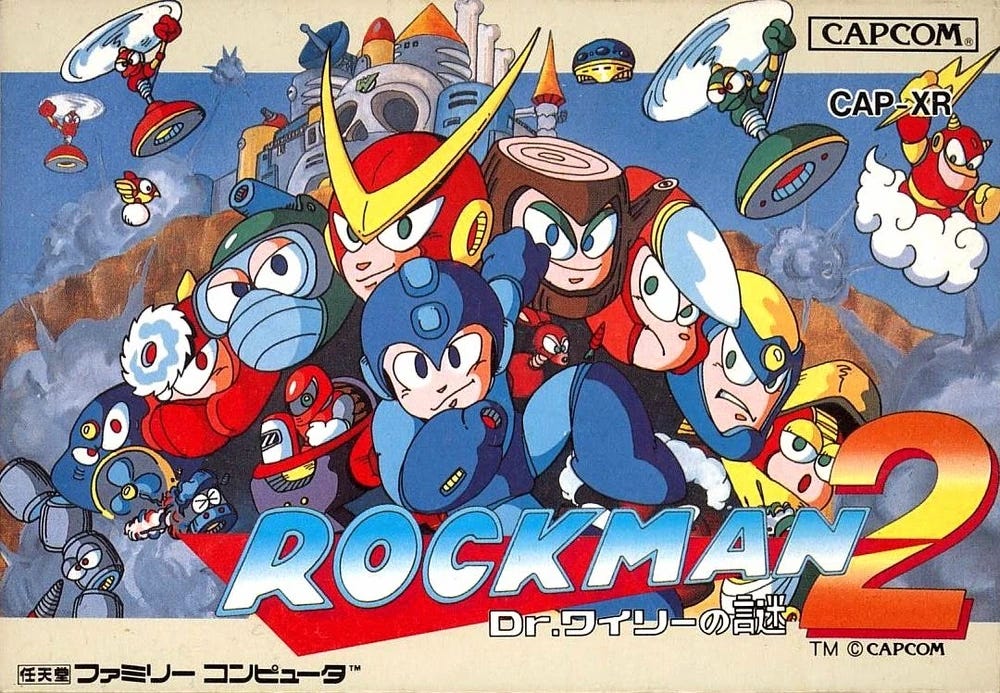
Check out the rest of the Mega Retrospective here!
Despite being a lot better than most games from the time, the original Mega Man had pretty average sales. Considering its circumstances, it could have been a lot worse, but it makes sense that it didn’t instantly become a phenomenon. Mega Man’s director, Akira Kitamura, wanted to give Mega Man a second chance, but Capcom’s higher-ups barely even had enough faith in the first title to release it stateside. Mega Man 2 only got greenlit on the condition that its team wouldn’t stop working on other projects during its development, leading to an extremely harried development cycle that took place over just three to four months.
Mega Man 2’s development seemed even more disaster-prone than Mega Man’s. Passionate people have a way of making the most out of these situations, though; if there’s one thing you could say about the Mega Man 2 team, it’s that they really wanted to make it happen. Keiji Inafune was back, working not just as artist but also producer. Kitamura had the idea to let fans submit concepts for the Robot Masters, receiving 8,370 suggestions in total to then narrow down to eight and further refine for actual in-game use. Takashi Tateishi replaced Manami Matsumae as the composer this time around; without classical music training, his score would bring in a lot of influence from performing in a band. Don’t forget, of course, that all of these people are splitting time with some other Capcom project. Despite everything in their way, the foundations of the first Mega Man and their simple willpower to make Mega Man 2 a reality gave this team just what they needed to prove Capcom’s skeptical higher-ups wrong about this series. Indeed, Mega Man 2 would be the success Mega Man was not, and it was quite well-deserved.
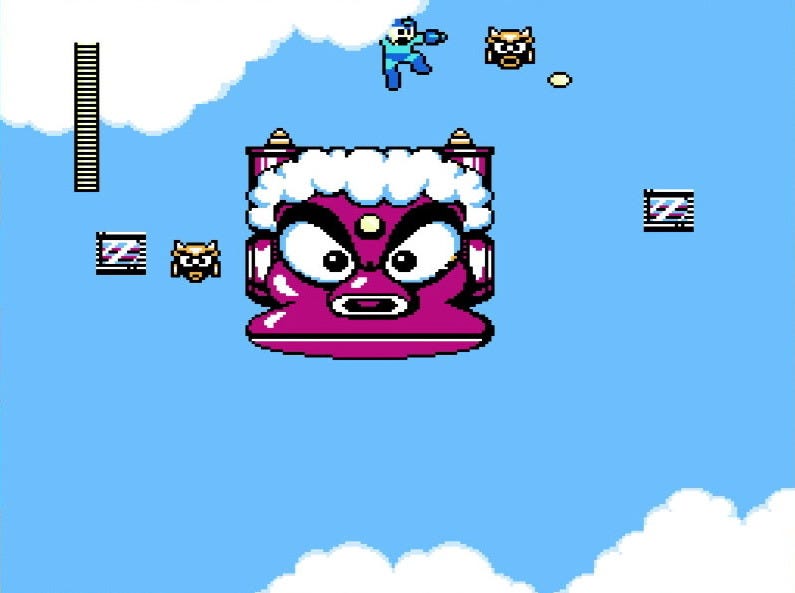
Within seconds of booting up Mega Man 2, it becomes clear just how much more polished this game is. Its iconic intro scene pans up to Mega Man standing alone on a skyscraper. The stage select screen is just that little bit more detailed. No matter which stage you jump into first, it’ll be more detailed and interesting than Mega Man’s levels. Single basic gimmicks like fire pillars and moving platforms give way to combinations of distinctive obstacles. Metal Man’s stage uses conveyor belts and crushers to keep you moving carefully, then complements them with enemies that drop from above on rolling gears. Bubble Man’s stage shows off the new water physics which let Mega Man jump higher and fall slower, introducing new series level design staples like carefully controlling your underwater jumps to avoid deadly spikes. Quick Man’s stage challenges you to move quickly as high-speed laser beams bear down on you. You feel a much better sense of place and theme in these longer, more engaging levels all the way through Dr. Wily’s castle, especially thanks to Tateishi’s score. The soundtrack’s rock influence is much more tangible this time around, resulting in some of the most iconic NES music out there.
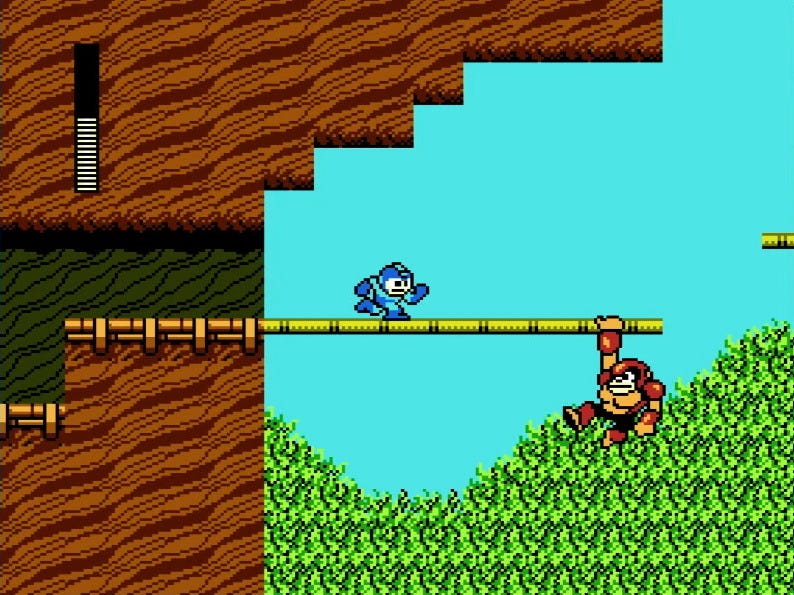
Mega Man 2’s gameplay has received just as much of a tune-up as the levels. Mega Man now stops walking the moment you release a direction, improving the feel of precise platforming. With eight Robot Masters to face this time, there’s more weapons and a greater variety among them. Many of the weapons established archetypes which the later games would expand upon. Heat Man’s Atomic Fire was the first weapon in the series which could be charged up for stronger blasts. Wood Man’s Leaf Shield surrounds Mega Man with a leaf barrier that damages nearby enemies; this was the first of many defensive-focused weapons. Crash Man’s Crash Bomber can be used to break hardy barriers which would become a staple in later games. Flash Man’s Flash Stopper freezes all onscreen enemies and hazards, being the first full-screen weapon in the series. Even beyond these archetypes, there’s greater variety between each weapon than there was before. Most of Mega Man’s weapons just shot something forward, but weapons like the ground-crawling Bubble Lead and the rising Air Shooter make Mega Man 2’s arsenal more fun to use. There’s much more reason than before to experiment with the whole arsenal…
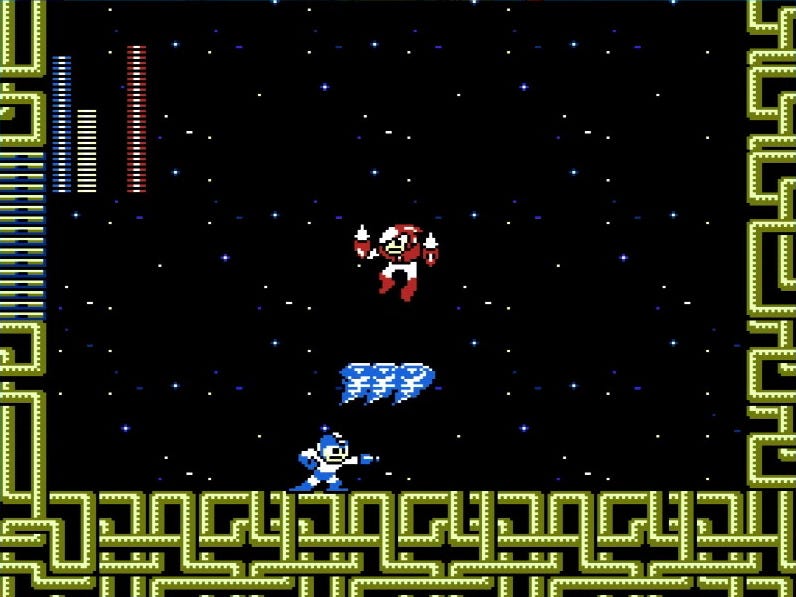
…well, that is what I would say if not for a certain weapon. To talk about that, though, we need to talk about a wider trend in Mega Man 2:
Apparently, Mega Man was so hard that the vast majority of the feedback Capcom got for it was about the difficulty. Looking back on my memories of jumping into it blind on the 3DS virtual console when I was ten or something, I can definitely empathize. It’s not as bad as other games could be, but there’s some real bullshit here and there. The point is that even the marketing department was asking the Mega Man 2 team to make it easier, presumably so they could actually move some copies this time around. This was the beginning of a largely positive trend of quality-of-life improvements across the history of the Mega Man series, but in Mega Man 2, there’s a few areas where they went overboard.
The best of these changes are the introduction of a few more movement tools and the E-tanks. Every time you clear a few stages, you unlock one of the three new items. Item-1 lets you place a floating platform in front of you which slowly rises, Item-2 is a rocket hoverboard which you can use to cross wide gaps, and Item-3 is another rising platform which climbs along the side of a wall instead of floating. Expanding on Mega Man’s Magnet Beam, these items let you spend some ammo to get around particularly tricky or risky platforming segments. It feels satisfying to come up with a way around tough areas using these items, although Item-3’s uses are a little more narrow than the other two.
The future series staple, the E-tank, is an item you can save for later to fully replenish your health. Dying in a Mega Man game at the wrong time can be quite punishing, especially since your special weapon ammo doesn’t replenish when you respawn. If you die to a boss right after using up a bunch of ammo for their weakness, you’re out of luck until you get a game over and restart the stage from the beginning fully restocked. E-tanks feel like a very fair way to smooth out these kinds of moments, especially since they’re not too common and often require you to spend ammo or risk death to collect them.
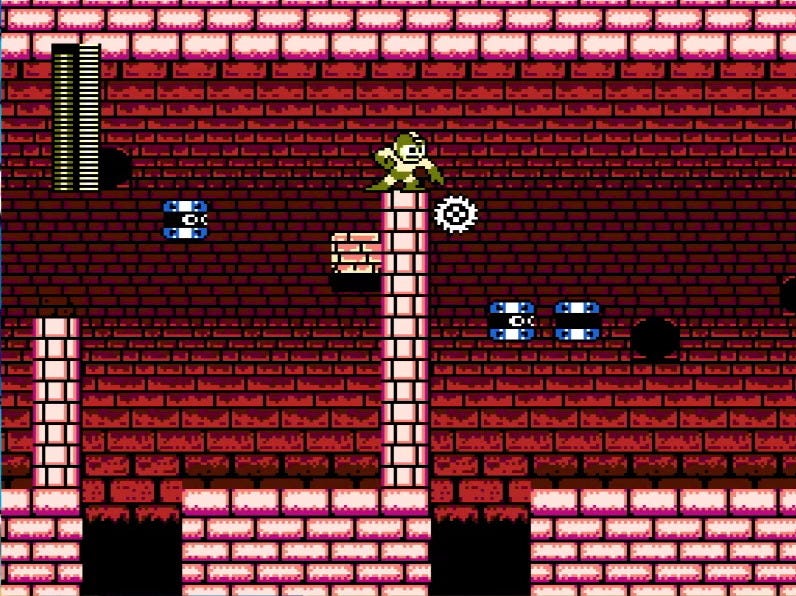
There is, of course, one other thing which makes Mega Man 2 a lot easier: the Metal Blade. It’s that certain weapon which I’ve saved for this paragraph since it well and truly deserves one all to itself. This weapon is an utter beast. It can be rapidly fired in all eight directions with higher damage per shot than the Mega Buster. If that wasn’t enough, the projectiles are fairly large and they’ll keep traveling right through destroyed enemies. You might be thinking that it’s a versatile option kept in check by limited ammunition, but you’re in for a surprise. The Metal Blade can be fired four times for each of your 28 ammo pips, resulting in 112 total blades! That’s probably enough to finish any level on its own, but I wouldn’t know since all the enemies you’re slicing apart with this thing have a chance to drop ammo refills that handily refund what you’ve used and then some.
Of course, one still has to earn the Metal Blade by defeating Metal Man. That’s no problem, really, since Metal Man is also possibly the easiest boss in the game. He takes double the usual damage from the default Mega Buster and has a simple, easily-avoided attack pattern. I think the developers really did intend for the Metal Blade to make the game easier, though they clearly went overboard. All of the game’s decision-making, from the order the player chooses their stages to the variety of weapons at their disposal, gets minimized and oversimplified thanks to the Metal Blade. Start the game with Metal Man, of course. Anytime you see a problem, just throw sawblades at it - unless said problem is immune to them. Thankfully, the franchise’s trademark system of boss weaknesses keeps the other weapons in the game somewhat, and a few of the more unique weapons find occasional uses in the regular stages as well. The game could have worse problems, especially since the Metal Blade is at least fun to use in a vacuum.
In fact, Mega Man 2 DOES have worse problems - NES-era kinds of problems. That’s right, readers; it’s time for another wonderful episode of…
Our first example of MegaJank this episode comes from outside of the game. We’re returning to the wonderful world of ‘80s video game box art! There’s nothing quite on the level of Mega Man’s disastrous US box art, but there’s still a lot of fun stuff to unpack here. Arranged here are the American, European, and German (yes, Germany did their own for some reason) box arts.
The US box is certainly an improvement this time around, but it still looks weirdly like a pulp sci-fi comic cover from the fifties. I think the artist mixed up which of the game’s two doctors is the evil one, because that sure looks like Dr. Light cowering behind Crash Man there. If you’re wondering why the artist - Marc Erickson, in this case - illustrated Mega Man here with a pistol instead of his arm cannon, it’s apparently because Capcom USA told him to. It’s like they really didn’t care if it looked accurate as long as it looked American.
As for the European art, it’s more of the sort of thing you expect from this era of box art. The protagonist is rendered with many liberties taken, and you can tell the artist actually had a few screenshots to look at with their takes on the more detailed enemies from the game. That floating grey head vexes me, though. I think it’s supposed to be like the big heads from Air Man’s stage, but why is it… like that?
Finally, we turn to the German box art. For some reason, this one matches the characters’ original designs very closely! It still looks pretty silly, though, mostly because Mega Man looks like he has no idea what’s going on and the Guts Tank is just floating in the air like an image dragged onto a PowerPoint slide. I also appreciate this one for continuing the tradition of Serious and Realistic Doctor Wily™ in the background just like the first game’s European art. It looks a lot more out of place here for the fact that the rest of the box doesn’t have that style at all.
Anyways, onto Mega Man 2 itself. The most blatant example of MegaJank in the whole game is the fourth Wily Castle boss, Boobeam Trap. First of all, it will never be anything less than profoundly insulting to die to something with a name that stupid. More importantly, this boss is a puzzle and you have absolutely no way of knowing it beforehand. Carefully observe the below image:
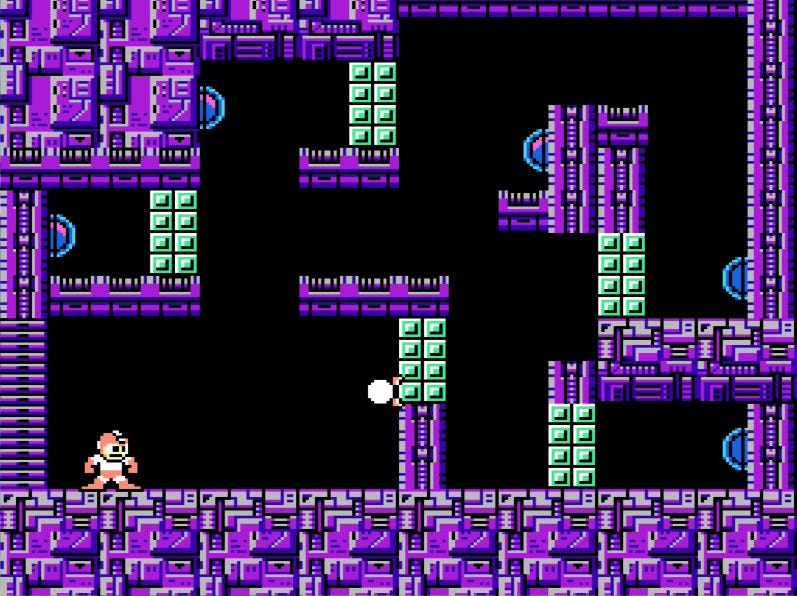
The boss itself is the five domes attached to the walls. Both the domes and the green blocks can only be destroyed using the Crash Bomber. With full ammo, the Crash Bomber can only be fired seven times; there are a total of ten targets onscreen, exactly seven of which must be destroyed to win. Once you know what to do, it’s easy, but anyone going in blind is going to have the exact same experience. Destroy the two walls right in front of you, try shooting the dome only to find you also need the Crash Bomber for it, and then run out of ammo because you’re supposed to go around that first wall with Item-1 instead of breaking it. Then you sit there in shame as the trap slowly fires enough shots at you to kill you. You might not even enter this boss with full Bomber ammo, and you’ll just be watching it kill you with no idea what to do! This is easily my least favorite boss in the entire Mega Man series just for how much of a cheap shot it is.
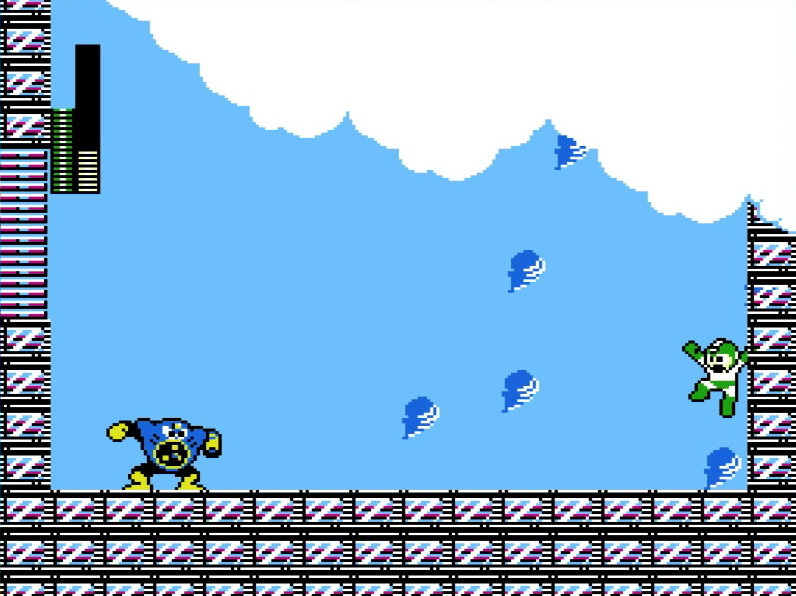
Boobeam Trap is just one of a few Mega Man 2 moments that show the series still had some growing to do. One of the disappearing block puzzles in Heat Man’s stage is almost as low of a blow. Normally, you’re meant to watch the pattern in which they appear before you try jumping between them. One of these puzzles continues over a pit, though, with the blocks appearing in consistent order such that the player can just jump from one to the other in a sort of rhythm. Once you’re finally comfortable with that rhythm, right before you hit solid ground again, a block appears right above your head to stuff your jump and doom you to a bottomless pit. Real classy. Some of the bosses also cover way too much of the screen with their attacks, making weaknesses a must. Finding the safe zones between Air Man’s tornadoes is really hard, for one. I also don’t think I’ve ever successfully jumped over Wood Man’s Leaf Shield attacks without hitting one of the leaves he drops from the ceiling.
Last but not least is a friendly example of MegaJank. The US version of Mega Man 2 bolted on an additional difficulty selection. Players can choose between “normal” and “difficult.” Despite the name, “normal” is the altered version where enemies have half as much HP and bosses take twice as much damage from your weapons. This of course doesn’t ease up any of the game’s most difficult and/or bullshit moments, such as very precise jumps or Boobeam Trap, but you will find your foes crumpling pretty quickly. Another silly bit of friendly MegaJank is Metal Man’s extreme weakness to his own Metal Blades. When you fight all the Robot Masters again in Wily’s Castle, you’ll find that you can cut Metal Man right down to size with just two of your 112 Metal Blades. Since he’s already so easy, this is mostly just for the bit. Combine that with the US normal mode, though, and you can literally just pack him up with a single blade.
Speaking of packing things up, that’s about all there is to say about Mega Man 2. Mega Man may have laid the groundwork, but Mega Man 2 was the one to really put all the pieces together for that perfect run-and-gun formula. It’s one of the most famous NES games ever, and Capcom will never pass up a good chance to reference this one inside and out of the franchise. That said, it was far from perfect. Mega Man 2 might be the most iconic, but I don’t think it’s really the best, even if we’re just counting the NES games. Still, it’s a classic and a palpable improvement over the original that proved just how good Mega Man could be.
No posts
Comments
Nothing yet. Say the first thing.
Sign in to join the conversation.