
Games have many economies. Currency economies, resource economies, progression economies, attention economies, social economies, time economies, content economies. And, of course, monetization economies.
But, underneath all of them, there is another economy that studios rarely model directly: Trust.
Players continuously decide whether they trust the game, its systems, other players, and the people operating it. They decide e.g., whether an offer is real, whether a probability is fair, whether their progress is safe, whether rules will remain understandable, whether a purchase will keep its value, whether another player can exploit them, and whether a failure will be handled properly.
Most studios treat these things as separate UX, community, customer-support, economy, or communication problems. I think that is too narrow.
Trust behaves much more like an economy:
It can be accumulated.
It can be spent.
It can be transferred.
It can be protected.
It can be concentrated around certain systems, features, people, and brands.
It can also collapse much faster than it was built.
And, when trust collapses, the damage doesn’t remain inside one feature. It spreads into progression, retention, regularity, social behavior, monetization, community sentiment, and the players’ willingness to invest more time into the game.
That’s why trust shouldn’t only be understood as a soft brand concept. It should be understood as economic infrastructure.
I would define trust in games as:
The player’s confidence that the game, its systems, its operators, and its participants will behave within understandable and reasonably fair expectations over time.
This doesn’t mean that everything needs to be generous. It doesn’t mean that players must always win, receive the best reward, avoid losses, or agree with every decision. A difficult game can be trusted. A highly monetized game can be trusted. A game with harsh loss systems can be trusted. Even a game built around deception between players can be trusted.
What matters is whether the player understands the contract.
An extraction shooter can say:
If you enter the raid, you may lose everything you carry.
That can be trusted if the rules are consistent.
A gacha system can say:
This reward is rare, these are the probabilities, and this protection guarantees an outcome within a defined number of attempts.
That can also be trusted if it works exactly as communicated.
A subscription can say:
You receive these benefits while active, renewal works like this, and cancellation changes these things.
Again, that can be trusted.
Trust is not the absence of friction, uncertainty, loss, scarcity, or monetization. Trust is confidence in the rules surrounding them.
And, once this confidence exists, players are more willing to make investments:
Time investments
Emotional investments
Social investments
Progression investments
Creative investments
Financial investments
Identity investments
This is why trust is kind of like an infrastructure. It supports almost every other form of value creation inside the game.
Traditional game economies have sources and sinks. Currency enters through rewards and exits through spending. Resources enter through production and exit through e.g., crafting, upgrades, losses, and maintenance.
Trust behaves similarly.
Trust sources can include:
Consistent rules
Clear probabilities
Stable pricing
Honest communication
Predictable progression
Fair compensation
Protection systems
Reliable customer support
Transparent changes
Secure player-to-player interactions
Delivery on promises
Respect for earlier player investment
etc.
Trust sinks can include:
Hidden changes
Misleading offers
Fake discounts
Unclear probabilities
Unexplained nerfs
Broken purchases
Unstable progression rules
Unaddressed exploits
Inconsistent moderation
Poor compensation
Sudden value destruction
Systems that punish players for believing what the game previously taught them
etc.
The difficult part is that these sources and sinks do not have equal weight.
A game may build trust through months of stable operation, then spend a large amount of it through one badly handled economy change. A studio may communicate honestly for years, then create doubt through e.g., one misleading monetization surface. A social system may work well for thousands of trades, then become distrusted because visible scams are left unresolved.
Trust accumulation is slow. Trust destruction can be immediate. This asymmetry is important because it means trust can’t be treated like a resource that is always easy to regenerate.
Some trust losses are recoverable. Others permanently change how players interpret the game.
Studios sometimes try to repair low trust with generosity. More rewards, better events, free currency, compensation gifts, larger bundles, and temporary discounts. These can help, but generosity isn’t the same thing as trust.
A game can be generous and still feel untrustworthy. If rewards change without explanation, offers use artificial urgency, progression is constantly rebalanced, and player investments are repeatedly devalued, generosity may only make the system feel temporarily less painful.
Predictability is usually more foundational.
Players want to understand:
What their actions produce
What an item is worth
How progression changes over time
What can be lost
What is protected
What a purchase includes
What happens after a mistake or failure
Whether the same rules apply tomorrow
This doesn’t require complete certainty. Games need surprise, tension, mystery, discovery, and changing conditions. But uncertainty should be designed. It shouldn’t feel like the rules themselves are unstable. A player can enjoy uncertain outcomes when they trust the outcome system. They struggle to enjoy outcomes when they are uncertain whether the system itself is honest.
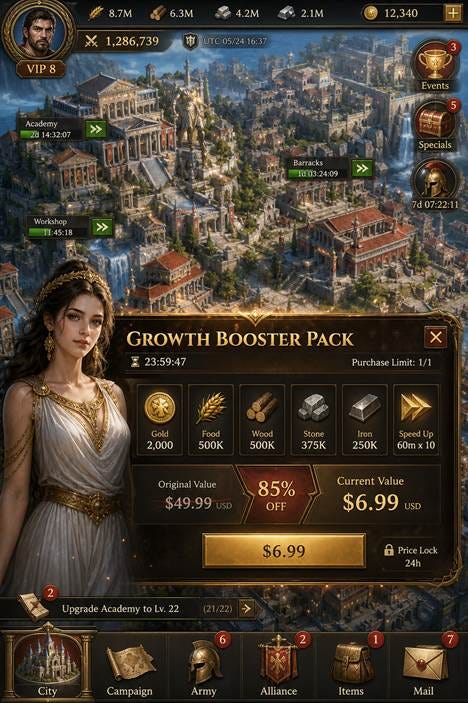
Mobile strategy example: a premium offer showing its contents, quantities, purchase limit, duration, and value structure directly inside the game.
Monetization is one of the clearest places where trust becomes economic. Every offer asks the player to believe something.
The player may need to believe that:
The price represents real value
The discount is genuine
The bundle contents are useful
The timer means what it says
The item will retain some relevance
The purchase will be delivered correctly
The offer is appropriate for their progression state
A better offer will not immediately make the purchase feel foolish
etc.
If these beliefs repeatedly prove correct, monetization becomes easier to understand. Players don’t need to re-evaluate the entire commercial relationship every time a store surface appears.
If these beliefs repeatedly prove wrong, every offer gains friction.
The player starts asking:
Is this actually discounted?
Will this be cheaper tomorrow?
Is the item about to be nerfed?
Does this bundle contain filler?
Am I being shown a different price because the game thinks I will pay more?
Will this purchase become obsolete next season?
That hesitation is trust friction. It may not appear directly e.g., in an economy dashboard, but it affects conversion, purchase frequency, long-term value perception, and willingness to consider new monetization formats.
Transparent monetization doesn’t mean removing commercial design. It means making commercial design legible.
This can include:
Exact bundle contents
Comparable quantities
Clear purchase limits
Honest discount references
Visible duration
Upgrade or duplicate handling
Refund and delivery expectations
Relevance to the player’s current progression
The strongest offer isn’t always the cheapest offer. Sometimes, it’s the offer the player can evaluate without suspicion.
Note: This connects directly with what I covered in article 73 about earning monetized value through gameplay, progression, regularity, mastery, and social engagement. An earned offer only feels valuable if the player trusts the conditions through which it was earned.
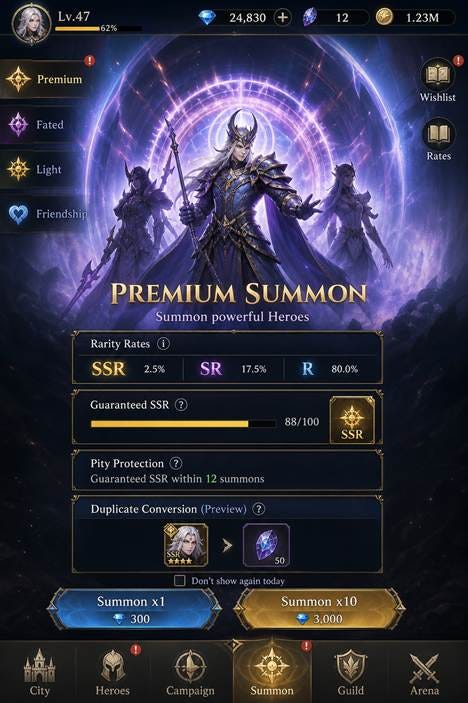
Mobile RPG example: visible rarity rates, guaranteed reward progression, pity protection, and duplicate conversion before spending.
Random reward systems aren’t automatically untrustworthy. Players often enjoy randomness. Randomness creates anticipation, stories, surprise, collection tension, and different progression paths.
The trust problem begins when randomness feels unreadable, selectively communicated, or structurally unfair.
There is a major difference between:
I didn’t receive the reward I wanted.
And:
I don’t trust how the game decided what I received.
The first can be part of the entertainment. The second damages the system itself.
Protection systems help because they make negative outcomes bounded.
Examples include:
Pity progression
Guaranteed rarity thresholds
Duplicate conversion
Bad-luck protection
Choice after repeated failures
Visible probability changes
Reward history
Previewed outcome pools
Confirmation before spending
etc.
These systems do more than improve expected value. They create trust boundaries.
The player may still experience disappointment, but they understand that disappointment can’t continue indefinitely or outside the communicated rules.
This is important because perceived fairness is not produced only by mathematical fairness. A mathematically correct system can still feel unfair if players cannot see, understand, or verify its logic. Visibility matters, memory matters, and protection matter. And, in many cases, actually the interface communicating probability is part of the economy itself.
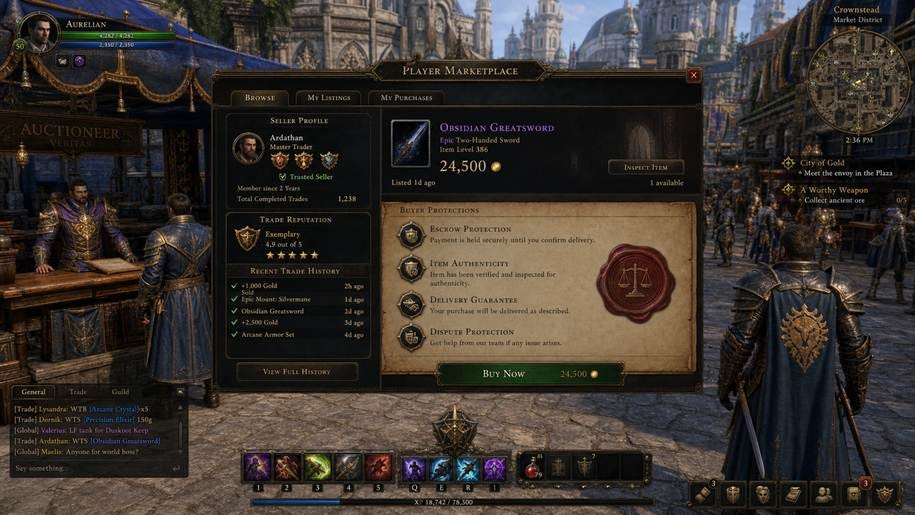
PC MMORPG example: seller reputation, trade history, escrow, item inspection, delivery guarantees, and dispute protection supporting a player marketplace.
Trust doesn’t exist only between the player and the studio. It also exists between players.
This becomes especially important in games with:
Trading
Auction houses
Guild treasuries
Crafting contracts
Player services
Carry systems
Resource lending
Shared progression
Creator marketplaces
User-generated content economies
Many games want rich player economies, but they underestimate how much economic activity depends on trust infrastructure. If players fear scams, manipulated prices, fake items, unreliable delivery, account theft, or unresolvable disputes, the economy becomes smaller than its theoretical design.
Players trade only with friends. They avoid high-value exchanges. They move activity into external communities. They create manual reputation systems outside the game. Or, they simply stop participating.
Games can support player trust through systems such as:
Escrow
Verified delivery
Item inspection
Trade history
Reputation signals
Role permissions
Transaction logs
Price histories
Limits for new accounts
Dispute handling
Reversible confirmation stages
The goal isn’t to remove every possibility of deception. In some games, deception is part of the fantasy.
The goal is to make the boundary clear.
If betrayal is intended gameplay, players should understand where betrayal is possible. If a marketplace is presented as secure infrastructure, security shouldn’t depend on the player detecting every trick manually.
That distinction protects both the fantasy and the economy.
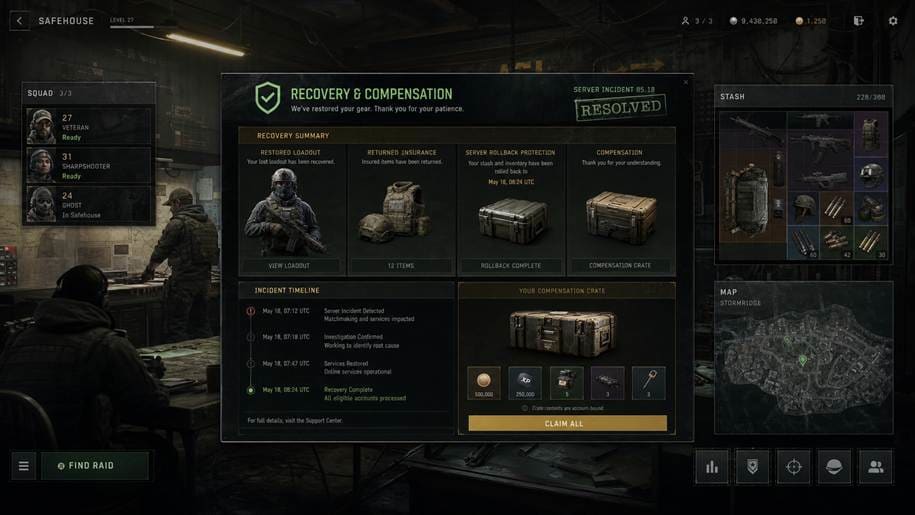
PC extraction shooter example: restored loadout, returned insurance, rollback protection, an incident timeline, and compensation after a service failure.
Games fail. Servers go down, items disappear, purchases are delayed events break, exploits damage economies, match results are lost, and/or progression is rolled back. Players lose resources through circumstances that weren’t part of the intended game.
The question isn’t whether every failure can be prevented. The question is what the game teaches players after failure happens.
Poorly handled failures teach:
Your investment isn’t safe, and the game may not protect it.
Well-handled failures teach:
The system failed, but the relationship still works.
This is why compensation is economy design, not only customer support. Compensation determines how much trust is returned after the game has consumed it through failure.
Good recovery can include:
Restoring the actual lost value
Returning insured or protected items
Explaining what happened
Showing the recovery timeline
Applying compensation consistently
Differentiating affected and unaffected players where appropriate
Protecting players from having to prove obvious system failures individually
Giving additional value when the disruption created meaningful opportunity cost
The amount matters, but the logic matters more. An arbitrary gift can feel disconnected from the loss. A recovery that clearly maps to what happened feels like the system understands the damage. Speed also matters.
Silence creates speculation. Speculation spreads distrust beyond the players directly affected. Once players believe that losses may not be recognized, they begin reducing future investment before another failure even happens.
The economy then suffers twice:
First from the incident.
Then from players protecting themselves against the next one.
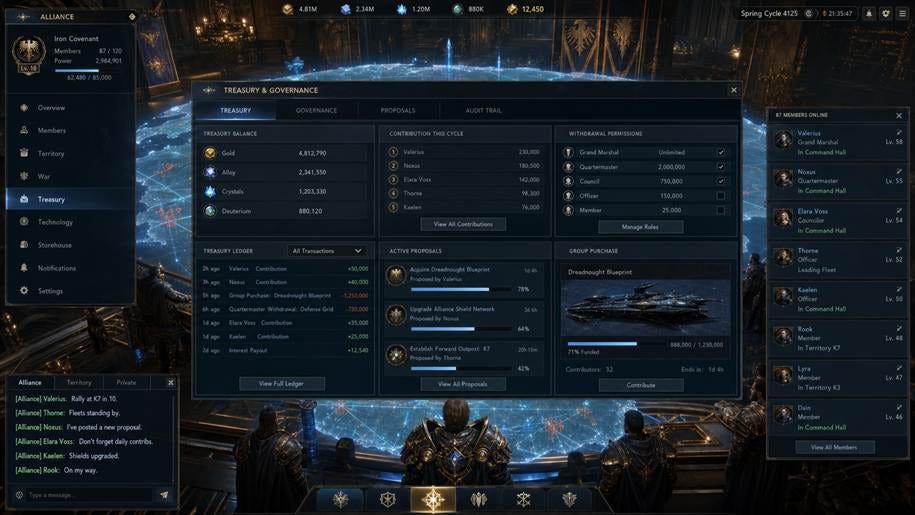
PC strategy example: visible contributions, treasury history, withdrawal permissions, proposals, voting, and safeguarded group purchases.
Social systems often ask players to share value before giving them enough tools to trust how that value is controlled. Guild members contribute currency, items, time, event progress, territory, crafting materials, strategic information, and social labor.
Yet, in many games, visibility and accountability remain surprisingly limited:
Who contributed?
Who withdrew?
Who changed permissions?
Who proposed the purchase?
Who benefits from the result?
Who can reverse a mistake?
When these questions are difficult to answer, social trust depends too heavily on personal relationships and external tools. That can work for small groups, but it scales poorly.
Social trust systems can include:
Contribution histories
Treasury ledgers
Role-based permissions
Withdrawal limits
Voting thresholds
Proposal systems
Audit trails
Shared purchase safeguards
Leadership succession rules
Recovery from inactive or abusive leadership
These systems may look administrative, but they create gameplay. They allow groups to take larger risks, pool more resources, plan further ahead, and build more meaningful shared ownership. Trust expands the scale of cooperation.
Without trust, players optimize around individual safety. With trust, they can create institutions. That is a major difference for e.g., guilds, alliances, clans, creator groups, and persistent social worlds.
Players also build expectations through progression. Every system teaches them what investment means.
If upgrading a character is consistently valuable, players trust upgrades. If collecting a category repeatedly leads to devaluation, players become cautious. If battle pass rewards retain relevance, players trust future passes more. If seasonal resets respect long-term investment, players are more willing to begin the next season. This means progression design has a trust memory.
Players remember:
What happened to earlier investments
Whether previous promises were kept
How often systems were replaced
Whether catch-up invalidated effort
Whether balance changes respected sunk resources
Whether endgame goals remained meaningful
Whether paid progression retained relevance
etc.
This is one reason why technically reasonable changes can still create negative reactions. The studio may evaluate the new system by its future performance. Players evaluate it through the history of what they already invested. Both views matter.
A progression change isn’t only a new mathematical model. It’s also a renegotiation of the relationship between the game and existing players. Live operations should treat it that way.
Strong games sometimes have enough accumulated trust to make difficult decisions. They can rebalance economies, remove exploits, change progression, increase prices, retire content, reduce overpowered rewards, delay features, reset systems, and ask players to accept temporary inconvenience for long-term health. This is trust being spent.
Players may not like the decision, but they are willing to believe that there’s a reasonable explanation behind it.
The danger begins when studios mistake this tolerance for unlimited permission. Trust isn’t a permanent entitlement. It can’t simply be converted into short-term revenue over and over again.
A studio may get away with one aggressive offer, one poor communication cycle, one underwhelming update, or one disruptive economy change because players still trust the broader relationship. But that doesn’t mean the decision was free. It may have consumed trust that was needed later.
This creates a hidden form of economic debt:
The dashboard may show successful revenue.
The community may show manageable sentiment.
Retention may not move immediately.
Yet, the player’s threshold for the next mistake has changed. That’s why short-term performance can hide long-term trust consumption.
Trust is difficult to reduce into one metric. That doesn’t mean it can’t be observed.
Possible trust signals include:
Offer hesitation and delayed conversion
Reduced willingness to pre-purchase
Lower participation in e.g., random reward systems
Increased refund behavior
Lower marketplace activity
More external price checking
Increased support contacts before purchases
Players holding resources instead of investing them
Declining guild contributions
Reduced adoption of new progression systems
Stronger negative response to small changes
Players waiting to see whether others are harmed first
etc.
These behaviors can look unrelated. Together, they may indicate that players are protecting themselves.
And self-protection is often what low trust looks like inside a game economy:
Players keep currency liquid.
They avoid long-term commitments.
They purchase only proven value.
They reduce social exposure.
They wait before adopting new systems.
They stop believing future promises until the results are visible.
This is economically rational behavior when trust is low.
Trust shouldn’t become another manipulative optimization surface.
The goal isn’t to manufacture the appearance of fairness while preserving hidden systems that work against the player.
There are several risks:
Trust theatre: showing badges, guarantees, or transparency language without meaningful protection
Selective transparency: revealing favorable information while hiding important conditions
Reputation abuse: allowing coordinated groups to manipulate trust signals
Overprotection: removing uncertainty, responsibility, or meaningful risk from gameplay
Inconsistent recovery: compensating visible groups while ignoring quieter affected players
Trust segmentation: giving clearer or fairer treatment only to high-value players
Communication inflation: explaining everything so often that important messages lose weight
Trust systems need to be real:
A guarantee should guarantee something.
A reputation signal should be difficult to manipulate.
A compensation process should recognize actual damage.
A transparent offer should provide information that helps the player make a decision, not only info that helps the game close the sale.
Otherwise, the trust layer becomes another trust sink.
Games ask players to invest continuously. They ask for time, attention, learning, emotion, relationships, identity, creativity, and money. The deeper the game becomes, the more of these investments begin to overlap. Trust is what allows the player to make those investments without evaluating every system as a potential threat.
When trust is high:
Players commit further into progression
Players participate more actively in economies
Players experiment with new systems
Players make longer-term purchases
Players cooperate with more people
Players tolerate reasonable uncertainty
Players recover from failures more easily
Players believe that future investment may still matter
When trust is low, the opposite happens:
Players become defensive.
They hoard.
They wait.
They avoid.
They reduce social and financial exposure.
They interpret ambiguity against the game because earlier experience taught them to do so.
That’s why trust should be designed, protected, monitored, and repaired like an economy. Not because trust should be monetized directly. But because almost every sustainable form of monetization depends on it.
The strongest games don’t simply convince players to spend. They create systems in which players feel safe investing more of themselves. And, in long-running games, that may be one of the most valuable economies of all.
Comments
Nothing yet. Say the first thing.
Sign in to join the conversation.