
ED. NOTE: This is a follow-up to my previous piece, I Hope Divinity Uses Even More AI. If you haven’t read that one, go ahead and read it first, because I really don’t feel like re-litigating its arguments here (and therefore I won’t, at least not for the most part). And yes, the comment rules from that piece still apply here.
“In my years fighting crime, I've learned one truth: that every villain is the hero of his own story.”
~Bruce Wayne, Injustice 2
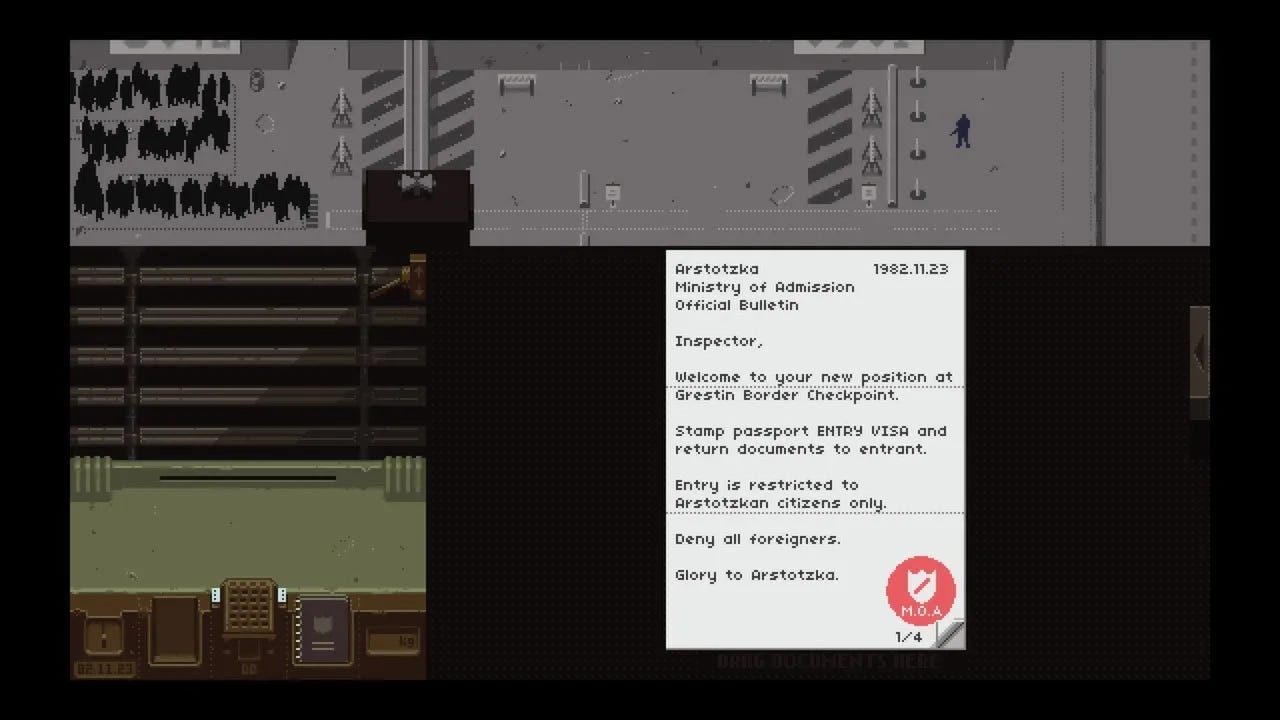
Papers, please!
If you’ve played Papers, Please (2013), then you already know the drill. You play as a border inspector in the glorious communist dystopia of Arstotzka, and your job is to check the documents of migrants, travelers, guest workers, and other passers-by.
Passport? Check.
Entry permit? Check.
Work pass? Check.
The rules change daily, while edge cases become… erm, edgier? (sorry) as the game progresses. And if you get it wrong? Well, that’s coming out of your family’s food budget, comrade.
And every so often, the game hands you a person whose papers are almost in order. So close, and yet so far… like a woman fleeing violence, whose permit expired yesterday. Or a man who weighs 2 kilos off from what his passport says, whether because the scale is broken, or because he’s literally starving, or simply because the state just keeps garbage records.
In each case, the stamp hovers in your hand:
APPROVED or DENIED.
Papers, Please is so evocative because it makes you feel, in that brilliant way that only a video game can pull off, what being the machine feels like. In case after case, you’ll reduce a living, breathing human being (not literally, I know… but really, your brain doesn’t know that! Mirror neurons, and all… remember those?) to a checklist of surface features, and in each case you’ll render a passionless verdict that could well radically alter their life. The tools you’ll use to pass these judgments are flawed… and you know they’re flawed. The rules that guide you and bind you while making these decisions are arbitrary… and oh yes, you damn well know they’re arbitrary… because you see, the regime that instituted those rules simply doesn’t care — AH! SORRY!! I meant to say, “the glorious regime cares for and protects us all!”
Ok, phew… that was close. Remember, comrade… cause no trouble.
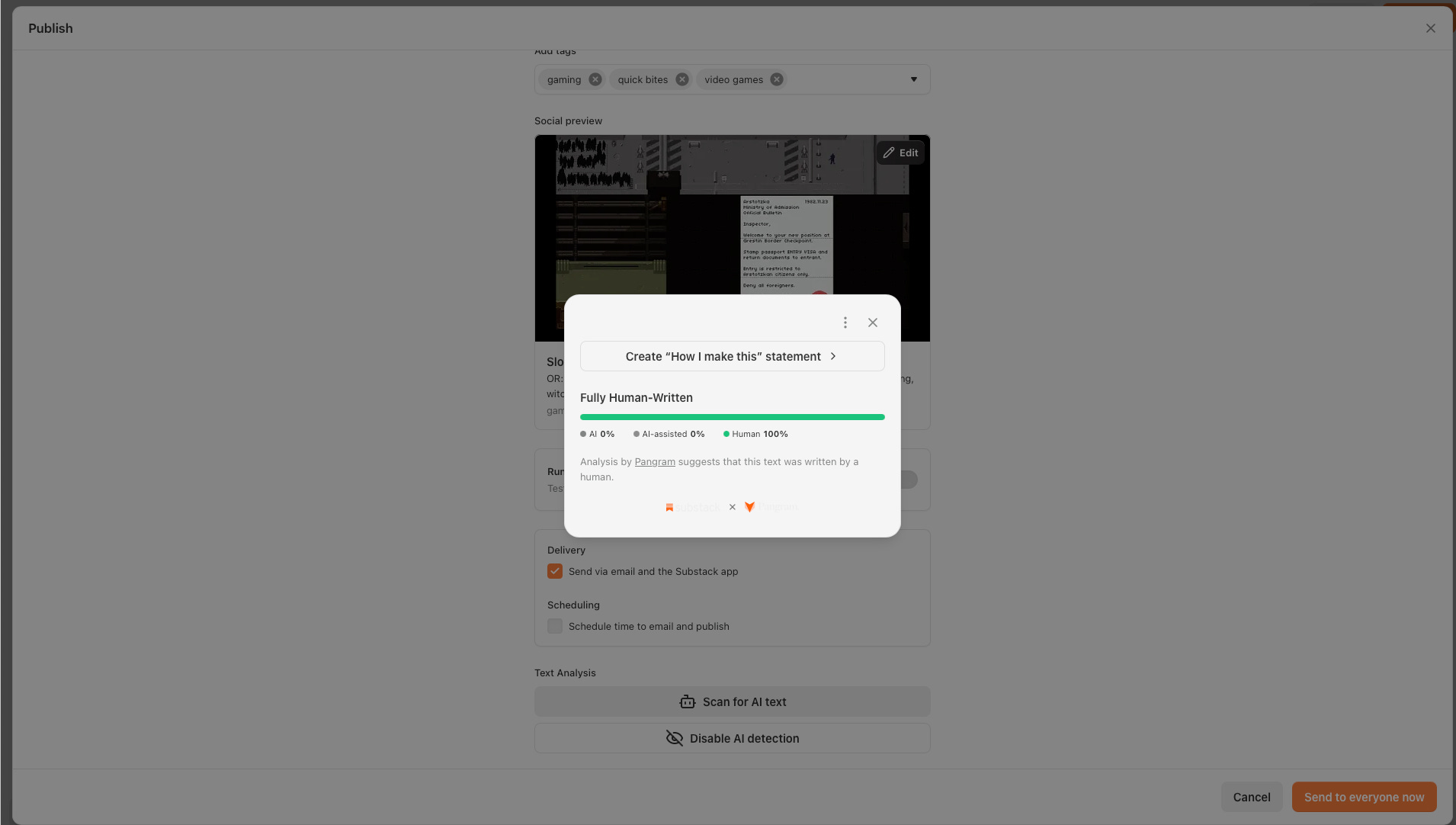
Anyway! On July 21st, Substack announced that it has integrated Pangram, an AI detection tool, directly into the platform. Now, any reader can scan any post, Note, reply, or comment over 100 words long and get an official-looking verdict on how much of it was “written by a human” versus “with AI assistance.”
This means, in plain English, that Substack has now decreed every reader a border inspector… and every writer now stands waiting at the checkpoint.
Glory to Arstotzka!
Let’s start by getting our facts in order, shall we? Before I flambé them to a crisp, that is. Because, you see, accuracy still matters (even when I’m furious), and believe it or not, I actually care about verifying claims before I weaponize them… unlike the people I’m about to spend several thousand words eviscerating.
So, what did Substack actually launch this week? Well, per their own announcement and help docs:
Readers can now scan posts, Notes, replies, and comments (as long as they’re over 100 words, and published on or after July 21, 2026) and get a Pangram-generated estimate of how much of it was written by a human vs. AI-assisted.
It’s live on web and iOS as we speak, with Android coming soon.
Writers get to make an optional “How I make this” statement to disclose their writing process and if/how AI fits into it.
Writers can pre-scan their own drafts, report detection errors, and even disable detection on their posts... in which case, readers simply see a message saying “AI detection unavailable” (more on this shortly).
Substack CEO Chris Best laid out his case for the whole thing in a post titled “Against Claudefishing”,1 framing it as a simple matter of reader expectations: basically, people should know what they’re getting when they click into an article. He acknowledged that no AI detector works perfectly, that not all AI writing constitutes “slop,” and that Substack itself uses AI internally for things like software and research. According to Best, the stated spirit of this tool is transparency, not prohibition.
And fair enough, it’s not like the entire thing is unreasonable (and don’t worry, I’ll circle back to the reasonable parts in a bit). After all, Substack didn’t ban anything. And it’s also not an auto-flagging system; it only scans an article when a reader requests it.
But.
BUT!
Nothing exists in a vacuum, and Substack sure as hell didn’t launch this feature into a vacuum! They launched it into a noxious and corrosive Discourse™️ that has spent the past year using Pangram screenshots as digital stocks with which to punish writers. In launching this integration, Substack has handed a loaded rhetorical rifle (and one that demonstrably fires sideways, no less) to the absolute worst people on this site, who’ve been relentlessly begging the institution for ammunition. Well, they got their wish, and now the institution has provided them ammo… and even stamped the company logo on the bullet casings! How thoughtful.
You say: “Oh, but you can opt out of it!” Uh huh… so tell me, genius: in the current climate on Substack (to say nothing of social media at large), what do you suppose the mob will conclude about a writer who opts out of the scan? What do you think will run through the accusers’ minds when they see that little “AI detection unavailable” message? That the writer values their privacy? That they’re objecting out of principle?
No! Where the hell have you been all year?! In the midst of this hellish moral panic that’s currently firing on all cylinders, opting out is a confession. I can already see the dunking screenshots writing themselves. If you can’t see them as well, you haven’t been paying attention. Seriously, can we please just be real for just a second?!
Substack built an inescapable scarlet letter: one that any reader can brand any creator with, and one in which its opt-out clause is also a scarlet letter. Somewhere, Kafka’s looking down with a sense of befuddled admiration.
Seriously… did NOBODY in that product meeting read The Crucible (1953)? Did we learn nothing from the last 15 years of living under the cancel mobs’ Reign of Terror across social media? Do they not know that accusation machines inevitably eat their builders in the end?
Apparently not… so, we might as well go through it all here. Yes, all of it… and I don’t think you’re gonna like it.
Now… Pangram, to its credit, IS the best AI detector currently on the market. Independent evaluations, for the most part, back this up; a University of Chicago Booth analysis found it was the only tool that could operate under a strict false-positive cap without sacrificing accuracy, which is kind of a big deal. The company claims a false positive rate of 1 in 10,000.
Oh my! One in ten thousand?! That sounds fantastic. It must be practically infallible!
Aaaaand stop right there. Because people these days are so embarrassingly innumerate, and this is the exact point where everyone’s intuition tends to break. So, let me show you why that number is still highly problematic… even if we take it completely at face value.2
TL;DR — Even a false positive rate that low still guarantees a steady supply of innocent casualties.
Princeton computer scientist Arvind Narayanan (the co-author of AI Snake Oil) ran the numbers in an education context: basically, if you take that 1-in-10,000 rate at face value, have every instructor scan every submission, and keep in mind that the average student submits roughly 500 to 1,000 written works across four years of college, what result would you get?
I’ll tell you: 5–10 percent of the entire student body would get falsely accused of cheating at some point in their college career.
That’s not a ding specific to Pangram, by the way. That’s simply what happens when you run any test, even an impressively accurate one, enough times. Statisticians call it the base rate problem. And gamers, actually, already understand it on an intuitie level; we just call it something else.
🎲❌😵 SIDE QUEST: The 95% That Misses
Every XCOM: Enemy Unknown (2012) player carries a very specific trauma: that of the 95% shot that misses. But… how does this even happen?! After all, you KNOW it’s 95%, because the game TOLD you it’s 95%. That’s almost a guaranteed hit, isn’t it? And yet, every player has a story. You know how it goes: your sniper stands on a roof, with height advantage, aiming at a Sectoid in the open… and your plasma bolt sails right past it, into the void… right before your best soldier dies and you rage quit right on back to your desktop (assuming you didn’t smash your keyboard through your monitor in the process).
Again, 95% sounds practically guaranteed… so why does this happen to everyone? Well, because you don’t take just one 95% shot! Across an entire campaign, you take thousands of them. A 5% miss chance, rolled thousands of times, isn’t a rare event at all… it becomes literally inevitable. The question is not if the crit-fail will ruin your Ironman run, but when.
Now, flip it: a 0.01% false positive rate sounds unassailable... until you realize that Substack hosts millions of posts, Notes, and comments over 100 words long. Every single one of those is now a die that any reader can roll, as many times as they like. It’d be one thing if a careful adjudicator ran the scan once. But instead, we’ve got the most suspicious, bored, jealous, and vindictive cohort on the entire site, running the scan endlessly against writers who have no idea they’re even at the checkpoint.
At that scale, false accusations are a mathematical certainty. They’re a drop table, and somebody’s pulling that item every single day. The only question is whose career it lands on at any given moment.
And that’s just when you run the math charitably, using the vendor’s own highly-polished and lab-controlled numbers. Once you get into the real world, the scan’s performance gets far messier. When Wall Street Journal columnist James Taranto tested Pangram on articles that a Pangram-affiliated study had flagged as AI-generated, the scan rendered a different verdict than the study did on two out of three articles, and the researchers’ own database disagreed with both results! So the same tool analyzed the same text, but rendered a different verdict. Why? Because fuck you, that’s why.
Taranto was even helpful enough to put his conclusion right there in the headline: Pangram is a “defamation machine.”
Independent research further confirms this instability: the same detector, analyzing the same text on different days, can classify it wildly differently. Furthermore, detector accuracy collapses by 25–50% when analyzing paraphrased, hybrid, or lightly edited text… in other words, the kind of text that most people produce when they use AI to supplement their writing process rather than replace it.
This is why NYU disabled Turnitin’s AI detection feature, by the way (as an instructor myself, I can personally attest that it’s uniquely terrible). Similarly, the University of Texas has prohibited all third-party AI detection software for evaluating student work, even warning faculty that they could be personally liable for damages if they bought their own. The list goes on, with Berkeley, Yale, Georgetown, Vanderbilt, Northwestern, and MIT having all reached similar conclusions.
Gee, this sure seems like quite a challenge to these AI detectors’ claims of reliability. Maybe even enough to call into question Substack’s decision to partner with them! So surely the AI detectors’ vendors have something to say in their defense, right?
WRONG!
As it turns out, the vendors fully agree with the universities that actively discourage their use! Turnitin’s own documentation says that educators shouldn’t use its tool as the sole basis for initiating adverse action against a student, while Originality.ai’s terms of service flat-out forbids using its output for anything with “a legal or material impact” on a person.
But perhaps most tellingly, even Pangram’s own technical report (co-authored by CEO Max Spero in February 2024) includes an “ethics” section that “strongly discourage[s]” using the classifier as a sole arbiter of academic integrity, on the grounds that ALL detection tools have a non-zero false positive rate and therefore should be used alongside other evidence.
Well, well, well… would ya look at that? It turns out that the institutions that employ actual adjudication processes, with actual appeals mechanisms, that would face actual legal exposure if things went sideways, took one look at these tools and said NOPE, these aren’t reliable enough to discipline a freshman over a term paper.
Substack, meanwhile, looked at these same tools and said Perfect! Let’s hand them to absolutely everyone with an axe to grind and a functional screenshot button!
So, coming back to our border checkpoint… do you know who really walks through it? Because I’ll tell you right now, it is emphatically not a random or balanced sample of humanity.
To start us off with: research published in Patterns back in 2023 found that AI detectors were systematically biased against non-native English speakers. In that study, widely-used AI detectors flagged the majority of essays written by real human TOEFL test-takers as having been machine-generated.
Now, detection tech has improved since then (and Pangram claims to have specifically addressed this), but the bias finding has since been replicated several times in multiple later studies. And when the American Association for Cancer Research screened its journal submissions with Pangram, one of its headline findings was that authors at non-English-speaking institutions were flagged for LLM use more than twice as often as everyone else!
Why? Because non-native speakers, quite reasonably, learn English from textbooks and other similarly more formal sources. As such, their prose tends to read as highly structured, grammatically careful, and decidedly… erm, regular (for lack of a better word). You know what else produces regular, structured, and grammatically careful prose?
Exactly.
And that same statistical shadow falls particularly hard on neurodivergent writers. Many of these writers have spent their entire lives being told their writing is “too formal,” or “too structured,” or too “oddly precise” (iykyk), and now they’re discovering that their prose patterns, the exact same ones they were once penalized for in school, are now being read as the fingerprints of a machine.
The shadow also falls on anyone who simply learned to write well, because (as I ranted about in Part 1) the “AI tells” that all the armchair detectives love to cite are just... what used to be the features and hallmarks of skilled prose! Things like em dashes and triads, or parallel structure, or even just vocabulary above a 6th-grade level. The models write that way because they were trained on good writing; ergo, when you punish those patterns, you punish craft itself.
So, let’s take stock of who’s really standing at the checkpoint:
An ESL immigrant pouring her heart into her first English-language newsletter, which she would not have had the courage to even write, much less put out into the world, in the pre-LLM era;
An autistic essayist, whose syntax people have always told him is “suspiciously” precise, who writes and publishes as a way to make sense of the world as he sees it;
A veteran stylist who’s been deploying em dashes, semicolons, and Oxford commas3 for decades before Sam Altman even had a LinkedIn profile.
These travelers’ papers will read as forged. DENIED.
(Also, isn’t it funny how much the anti-AI crusaders claim to champion minorities? Remember back in the 2010s era (and for some of them, even today!), how often they’d proclaim their “allyship” with immigrants, non-English speakers, and the disabled? Where’s their allyship now, I wonder? Gee, what a goddamned mystery! It’s almost as if it was all bullshit, and they were just using these people as props to inflate their own sense of moral superiority! But hold that thought for now, we’ll get to it soon enough.)
Meanwhile, who sails through the checkpoint? The actual bad actors. What, did you really think the content farm operators running a hundred sloppy newsletters through a Claude Max account just passively submit to scans? Oh, you sweet summer child… no. Not at all. My brother in Christ, they relentlessly iterate against the detector! They run “humanizer” tools on their slop and A/B test their way to a green “human-made” checkmark. Detection is an arms race, after all, and who wins arms races? The people who care the most about winning them: the cynics. The writer most likely to get flagged by a Pangram scan (and subsequently pilloried) is the casual and honest essayist who used Claude to tighten a paragraph and didn’t even think to launder the evidence afterwards.
So, congratulations, activists! You’ve built a machine that stamps DENIED on the refugee’s papers, while waving the smuggler through.
Furthermore, this creates a horrible incentive structure for everyone else. As I detailed last time, writers are already mutilating their own prose to dodge the accusations. I’m saddened to say that I’ve done this, too… I’ve all but abandoned em dashes, one of my favorite forms of punctuation (if you don’t believe me, go through the archive and see how many more em dashes you see in my pre-2022 articles than in any I’ve published this year). Other writers have flattened their vocabularies, or even gone so far as to deliberately insert typos into their published work! We’ve done everything from breaking up our triads to roughing up our transitions, deliberately sanding the polish off our work as if we were medieval villagers uglifying our daughters so the raiders pass them by.
I said it in Part 1, and it’s only gotten truer since then: the scolds have become the slop makers. These anti-AI crusaders are actively degrading the median quality of human writing, all in the name of defending it.
These people make me sick.
Oh, and I’m not done yet. For there’s one particular design detail I still haven’t touched on. It’s so insidious, it deserves its very own paragraph of contempt: this entire apparatus puts the burden of proof on the accused.
Here’s how that looks like in practice: it only takes one click to scan an article… but the process of rebutting the scan is a nightmarish labyrinth that the author has to navigate in a moment of acutely stressful career crisis. A reader spends just four seconds to generate an official-looking verdict… meanwhile, the writer spends days drafting statements, publishing version histories, and screenshotting their Google Docs edit logs, all to futilely attempt to prove a negative to an audience that has already made up its mind and already moved on. Just ask novelist Mia Ballard, whose publisher pulled her book Shy Girl this past March after a Pangram flag, precisely how fair and symmetrical that process really feels.
“Innocent until proven guilty” was, historically speaking, kind of a big deal. It used to be practically unheard of, and even today is very much the exception instead of the norm. We even fought some wars about it, back in the day! But now, it’s been quietly patched out… and the patch notes just say “transparency, yay!”
When I published Part 1, I braced myself for impact. I knew it would cause a stink and ruffle some feathers. And I do want to report on what happened afterwards. Let’s just say that the results were... clarifying, to say the least.
My readers were, almost uniformly, quite lovely and wonderful. Yes, including the ones who firmly disagreed with me! They gave thoughtful pushback and detailed the personal lines they’d drawn, all while displaying truly admirable levels of honesty, decorum, and self-awareness. There were many people who told me, in effect, “I hear your argument, but here’s where I land differently, and why.” It was a wonderful conversaion! I’ll certainly take that conversation every day of the week, and twice on patch day, over literally any other AI-related conversation I’ve had online. If that was you: thank you, truly. You’re quite literally why I write.
Also, if that was you, please understand: from this point forward, I’m NOT talking about you.
Because now, I want to talk about the interlopers. Those wretched drive-by discoursers and Notes-spamming moral entrepreneurs who either never read past the headline, or did but instead of presenting a proper rebuttal, resorted to name-calling and baseless ad hominems because they didn’t have a proper rebuttal and they knew it. Those folks are a different story altogether.
I watched, over the following weeks after publication, a small parade of nasty comments (which I had to ban people over) and thinly-veiled subtweets (sorry, sub-Notes) about my essay… and as recently as last week, I even saw one about my AI gamer tarot card project! I ignored most of them, but whenever I did engage, I did so directly, politely pointing out specific inconsistencies in these people’s arguments without letting them move the goalposts. And do you know what happened, almost every time, the moment it became clear I was not going to let the goalposts wander?
Blocked!
There were no rebuttals, nor concessions. Hell, I didn’t even get a good old-fashioned “lol ur full of shit bro.” All I got was the rhetorical equivalent of my opponent flipping the chessboard and storming out of the room. Which told me everything, really: it was never actually a debate with me, but a performance for their audience. I was merely a prop in someone else’s morality play… and when the prop started talking back, the scene got cut.
And good God almighty, the monologues in these morality plays are something to behold, just in and of themselves! Go ahead and read the anti-AI discourse on Notes right now (as always, I’ll wait), and be sure to count the pronouns. No, not the gendered pronouns (don’t you worry, that’s a debate I very gladly stay far away from), but the personal pronouns:
I don’t want to see this.
It’s important that I take a stand.
I will be blocking anyone who [X].
My feed.
My truth.
My boundaries.
My moral hygiene.
I…
My…
Me…
I Me Me My I My I Me Me My I Me Me I…
Notice what’s missing in all of that? Anyone else. Throughout literally hundreds of these declarations, I’ve almost never seen these people express a moment’s worth of genuine concern for the English learner or disabled writer trying to put her thoughts into the world using the tools available to her, or for the lifelong stylist who now has to strip-mine her own voice just to appease a faceless classifier. As always, the Discourse’s aperture never widens past the speaker’s own reflection. Narcissus would be very proud indeed.
As I argued back in Part 1: it’s all ego, and it’s all optics. It was always nothing but optics.
And now these same people (ie, the ones who were already posting screenshots of their personal Pangram dashboards, like a shitty Temu Van Helsing brandishing vials of Aquafina and calling it holy water) get to do it with a Substack logo in the corner of their frame. This platform has recklessly upgraded their moral cosplay to canon.
Also, I cannot be the only one who’s noticed this most exquisite contradiction:
They are detecting AI... with AI.
Pangram is a machine learning classifier… in other words, a neural network. It was trained on the same scraped text that these people constantly screech about being “stolen” from artists, and it runs on the same GPUs in the same data centers that burn the same watts and sip the same water and belch the same carbon into the atmosphere as every other model in the Great Satanic Server Farm of their worst nightmares.
That’s right: every gleeful “GOTCHA, 97% AI!!1!” screenshot is a product of the exact same technology that the screenshotter claims to be morally opposed to on a fundamental level. Aw geez, gang… how many gallons of water did that scan guzzle? Should we hold a vigil?4
If the moral cosplayers’ objection to AI was actually about energy, or labor, or uncompensated scraping, this would be an unbearable hypocrisy. But it isn’t unbearable to them, because their objection was never really about those things. Their objection is about purity; about whose hands touched the text. And fortunately for the crusaders, purity systems have never once in human history minded using the profane to hunt the profane. After all, the Inquisition employed torturers, and the drug war employs informants, so why wouldn’t the slop war employ a slop-detection model? The tools are always exempt from the purity laws whenever they’re wielded by the righteous. It’s practically a law of human nature!
And there’s an even deeper contradiction buried underneath all of this… and in fact, it’s so deep, I don’t even think the crusaders have noticed it at all!
Go ahead and read through the anti-AI canon again, all the insufferable essays and cringey manifestos and insipid Notes threads pulling 4k restacks… and tell me, what’s the single most repeated claim in the whole corpus?
Nope, it’s not the one about energy or water (that one probably doesn’t even register in the Top 5, to be honest… which once again proves that the whole argument was highly selective, to be wielded only when convenient). And no, it’s not even the one about training data, either. So… which is it?
I’ll tell you: it’s the one about atrophy, the warning that if you let the machine think for you, you will eventually forget how to think. You see, judgment is a muscle! And if you keep outsourcing your discernment to a statistical model, you’ll slowly stop being a person and start becoming a terminal shell.
And I agree with that, by the way! I mean it, sincerely. I think it’s the best argument the crusaders have, and if it were anybody else making it, I’d defend that argument without hesitation or equivocation.
So, in that spirit… can somebody please explain to me what a Pangram scan is?
Because from where I’m standing, a reader who scans a post instead of reading it has just performed what might be the purest act of cognitive outsourcing ever done on the internet today. They took the one question that actually, completely, and genuinely requires a human being (“Is there a mind on the other end of this sentence?”) and straight-up handed it to a neural network for adjudication. They didn’t read the article for voice. They didn’t sit with the thing and notice whether it moved them, bored them, changed them, or even just triggered their disgust reflex once they registered “SLOP! SLOP! SLOP!”
Instead, they asked an AI classifier to have that experience on their behalf, and even file a report so they’d have the receipts afterwards.
Notice how that’s the exact same muscle they’re admonishing everyone else to preserve. And look at how quickly they themselves let it go slack, all in the name of preserving it.
Oh, and it runs in both directions, too… which is how you truly know how bad the rot has gotten:
Scan comes back RED: Instant dopaminergic outrage, followed by a screenshot and ensuing condemnation. Actually consuming a single word of the actual post not required.
Scan comes back GREEN: Oh, sweet relief! Permission to enjoy it. Machine-certified authenticity… issued to a person who apparently could not determine, on their own, using their God-given cognitive faculties, whether the thing they’d already read was actually any good.
That last sentence, right there, might be the saddest one I’ve ever written. These people read something... they liked it... and then they needed an algorithm’s blessing to be allowed to have liked it.
Every critic worthy of the title, from Johnson and Hazlitt to Ebert and Kael, could tell you why a piece of writing failed. Whether it’s because a piece’s structure was flabby, or it borrowed its opinions, or simply had nothing at all to say, the point is that rendering that kind of verdict takes a certain cognitive skill set. You have to be able to read and to think, and have the nerve to be wrong in public, under your own name. By contrast, “97% AI” takes four seconds and never requires you to actually engage with the text!
The moral cosplayers spent the last two years warning writers that if you let the model draft, you’ll lose your voice.
But nobody thought to warn them that if you let the classifier judge, you’ll lose your taste.
Papers, please. Don’t tell me your story, just show me the stamp.
Somewhere along the way, I crossed a Rubicon on all this: I have come to believe that broadcasting one’s virtue is, in and of itself, an inherently unvirtuous act. As in, it’s not merely a neutral or harmless act, and it’s certainly more than just “cringe” — I’m now fully convinced that virtue signaling is actively corrosive to our collective moral landscape.
After all, real virtue is quiet, habitual, mostly invisible, and speaks for itself; it’s done because it’s right, not because it’s seen. Think about it: why is any performatively moral action called “virtue signaling,” rather than just “virtue”? Because the moment that performance becomes the point, virtue leaves the building, and it leaves behind a status ritual merely cosplaying as virtue. Real virtue is done for its own sake, not performed for the masses!
Every ethical and spiritual tradition worth its salt already figured this out millennia ago, by the way; it’s why almsgiving in secret always outranks almsgiving with trumpets, at least according to every religion that has opinions about alms (namely, all of them).
If any AI use genuinely violates your conscience, then oh boy do I have some good news for you today! Did you know that you ALREADY have a complete, dignified, and (most of all) highly effective remedy available to you RIGHT NOW, today, and for FREE? It’s simply: don’t subscribe to writers who use it! Hell, unsubscribe from me! Genuinely! The button’s right there; no hard feelings, may your feed be everything you want it to be (and I do mean that sincerely).
But what you DON’T get to do, and what no serious moral tradition has ever endorsed, is deputize yourself as an inquisitor over everyone else’s reading habits and then justify the ensuing struggle session by saying you’re just “protecting art.”
No. That’s not going to fly here, so don’t even try it. GTFO.
Oh, and while we’re on the topic of crossing Rubicons, here’s another one I’ve recently crossed: I’ve decided the phrase “AI slop” needs to die, and I intend to help euthanize it.
Not because slop isn’t real, mind you. Slop is extremely real, and I agree that it’s a big problem! I hate it as much as you do. Rather, I object to the “AI” modifier; the phrase “AI slop” basically Trojan Horses a subtle and insidious assumption: namely, that the slop comes from the AI, that the machine is the one authoring the badness. And that assumption is actually a huge part of why this discourse is so bent.
So, let’s ask a painfully obvious question that (somehow, incredibly) never seems to get asked these days: who the hell PROMPTS the AI? After all, slop does not autogenerate, and there is no server rack spontaneously emitting shitty listicles into the void; AI agents are not that capable yet.
No… behind every soulless AI-generated newsletter is a human being who decided the world needed another soulless newsletter. In other words, a person who consciously chose volume over craft; a living, breathing human with a name and face who looked at the sacred act of writing for another person, and saw only an arbitrage opportunity to exploit for clicks and profit. The model may be the shovel that got us into this hole, but a human is always the one who digs with it.
And we know slop is fundamentally a human product, because humans have been producing it, at industrial scale, for decades before the first transformer was ever even a footnote in some Google paper.
Tell me, dear reader… do you remember the pre-AI internet?
Like, do you truly remember it? The way it really was, without your nostalgia goggles on? Because I remember… oh, do I remember! I work in marketing, I’ll remind you —I have been in the field for 15 years. And I very clearly remember all the SEO sludge farms. I remember all the endless “10 Reasons You Won’t BELIEVE [X]” headlines plastered all over my feed by Macedonian content mills. I remember those insufferable recipe pages with 4,000 words of “memoir” (written for Google’s algorithm, not for any actual reader) before you got to the ingredients list. And last, but not least… I remember BuzzFeed at its imperial peak, a veritable slop empire, built entirely on human-authored slop, and fully staffed by human sloppers… all of them slopping by hand, the old way, so you could read your artisanal slop in your Facebook feed on your way to work each morning.5
So in the spirit of consistency (and surely the moral cosplayers love consistency!), I’d like to propose our next campaign:
If slop is the actual enemy, then let us be thorough! Let us launch the Great Crusade against human slop. Scan the archives! Flag the listicles! Demand disclosure statements from everyone who has ever written a “Top 10 Anime Betrayals” headline for a content farm! Retroactive scarlet letters for all BuzzFeed alumni! No amnesty for the SEO bloggers of 2014! GIVE NO QUARTER! Nothing less than the epistemic integrity of our information ecosystem is at stake here!
I’m being hyperbolic, obviously. (Obviously?) But let’s also be real here: you would never support that crusade. And you wanna know why? Because the moment we start judging human writing purely by whether or not it’s slop, we’d have to admit a most horrible and uncomfortable truth to ourselves: that a well-prompted Claude essay is, by any honest measure of both information and readability (may I suggest “insight per paragraph” as a suitably appropriate metric?), a much better read than the median content mill listicle ever was.
We’d have to admit that an essay’s provenance and its quality are two totally different axes! And deep down (way down, beneath the annoying performative layer, in that dark and quiet place where people are actually honest with themselves at 2 AM), even the moral cosplayers know they’d rather read Claude than BuzzFeed.
Oh, they know. You can tell they know by how furiously they avoid the comparison. I reckon a textbook example will pop up in the comments soon enough!
No… they’re not ready for it. We’re not ready for it. Jack Nicholson was right… we can’t handle the truth. So I’ll settle for simply restating the following truism:
Slop is, and has always been, a human sin. The machine just made it faster for us to sin. So judge the work, yes… and sure, judge the person who chose to make it so badly. Go right ahead. Just leave the shovel out of it.
Ok, I’m going to take off the flamethrower for a bit, because I’m nothing if not fair, and I fully recognize that there are legitimate concerns buried under all this performance. I covered some of them back in Part 1, but others, I didn’t have room for. So I might as well address them here!
One of the strongest anti-AI arguments, by a country mile, is the one involving training data. The frontier labs initially trained their models on oceans of scraped text and images: much of it copyrighted, some of it outright pirated, and essentially none of it compensated. So if you object to AI because your work was taken without your permission and without payment in order to build the machine that’s now competing with you? That is a real, material, and adjudicable grievance. You have every right to be pissed about it!
The state of play here is obviously in flux. The courts are actively working this out, and the best I can make of the early results is that… they’re kinda mixed, honestly. In 2025, a federal judge ruled that training on lawfully acquired books qualifies as fair use (even calling it “quintessentially transformative”… which I fully agree with! After all, if a kid learns to write by reading your novels, and then that kid becomes a bestselling novelist who sells more books than you, can you then sue him for copyright infringement?), while drawing a hard line at piracy; this distinction ended with Anthropic agreeing to a settlement reported at $1.5 billion over pirating training books. But other cases (against Meta, OpenAI, and others) are still ongoing, and the emerging licensing deal economy between publishers and labs continues to quickly grow and evolve every single day.
It’s all so dizzyingly hard to keep track of, and I have no idea where the legal doctrine will land; and by the way, nobody does, at least not yet. So anyone confidently referring to the whole thing as “theft” is either prematurely calling it, has insider information and can thus be sued for breaking some NDA, or is simply performing moral cosplay.
In any case, which venue is that whole fight taking place in? That’s right, the one it actually belongs in: the courts. Also: in legislatures, in licensing negotiations, and through collective bargaining agreements... in other words, in places with little things like… *checks notes* oh, right: discovery, evidence, damages, and appeals. These places are literally designed to transmute grievance into real remedy and actual relief.
And all that aside, the question about training data use (and compensation thereof) is ultimately a dispute between creators and billion-dollar AI labs, and believe it or not, I fully support pressuring those labs through things like law and policy! That is legitimate and necessary work. It has my full blessing.
But you wanna know what does absolutely nothing for that cause? Pangram-scanning a mid-tier Substack essayist and posting the glaring red percentage number for all the internet to see. Just… what the hell do you think you’re accomplishing with that?! The writer you just flagged didn’t scrape your novel! She doesn’t even have a licensing budget! Ruining her Tuesday transfers exactly $0 from Sam Altman’s bank account to any single, solitary starving artist.
What you’re doing, and all you’re doing, is just weaponizing the streetlight fallacy: the real dispute is hard and far away, meanwhile the essayist is soft and right there, so you direct the mob to swing at whatever it can reach and then have the cojones to call it “justice.”
And hey, while I’m in the process of conceding things in good faith…
Yes, wanting disclosure for AI use is eminently reasonable; in fact, some of my own (and always highly thoughtful) readers have expressed to me that they simply want to know what they’re engaging with so they can choose accordingly. And I respect that; certainly, if the choice is between a food label and a food ban, I’d pick the label any day of the week!
(That said, disclosure can only work in an environment where said disclosure doesn’t result in immediate social immolation… which the cosplayers have made clear as day that they do not actually want. Make no mistake, the cosplayers are pushing for a food label and a food ban, with all the warped incentives that materialize from pursuing both, and I believe this is entirely by design. Anyway, go ahead and read Part 1 for more on that.)
And yes, game developers’ anxiety is real too: the industry has shed tens of thousands of jobs over the past few years, and when GDC’s 2026 survey found that 52% of developers now think generative AI is harming the industry (up from just 18% two years prior), I can see where that’s coming from; namely, from people nervously watching executives eyeing their salaries (even though the real reason for these layoffs, in most cases, has nothing to do with AI and everything to do with AAA leadership’s major strategic misfires finally coming home to roost… but that said, I do understand where the fear is coming from).
And finally, Pangram itself, at the population level (ie, studying aggregate trends across things like ~250k news articles, or screening tens of thousands of journal submissions), really does do useful work. Aggregate inference is a legitimate science! It’s just that the math can’t support an individual accusation from the same tool.6
Anyway, all of that is real… but regardless, none of it justifies propping up the checkpoint.
Since this is nominally a gaming publication (o hai, welcome! we usually do video games through the lens of Jung and Kabbalah here), why don’t we check in real quick on how the crusade is faring in its original theater? Because wouldn’t you know, gaming (bless it) has been running the crusaders’ natural experiment for over a year now… and what good timing, the results are in!
Arc Raiders (2025) launched on October 30th to perhaps the most sustained AI controversy of any major release: Embark Studios openly used text-to-speech AI (trained on paid and consenting actors… not that it mattered one whit to the cosplayers) for ancillary voice lines, so of course the discourse ignited, right on schedule. Eurogamer gave it a 2/5 almost entirely over its AI voices, conspicuously alone against an 84 Metacritic spread, and as they always do, the crusaders started piling on and quote-tweeting each other’s quote-tweets, hoping to astroturf a consensus (or at least the appearance of one) against the game.
But it ultimately didn’t matter. Arc Raiders went on to sell 14 million copies by February, with analysts now estimating over 15 million copies sold and half a billion dollars in revenue, peaking at near a million concurrent players. It became publisher Nexon’s biggest launch in their entire history. So, to recap: the cosplayers kept up their crusade against this game for several months… only for the market to respond by shrugging so seismically hard it registered on the Richter scale.

(And before anyone tries to gotcha me here: yes, I know Embark then went back and re-recorded many of its AI lines with human actors, and yes, I know that CEO Patrick Söderlund even said, on the record, that “a real professional actor is better than AI.” But notice how that happened through normal product feedback, not through any moralist’s crusading ministry via quote-tweet. The studio used AI as scaffolding, then it shipped, listened to players, and upgraded to humans in the places where it most mattered… which you might recognize is the exact same outcomes-based framework that I suggested in Part 1, working exactly as designed.
There’s also the curious case of Neverness to Everness (2026), or NTE for short, which is actually the gaming AI kerfuffle where the crusaders had their BEST case… and still lost.
Hotta Studio launched its ambitious open-world anime gacha game (think GTA by way of Persona, with more gooner-coded character designs and an otter cheering you on) on April 29th to the tune of 35 million pre-registrations. Within days, players started circling billboards, posters, and background textures with that telltale “AI shimmer,” including a cutscene backdrop that looked an awful lot like Makoto Shinkai’s Weathering With You (2019). In response, Hotta confirmed that they only used AI tools on “only a small number” of background and environmental assets, not on the characters or stories, and named two specific pieces they were already in the process of reworking.7
But something quite curious happened next… instead of uniting behind the pitchforks, NTE’s community split, and then a sizeable chunk of said community turned their pitchforks back on the pitchfork brigade! The game’s defenders pointed out what should’ve been painfully obvious: that this game is the culmination of years of labor by hundreds of programmers, composers, writers, animators, and voice actors… and that flattening it all into “AI slop” because of some background billboards that accidentally slipped through the cracks is… kind of a slap in the face to everyone who made it! Others noted (quite dryly) that a truly soulless cash grab does not, typically, claw its way to the top of a market as cutthroat and brutal as the gaming scene in 2026.
An interesting cultural dimension also surfaced amidst this kerfuffle. Initially, the controversy had simply simmered quietly in Chinese and Japanese player forums; these players, by and large, treated the whole thing as a minor issue relating to poor asset quality. But then Western audiences got a hold of it, and sure enough it detonated. Asian players then grabbed their popcorn and watched the Western meltdown with palpable bemusement, as if they were observing the weather on another planet for the first time.
So, add that to my list of arguments against this whole stupid crusade: this crusade that you claim is some universal moral awakening is actually, as it turns out, region-locked. The anti-AI panic has a Western passport, and a Western demographic profile.8 It is NOT the collective conscience of gaming; it is merely a localized conscience, specifically that of one VERY loud slice of the anglophone internet, which (as it is wont to do) has mistaken its own deafening volume as a verdict on behalf of all of humanity (as I detailed in Part 1, this is far from the first time the moralizers have done this, and in fact it’s a highly recurring and predictable pattern of theirs).
So, what’s the verdict that actually came in? Well, despite this “controversy” and its attendant noise, NTE cleared $207 million in its first two months, (per publisher Perfect World’s July earnings disclosure), $14.8 million of that from Day One alone! The game made repeat appearances in the Top 5 of iOS’s highest-grossing apps, and even hit #1 on the Japanese PlayStation Store. The “boycott” achieved less than a blip… hell, it wasn’t even a rounding error, the equivalent of a fraction of a fraction of a drop of water against the big, vast ocean.
Now, it’s true that the developers reworked and re-shipped the assets in question anyway… but that’s because they listened to a legitimate player complaint, which they would’ve addressed anyway, regardless of whether any anime furry profile pictures had quote-tweeted invectives at them.9
I could go on... Remember Clair Obscur: Expedition 33 (2025)? The indie darling that swept last year’s Game Awards, winning nine trophies (including Game of the Year) despite the retroactive inquisition that was being conducted over some leftover placeholder texture? Yeah, turns out people didn’t care all that much about that, after all! Oh, and speaking of the Game Awards… how’s Divinity‘s hype train chugging along? I’ll tell you: it’s still going at full steam, Larian’s “cancellation” notwithstanding. We’re also at a point now where roughly 1 in 5 games released on Steam now disclose generative AI use (a ~700% increase in disclosures, all within a single year!)… and still, the sky stubbornly refuses to fall.
“But Jay,” you huff and puff at me as you blow the house down, “the surveys show that gamers hate AI!” And yeah, sure… some of them do show that. But what’s that quote again? The one about “lies, damned lies, and statistics”? Because yeah, it turns out the survey landscape you’re referring to actually constitutes a textbook example of how you can manufacture your own reality by playing fast and loose with statistical methodology!
Take, for instance, Quantic Foundry’s December 2025 survey, which found an absolutely brutal 85% negative sentiment towards GenAI... oh but wait, what’s this? Oh, right… in an opt-in survey, and one whose respondents skewed 90% PC and 74% “core” gamers, to boot. In other words, a poll that’s most likely to survey the extremely engaged and terminally online population that’s singlehandedly keeping this cursed Discourse alive.
Meanwhile, Circana’s PlayerPulse panel, built to actually represent US players more broadly, found in the same month that only 25% of players said they’d be less likely to buy a game over the developers’ AI use… while the majority were either “neutral” or “unsure.” And just in case the implications weren’t clear enough, Circana analyst Mat Piscatella went on to helpfully sum up this entire culture war, in just one sentence:
“A vocal minority is against genAI usage, while the majority of video game players don’t currently care that much either way.”
Similarly, a recent GameDiscoverCo survey of Steam users landed in the same place: roughly 69% either don’t mind AI disclosures, or are neutral about them. And then there’s BCG's late-2025 gaming report, which found that only 10% of adult gamers viewed AI-generated art/animation negatively, and just 5% felt that way about AI-generated NPC dialogue.
If you poll the mob, don’t be surprised when the mob renders a unanimous verdict. But if you poll the world, something remarkable happens: the mob turns out to be at most a quarter of it, furiously and loudly trying to psy-op a consensus into existence, one Twitter pile-on at a time.
So with that, I’ll take the opportunity to reiterate my main prediction from Part 1, only now with far more confidence and conviction:10
The moment a truly great AI-native game ships (and not just a tech demo, or the kind of generic slop you can currently find on Steam… I mean a real banger that could not have existed without these tools), this entire “debate” will evaporate.
And I mean, fully evaporate into thin air. It will go out not with a bang, but with a whimper, as uneventfully as one switches the lights off before going to bed.
If you look at the history of moral panics, you’ll recognize that this is the same arc that every technologically-driven moral panic has followed. Remember when CDs were going to kill music? ‘Member how confident everyone was that Photoshop would kill photography? Or that photography would kill portraiture (not that any of us were alive back then, but we can imagine)? Hey, wasn’t sampling supposed to have been the death knell of musicianship? Remember when computer animation was just a soulless and inferior imitation of hand-drawn animation… right up until Toy Story came out? Remember how quickly the “debate” died down after that?
And that’s the pattern, right there! Every single time, these moral-panicky arguments were defeated not by counter-arguments, but by hits. After all, the crowd always gravitates towards wherever the joy is (duh), and so eventually, but quite inevitably, the scolds are always left holding their picket signs outside an empty building, with nothing and nobody to wag their fingers at except the cold, empty void in front of them.
Unless, of course, the crusade ends the other way first… which brings us, at long last, to Salem and its (in)famous witch trials (I’m surprised it took me this long!).
So, here’s what they don’t teach you in the Sunday-school retelling of Salem: the trials didn’t end because the ignorant and superstitious villagers gradually discovered the Scientific Method. They ended fast, and for reasons that should make you very uncomfortable if you’re one of these crusading moral cosplayers salivating over the prospect of Pangramming all the Substackers that are more successful than you on your shit list.
At the end of the day, three things killed the Salem witch trials. I’ll now present them all to you, in escalating order:
First: the “evidence” collapsed under closer examination. The panic’s witchcraft convictions ran on “spectral evidence” — testimony that the accused’s spirit had somehow tormented the accuser. Now, if you’re smart, you’ll notice that this was quite intentionally unfalsifiable; after all, you cannot cross-examine a specter! When Increase Mather and other ministers finally pressed the point that the Devil could impersonate an innocent person’s shape, and in doing so rendered all this “evidence” worthless, the panic’s entire evidentiary engine seized up.
Mather’s formulation survives to this day as one of the greatest sentences ever uttered in the English language: better that ten suspected witches escape than one innocent person be condemned.
And all of this applies even if no witches are involved, because every moral panic runs on some flavor of spectral evidence: proof that the accused cannot examine, confront, or replicate. So, considering that definition… what is an AI-generation probability percentage, that changes depending on which day you run the scan, if not spectral evidence?
Second: people simply got sick of it. Panics are exhausting to sustain. The Satanic Panic of the 1980s ground itself to death in the McMartin preschool case, which (at the time) was the longest and most expensive criminal trial in American history. And yet, even after seven arduous years, said trial produced ZERO convictions. Why? Because there was nothing to convict anyone for. It’s that simple! The public watched the machinery of accusation churn and churn, year after year, chewing up innocent bystanders and ruining their lives while producing absolutely nothing in return, and the nation’s collective stomach finally turned.
People may not realize it, but fatigue is a highly underrated historical force and catalyst for change. It’s arguably what ended the wretched 2010s cancel era, as well! And I’d even bet real money that when a similar vibe shift finally hits the AI culture war, we’ll be showing receipts that we’re already accumulating right here and now; nobody likes being scolded, and every “97% AI” screenshot leveled at a beloved human writer will become a future exhibit in the backlash against the backlash.11
Third: the accusers flew too close to the sun. [If you’re a crusader, pay real close attention to this one, if you care at all about actually winning!] In Salem, accusations kept gradually climbing the social ladder until, by most historical accounts, they reached the wife of Governor William Phips himself. And Governor Phips, who up until that point had tolerated the unjust deaths of his powerless subjects with remarkable equanimity, suddenly rediscovered his skepticism (and rather impressively quickly!) once the mob’s finger pointed at his own household. Within weeks, he’d dissolved the special court and gutted all of its “spectral evidence.” The trials, at long last, were over.
But alas, it would not be the last such trial in our nation’s history. In 1954, we re-enacted the same script, practically beat-for-beat: Sen. Joseph McCarthy had spent years baselessly accusing people of communist espionage and subterfuge, gleefully and self-righteously destroying the lives and reputations of countless people he knew couldn’t fight back.12 And for a while, it worked great… right up until he accused the United States Army, that is.

You already know what happened next: you might remember seeing the televised hearings in your 8th-grade history class. You know… the ones that lay bare the rotten core of his moralized and weaponized cruelty to the entire nation, capped by Joseph Welch’s delightfully cutting admonishment (“Have you no sense of decency, sir, at long last?”), followed by a formal Senate censure by December of that year.
That panic had finally died down… and McCarthy himself died in disgrace only three years later, his name forever immortalized as a pejorative.
Whether it’s Salem or McCarthy, there’s a grimly consistent lesson in here for any would-be witch hunters: witch hunts end when the witch hunters accuse someone with the power and the will to bite back. And in our current AI-related panic, the mechanism for said biting back already has a name… courtesy of the Wall Street Journal‘s coverage of the Pangram wars, which I cited earlier in this piece: the defamation machine.
Somewhere out there, right now, exists a wealthy, well-lawyered, and highly-litigious author (or a publisher, or a studio, or a blogger, or a Substacker!) who is going to get publicly branded with one of Pangram’s inevitable false positives, and who will respond to the accusation… not with a sad and mealy-mouthed clarification thread, but with legal discovery.
And when a court of law makes some spiteful accuser produce, under oath, the scientific basis for their public claim that a specific human being’s specific words were actually made by a robot (or, to put it more clearly: when the accuser’s “receipts” turn out to be nothing more than probabilistic guesses from a tool whose own maker’s terms expressly discourage this exact type of use), that will be this panic’s “spectral evidence” moment. Whether in 1697, 1954, 1987, or 2026, the Court of Oyer and Terminer will adjourn very, very quickly.
So… there you have it. Those are the only two ways in which all of this can end. So go ahead and pick one of the two deaths available for your crusade: do you want a masterpiece to render it moot, or do you want it gutted by a lawsuit? Again, those are the only two options: it can end either by joy, or by consequences.
Which one is it gonna be? Because it’s ultimately up to you and your fellow crusaders. Personally, I’m rooting for joy… frankly, it’s a much better story, and nobody’s life has to get ruined in the third act. But make no mistake… I’d gladly settle for consequences.
Ok… I’ve spilled enough digital ink on this topic today, so let’s bring all of this home so we can finally get back to our regularly scheduled programming (speaking of which… new feature coming your way soon! If you haven’t subscribed yet, and I haven’t scared you off by now, be sure to subscribe so you don’t miss it.)
To the Substack Team (assuming anyone over there actually reads the little publications over in the small but vibrant gaming neighborhood that you still refuse to acknowledge): you do know you had options, right? Here are a few, just off the top of my head:
You could have fixed the Notes algorithm that constantly surfaces engagement-bait sludge and other foul varieties of slop (of both the human- and machine-authored varieties).
You could have invested in the anti-spam systems that your own announcement vaguely gestures at.
Hell, you could have even promoted the mute and block buttons… you know, those individual, quiet, dignified, and (most of all) effective curation tools that let every reader shape their own feed without deputizing them over anyone else’s.
But no… because that would’ve made too much sense, wouldn’t it?
Instead, you built a border checkpoint and handed out inspector badges to the most rabidly vindictive cohort stalking these pages. You may not have created the mob, granted… but you absolutely uniformed it. And I should point out that history has never once been kind to the people who did the uniforming.
And finally… to the moral cosplayers themselves (assuming you’re even still here), I have but one last, final question to ask you.
Your entire project is built on the concept of you being on “the right side of history.” It’s the phrase that powers your whole vindictive apparatus: be on the right side, shame the wrong side, and let the future vindicate your shaming.
Fine. Let’s take history seriously, then… and I mean actual history, like the kind with physical archives and the like.
So, what does history tell us about what happens after the witch hunt? Simple: where there once was a hunt, there now becomes a reckoning. And it’s not at all fun for the former hunters.
In 1697, Samuel Sewall, the only Salem judge to publicly repent for his role in the trials, stood humbled before his congregation while a minister read his confession of guilt aloud. The jurors, meanwhile, had signed a declaration begging for forgiveness, admitting that they’d convicted innocent people on evidence that they now understood was worthless. This would all mark the beginning of a long and arduous process of atonement; Massachusetts would spend the next three centuries formally exonerating the trials’ victims, one by one. The last of them, Elizabeth Johnson Jr., was finally cleared in 2022 (a crisp 329 years after her conviction) and that’s only because a local 8th-grade civics class took up her case.13
Again… 329 years later, and we are still apologizing for Salem. Nobody remembers the accusers’ righteousness. Nobody remembers how certain they felt in their righteousness, how good that certainty must have tasted, how completely their community validated their finger-wagging in the moment. We remember one thing, and only one thing, about them: that they were wrong, and that people burned for it.
Remember, the path to hell is paved with good intentions. Nobody thinks that what they’re doing is ever wrong in the moment. Some of history’s worst atrocities were carried out by people who thought they were the good guys, fully confident in their conviction that inflicting such horror was the moral and righteous thing to do. And even on a less grand scale… when two neighbors beef with each other, does either of them ever stop to think that maybe they’re the one in the wrong?
So yes, I know you think you’re being moral and righteous by pushing for and siccing these scans on writers. And that’s exactly all the more reason to pay attention so what I’m about to say, and really reflect on what you’re doing.
Anyway, I’ve rambled and danced around it long enough, so at long last, here is my question for you… and I’ll even do you the courtesy of asking it straight. Because believe it or not, and in spite of everything you’ve just read… underneath everything, I think some of you actually do care (and caring is the one thing I refuse to give up on):
If being on the right side of history matters to you as much as you say it does... doesn’t it worry you, even a little bit, that history has NEVER once sided with the accusers?
Just some food for thought. Anyway, the stamp is in your hand, comrade: APPROVED or DENIED.
Which will it be? Choose like someone’s watching from three centuries out.
Because they are.
~Jay
“Beware that, when fighting monsters, you yourself do not become a monster... for when you gaze long into the abyss, the abyss gazes also into you.”
~Friedrich W. Nietzsche
Yes, they coined a brand-new term! “Claudefishing (n.): the gap between a reader assuming a human wrote something, and the reality that one didn’t.”
As a portmanteau, it’s actually not bad! But as a policy rationale? Well... keep reading.
Which you really shouldn’t… and also, isn’t it funny how quickly these people, who are (rightly) skeptical of taking what any company claims at face value and are highly vocal about their skepticism, suddenly check their skepticism at the door so they can uncritically cite Pangram’s self-declared false positive rate?
I will never forgive these shitbags for ruining the Oxford comma…
Before someone rushes to the comments… yes, I know a single inference is, from an environmental standpoint, utterly insignificant. But that’s precisely my point! It was insignificant when you did it, it was insignificant when I did it, it was insignificant when the ESL learner did it… and the fact that the water argument only ever activates in one direction proves it was never really about the water in the first place.
Now, a moment of respect for all the human slop artisans put out of work by AI. Because whatever else you may say about them, they had hustle, and I respect the hustle. They churned out endless inane “Which Potato Are You?” quizzes day after day, with their bare hands, uphill both ways, in the snow. Game recognizes game.
And yes, full disclosure, as always: I co-founded an AI game studio. It failed, for all the boring reasons I detailed back in Part 1. So no, I’m not a neutral observer here. And neither is anybody writing about this, by the way; I’m just the only one telling you upfront.
And look, there is quite a bit of messiness here that goes beyond the mere fact of AI use. VTuber Ironmouse cancelled a sponsored NTE stream and cut ties with Hotta, claiming they’d told her team that the game had “literally no AI in it” (a voice actor also threatened to walk over the revelation). Now, if her account is accurate (Hotta has not confirmed or denied Ironmouse’s retelling of these events), then that’s really not cool; it means that Hotta basically misled one of their partners into lending her reputation to their game under false pretenses. She had every right to be furious about that!
This is a good illustration of what I was getting at with labeling earlier; wanting disclosure is a legitimate grievance, and it’s completely different from the crusaders’ usual “REEEE, AI TOUCHED THIS, THEREFORE UNCLEAN!!!1!!”
This should also disconcert the crusaders for purely strategic reasons: as I’ve detailed many times before, China is ascendant as a gaming power, and is on track to eclipse the West in both development capacity and market size (ie, purchasing power). Soon, they will set the terms and the norms for the global games industry at large. Which is bad news for anyone who cares about stopping AI adoption.
Really, do you think China cares about AI “harms”? Do you think Xi Jinping is concerned more about labor, art, or the environment than maintaining China’s dominance? Are Chinese studios losing sleep over whether their AI placeholder textures are feeding a machine that will replace artists and voice actors? If your answer to any of those questions was anything other than “no,” “absolutely not,” or “lol, lmao even”, then we’re done here. You are clearly not a serious person, and are therefore not worth engaging with.
Even if you were right about all the moral arguments, it ultimately doesn’t matter because China would still render the whole debate moot, because they are rising to the top, purely by dint of size and numbers (though also aided, in no small part, by Western AAA’s stubborn refusal to listen to its players), and once they’re on top, where they go, the rest of the industry will follow. And China sees AI as a tool to use, not a job/environment killer or “plagiarism machine.”
Mauld out all you want, but you know this is true. Deep down inside, you know. So you might as well face the truth, and start preparing for it. Deal with reality, or reality will deal with you.
(Also, if you play a Chinese game, chances are very high that AI was used at some point in making it. Frankly, I wasn’t surprised at all to find out NTE had used it! So if you feel AI = instant boycott, then just go ahead and internalize that heuristic right now, and avoid any games coming out of China. Trust me, it’ll make things much easier on your mind. You’re welcome, by the way.)
Now, it’s worth noting this, since we’ve already touched on my outcomes-based framework: Hotta named the two flagged pieces, and committed to reworking them within days. Good work! Now, whether they follow through on the rest is, in my view, a fair thing to watch. That’s called accountability — like, actual accountability, not the social media struggle sessions the crusaders love to call “accountability.” The two are nothing alike: the former is specific, it’s actionable, and most crucially, it ends.
Man, I really should learn how to set up those Polymarket thingies so I can actually take bets on these things. If anybody wants to take me up on this, let me know!
Again, DM me if you want to help me set one up! Yes, I know I could ask AI, but sometimes, I do prefer asking a human. I’m sure you of all people can understand this, dear reader :)
Arthur Miller wrote The Crucible (1953) as a thinly-veiled allegory for McCarthyism, right at the moment McCarthy’s own witch trials were reaching a fever pitch. Tellingly, he set the play during the Salem Witch Trials… that’s how on-the-nose the resemblance was! The parallels between the two events could not have been more obvious to any but the most unattentive observers.
Let the record show that the moral cleanup crew for one of history’s most infamous moral panics was, in the end, a group of middle schoolers quite literally doing their homework… quietly, for its own sake, on behalf of a woman who could never thank them, and in front of no audience at all.
That’s what “the right side of history” actually looks like, in case you were wondering.
Comments
Nothing yet. Say the first thing.
Sign in to join the conversation.