


Publisher: Jay Rooney
Author, Graphics, Research: Jay Rooney
Logo: Jarnest Media
Summary & Housekeeping
Feature: “No Such Thing as a Free Lich” (~47 minute read)
Food for Talk: Discussion Prompts
Further Reading
Game & Word-of-Mouth
Footnotes
Picture the following scene, dear reader.
It’s 11:47 PM on a Tuesday. You’re hunched over your controller in front of your TV’s blue glow, and you have just (very casually, between sips of an off-brand energy drink) raised an army of the dead. Skeletal warriors claw their way out of the frozen dirt at your command, ready to do thy bidding. Somewhere, an ancient seal has been broken... somewhere, a horror that predates language itself has learned your name.
You then pause the game and go make a sandwich.
But no candles gutter out in your kitchen. Nor do any whispers coil up through the floorboards. Your reflection stays put in the microwave door, obediently mimicking your movements and showing precisely zero interest in becoming you. You have committed the gravest transgression in the entire occult canon, the sin that got actual, real, flesh-and-blood people shunned, burned, banished, flayed, and buried at unmarked crossroads for the better part of recorded history… and the universe’s grand cosmic response to your profane meddling with the sacred forces of life and death is…
Nothing.
Anyway, mustard or mayo?
Now, compare your evening to that of an actual historical practitioner of the ominously-named “dark arts.” Before so much as even addressing a spirit, the medieval necromancer fasted, purified, and drew elaborate protective circles, because the assumption going in was that the entities he was calling would absolutely eat him and his soul for breakfast if given a quarter of a chance. Similarly, the classical Greek petitioner scratching a curse into a lead tablet did so in the dead of night, in the middle of a graveyard, with the full understanding that he was taking out a loan from the gods of the dead… the kind of lenders who always collect, and had an eternity to do so. Just like how thousands of years later, the Renaissance magus triple-checked his sigils in much the same way you’d triple-check a parachute before leaping out of the skydiving plane.
You get the idea. They had to draw protective circles... but you get a respawn.
And that gap, between the ritual terror of the real thing and the breezy convenience of the digital facsimile, is what we’re exploring in today’s issue. Because it turns out that the difference between ye olde necromancy of olde and the Dead Thrall spell in Skyrim isn’t really about belief. Nor does it involve graphics, or whether the necromancer or the game developer had better taste in ambient lighting.
Believe it or not, it’s actually about money! Or rather: it’s about who pays, what they pay, and whether the bill ever arrives at all.
So finish drawing those magical circles and perform your banishing incantations, folks. It’s going to be a wild ride!
~Jay
ICYMI, I recently launched a sister publication, Spawn Point Marketing, that serves as a companion newsletter to my brand-new games marketing consultancy of the same name.
Subscribe for weekly game marketing tips, analysis, and case studies for indie and AA game developers who need to successfully market and their game in an increasingly crowded marketplace, but lack the expertise to do so or the budget for a full marketing team (oh, and all my industry analysis will live there going forward, so if you enjoy those pieces, subscribe to SPM for those as well; going forward, Game & Word will exclusively be about the games themselves):
I also, through Spawn Point Marketing, offer fractional marketing leadership services to indie and AA game studios. To learn more about the services I offer, or to book a free consultation, visit https://spawnpointmarketing.com or click the button below:
Game & Word’s most recent issues (currently, all of Volume 5) are available to all, free of charge.
Older issues are currently archived and only accessible to paid subscribers. To access the full archive, upgrade to a paid subscription:
Volume 1 (The Name of the Game): Issue 1 ● Issue 2 ● Issue 3 ● Issue 4
Volume 2 (Yo Ho Ho, It’s a Gamer’s Life for Me): Issue 1 ● Issue 2 ● Issue 3● Bonus 1 ● Issue 4 ● Issue 5 ● Issue 6 ● Issue 7 ● Bonus 2 ● Issue 8 ● Bonus 3
Volume 3 (Game Over Matter): Intro ● Issue 1 ● Issue 2 ● Issue 3 ● Podcast 1 ● Issue 4 ● Video Podcast 1 ● Bonus 1 ● Issue 5 ● Podcast 2 ● Issue 6 ● Issue 7 ● Issue 8 ● Issue 9 ● Podcast 3 ● Bonus 2
Volume 4 (Tempus Ludos): Intro ● Issue 1 ● Video Podcast 1 ● Video Podcast 2 ● Issue 2 ● Issue 3 ● Issue 4 ● Issue 5 ● Podcast 1 ● Issue 6 ● Issue 7 ● Issue 8 ● Issue 9 ● Issue 10
Volume 5 (AbraCODEabra!): Intro ● Issue 1 ● Issue 2 ● Issue 3 ● Issue 4 ● Issue 5 ● Issue 6 ● Issue 7 ● Issue 8 ● Issue 9 ● Issue 10 ● Issue 11
🚨🚨🚨 SPOILER ALERT 🚨🚨🚨
This post contains story and ending SPOILERS for Elden Ring (specifically THAT ending… you know the one), mild mechanical and atmospheric spoilers for Bloodborne, light spoilers for Dragon Age: Origins, slight mechanical spoilers for Cultist Simulator, and more significant narrative and lore spoilers for Wyll’s companion arc in Baldur’s Gate 3. Oh, and also some spoilers for The Elder Scrolls V: Skyrim. But let’s be real here… that game is fifteen years old; if I spoil Skyrim for you, that’s between you and your deity of choice.
⚠️⚠️⚠️ CONTENT ADVISORY ⚠️⚠️⚠️
The usual house rules apply. This article discusses occultism, necromancy, curses, blood rites, and other forbidden arts, treated (as always) academically and with respect but without endorsement or counter-endorsement.
Game & Word makes zero claims on the veracity (or lack thereof) of any belief or practice discussed herein. If the mere mention of these topics has you reaching for the garlic and holy water (or, alternately, your Notion doc full of copy-pastable Richard Dawkins quotes), this one’s probably not for you.
Also (and I shouldn’t have to say this, but alas the internet is the internet) please do not attempt any of the historical practices described below. Not because I’m certain they work, but because I’m not certain they don’t work… and unlike the games we’ll be discussing, reality has no known respawn mechanic.
💡💡💡 POINT OF CLARIFICATION 💡💡💡
To more easily distinguish between “stage” magic and “for realsies” magic, some practitioners spell the latter with a “k” at the end, as “magick.” I prefer to spell it as just “magic.” So if you’re used to spelling it as “magick” or are unclear if I’m referring to the stage or supernatural variety, remember that I’m talking about the latter, unless otherwise noted.
🔥🔥🔥 ETHICS CLAUSE 🔥🔥🔥🔥
Way back in Issue 5.0, at the start of this Volume, we settled the ethics question that will undoubtedly lurk in the shadows of this piece like a feisty imp: magic is a technology, morally neutral in itself, with the magician’s intent and spell’s application deciding whether any given working lands on the Right-Hand or Left-Hand side of the ledger. I’m not going to relitigate any of that today, so if you’re new here and itching to debate whether the dark arts are Actually Evil™, maybe go read that issue first.
Because today, we’re not asking whether the forbidden arts are evil, but why they’re forbidden. And, dear reader, we’re going to quite literally follow the money, because it’s not for the reasons you’re imagining!
So if you don’t think you’ll like the implications, this is your off-ramp. No judgment, see you next time (or not… entirely up to you).
🚫🚫🚫 DON’T BE A MORAL COSPLAYER 🚫🚫🚫
Oh, and this piece uses a couple of AI images. If you have a problem with that, I REALLY don’t want to hear it; the unsubscribe button is right there, just go ahead and use it if this is that big of a deal to you. No hard feelings, it’s not me it’s you, etc… but if you start sounding off about it, that’s an instant permaban. Moral grandstanding is not welcome here.
Constructive criticism and debate, on the other hand, is always welcome… but when AI is the topic, that always seems to go right out the window. So I’m disallowing it right off the bat; don’t want to deal with it here.
(Click here to read my full position on AI and the surrounding “discourse,” if for some reason you’re so inclined.)
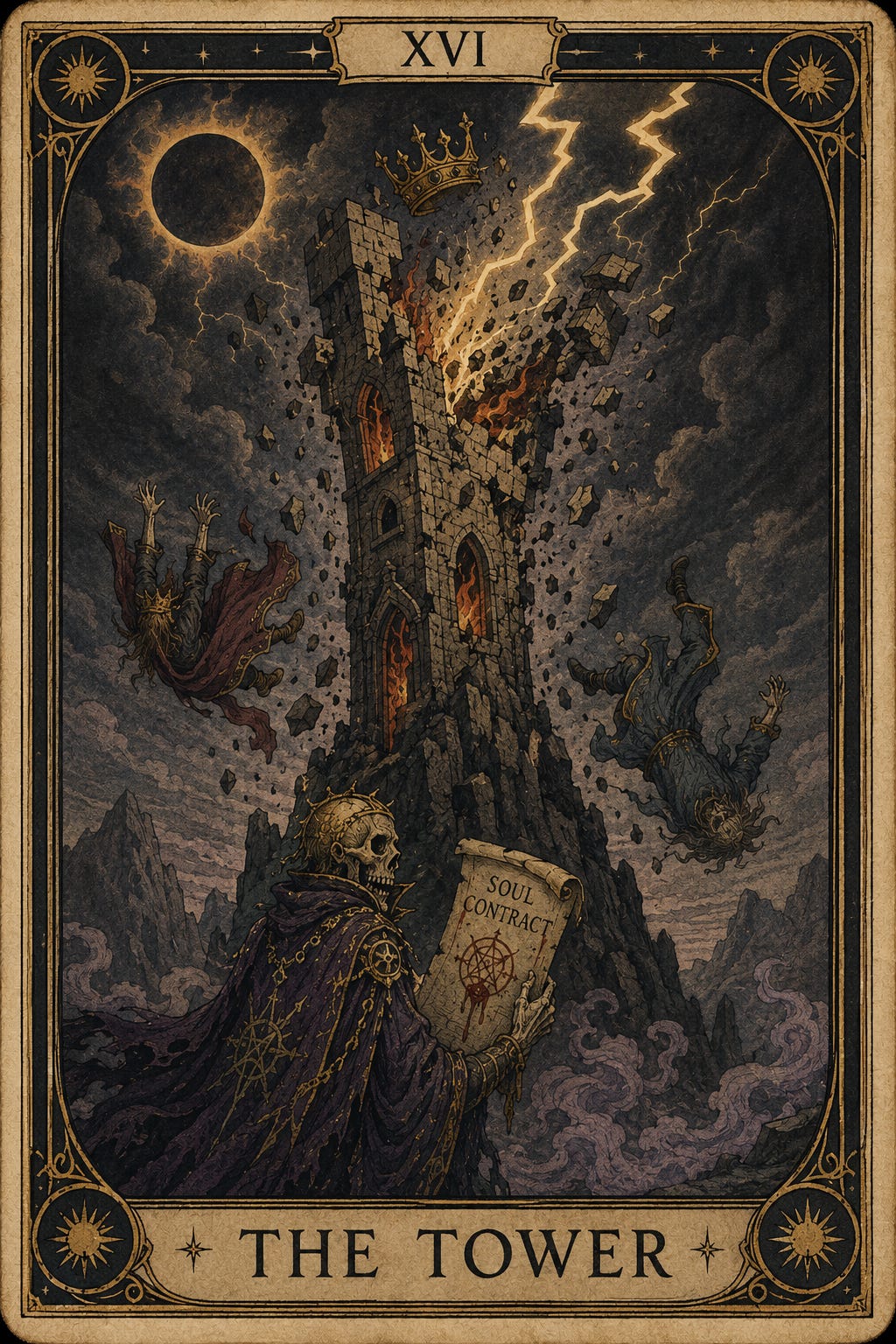
I’m going to do something a little different this week. Instead of spending the first 2,000 words leading up to it, I’m just going to front load my thesis! So here it is, stated up front, so you can instead spend the next several thousand words deciding whether or not I’ve earned it:
The Left-Hand Path was never really forbidden because it’s evil... Instead, it was forbidden because it’s expensive.
If you’re coloring yourself skeptical right now, I understand. But I’d encourage you to go rummage through the historical and folkloric record (pick any culture, from any century… go ahead, I’ll wait right here) and look at what the “dark” arts actually are, underneath all the crooked daggers, pointy hats, backwards Latin, and inverted pentagrams. Strip away the theology and the moral panics, and you’ll find, over and over and over again, the same underlying skeletal structure (pun intended, deal with it):
A transaction.
Blood for power. Or knowledge, at the cost of your sanity. How about your Soul, in exchange for talent? Too steep? Then how about some form of favor, in return for some form of obligation? Perhaps… oh, shall we say… years of your life, for one perfect curse?
You get the idea. The forbidden arts, across practically every tradition that ever bothered to actually forbid anything, are the arts where the practitioner pays — whether out of their own body, mind, self, or eternal standing — for results that the ordinary channels of reality simply won’t provide, no matter how politely you ask.
And what about the taboo? What’s the deal with all the dire warnings, the excommunications, that unmistakable “here be dragons” energy surrounding the whole enterprise?
Yeah, that was never a moral judgment. What it really was, under all the gloomy trappings, was simply a warning label about the exchange rate involved.
You see, “forbidden” is just what a culture stamps on a transaction when it has decided that the price is ruinous but knows — truly knows, with the weariness and resignation of a parent who’s had to hide the cookies on progressively higher shelves — that people are going to attempt the purchase anyway.
Anthropology backs me up here, incidentally. Mary Douglas, in her landmark teatise Purity and Danger (1966), famously argued that “dirt is matter out of place.”
If you just rolled your eyes a bit, let me put it a bit more concretely: taboos aren’t just arbitrary squeamishness, but the way a society maintains boundaries, walling off the things that threaten its categories and (ultimately) its order. In other words, a taboo is a fence. And you don’t build fences around things nobody wants! You build fences around things that are dangerous precisely because we desire them; you wall off the very transactions people will ruin themselves attempting.
Nobody taboos eating gravel, even though it could be fatal.
But everybody, everywhere, around the world and throughout history, taboos raising the dead.
See what I mean?
So today’s issue is more a design piece than a cosmology piece (though there’ll be a fair amount of that as well, even if mostly implicitly). We’re going to look at what happens when video games, the only medium in human history that lets you actually perform the forbidden transaction instead of just reading about it, handle that price tag.
Some games honor the bill, and something truly remarkable happens: the digital dark arts feel genuinely transgressive, heavy, and thrilling. Other games, meanwhile, quietly void the bill... and the darkness evaporates on contact, leaving behind the magical equivalent of an emoji skull sticker.
The taboo, as it turns out, is the design! Strip the price, and you strip the dark right out of the dark arts.
But before we hit the exhibit hall to prove me right, let’s start with a quick primer for the uninitiated.
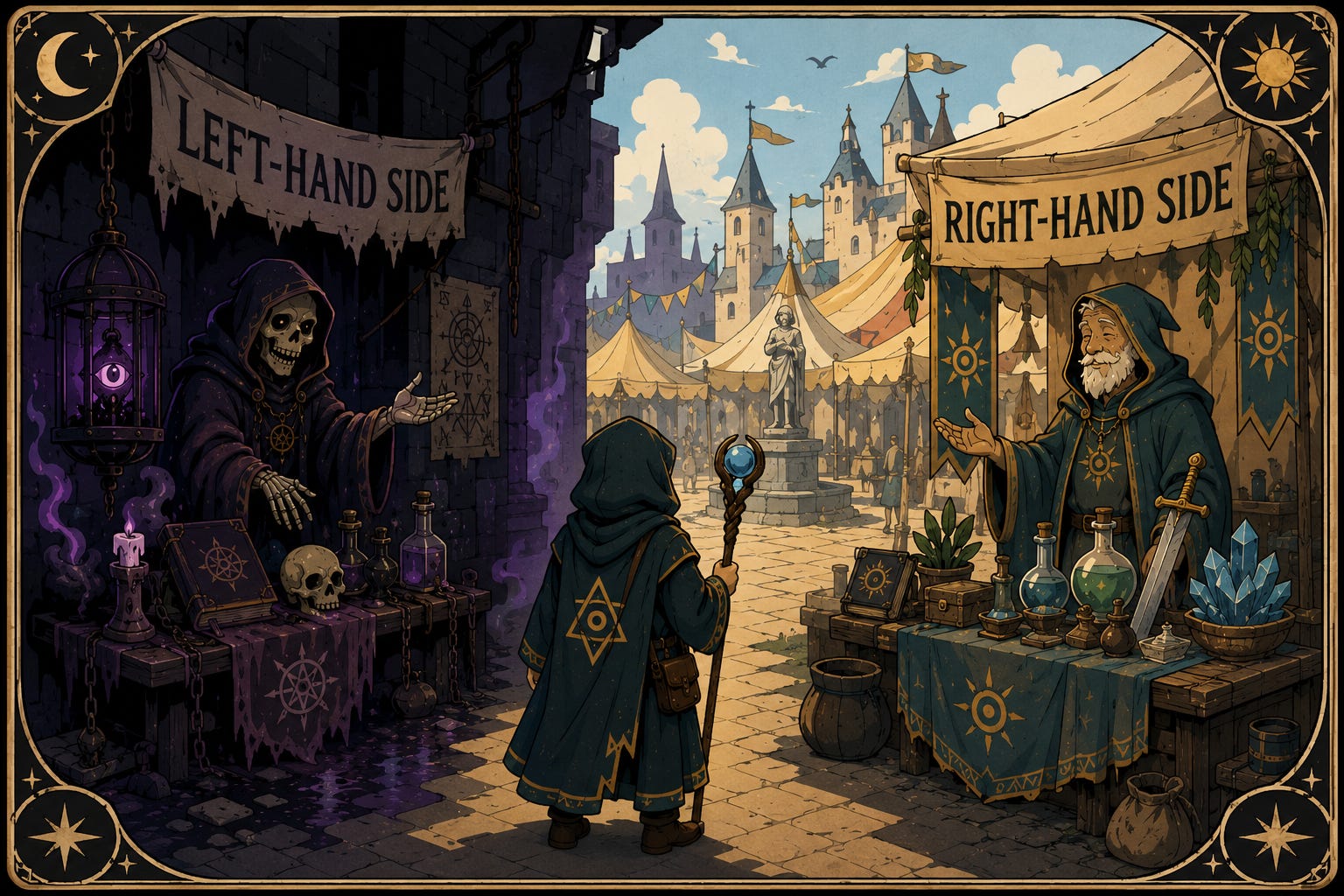
If you’ve been following this volume for a while, you already know the term “Left-Hand Path” gets bandied about a few different ways. Modern occultists tend to use it more philosophically, to describe traditions of self-directed spiritual development which we’ve covered elsewhere in this volume (if you need to, open a new tab and peruse the archive to fully catch up). But there’s an older, folkier, and more practical usage, which is the one we’re operating under today:
The Left-Hand Path is the path that bills you.
Think of the entire magical economy as a marketplace. On the Right-Hand side of the bazaar, you’ve got licensed vendors: prayer, devotion, petition, and sacrament. You ask nicely, through approved channels, and power may be granted to you, at management’s discretion. It’s a gift economy, its currency is faith and patience, and its delivery timeline is… shall we say, flexible.1
On the Left-Hand side, in the seedy alley behind the bazaar, you’ve got the… ahem, other vendors. No waiting, no deferring to the discretion of management, no “if it be thy will, be done.” You want the dead raised, your rival cursed, the future revealed, or the storm called? Done. Tonight? Sure! Whatever you want, whenever you want, guaranteed. The customer is always right.
Oh, and payment is due on receipt.
Wait, what’s that, you ask? What does the alley accept as payment? Well, survey the folklore of almost any culture and you’ll get essentially the same short list of accepted payment methods:
Your blood (aka the currency of life… more on this shortly)
Your sanity (forbidden knowledge famously does not fit comfortably inside a human head)
Your soul or self (the premium tier)
Or some other more open-ended obligation to something insanely powerful and beyond your comprehension… that now knows where you live.
Observe what’s NOT on the list: gold. Or dollars, or pounds sterling, or Imperial Credits. Ordinary money, however you want to call it. In other words: the one currency you can actually earn back.
The forbidden arts only accept payment in the currencies you can’t get back.
And that’s why they’re forbidden; not because their power is dirty (though that, perhaps, is in the eye of the beholder), but because you are the collateral. When you look past the poetry and theatrics, every grimoire’s dire warning, every priest’s condemnation, and every grandmother’s whispered “we don’t speak of such things” admonition is, at bottom, the same basic consumer protection advisory: this vendor’s prices are predatory, and previous customers are unavailable for comment.
If you need a cultural shorthand for this whole arrangement (and I certainly do, because I’ll be invoking it throughout the rest of this article), let’s borrow one from anime: equivalent exchange, the iron law at the heart of Fullmetal Alchemist (2001), where “to obtain, something of equal value must be lost.”2
Equivalent exchange. The very thing that the dark arts run on, with the taboo as their price sticker(s).
Ready? Good. Now, let’s go shopping!
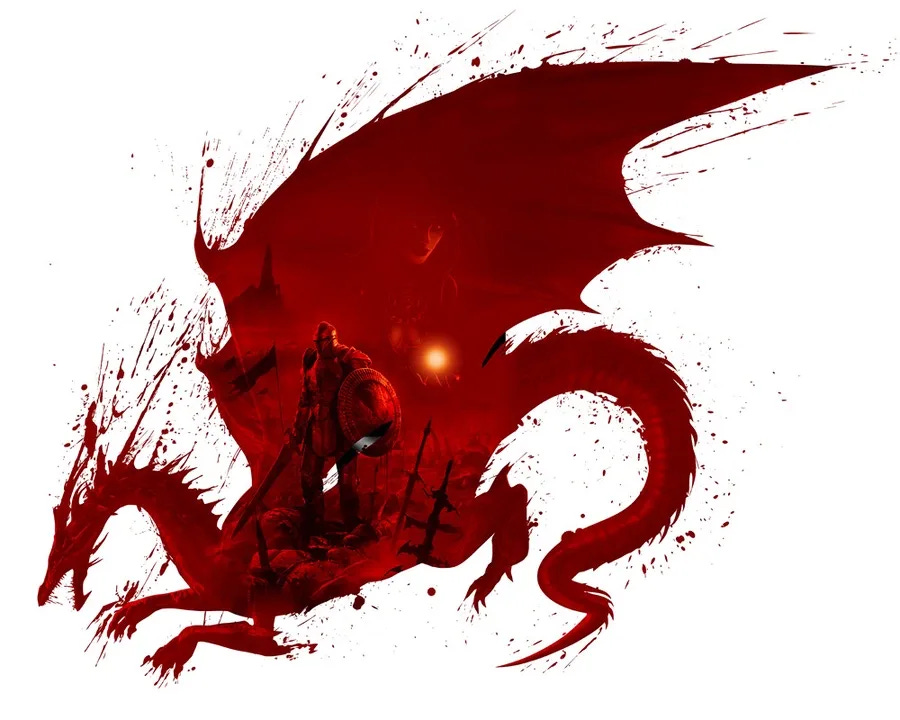
Ok, so why did I list blood first? Well, because blood is the original magical currency, and yes I have the receipts.
“For the life of the flesh is in the blood,” declares Leviticus 17:11, in one of the Hebrew Bible’s most quoted metaphysical claims, going on to explain that blood makes atonement possible precisely because it carries life. That verse, right there, is the scriptural wall that propped up the entire ancient sacrificial economy as well as one of the world’s largest practiced religions to this day.
Blood wasn’t merely symbolic of life in the ancient Mediterranean imagination… blood was life, in liquid form, spendable and bankable. Which made it, quite literally, the hardest currency in all the cosmos; you could offer a god grain, incense, or a really nice goat… but a blood offering underwrote the transaction that actually cleared.
If you’re wondering whether that’s exactly why blood magic sits near the top of nearly every culture’s forbidden list, congratulations! You figured it out. Blood magic is so transgressive not because it’s the weirdest magic, but because it’s the most expensive. It spends the one thing you can’t budget for: life itself.
So with that in mind, let’s examine Dragon Age: Origins (2009), which so completely internalized this assignment, it built its setting’s entire theology around it.
In Thedas, blood magic is the forbidden art. The maleficarum’s craft, taught to mortals by demons, hunted by Templars, and banned by the Circle of Magi with the kind of institutional fervor usually reserved for literal plagues. And crucially, BioWare didn’t just tell you it was forbidden... they made you feel the price, mechanically, in your own health bar.
So, how does the Blood Mage specialization actually work? It’s simple, really: activate Blood Magic, and your spells stop drawing on mana… they draw on your hit points instead. Now, every fireball, mind control, and crushing prison is paid for in your own blood, deducted directly from the same resource that keeps you alive when a darkspawn’s chewing on your face.
Oh, and the game doesn’t stop there. It twists the knife not once, but twice more: first, while Blood Magic is active, it drastically nerfs healing effects on you. And second, if you try to cast a spell that costs more health than you currently have, you don’t get a helpful “insufficient funds” error…
Instead, you collapse, mid-incantation. The spell fizzles, and you hit the floor.
Mwahaha. Going back to the marketplace analogy, this mechanic has gotta be one of the shadiest vendors in the bazaar. It’s a straight-up loan shark! The game lets you overdraft your own life, and the penalty for bouncing the check is you laying unconscious on the battlefield… which, in a party-based RPG where you are the healer’s problem now, has cascading costs of its own.
Oh, and the currency escalates… because of course it does. The Blood Sacrifice spell lets you replenish your own health by draining it from your allies (you know… your friends, your companions, the people who trusted you), and right about now is where this mechanical metaphor takes on a decidedly more sinister overture. First you spend your own blood… which is questionable and a little unnerving, but hey, it’s your blood, right? But then, when that runs short, you start spending other people’s blood. Uh… gulp? I see where this is going, and it never ends well!
Oh, and quite notably, there is not a single cautionary tale in the entire folkloric record that escalates any differently than this.
But my favorite touch (which, in my headcanon, proves BioWare was reading the same grimoires I am) is in how you acquire the specialization in the first place. You can’t learn Blood Magic from a book or a trainer; in the base game, the Warden (ie, the PC) can only unlock it one way, assuming they’re a mage: during the Arl of Redcliffe questline, inside the Fade, by striking a bargain with a desire demon.
In other words, the forbidden art is not found like you would by, say, learning Fireball once you reach Level 10. Instead, it is purchased… from the exact type of vendor your Chantry granny warned you about, no less. And the lore’s ambient threat (that blood mages court demonic possession, and that the Circle’s prisons are full of the sorry souls who couldn’t cover their debts) means the sticker price (your HP) is only the down payment; bood magic’s financing terms involve your autonomy.
Health and selfhood, principal and interest. Ka-ching!
Dragon Age honors the bill, as you can see. And notice what that does to the feel of the whole thing: playing a blood mage in Thedas feels truly uncomfortable on a level that very few “evil playthroughs” ever truly manage. In most so-called “evil playthroughts,” at most you get a salty NPC frowning at you, or an easily-shaken “wanted” level. But here, you can actually feel your tab running because every cast is a small act of self-harm.
That, right there, is the taboo. And it’s working as designed!
📜🗡️☠️ SIDE QUEST: Curse Tablets Were the Original PvP
Hey, since we’re on the subject of paying for hostile magic, let me introduce you to the ancient world’s most delightfully petty artifact class: the defixio (plural defixiones). The Greeks called them katadesmoi, or “binding spells.”
These were thin sheets of lead (cheap, durable, and satisfyingly grim) onto which ordinary Greeks and Romans scratched curses against their rivals, before folding them up, often piercing them with a nail (the “binding”), and depositing them somewhere with a direct line to the underworld: a grave, a well, or some other chthonic sanctuary.
Well over a thousand of them have been recovered across the Greco-Roman world, and they kind of read like the world’s oldest Twitter pile-on. Litigants cursed the tongues of opposing witnesses, merchants cursed competitors’ shops, and jilted lovers cursed... well, you can imagine. And my personal favorite genre? Fans and rival factions cursed charioteers in graphic, granular detail: bind their horses, tangle their reins, shatter their axles in the turn.
That’s right: the humble debuff predates video games by two and a half millennia. Some anonymous Roman racing fan invoking dark gods against the Blues’ star charioteer is, spiritually speaking, indistinguishable from you hexing an opposing player’s ping. In other words, this is PvP. Always has been.
But notice how even this — ancient dark magic’s budget option; a drugstore-tier curse — was still a transaction. The petitioner, after all, performed ritual labor: inscribing the formula, sometimes in deliberately scrambled or archaic script, sneaking into a graveyard at night (a real social and religious risk back then), and then, most critically, invoking chthonic powers like Hermes Chthonios, Hecate, or Persephone by name, which meant formally entering into obligation with the gods of the dead.
You were quite literally asking the underworld for a favor. And wouldn’t you know it, the ancient Mediterranean had exactly zero folklore about the underworld ever forgetting a debt! Color me shocked.
So, even the cheapest curse on the menu cost something. Remember that as we carry on.
Blood may buy power, but the alley vendors stock something even more dangerous than mere power… one that opens a different type of door and commands an entirely different currency:
Knowledge.
Every mystical tradition worth its salt repeats this same warning over and over again: there are some stones best left unturned. There are things a human mind is not built to contain. The Kabbalists told of four sages who entered the mystical orchard of Pardes — one died, one went mad, one became a heretic, and only one emerged in peace. Centuries later, H.P. Lovecraft industrialized the idea into an entire storytelling genre. And the price of forbidden knowledge, in all these tellings, is never your blood...
It’s your mind.
In other words, you pay for the truth with the very instrument you’d need to survive knowing it!
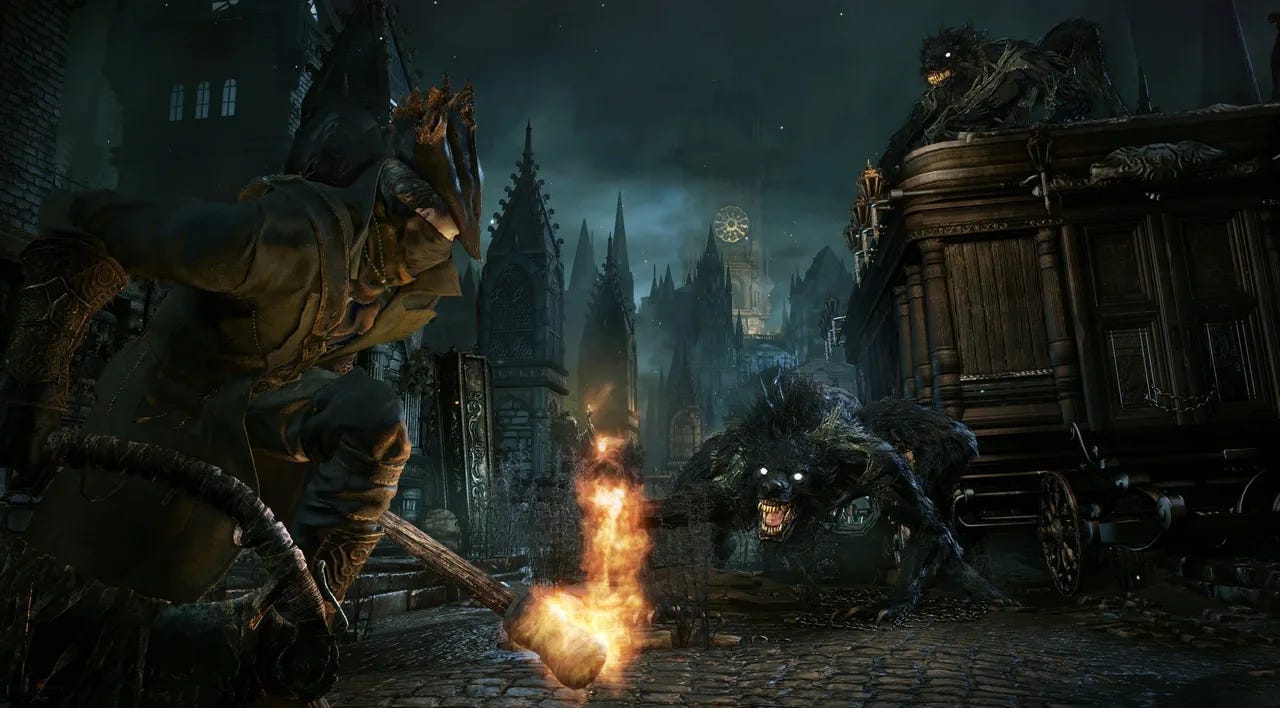
Which brings us (inevitably, and gloriously) to Bloodborne (2015), which gave us the single most elegant Faustian bargain that’s ever been rendered as a character stat:
Insight.
Quick primer for the uninitiated: Insight is a numerical resource in Bloodborne, gained by encountering the game’s cosmic horrors. You increase your Insight stat by glimpsing bosses, consuming the queasily-named “Madman’s Knowledge,” and stumbling into revelations you cannot subsequently un-stumble yourself out of. Each point represents the Hunter’s (ie, the player character’s) expanding awareness of what the gothic nightmare city of Yharnam actually is beneath its superficial trappings of werewolves and torches.
But what’s truly genius about how FromSoftware played with this is how Insight isn’t really a score, or a even stat (at least, not in the way you’d usually think of it in a game). It’s a debt meter, and the more of said debt you have, the more the world charges you.
Come, I’ll show you. Notice how all the Insight thresholds are almost liturgically specific:
At 1 Insight, your very first taste: the Doll in the Hunter’s Dream (your safe zone in the game) awakens, and you can finally level up. The first hit is always free… ish.3
At 15 Insight: the Church Doctors of the Cathedral Ward get meaner; their lanterns start flinging projectiles, their scythes ignite, and their cross/scythe attacks begin building Frenzy. But the key here is that the enemies themselves didn’t change. What changed was your ability to perceive what they were always doing. Ignorance was your shield, and you’ve been slowly whittling it down with each hit of the Insight pipe.
At 30 Insight: you begin to hear the Winter Lanterns — by far the game’s most traumatizing enemies, and I will be taking no questions here — singing, off-key in the distance, before you can see them. A warning, technically. But practically, the most upsetting warning system ever devised in a video game (again, no questions here, thank you very much).
And finally, at 40 Insight, the veil shreds: the Lesser Amygdalas become visible. These colossal, many-eyed, spider-like things have been clinging to the buildings the entire game. They’ve been watching you, and occasionally even grabbing you with invisible hands that you’d most likely previously chalked up to jank. They were always there, dear Hunter… you simply hadn’t paid enough to see them.
Meanwhile, running under all of that progression (if you care to call it that), the interest on your loan is quietly but as-surely-as-the-day-is-long compounding: every point of Insight lowers your Frenzy resistance. Frenzy, of course, being the madness status effect that detonates a huge chunk of your HP when its meter fills.
This mechanically expresses an IRL truism: the more you know, the more fragile your mind. FromSoftware has thus brilliantly rendered cosmic horror as a character sheet. Players have even discovered the inverse: stroll through the Nightmare of Mensis with zero Insight, blissfully and deliberately ignorant, and the Frenzy that shreds knowledgeable Hunters barely touches you.
The game’s most famous line — “Grant us eyes,” the plea of the scholar Willem, who sought to elevate humanity by lining its brains with eyes — is usually read as lore. But it’s also a price quote: eyes are granted, and eyes are charged for. In Yharnam, enlightenment has a running tab that’s denominated in your capacity to remain sane while enlightened. And the game, for its part, will happily let you keep spending right up to the moment a Winter Lantern’s lullaby overdrafts your entire skull.
Like Dragon Age: Origins in the previous section, Bloodborne honors the bill. And again, you feel the result. Insight is why Bloodborne‘s horror gets worse the better you get at the game, and why veterans speak of the Nightmare of Mensis in the same way sailors speak of storms. The dread is both the horror and the price of admission.4
🕯️🃏🤪 SIDE QUEST: The Purest Price [Cultist Simulator]
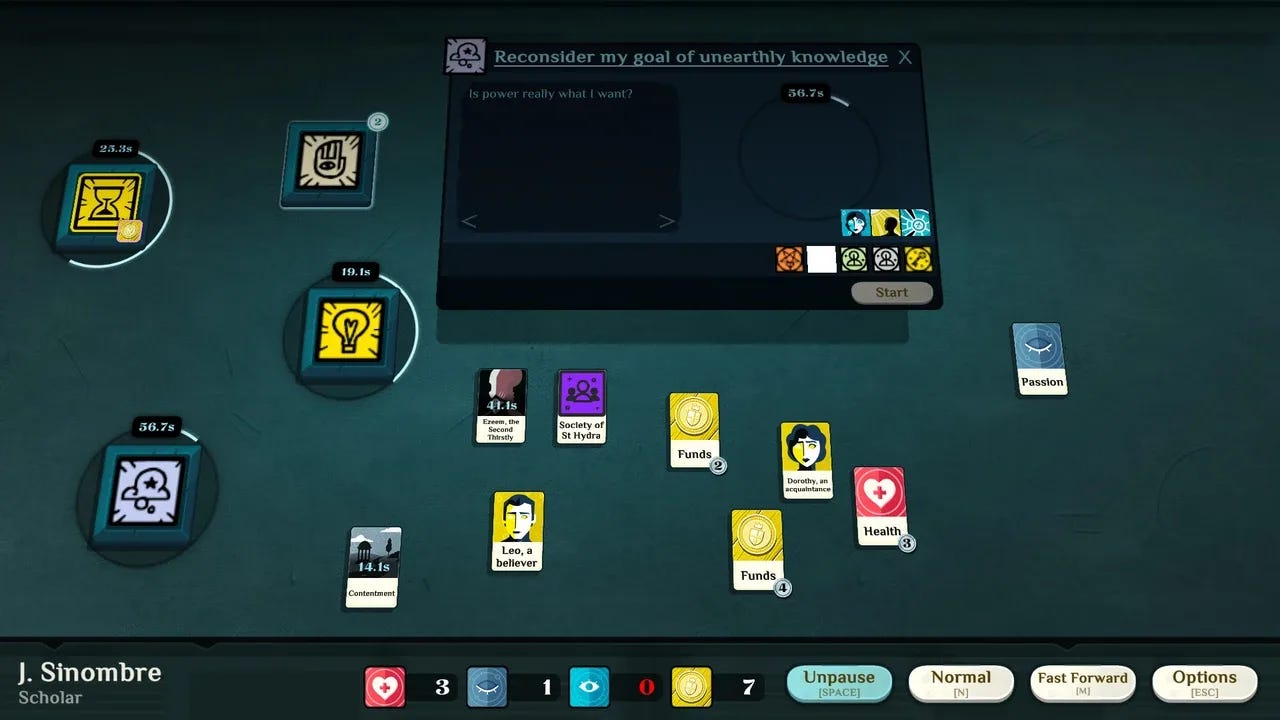
Bloodborne’s main narrative innovation was rendering the Faustian bargain as a stat. Cultist Simulator (2018), meanwhile, renders it as an entire accounting system. It’s the closest any game has come to just straight-up publishing this article’s thesis as software. So let’s have a look!
Weather Factory’s delightfully simple and occult-y card game casts you as a seeker of forbidden lore in a Lovecraft-adjacent 1920s, and it is, mechanically, a game about paying. There is a timer on your table called Time Passes, and it eats your Funds. When your Funds run out, it starts eating your Health. When your Health runs out, you get a small red countdown, and then you die. Instead of falling to a boss or a monster, you succumb to the sheer overhead of being alive while pursuing the unspeakable.
Oh, and that’s just the rent; the actual occult pursuit charges you separately. Read the wrong books, dream too deep, or glimpse too much into the Mansus, and you accumulate Fascination as your mind wanders somewhere very bright and very, very wrong. Let three Fascinations gather, and you don’t die (though death may well be a mercy at that point); you end up as a lunatic, convinced you’ve ascended.
But overcorrect into despair, and you accumulate Dread instead; get three of those, and the countdown to… erm… No More begins. These two conditions can only reliably be treated with each other — yes, you quench obsession with terror and terror with obsession, like a (mad) man crossing a river by leaping between two crocodiles.
Health, reason, and money: the game runs a simultaneous tab in all three currencies, and every single verb on the table (Work, Study, Dream, Explore) spends at least one of them. There is no free action in Cultist Simulator… hell, there is no free anything, really. The game’s whole design elegantly restates the alley vendor’s terms: you may absolutely have the forbidden knowledge, seeker. Now, how will you be paying today… body, mind, or purse?
Most games put the price in the fiction. Meanwhile, Cultist Simulator puts the fiction in the price. It’s the purest equivalent-exchange design I know of in gaming, and if this article had a North Star, it would be that hateful little Time Passes timer… ticking away, forever presenting the bill.
Blood grows back, eventually. And even sanity, in kinder stories, can be recovered.
But the alley’s top shelf stocks powers that cost the one thing with no known regeneration mechanic: your self. Your name, your continuity, your very place in the realm of the living. The world’s folklore is unanimous and unambiguous here — this is the premium tier, where you offer your soul as collateral and the contract’s fine print simply reads “you.”
FromSoftware, bless their merciless hearts, didn’t stop with Bloodborne. In fact, they’ve built something of a cottage industry on this exact price point.
Let’s start with Hollowing, the signature affliction of the Dark Souls series (2011–2016). The Undead of Lordran and Drangleic don’t die, but diminish. Each death, absent the restorative currencies of Humanity or Embers, erodes them toward the Hollow state: they each eventually become a withered, mindless husk that has forgotten its name, its purpose, and finally the fact that it was ever anyone at all. Dark Souls II (2014) did the original one better and made this erosion actually (and characteristically brutally) literal: each death as a Hollow shaves off a chunk of your maximum HP, down to half. Your very capacity for existence thus shrinks with each of your failures, until you spend a precious Human Effigy to buy your selfhood back.
Feel free to read that as a transaction, by the way, because it totally is one. The Undead Curse grants you the ultimate forbidden prize (you cannot die) but the bill arrives in installments, deducted from your very personhood. Immortality’s exchange rate, it turns out, is identity. Every ghost story ever told has tried to warn us as much: the things that persist past death, persist as less than they once were. The brilliance of Dark Souls is in making you actually play the installment plan. It makes you feel your very (maximum) self tick downward, death by death… and finally, as if to twist the knife in further, it gates the restoration of your humanity behind a consumable (bearing a market price, obviously).
(Mobile game devs everywhere are glaringly side-eyeing Miyazaki with seething envy.)
But for the full, notarized, signed-with-blood version of the “self as payment” contract that Dark Souls so viscerally portrayed, we must turn to FromSoftware’s true magnum opus: Elden Ring (2022), which gave us the Frenzied Flame.
Longtime readers will remember the Lands Between from our Elden Lore series earlier this volume, so I’ll spare you the full cosmological recap here. Suffice to say: the Golden Order maintained a tier list of proscribed heresies and forbidden practices, on which the Flame of Frenzy sat at the very tippety-top, to the point it went far beyond just forbidding it and straight-up sealed the damned thing beneath the capital’s deepest catacomb and never spoke of it again.
To acquire it, you undertake what I can only describe as an anti-pilgrimage: you must descend beneath Leyndell, through the snaking sewers and interminable catacombs, past the shunning-grounds, down a sheer abyss of coffin-strewn darkness, battling hordes of overpowered Omens, giant lobsters, and other monstrosities… to finally, at long last, reach a door.
But oh no, sweet summer child, this is a FromSoftware game… you didn’t really think it’d be that simple, did you? For that door will not open for the armed and armored. So in order to proceed, the game makes you do something… different. Something that no other power in Elden Ring requires you to do:
You must strip.
Yup, you read correctly. You must unequip every weapon, remove every piece of armor, and only then may you approach the Three Fingers (the conduit between the Frenzied Flame and the foolish mortals who wish to wield it, much like the Two Fingers are to the Greater Will)… as naked and defenseless as a newborn.
Ponder the implications of that design decision for a bit. Every other power in this game, you take — you kill its owner and pry it from the corpse, like the good little murder-hobo you are. This one, however, you receive… and receiving it requires ritual vulnerability: nothing standing between your bare skin and the entity forbearing the world’s doom. No negotiating position, and certainly no dignity. This game, quite literally, lays bare (ahem) the terms of a Faustian pact: the Three Fingers grip your body, searing the Frenzied Flame into your flesh, and the transaction is complete.
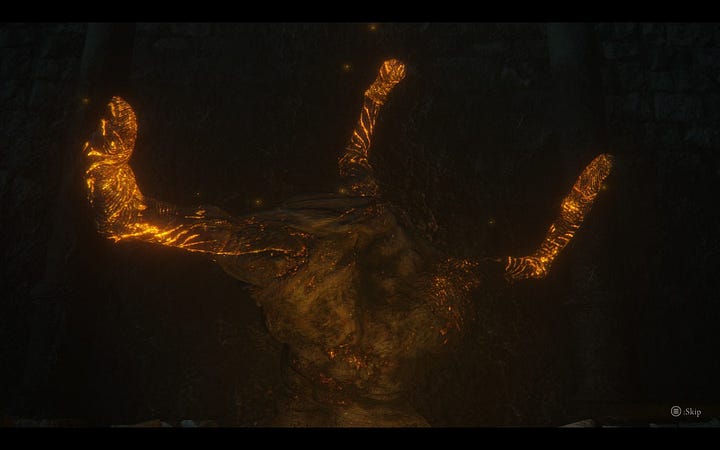
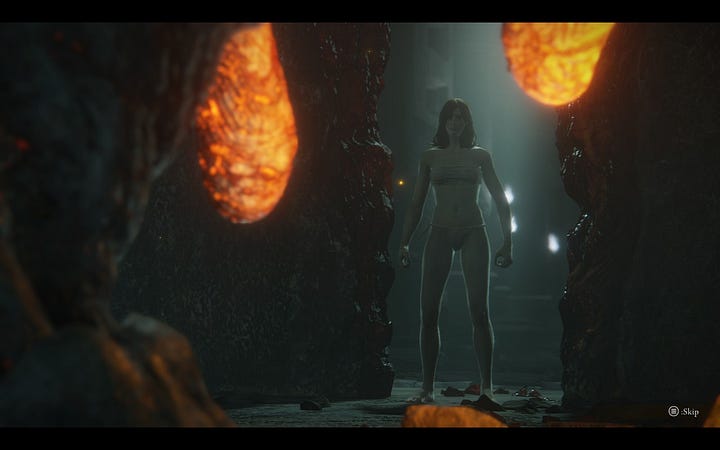
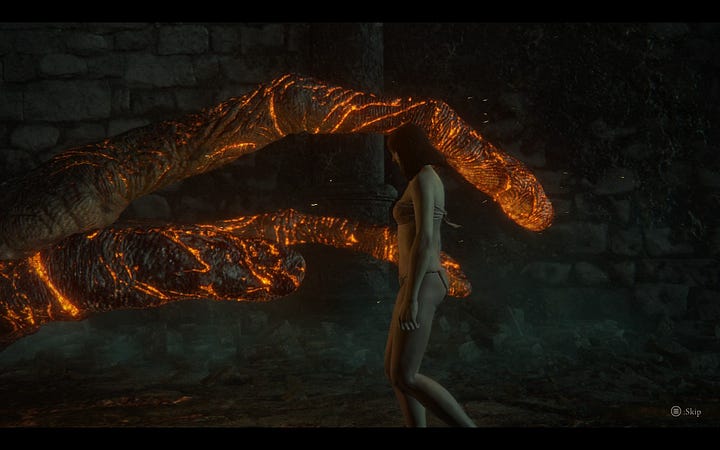
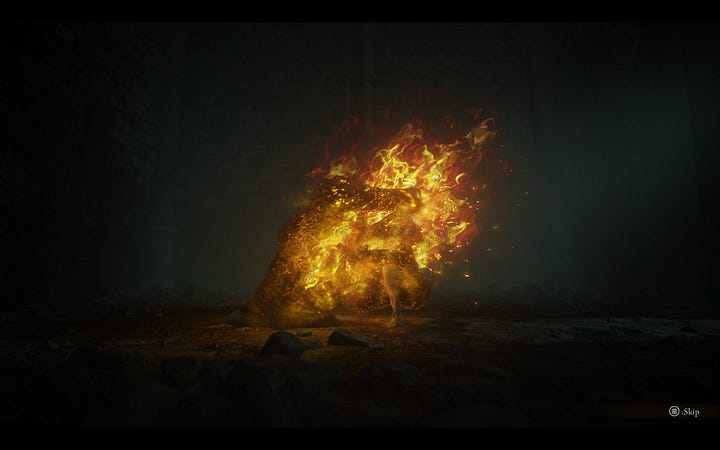
Then, the bill arrives, fully itemized:
Immediately after you receive the Flame, Melina — your maiden, your guide, your stalwart and faithful companion since literally the game’s very first hour — leaves you. Just… straight-up packs her stuff and peaces out. And the worst part about it is, she doesn’t even do so angrily. She ditches you formally; she renounces you, promising to deliver Destined Death onto you herself… and then, she’s gone. The one relationship the game ever gave you… spent.
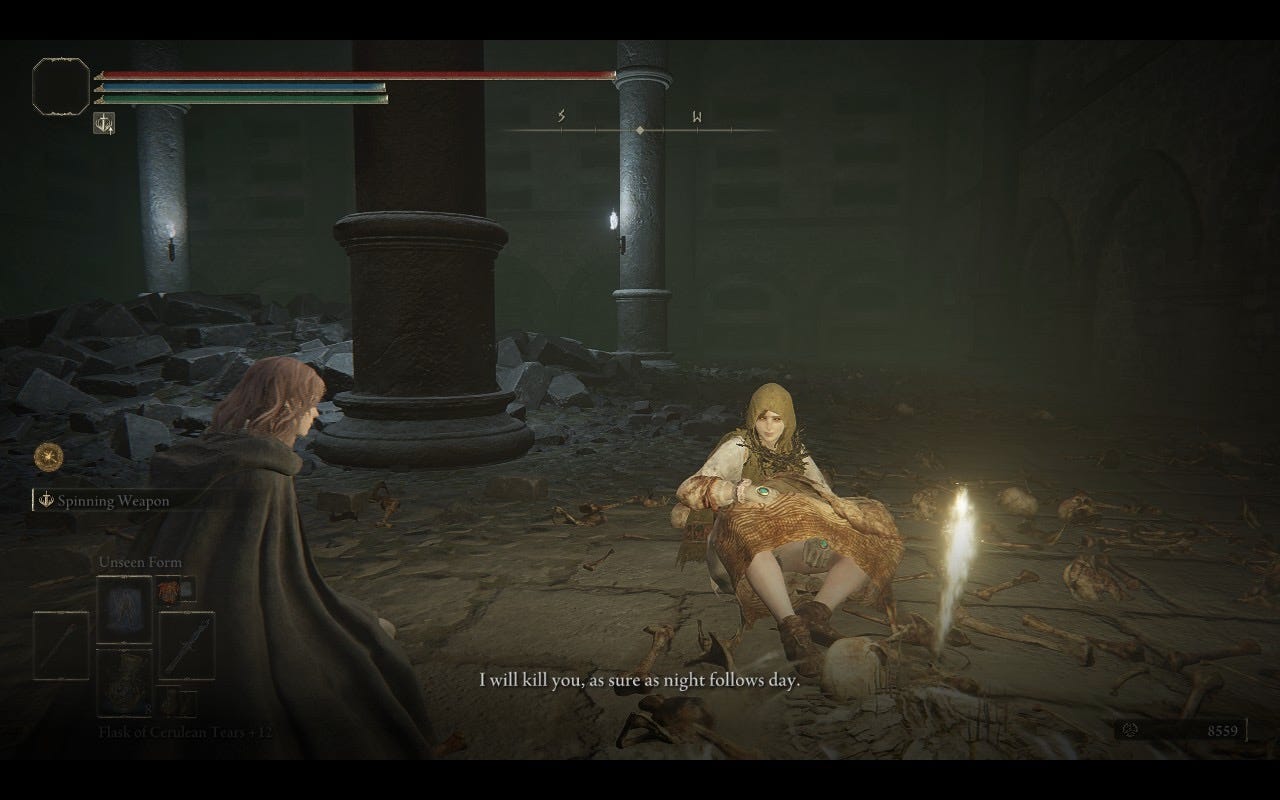
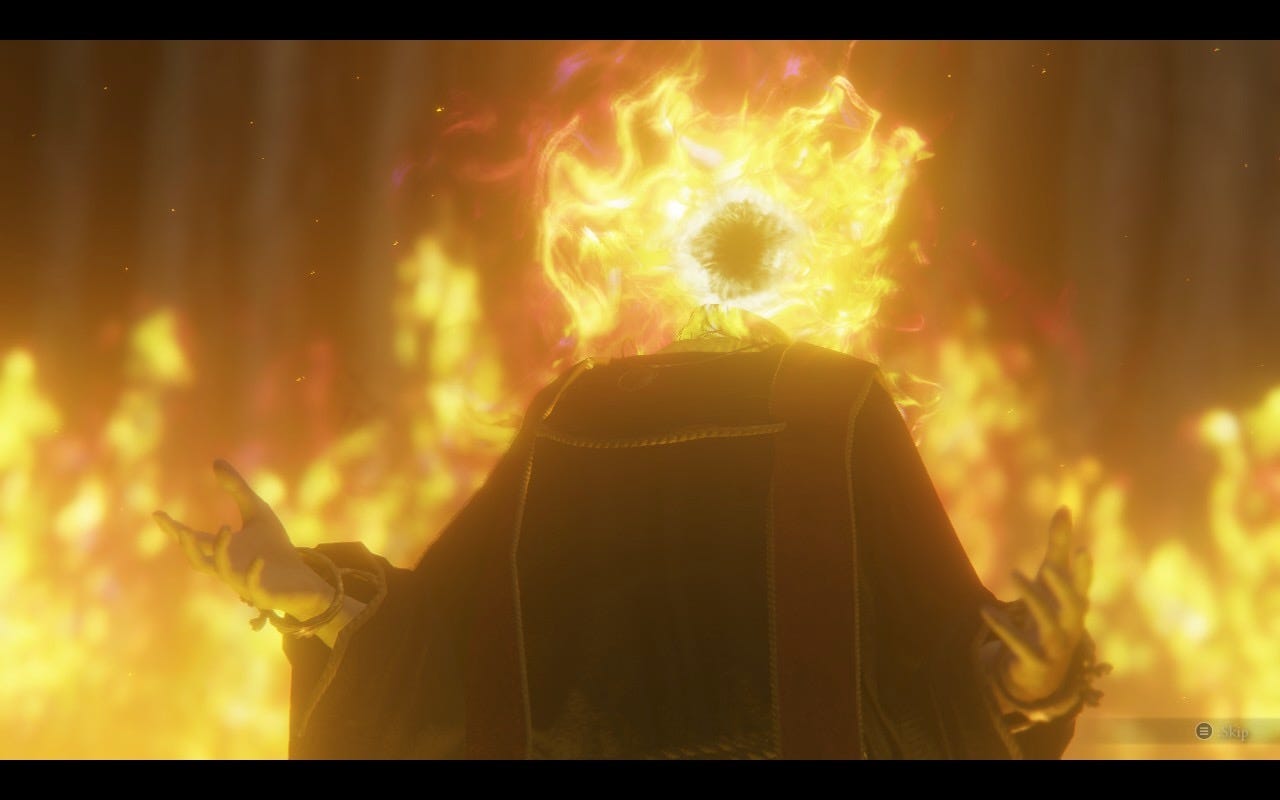
And then, your endings collapse. You’re now locked out of every other resolution to the game’s story, every future in which you fix, restore, or transform the world. There is now exactly one road forward, and it terminates in you, faceless and gilded in flame, unmaking the world: melting everything and everyone back into the screaming, undifferentiated One.5
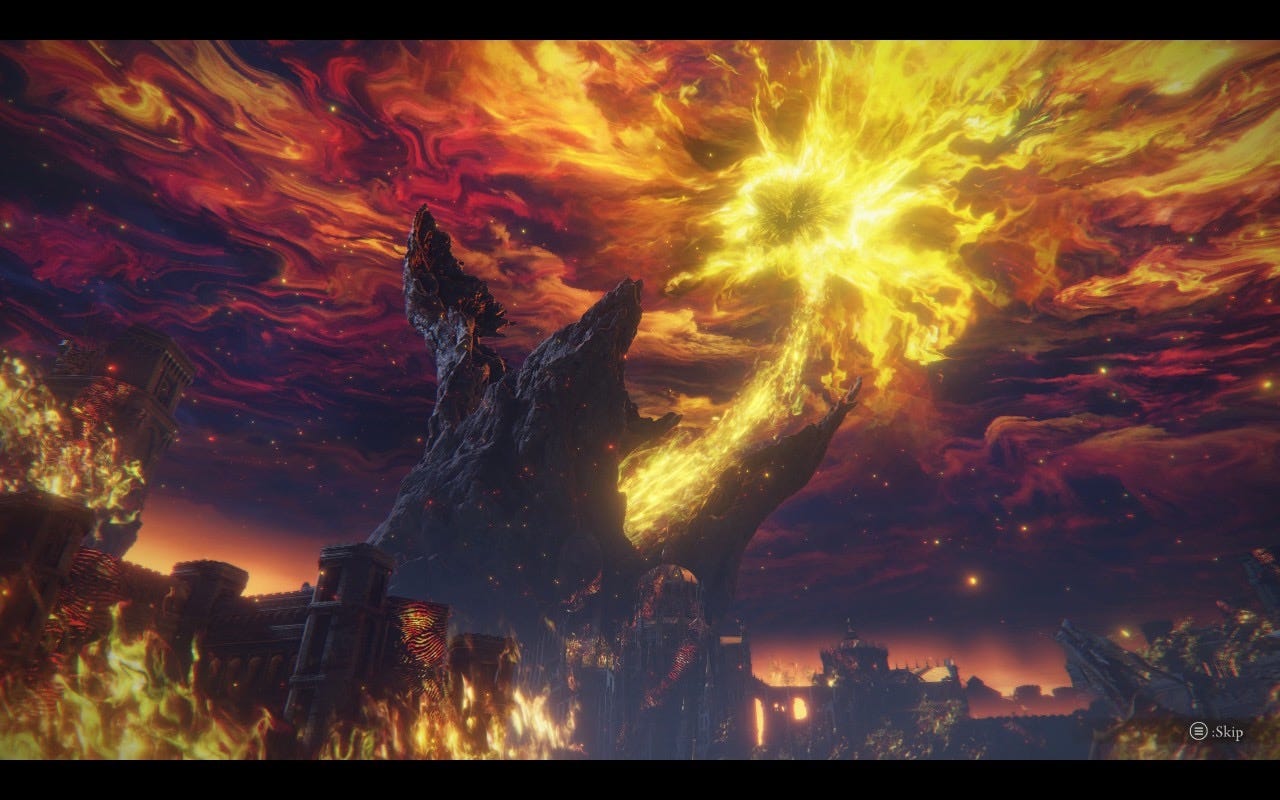
You’ve earned power… that costs you the world. And I don’t mean that metaphorically — the ending is literally called “Lord of Frenzied Flame,” and its cinematography (pictured above) is a visual eulogy to the realm once called the Lands Between. You wanted the strength to end suffering, and the vendor delivered exactly what you ordered: an end to suffering, by way of ending everything that can suffer, with you as the sole, howling exception.
TL;DR — The Three Fingers honor the bill. Oh, how they honor it.
🎸🤝🪦 SIDE QUEST: §27 – The Deal at the Crossroads
The eternal song of exchanging your soul in a forbidden transaction has a distinctly American verse, with a twelve-bar structure. Let’s take a listen.
The legend goes like this: Robert Johnson, a middling young guitarist from the Mississippi Delta, disappears for a stretch in the early 1930s. When he resurfaces, he plays like nothing anyone has heard — a guitar style so complete, so arrived, that fellow bluesmen start telling a story to explain it: Johnson took his guitar to a crossroads at midnight, where a large dark man took the instrument, tuned it, played a few numbers, and handed it back. He exchanged talent for soul, the purest one-line contract in humanity’s entire folkloric record. No Latin, no lawyers, no 90-page Goetic operating manual, no hassle… just what you want, for what you are.
Now, the historian in me obliges that I put forth some disclaimers: this is legend, not biography. The crossroads story seems to have originally attached to an unrelated bluesman, Tommy Johnson, then migrated to Robert posthumously, surely fed in no small part by his eerie catalog (“Cross Road Blues,” “Me and the Devil Blues,” “Hellhound on My Trail”) as well as by his untimely death in 1938 at the ripe old age of 27… poisoned, the stories say, over another man’s wife.
Scholars will also tell you the crossroads figure owes as much to the Yoruba-derived trickster of the crossroads, carried through Hoodoo, as to any church-approved Devil. The alley bazaar, as ever, is delightfully syncretic.
But notice what this legend actually is, structurally speaking: it’s the folk/blues equal exchange rate, published for all to see. The Delta didn’t tell this story because it hated Robert Johnson, but because his talent was unaccountable — power that arrived outside the visible economy of practice and patronage. And folk logic knows, in its bones, that unaccountable power is never free. If nobody saw you pay, the payment must have been made in the other ledger. Somewhere, the story insists, there is always a bill.
Also, this legend contains at least one crucial distinction from Faust’s. In that legend, Faust bought knowledge and pleasure — consumption, in other words. The crossroads deal, on the other hand, buys creative power — the ability to make something the world has never heard. It’s basically the artist’s own version of the contract. Every songwriter who’s joked about it since (and the number who have joked about it is rivaled only by the number who’ve quietly written about it) completely understands the terms of the contract: the work that comes from nowhere costs everything.
Twenty-seven years old... gee, where else have we heard that number? Some contracts, the folklore whispers, would seem to have a fixed term.
One currency remains on the alley’s list of payment options, and I’ve saved it for last because it’s the one that most imbues these stories with their frightful charge, making them not just scary or creepy, but genuinely terrifying.
Blood, sanity, self? Eh, those are all prices you pay at the register. Terrible, yes. But also finite; the transaction completes, the account settles, and whatever’s left of you walks out of the shop.
Obligation, however, is different. Obligation is the price you pay in the future… not what the power takes from you, but what it now holds over you. It’s the fine print clause in every folkloric pact that’s actually scary, and whether it takes the form of the fairy favor that must be repaid on demand, the summoned spirit who considers its summoning a hiring, or the demon whose contract stipulates not your soul at death but your service in life, the scariest question in the entire canon of the dark arts has never been “what will this cost me?”
It’s “who do I belong to now?”
Because now we’ve arrived at the debt’s terminal stage, the one all the cautionary folk tales keep circling around like a ship endlessly rounding a bottomless whirlpool: you set out to bind a power, and the power binds you. You wanted a servant, but instead you became one. The necromancer’s ultimate nightmare was never the skeleton failing to rise, it was looking down one day and realizing that he was the thrall — that somewhere along the line, without any single signature he could point to, the leash had changed hands.
Very few games have the nerve to run this transaction on the player. And no game has ever rendered that arrangement with more contractual precision — with more actual, literal, notarized, clause-and-subclause paperwork — than Baldur’s Gate 3 (2023).
Let’s start with the obvious: Larian didn’t have to invent the obligation transaction, because Dungeons & Dragons institutionalized it decades ago. It’s called the Warlock: the only class in the game whose power source is, functionally speaking, a creditor. The wizard studies, the sorcerer inherits, and the cleric petitions through approved channels (from the Right-Hand bazaar: appointment required, results not guaranteed). But the warlock simply walks into the alley, signs, and walks out with the goods that same evening — pure eldritch power on layaway. Patron’s terms, patron’s discretion. The very class itself is the payday loan! That’s right, every warlock in every campaign is actually a debtor… with the kind of lender that takes calls at 3 AM.
(Hmmmm… that actually gives me an idea for my next D&D session. Don’t tell my players.)
Anyway, BG3 gives us a warlock whose loan has finally come due: Wyll Ravengard, the Blade of Frontiers, folk hero of the Sword Coast… and, beneath all the swagger, a young man seven years into servicing a crippling spiritual debt that he signed at the wise old age of seventeen.
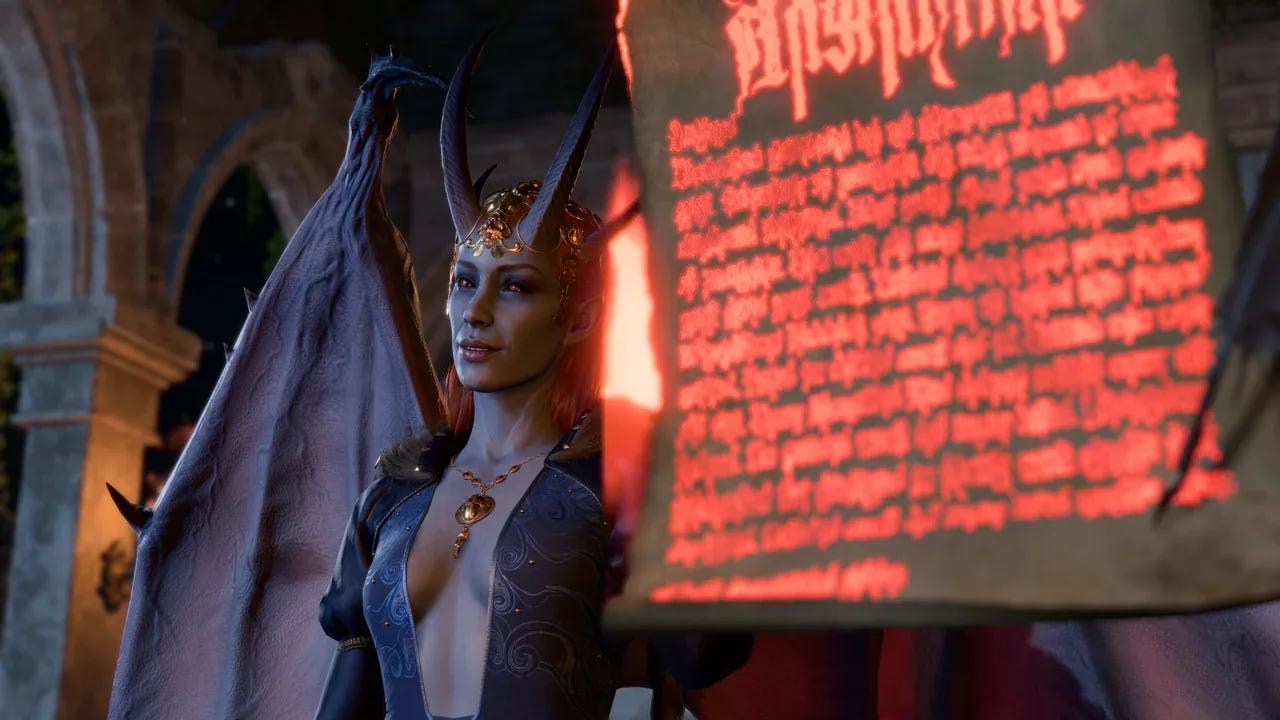
The debt’s origin story is the cruelest part, so let’s start there: unlike most debtors in stories like these, Teenage Wyll didn’t sell his soul for power, riches, or glory, but to stop a cult of Tiamat from burning Baldur’s Gate to the ground… which might be the single most sympathetic reason any debtor in the folkloric record has ever had for walking into the alley! But the vendor — Mizora, a cambion in the service of the Archdevil Zariel — did not care one bit. Not even slightly. In case it wasn’t obvious, the alley doesn’t do hardship adjustments. The terms are always devilishly simple: power for eternal servitude, no carveouts (sign here).
But wait, there’s more! The contract’s first collection wasn’t Wyll’s soul… because that wouldn’t be poetically cruel enough, you see. Rather, it was his voice. This pact included a literal gag clause; Wyll was magically unable to explain himself to anyone, including the father who came home to find his son standing next to a devil. Duke Ravengard demanded an explanation, but the contract held Wyll’s tongue, so the Duke exiled his own son to the frontiers in disgust. Obligation, the game understands, eats your relationships before it eats your soul. The debt isolates the debtor… which is, you know, bog-standard predatory lending practice (regardless of whether the human or infernal division carries it out).
Then the game really pours salt in poor Wyll’s wound by making the contract mechanically enforceable, on-screen, against you… the player.
In Act 1, Mizora assigns Wyll a hunt: kill Karlach, whom the contract classifies as a soulless fiend (she’s actually, in fact, an escaped slave with a gnarly heart condition… the paperwork, as ever, describes the asset but never the person). If you spare her — ie, if you do the obviously right thing — then Mizora arrives in camp to explain, pleasantly but firmly, that mercy constitutes a breach of contract. And then she executes the penalty clause by permanently and visibly transforming Wyll into a horned fiend. His face (you know… the folk hero’s face? The face on all the “Blade of Frontiers” stories??) becomes repossessed and replaced with the debtor’s brand.
Holy crap. Just sit back and take all of that in for a second! The pact punishes him (and punishes him quite harshly, at that) for being good. That, my friend, is the obligation trap’s purest incarnation, which neither Faust nor the crossroads ever quite fully portray or dramatize: Wyll borrowed the power to do good, but he paid the interest in evil, on command and in perpetuity. Every act of conscience constitutes a missed payment... and the worst part is, you can’t even feel fully sympathetic towards him because he agreed to these terms!6
Oh, but we’re not done yet! For the real masterstroke comes in Act 3, when an exit FINALLY appears. Pay attention; in these stories, about these types of obligation, the “exit” (scare quotes intentional) is often where said obligation finally reveals its true nature.
Mizora arrives in camp flanked by two infernal arbiters: adjudicators of diabolical contracts, present as legal witnesses. Because just like in our world, the Hells are nothing if not procedural. She comes bearing an offer: she knows where Wyll’s captured father is being held, and she is, at long last, prepared to discuss termination of the pact.
The terms:
Option One: The pact is broken. Wyll is free. And his father, per Clause A § 2 (already on file), is “fated to die by an enemy’s hand.”
Option Two: His father’s location, and his father’s life... in exchange for a brand-new pact. What are the new terms? Seven more years of service? No. A renegotiated rate? Give me a break. Less harsh penalties? LOL, LMAO even. No, this new agreement is actually much more devious in its simplicity: Wyll’s soul, pledged to Mizora and Zariel, for all eternity — first, through service in life, and then, eternal soldiery in Zariel’s legions after death.
And there you have it! The exit fee is numerated in the form of an even bigger contract. It’s this move, right here, that separates obligation from every other currency and price point we’ve covered in this article: blood is spent, sanity is spent, and even the soul is spent… but a debt compounds. Every door out of the alley only opens into a deeper room, and the vendor has arbiters on retainer for navigating exactly this type of negotiation. The Hells don’t want your payment, magus... they want your entire bank account.
And should you get clever (break the pact and race to rescue the Duke from his underwater prison anyway) Mizora does not simply shrug and take the loss. No, she appears in person, forces the Duke to his knees, and summons a scuttling clutch of exploding spiderlings to finish him, explaining that she is “merely ensuring the deal goes through as pacted.”
Thought you’d get one over on her, did you? Nuh uh uh… the contract, it turns out, has an enforcement division. Granted, you can still outfox her and save him, at which point she congratulates you through visibly gritted teeth… and a well-placed Detect Thoughts will reveal that she’s already planning the next attempt. Devils may lose battles, but contracts don’t expire.
Hell, even the epilogue keeps the ledger open: sign the eternal pact, and Mizora simply... stays. She’s always at Wyll’s side, in human disguise, smiling, forever… at his victory celebration, and at his ducal coronation (if he gets one), there she is, always and forever. A creditor in a cocktail dress, radiating the serene patience you’d fully expect from an immortal fiend who holds paper on everything you are and ever will be.
That’s obligation, as the back alley vendors define it. BG3 never drains a meter or a stat for the pact, because it doesn’t need to. Instead, it charges Wyll’s face, his voice, his father, his exile, and his very eternity. Wyll pays every price in the future tense, the contract having barricaded and toll-gated his every escape route while also billing his every kindness as breach.
The bill, honored in full. Payment schedule: perpetuity, with penalties.
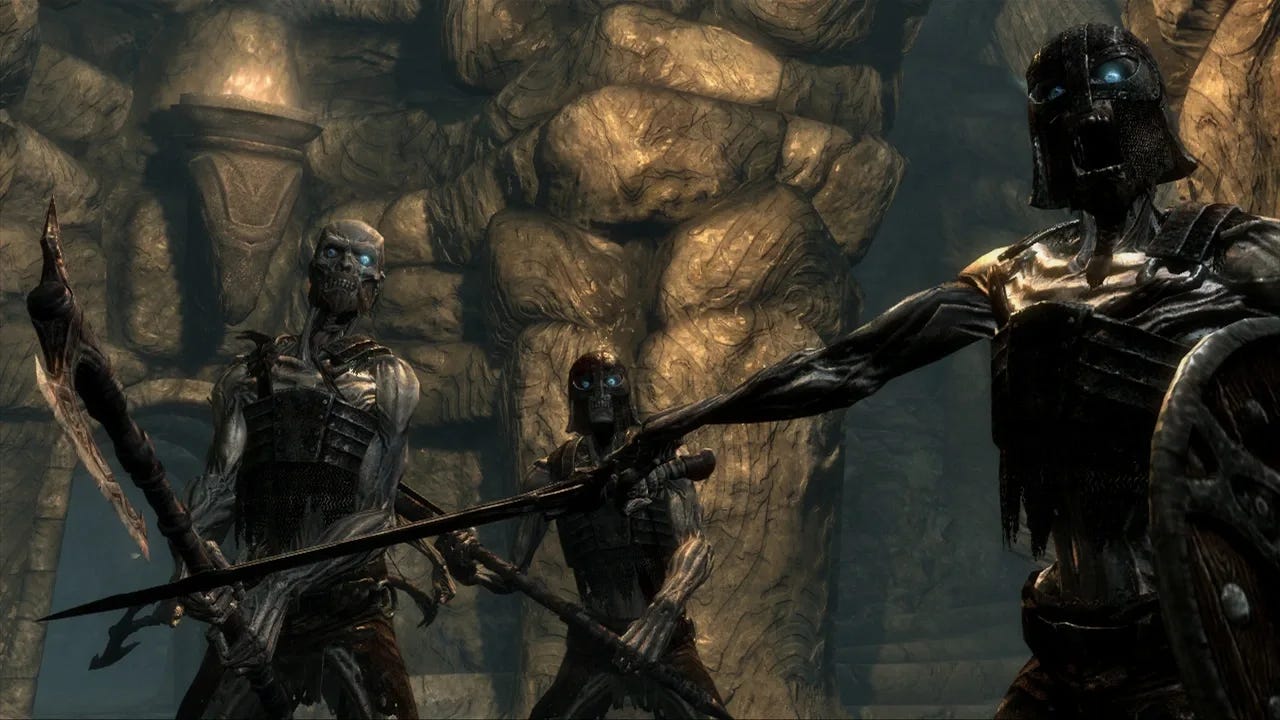
So, there you have it: we’ve toured the whole alley now! We’ve seen games charge the body (Dragon Age), the mind (Bloodborne, Cultist Simulator), the entire self (Dark Souls, Elden Ring), and even the deed to your eternal future (Baldur’s Gate 3), in exchange for some flavor of forbidden power or knowledge, and we’ve also seen how honoring the bill produces digital dark arts that actually feel dark… heavy, thrilling, and most importantly, consequential.
Now, let me show you what happens when you void the bill. Nothing (and I really do mean nothing) proves that the price is the point quite like watching a game delete the price and sifting through what’s left.
So with that in mind, ladies and gentlemen, I give you The Elder Scrolls V: Skyrim (2011), and its master-level Conjuration spell, Dead Thrall.
And really, the contrast between this and the previous section could not be starker. It’s such a delicious juxtaposition: Larian charged Wyll his face, his voice, his father, and his eternity for one pact… meanwhile, Bethesda just charges you a spell tome and some mana for an entire friggin army of enslaved dead. Here we have two games, in the same fantasy tradition, serving up the same forbidden arts… but pricing it in opposite directions, and as a result yielding completely different outcomes.
Anyway...
On paper, Dead Thrall is quite possibly the single most transgressive spell in all of mainstream gaming. Its function, per the in-game description:
Reanimate a dead body permanently to fight for you.
Pay attention to that ultra-precise wording (generally a good practice when parsing game lore, especially fantasy games). No, this isn’t a random skeleton, like with Diablo’s Necromancer. Nor is it an abstract summon from some tastefully distant plane, as is par for the course in just about every fantasy game of this sort. No, this is a person; a specific, named, formerly-alive person, with a face and a voice and a house somewhere, whom you (yes, you… let’s be real about the causal chain in this particular situation) usually killed, and have now conscripted into eternal postmortem service.
This is it.
This is the thing.
This is the act that the Witch of Endor was condemned for in the Bible, what medieval Europe accused its worst heretics of before burning them at the stake, what every necromantic taboo in the historical record exists solely to fence off.
Yet Skyrim simply hands it to you… as a purchasable spell tome, no less!
And what, dear reader, does it cost you?
Well, let’s audit. To even qualify to cast the spell, you first need Conjuration 90 and to complete a short ritual quest, after which a mage named Phinis Gestor (a mid-level college administrator, which is already depressing enough as it is) will simply sell you the tome for gold. The casting itself costs mana, of course… which you’ll recognize is the same renewable resource you use to light candles and shoot sparks.
And then?
Then nothing, that’s what. Just a little gold, and a little mana; that’s the whole bill!
Oh, and the thrall is permanent. Under the hood, the spell’s “duration” is 23,976 game-hours, which is Bethesda-speak for “f*cking FOREVER.” Nor do you even have to do anything to maintain the spell:
There is no upkeep,
Nor is there a concentration requirement,
Nobody’s holding a fragment of your soul in escrow,
The spell doesn’t drain your vitality,
There’s no hidden corruption meter that slowly creeps full,
No factions start meaningfully hunting you,
And there’s no god who even notices, let alone cares.
Not even (re-)death can meanintfully impede your necromancy! If your thrall dies, you simply cast the spell again — on the same corpse, unlimited times. Free lich refills with your initial purchase, forever! If only Wendy’s were so generous with their soda fountain.
Oh, and with the Twin Souls perk, you can even run two thralls at once. Double the befoulment, double the fun!
Really, the only real restriction is bureaucratic in nature (of course), and it’s far from what anyone would call onerous. For the spell to work, your target must be level 40 or below, a humanoid, and in possession of an intact head.
Yup, that’s right! The only thing that can actually stop you from pressing a corpse into serfdom is a level cap. Here we have the great and terrible art of necromancy, and its one meaningful constraint is a friggin level cap; this gives off the same energy as the minimum height signs when you’re waiting in line at an amusement park ride: “You must be this tall to transgress the most sacred, ironclad boundaries of life and death.”
Oh, and it gets better (worse): the community’s collective wisdom on Dead Thrall basically reads like the world’s most profane HR onboarding manual. You might already sense where this is going: lich min-maxing. You see, thralls will equip whichever weapons you assign them, but only wear the specific armor they died in, so guides earnestly advise you to undress your victim’s corpse, upgrade the armor at a forge, and re-dress them before reanimating them. They have unlimited carry weight, so the meta is to use your eternally enslaved dead as pack mules. I’m not even kidding; players even maintain tier lists of the best corpses. Yes, there are spreadsheets.
The terrible, fearsome dark art of Necromancy has thus been reduced to onboarding paperwork. Requisition your thrall, assign equipment, note the carrying capacity… geez, at least Diablo’s Priests of Rathma had the decency to euphemistally justify it as compost management; Skyrim doesn’t even bother with philosophy, it just hands you the employee manual before giving you root access to the Slack admin panel.
And oh look, what’s that over there? Why, it’s this article’s thesis, arriving right on schedule! For did you notice what just happened to the darkness in Skyrim’s take on the most forbidden art?
It’s gone. Completely, utterly, totally gone. Raising the dead in Skyrim is not frightening, nor is it transgressive, and it’s certainly not heavy… it’s nothing more than utility, emotionally identical to hiring a follower or buying a horse, and every Skyrim player knows it (even the ones not actively min-maxing their undead serfs). The act itself might be the most forbidden in the entire occult canon, but the actual experience is one of routine and humdrum inventory management. And it’s not because of censorship, or squeamishness, or a failure of art direction (at the very least, the shambling corpses still look appropriately gross and off-putting).
No, the darkness is gone because the price is gone. You got your shiny new lich slave, and you didn’t have to pay for it in blood, sanity, self, or obligation. The transaction that literally defined the taboo has thus been converted into a mere purchase, and a purchase that you can afford is, by definition, not forbidden… it’s just shopping.
Strip away the equivalent exchange, and necromancy (actual, human-corpse-puppeteering necromancy!) becomes about as spooky as adopting a dog that you don’t need to feed. Your free lich is a pet, not a pact.
The darkness was never in the skeletons, my brothers and sisters… it was in the invoice for said skeletons.7
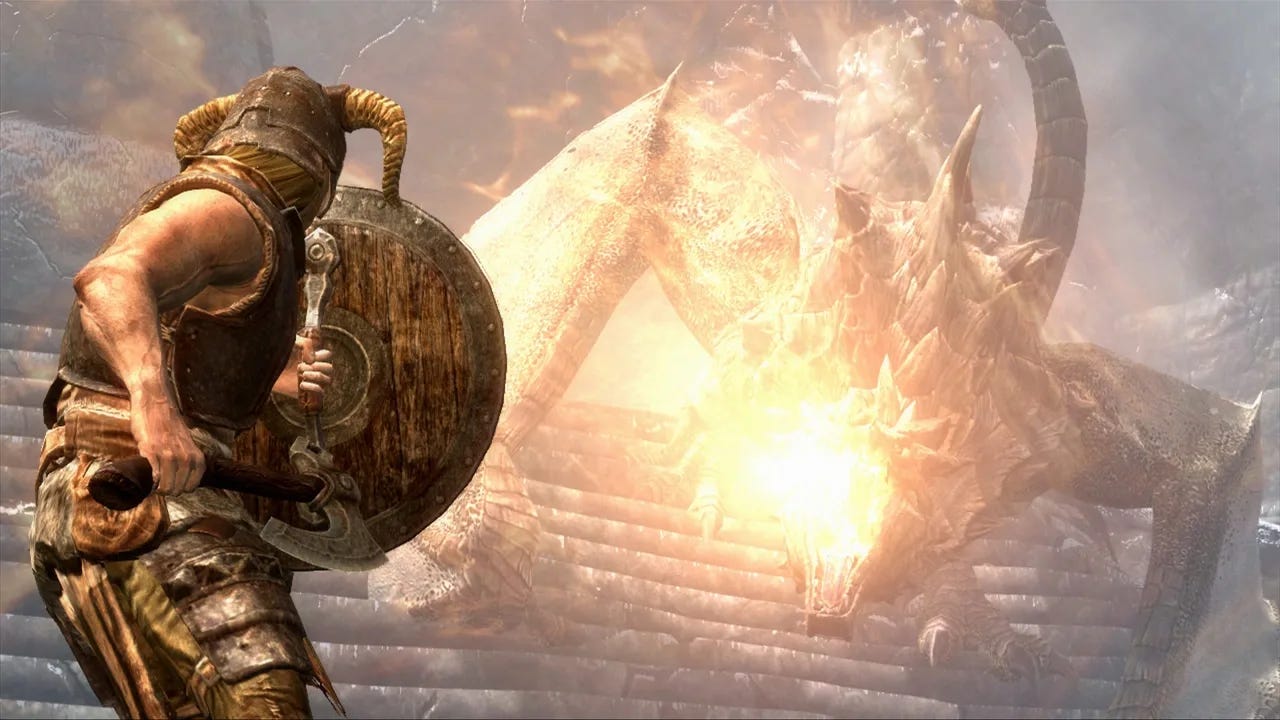
Now, before all the Skyrim faithful in my audience sharpen their ebony daggers and point them at my throat, I do want to make a concession. Yes, it’s a sincere one, don’t you worry.
Whatever else Skyrim’s frictionless necromancy may be, it isn’t an instance of bad design. It’s simply a different type of pleasure, one that’s thematically and experientially closer to LEGO than it is to Faust (and I mean this as the highest possible praise, as a LEGO fanatic myself).
Skyrim is a power fantasy, from top to bottom, and it’s refreshingly honest about that fact. The game has deliberately chosen to make its magic a toybox, not a moral laboratory, and Dead Thrall is consistent with this paradigm; it belongs to the same design philosophy as shouting a dragon out of the sky and stuffing 40 cheese wheels into your pockets. Skyrim’s world, by design, is an enormous digital playground where consequences are optional.
And that’s a completely legitimate thing for a game to be! Hearing me say this might shock longtime readers of this volume (or hell, this newsletter as a whole), but not every title needs to be a morality sim. In fact, if I’m being honest, I reckon most of them shouldn’t! There are days (many days… in fact, entire seasons of one’s life) when what you really need is not a meditation on the price of power, but two undead bandits carrying all your loot while you commit light crimes against the Thalmor. Tastes and pleasures vary, often within the same player and even on the same day, and the medium contains more than enough square footage to fit both the seedy back alley and the big-box toy store.
I’m also not claiming that “expensive” constitutes the complete anthropology of the forbidden, that it’s the only reason for forbidding a forbidden art. Real taboos are often tangled up in power, priestcraft, fear, class, in-group preference, and spiritual institutions’ perennial urge to monopolize the miracle business… which, if you’ve been reading this newsletter for a while, you already know is a central theme and thesis of not just this article, but this entire volume. As we’ve explored time and time again over the past 11 issues, the Right-Hand bazaar has never loved competition from the back alley, and plenty of “forbidden” arts were forbidden partly because they were freelance arts. The transactional reading we’ve explored in this article is but one lens; it’s far from a unified theory of everything.
Finally, I feel compelled to add the following obligatory epistemic disclaimer, per my house rules: my sources today are folklore, scripture, legend, and lead tablets… these constitute the accumulated cultural risk assessment of human civilization across all continents and several millennia, not rational post-Enlightenment lab reports. Whether the alley vendors are real is a question that this publication cheerfully declines to adjudicate. But what’s documented beyond dispute is that humanity believed in the bill, universally and emphatically, and built its warning labels accordingly.
I’m merely insisting on the design consequence we’ve spent the last 10,000 words exploring: you can void the bill, or you can keep the darkness, but you cannot do both. Skyrim made its choice, consistently and coherently, and gave us a great toy. We just shouldn’t be surprised that the toy isn’t scary.
So let’s total the receipt, shall we?
The forbidden arts, across the folkloric record, are transactions: power and knowledge purchased in the non-renewable currencies of blood, mind, self, soul, and future. The taboo around them was never primarily a moral verdict, it was more like UX. A warning sticker, if you will, applied by cultures that knew perfectly well that their members would keep reaching for the cookie jar on the shelf: this product will cost more than you think you’re agreeing to pay. Mary Douglas’ fences, which we build at the exact spot in the Venn Diagram where desire and danger overlap. Again, nobody taboos gravel.
And games, alone amongst all media, put the product in your hands. A novel can describe the pact, and a film can show it, but only a game can make you actually sign it. Which means that game designers inherit, whether they know it or not, the taboo-maker’s ancient job: setting the exchange rate.
Honor the bill (whether you spend the player’s health bar like Dragon Age, tax their perception like Bloodborne, run the triple tab like Cultist Simulator, wither their soul like Dark Souls, cost them the world like Elden Ring, or bill every act of conscience as a breach like Baldur’s Gate 3), and the digital dark arts keep their gravity. Their transgression feels transgressive because it actually transacts! That shiver you feel while accepting the Frenzied Flame is the same shiver the defixio writer felt in the midnight graveyard, because it comes from the same place: knowing that you are paying.
Void the bill, and you get the free lich: perfectly functional, genuinely fun… and about as dark as a foam skeleton decoration at Spirit Halloween. Which is fine! But by breaking the rule, you confirm it: the taboo is the design, in and of itself. The price has always been the darkness, and 50 centuries of forbidden arts folklore compress into a single design principle you could print on an index card: no exchange, no dread.
Games didn’t invent power released from consequences; humanity has fantasized about skipping the bill ever since the very first shaman padded his invoice for the very first time. But games did productize it, quietly and at industrial scale. For just $60, you can make the one purchase mystics throughout untold millennia could’ve only dreamed of: ripping the price tag off the forbidden art. Every dark ritual, every sinister pact, and every unholy rite, fully prepaid at the register… no further billing, cancel anytime.
Which is, when you think about it, the actually supernatural part of the whole arrangement. Reality’s alley vendors, per ~5,000 years of unanimous folklore, never once offered those terms. But somebody in this transaction is granting cost-free power to millions of eager supplicants, every single night, and I’ll tell you right now that it isn’t the Three Fingers.
But if the game itself is the entity handing you all this forbidden power with the bill mysteriously settled... what does that make the people who built it?
Ah... but that’s a question for another day. It’s getting late, and the spectral bells are about to toll at 3 AM.
So for now: go raise your skeletons, magus. Sign your blood pacts. Enjoy the free lich — genuinely, guiltlessly, and with my full blessing!
All I ask is that you spare but a single thought, perhaps mid-sandwich, for everyone in history who did it the old way, at the old prices. And if your thrall ever whispers “release me…” on the road to Whiterun?
Well... now you know whose bill you’re not paying.
~Jay
Alright, you made it through the whole thing! Now it’s your turn. While you wait for the next issue, I invite you to mull over the following discussion prompts. Please reply to this email with your answers, or post them in the comments. I'd love to hear your thoughts!
Your Priciest Purchase: What’s a game where wielding dark or forbidden power actually felt transgressive to you, where you actually hesitated before casting, signing, or accepting? What was the game charging you, and did you pay willingly?
In Defense of Your Free Lich: Conversely, what’s your favorite cost-free power fantasy? Which forbidden art have you most gleefully wielded with zero guilt and zero consequences? Now that you’ve read this issue... does knowing the bill was voided change how it feels? (Be honest! No judgment, this is a safe alley.)
Patch Notes from Hell (one for the game devs): Imagine you’ve been hired to patch Skyrim‘s Dead Thrall so that necromancy feels forbidden again, but the suits insist you can’t make it un-fun. What’s the ONE cost you’d add? Blood, sanity, self, obligation... or something the alley hasn’t thought of yet?
The Wyll Question: If you’ve played Baldur’s Gate 3: when Mizora put the contract on the table (Wyll’s freedom vs. his father’s life) which did you choose, and how long did you sit there before clicking? If you haven’t played: which would you choose, knowing the exit fee is always another contract?
Warning Labels IRL: Where else in modern life do we stamp “forbidden” on something that’s really just expensive, a warning label about an exchange rate rather than a moral verdict? (I can think of a few four-letter examples starting with “d-e-b-t,” but I want to hear yours first.)
The Ignorance Build: Bloodborne lets you stroll through its most maddening areas untouched… provided you stay at zero Insight, deliberately unenlightened. Would you take that deal in real life: perfect peace of mind, at the price of never knowing what’s actually clinging to the buildings? Or is the knowledge worth the Frenzy?
Want to keep browsing the alley after hours? Here’s where I’d start:
Purity and Danger: An Analysis of Concepts of Pollution and Taboo by Mary Douglas (1966) — The anthropological backbone of this entire issue. Douglas argues that taboos are how societies maintain their boundaries and categories, by building fences where desire and danger overlap. Can be dense in places, but the “dirt is matter out of place” chapter alone will rewire how you think about every content advisory, dietary law, and “we don’t speak of such things” in human history. – Routledge
Curse Tablets and Binding Spells from the Ancient World edited by John G. Gager (1992) — The definitive English-language collection of defixiones, fully translated and annotated. Reads like the world’s oldest comment section, so you know it’s gonna be amazing. If the Side Quest on curse tablets left you wanting more chariot-hexing pettiness, this is your next read. – Oxford University Press
Forbidden Rites: A Necromancer’s Manual of the Fifteenth Century by Richard Kieckhefer (1997) — A scholarly deep-dive into an actual medieval necromancer’s handbook (the so-called Munich Manual), showing what the IRL historical “dark arts” actually looked like on the page: the circles, the fasting, the obligations, and the sheer terror. The real-world source code behind every protective-circle reference in this issue. – Internet Archive
Grimoires: A History of Magic Books by Owen Davies (2009) — A lively, rigorous history of the forbidden books themselves, including how they were written, banned, smuggled, and feared, and why owning one was often treated as more dangerous than reading one. Shows you why “forbidden knowledge” was actually a physical object problem for most of recorded history. – Oxford University Press
Up Jumped the Devil: The Real Life of Robert Johnson by Bruce Conforth & Gayle Dean Wardlow (2019) — The definitive, award-winning biography that painstakingly separates the man from the crossroads legend. If the Side Quest made you want the actual story (which is, in its own way, sadder and stranger than the myth), start here. – Amazon
Doctor Faustus by Christopher Marlowe (c. 1592) — The Ur-text of the Western obligation pact narrative, and still its most chilling rendition. Skip the Sparknotes and read the final scene aloud at midnight; Marlowe understood the horror of a payment deadline better than any writer before or since. (Goethe’s Faust is the more famous treatment, but Marlowe’s is the one that reads like a countdown timer.) – Project Gutenberg
Fullmetal Alchemist by Hiromu Arakawa (2001–2010) — Yes, the manga. If you’re going to borrow “equivalent exchange” as your organizing law (as I did, shamelessly), you owe it to yourself to see the source material interrogate, stress-test, and ultimately complicate its own iron rule across 27 volumes. Quite possibly the single best long-form meditation on magical cost ever put to page. — Amazon
Esoterica (YouTube channel), hosted by Dr. Justin Sledge — A working academic historian of Western esotericism covering grimoires, necromancy, demonology, and forbidden rites with actual scholarly rigor and zero sensationalism. If this volume has been your gateway drug into occult history, this channel is the harder stuff. — YouTube
Weather Factory’s developer blog — Alexis Kennedy and Lottie Bevan’s studio blog, where they’ve written candidly about Cultist Simulator‘s design philosophy of hunger, dread, and paying for everything. Rare insight into how the alley vendor thinks when the alley vendor is a game studio. – Weather Factory
Bloodborne Wiki: Insight — The full, obsessively documented breakdown of every Insight threshold and effect, compiled by the community over a decade of collective madness. – Fextralife
bg3.wiki: Wyll & Mizora — Every clause, consequence, and enforcement mechanism of gaming’s most meticulously documented infernal contract, including outcomes I didn’t have room to cover (there are several). — BG3 Wiki [Wyll + Mizora]
Dragon Age: Origins, developed by BioWare, published by Electronic Arts — Steam
Bloodborne, developed by FromSoftware, published by Sony Interactive Entertainment — PlayStation
Cultist Simulator, developed by Weather Factory, published by Humble Bundle — Steam
Dark Souls, developed by FromSoftware, published by BANDAI NAMCO — Steam | PlayStation | Xbox | Nintendo Switch
Elden Ring, developed by FromSoftware, published by BANDAI NAMCO— Steam | PlayStation | Xbox
Baldur’s Gate 3, developed and published by Larian Studios – Steam | GOG | Playstation | Xbox
The Elder Scrolls V: Skyrim, developed by Bethesda Game Studios, published by Bethesda Softworks – Steam | Playstation | Xbox | Nintendo Switch | Nintendo Switch 2 | Amazon Alexa (yes, really)
Thank you for reading! If you enjoyed this content and would like to read more of it, hit the heart button at the top or bottom of the post—it really helps with my discoverability! You can also show your support by sharing this issue with your social networks and subscribing to Game & Word (if you haven't already).
See you next time!
#philosophy #metaphysics #religion #spirituality #narrative #magic #antropology
#AbraCodeAbra
#eldenring #bloodborne #dragonageorigins #cultistsimulator #baldursgate3 #skyrim
This is, of course, its own kind of price (decades of devotion aren’t exactly free, after all!), but it’s a subscription model that you pay in installments so small you barely feel them. The Left-Hand Path, on the other hand (pun intended), is a payday loan.
To be clear, I’m using this as a pop culture handle, not an academic citation. Hiromu Arakawa didn’t invent the idea; rather, she crystallized (in one beautifully merchandisable phrase) a principle that runs through sympathetic magic, sacrificial religion, and cautionary folklore going back as far as we have records. The Brothers Elric just have better brand recognition than the Ancient Near East, so here we are.
Also notice how drug dealers are another perennial fixture of seedy back alley marketplaces.
There’s a beautiful economic cruelty at play (pun again intended) here, as well: Insight doubles as literal currency at the Insight shop, so you can spend down your forbidden knowledge on consumables. In other words, you can trade revelation for bullets like a mystic pawning his third eye. The game lets you choose, continuously, between wisdom and safety… this is about as close as we’ve ever gotten to attaching a UI dashboard on a Zen koan.
Now, quite mercifully for a FromSoftware joint, the game does offer a single, highly obscure refund mechanism: Miquella’s needle. But, in a twist that’s more true-to-form for FromSoftware, you can only obtain it by completing one of the most missable questlines in a game made of missable questlines. Read: the only artifact that can catalyze your redemption can only be obtained in the hidden arena of a secret and tough-as-nails boss (harder, even, than the game’s actual final boss!), at very the bottom of a secret zone on the farthest edge of the map.
And then, even after you’ve obtained it, you can’t just use it on the spot… no, Tarnished, your ordeal isn’t over yet! For in order to actually exercise said artifact’s redemptive powers, you need to make your way to another secret dragon boss arena, in a late-game area, that the game gives next to no indication is mechanically or narratively required (or even just conducive) for doing so!
Which is to basically say: yes, this contract has an escape clause, but it’s written in six-point font, on the back page of the agreement, in a language you’d need a strategy guide to decipher. With a power as forbidden as the Frenzied Flame, even the refund comes with a price.
And lest you think I’m beating the legal analogy into the ground too much, the game shows you the actual fine print! Mizora quotes the document, clause and section, on-screen: “Clause A § 2: Should soul holder choose to abandon his patron, he is freed from his duty. His father Grand Duke Ulder Ravengard will be thus fated to die by an enemy’s hand.”
An infernal contract with collateral clauses that name his family! Somewhere, an IRL subprime lender is taking copious notes.
Bethesda, to its credit (or possibly by accident… which with Bethesda is a genuine coin flip), did leave one crack in the drywall through which the old horror leaks: Dead Thralls occasionally speak. As they shamble behind you, hauling your surplus dragon bones, they moan fragments through their dead vocal cords. Usually, it’s just combat barks like:
“You must die,” or:
“Must kill.”
However, very rarely, after a very long period of service, they’ll sometimes plea:
“Release me…”
It’s the single most disturbing detail in the entire game, and the reason it’s so disturbing is because it’s literally the only moment where the bill resurfaces, the only hint in the entire game that someone, somewhere inside that ambulatory corpse, is still paying for your convenience. One voice line... the entire deleted price of necromancy has been compressed into one optional and easily-missed voice line, asking you… imploring you… begging you, from off the books.
*shivers*
Comments
Nothing yet. Say the first thing.
Sign in to join the conversation.