
This bonus content is available exclusively to paid subscribers of Game & Word. If you’re reading this, thanks for supporting independent games criticism… and for trusting me to take you into some genuinely weird territory.
If you don’t have a paid subscription, now’s a good time to upgrade! You’ll receive bonus pieces like this one, gain access to the full archive, and get to feel good for being the type of person who supports indie publishers. It’s a much better way to feel better about yourself than doomscrolling and yelling at bots on Reddit or X! Just click/tap the button below to upgrade your subscription:
Oh, and if you haven’t read this supplement’s Main Piece, I’d highly encourage you to do so first, though it’s not strictly necessary if you’re already at least somewhat well-versed in Diablo lore:
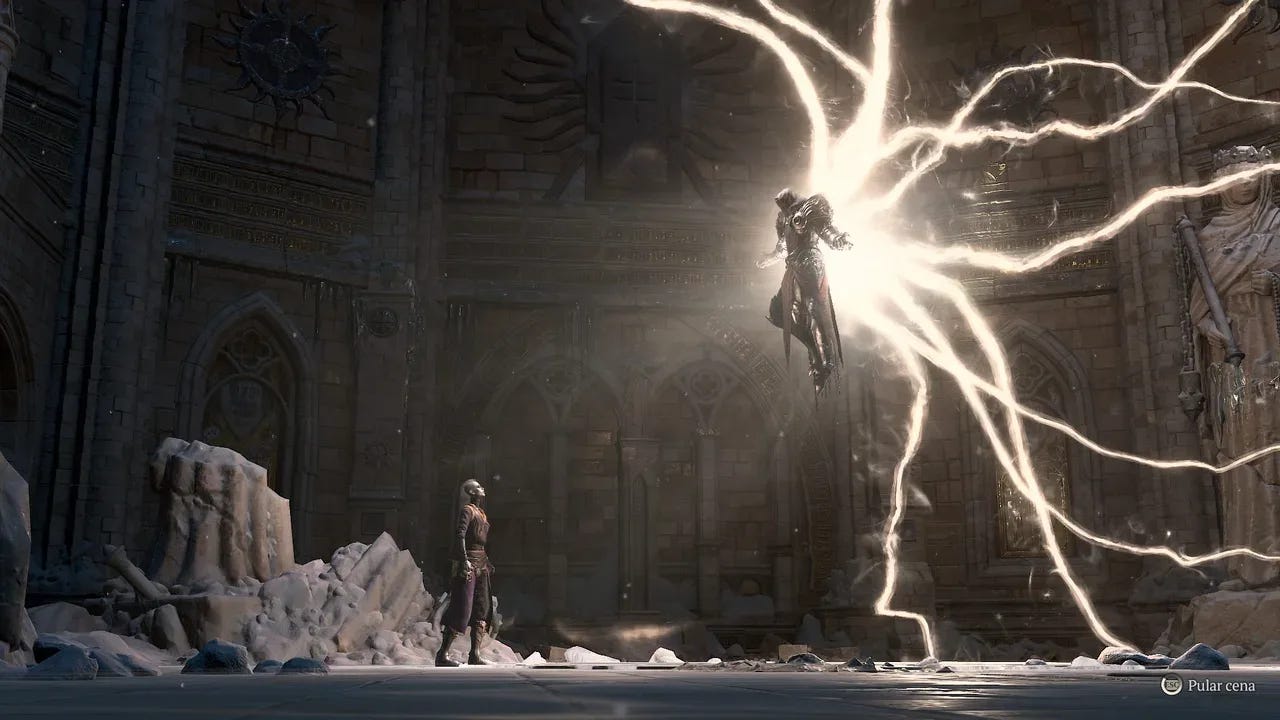
I want to open with a moment, towards the end of Diablo III (2012), that really should have felt triumphant but is more likely to instead register as a personal affront.
By now, you’ve clawed your way through the Burning Hells, slaughtered entire legions of demons, and stormed the High Heavens themselves to confront Diablo—now a fully-formed Prime Evil, wearing your former ally’s skin, who deftly exploited a cosmic loophole to launch a full-on assault on the heavenly host, breaching the pearly gates with his infernal hordes who then proceeded to ransack Heaven’s tall marble spires and glistening golden streets like a cohort of demonic frat bros tearing through Bourbon Street on Spring Break.
You’ve just repelled the invasion, saving the celestial realm itself from almost certain annihilation. Imperius, the Archangel of Valor, then turns his big shiny spear toward you and snarls:
“You! Your kind does not belong here, Nephalem. If I see you again, you will die.”
You’ve just saved his entire plane of existence. And he’s pissed that you even bothered!
You’d expect the angels to be grateful. Not least because… well, they’re angels. Things like gratitude implicitly come with their job description. But nope! They’re irritated. And even worse, they’re scared. You stand before the Angiris Council (Heaven’s supreme governing body) as humanity’s greatest champion, but they don’t see you that way at all. Instead, they view you as a walking violation of cosmic protocol. You’re a variable their system was never designed to accommodate.
It’s a hell of a thing, isn’t it? You spend 60 hours clicking through demons to reach Paradise, and Paradise looks at you like you’re a bug it hasn’t yet decided to squash.
If you’ve played enough video games, you might recognize this moment as part of a pattern: Heaven, when it shows up in games, almost never feels heavenly. It feels more like a courthouse, or a boardroom staffed by a schoolmarmish HR department that only exists to say “no” to things. Divine order, in game after game, functions like a bureaucracy: brittle, procedural, and utterly hostile to exceptions. Not exactly the image of moral perfection you’ve come to expect from church/shul/Michaelangelo, is it?
Diablo is far from unique in this, by the way. From Shin Megami Tensei‘s tyrannical YHVH to Elden Ring‘s calcified Golden Order and Dark Souls‘ divine gerontocracy, video games across disparate cultures, decades, and genres espouse a surprisingly consistent theology:
Heaven is a system,
Systems eventually fail,
When divine systems fail, they fail catastrophically.
This raises an obvious question: where did games learn to think this way?
The answer, I’d argue, is buried in one of Western spirituality’s most controversial texts, a book removed from nearly every biblical canon because it was considered too dangerous for mass consumption, and yet is quoted directly in the New Testament. A book that locates the origin of evil not in demonic temptation or human weakness, but in Heaven’s own agents’ authorized actions.
I’m talking about the Book of Enoch.
And I think games have been playing it for decades.
Comments
Nothing yet. Say the first thing.
Sign in to join the conversation.