
In July, a bookseller on Biblio received an order for roughly a thousand books. Random titles, no coherent subject, buyer anonymous, because the marketplace guarantees anonymity. The seller had seen the pattern before and had a theory about who was on the other end, so he slipped an Apple AirTag between the pages of one volume and handed the tracking feed to Emanuel Maiberg at 404 Media.
The tag flew to Milwaukee. It sat two weeks in a distribution warehouse outside Kenosha. A truck carried it west with an overnight stop in Grand Junction, and its last signal came from the north end of 5801 Nicco Way in northeast Las Vegas. That building is LAS8, an Amazon site mostly known for print-on-demand. The north end houses a separate team called VGT3, and the logo at its entrance is a Tyrannosaurus rex holding an open book.
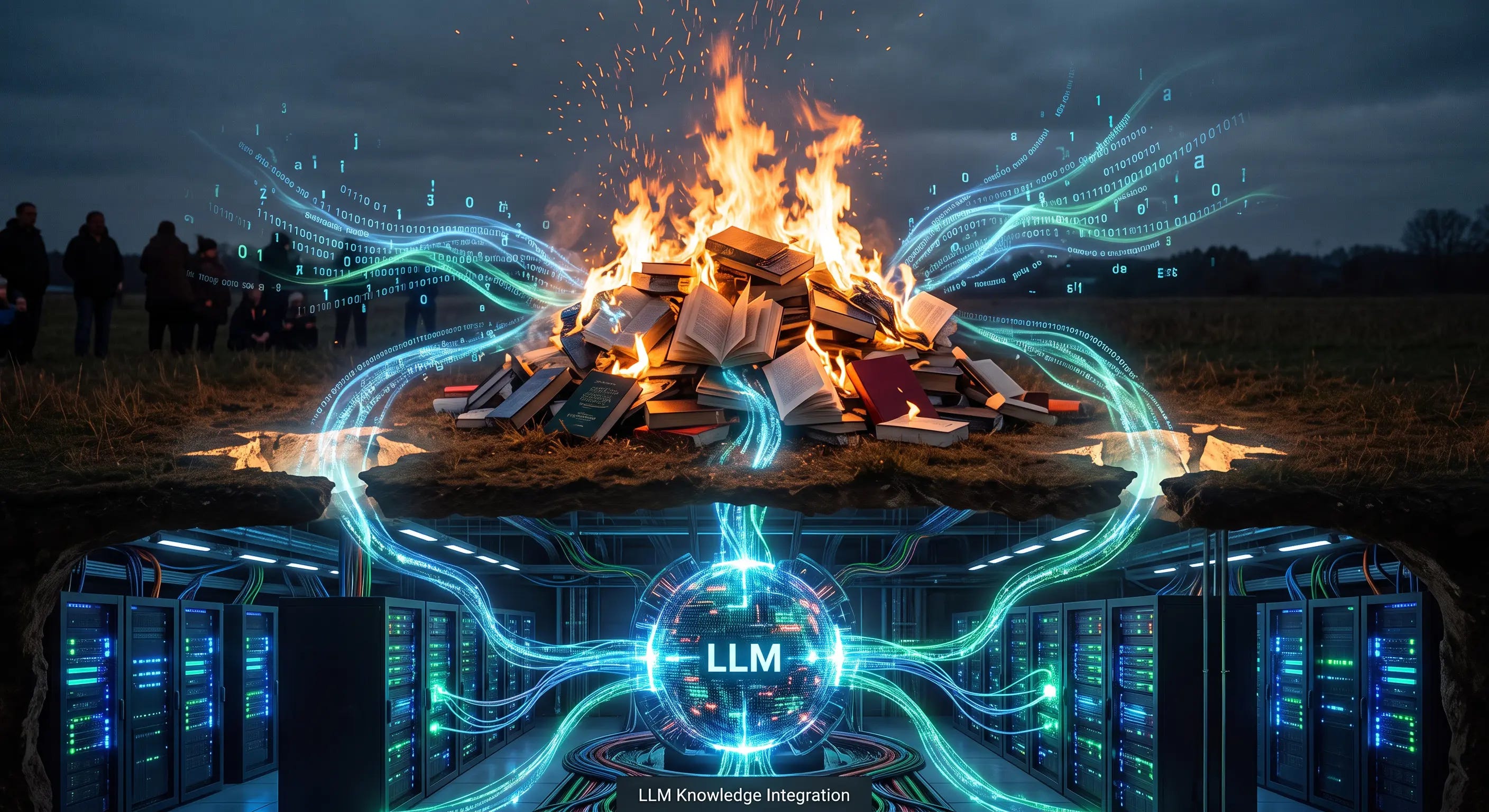
Amazon employees describing VGT3 on a workers’ forum say the job matches the logo. Pallets of printed books arrive. Some workers scan the ISBN barcode on each one to log what has already been processed, so the operation can target titles it hasn’t captured yet. Others cut the spines off so the loose pages feed through a scanner faster. The text becomes training data and the paper goes in the trash. One employee wrote that “all we do is scan books.”
Asked about it, Amazon said it buys books “through commercial channels” to help develop and improve its products and services. That is the whole statement. No mention of AI, and nothing about what happens to the books after the scanner.
That address is in my city. It is a beige box in the north valley with loading docks and a parking lot, and there is nothing on the outside that tells you anything. I have spent close to thirty years building document pipelines for other people’s businesses, and the last two building retrieval systems on SQL Server vector columns for clients who need an agent to answer from their own corpus instead of from a model’s fuzzy recollection. So I know what that warehouse produces, and it is not knowledge. It is a proprietary index.
The obvious question is why Amazon, a company that started as a bookstore, destroys inventory instead of reselling or donating it. The cost story is real but secondary. Cutting the spine lets you run pages through a sheet-fed scanner instead of a camera rig with an operator turning pages and software correcting for gutter shadow, which is roughly an order of magnitude cheaper and produces cleaner OCR. A slow-moving used title bought in a thousand-book lot also costs less than the pick-pack-ship labor required to sell it one at a time.
The real reason is Judge William Alsup’s June 2025 order in Bartz v. Anthropic, and the mechanism matters more than the headline. Alsup held that buying a print book, scanning it, and destroying the original was fair use because it was a format change that created no additional copies. The print original was destroyed and, in his words, “one replaced the other.” Ropes & Gray’s read of the order put the load-bearing part plainly: the format shift counted as transformative because it did not increase the number of copies in existence or send any of them outside the company.
Resell the book after scanning it and that reasoning falls apart, because now a digital copy exists and a physical copy is back in circulation. That is multiplication rather than format-shifting, and it hands the plaintiffs a clean argument. Donation has the same defect with worse optics for the defense. The Authors Guild already contends the format-shift holding contradicts ReDigi and Hachette v. Internet Archive and expects it reversed on appeal, so Amazon’s lawyers are not about to gift them a better fact pattern for two dollars a volume.
The destruction is the compliance step. A federal court told the industry that eliminating the original is what makes the copy legal, and the industry did what rational actors do when a court draws a line that clearly.
None of this started in Las Vegas. In February 2024 Anthropic hired Tom Turvey, formerly head of partnerships for Google Books, and set him to acquiring every book he could get. Documents unsealed in the Bartz litigation named the effort Project Panama and described it as an attempt to “destructively scan all the books in the world.” Industrial cutters took the spines, high-speed scanners took the pages, and the remains went to recycling.
The detail that should stay with you is not the machinery. It is a line from a 2024 internal planning document reported by the Washington Post: “We don’t want it to be known that we are working on this.” They understood exactly how it would land, did it anyway, and kept quiet about it, and the only reason anyone knows is that discovery pried the documents loose.
Then look at what the money actually punished. Anthropic paid roughly $1.5 billion, about $3,000 across some 482,000 covered works, finalized in July 2026 and the largest copyright class recovery in American history. Every dollar of it was for the seven million books the company torrented from Library Genesis and Pirate Library Mirror. The books it bought and shredded cost nothing beyond the purchase price. So the lesson the industry drew from the biggest copyright settlement ever recorded was not to stop taking books. It was to stop torrenting them and buy a paper cutter instead, and the warehouse in my city is that lesson in operation.
Google, whatever else it deserves, did not do this. Google Books used a patented non-destructive camera process on volumes borrowed from partner libraries and gave them back. The technology to digitize without destroying has existed for twenty years. It is only slower.
Blame the warehouse if you want, but the enclosure happened long before anyone bought a scanner.
On October 7, 1998, Congress extended copyright by twenty years, to life plus seventy and ninety-five years for corporate works, and applied it retroactively to works already published. The Senate passed it by unanimous consent and the House by voice vote. There is no roll call. Twenty-eight years later you cannot look up how your representative voted, because the record does not exist, and it does not exist by design.
Lawrence Lessig documented that ten of the thirteen original House sponsors had taken the maximum contribution from Disney’s political action committee, on a bill whose real deadline was Steamboat Willie’s scheduled 2003 entry into the public domain. Everyone called it the Mickey Mouse Protection Act. Mary Bono, whose late husband’s catalog the bill enriched, spoke in favor rather than recusing herself.
That vote is why a 1971 business manual with a dead author and a defunct publisher is simultaneously worthless and legally radioactive until the 2060s. Nobody can reprint it and no library can put it online. Its market value is zero and its legal risk is not, which is the exact combination that makes a book worth two dollars to a scanner and nothing to anyone else.
Congress knew. The Copyright Office studied orphan works and reported in January 2006. A bill followed that year and died. A better one, the Shawn Bentley Orphan Works Act, sponsored by Leahy with Hatch and Bennett, passed the Senate by unanimous consent on September 26, 2008. The House referred it to committee that May and let it expire at the end of the 110th Congress. That was eighteen years ago and nothing since has come close.
So the record reads like this. When the ask was twenty more years of monopoly for companies with lobbyists, Congress moved in months and left no fingerprints. When the ask was a limited-liability path to preserve books whose owners cannot be found, Congress ran out the clock twice. Amazon spent $18.9 million on federal lobbying in 2025 alone. Nobody spends anything on the other side of this, because there is no other side. Orphaned books have no rightsholder to write the check.
Alsup is the wrong target, and the easy version of this argument gets it backwards.
He has a mathematics degree from Mississippi State, clerked for Justice Douglas, writes code as a hobby, and taught himself enough Java during Oracle v. Google to look at the nine copied lines of rangeCheck and tell David Boies to his face that any competent programmer could have written them, which torched Oracle’s damages theory. He is also the judge who ruled against Anthropic on the piracy, which is what produced the $1.5 billion in the first place.
Fair use is a four-factor test with no statutory carve-out for cultural preservation, because Congress never wrote one. Alsup applied the doctrine he was handed to the facts in front of him, and he spelled out that the destruction of the original was doing the work, which was an open invitation to legislate that nobody on Capitol Hill picked up. He has since retired, and the settlement’s final approval came from Judge Araceli Martínez-Olguín.
Blaming judges is the comfortable move because they are visible and legible in a way that a 1998 voice vote is not. The statute is where this was decided.
There is a working version of the seed-bank idea for books, and it is not hypothetical. HathiTrust was founded in 2008 out of the Google Books scanning as a preservation repository holding millions of volumes. The Authors Guild sued. In June 2014 the Second Circuit held that keeping those digital copies for full-text search, for print-disabled access, and for replacing library originals that were lost or destroyed was fair use, and that full-text search harmed no existing or potential market for the works. A searchable database of everything, the court said, is quintessentially transformative.
The legal architecture for a book vault has been settled law for eleven years, and here is what happened to it. In 2011 HathiTrust announced an Orphan Works Project to open the full text of works whose owners could not be located. The Authors Guild sued, HathiTrust shelved the project almost immediately, and the court declined to rule on a program that never launched. Nobody has tried again in the fifteen years since. The vault exists and the precedent holds, but the one time an institution tried to define an access trigger for dead-author, defunct-publisher titles, a trade association scared it off with a lawsuit it never had to win.
On the night of May 10, 1933, students of the Nazi German Student Union burned roughly twenty thousand volumes on the Opernplatz in Berlin, working from blacklists assembled by a librarian named Wolfgang Herrmann under a campaign titled “against the un-German spirit.” Freud, Marx, Einstein, Heinrich Mann, Erich Kästner. Kästner stood in the crowd and watched his own novel go into the fire.
That square is now Bebelplatz, and set into its cobblestones is a glass panel over a white underground room lined with empty shelves. The Israeli sculptor Micha Ullman built it in 1995 and sized the shelving to hold exactly the number of books that burned there. A bronze plate nearby carries Heine’s line from 1820 about what follows the burning of books. The memorial works because you can stand on the glass and count an absence.
Every book burning in history shares one structural feature: nobody read them first. Destruction was the whole objective. Qin Shi Huang, Savonarola, the Index, Bebelplatz — the burner’s position was that the contents were dangerous and the world would be improved by their removal. Ignorance operating at scale, and legible as such to anyone watching.
VGT3 inverts that, and I want to be careful here, because the claim is not that Amazon is doing what the Nazis did. It isn’t, and pretending otherwise would be both false and lazy. The inversion is the entire point. The workers at that warehouse read every page before the paper hits the bin. The scanner is the reason the book is in the building. Destruction is not the objective, it is the receipt. Nobody at Amazon is arguing that a 1974 metallurgy textbook is dangerous. They are arguing that it is valuable, which is exactly why they want the only durable copy on their side of the wall.
You could not build a memorial for LAS8, because the text is not gone. That is what makes this hard to be angry about in the traditional way, and it is also what makes it worse. Ullman’s shelves are empty and you can see that they are empty. Amazon’s shelves are full, and you will never be permitted to look at them.
The word “public” is doing real work in this argument, so let me be exact. Publication means making public. That is what the word is. Every one of these titles was published: offered to anyone with a library card or a few dollars, reviewed, catalogued, shelved, assigned in classrooms. Then the term got stretched to life plus seventy, the publisher folded or lost interest, the print run sold through, and the book drifted into a legal condition where it was nobody’s product and everybody’s liability. What Amazon bought at two dollars a volume is the residue of that process — work that was once public, made inaccessible by statute, and now being converted into a private asset that will be metered back to you.
If you want the full sequence inside a single company, look at Wiley. Wiley was one of four publishers that sued the Internet Archive over controlled digital lending. They won at the Second Circuit in September 2024, and the Archive has since pulled more than half a million books from lending. Titles taken off a free digital shelf and handed back to nobody. Then, in the fiscal year ending April 2026, Wiley booked $49 million in AI licensing revenue. Same catalog, withdrawn from the library and sold to the model. The authors were not paid either time.
ISBNdb, which maintains one of the largest book metadata databases in the world, briefly ran a landing page pitching bulk physical book sourcing to AI labs at a thousand to a million volumes per order, buyer identity under NDA. Its own marketing copy included this line: “’AI company destroys two million books’ is not a headline that generates sympathy.” The page came down nine days after 404 Media wrote about it, and the company now says no such service ever existed. Nobody made them do that. No regulator was involved anywhere in the sequence. A reporter was the entire enforcement mechanism.
Pre-2022 print is the premium input because it predates both AI-generated text and any data-poisoning tooling, so it is structurally clean in a way no web crawl can match. Epoch AI has projected that the supply of public human-generated text could be exhausted somewhere between 2026 and 2032. Printed books are a fixed, finite, non-renewable corpus, and everyone bidding on them understands that.
That Wiley figure is not a rounding error in its business. Lifetime AI revenue is past $110 million, and net income jumped 163 percent to $221.6 million on essentially flat total revenue of $1.67 billion, which means nearly all of the profit growth came from licensing authors’ work to AI companies. No author revenue share was reported. HarperCollins’ Microsoft arrangement offered $2,500 per title and is the rare structure that asked authors at all, while academic authors at Wiley and Taylor & Francis reported neither separate consent nor payment.
On the buy side, in the quarter ending June 2026 AWS grew 36.7 percent, which Jassy called “booming,” with the AI business past a $25 billion annual run rate, Bedrock customer spend in the quarter exceeding all prior quarters combined, and 2026 capital expenditure guided to roughly $220 billion. Bedrock’s catalog includes Claude Opus 5. So Amazon shreds books in my city to train its own frontier model while renting you Anthropic’s model, trained the same way, by the token, on its own infrastructure, at its own margin. The books are the cheapest input in that stack at around two dollars each, the scan is a one-time cost, and the rent has no end date.
The part I care about as someone who builds these systems is what gets lost in the conversion. A model is lossy compression with the provenance stripped out. When I build a retrieval pipeline for a client, the whole discipline is keeping the source document reachable so the agent can cite a page and a human can go check it. VGT3 produces the opposite of that: a corpus nobody outside Amazon can query, feeding a model that emits assertions nobody can trace back to anything. If the only surviving route to a 1970s technical text is asking a model what it remembers, that book has not been preserved. A citable document has been replaced with an unauditable paraphrase, and a meter has been attached to it. Nobody needs to tamper with a single page for that to be a degradation.
Not forcing them to release the scans. Amazon owns a copy, not the rights, so a public-dump mandate would compel mass infringement, injure the few authors of out-of-print work who might still reissue, cost Amazon almost nothing given it has already extracted the training value, and hand destructive scanning a coat of civic paint. That is roughly why Judge Chin killed the Google Books settlement in 2011.
Two things would work, and both require Congress to do its job. The first is to condition the destructive-scanning safe harbor on deposit. If you want the fair use defense Alsup handed you, deposit a copy with the Library of Congress or a HathiTrust-class custodian under the access terms the Second Circuit already blessed: full-text search, preservation, print-disabled access. The scanning happens either way. The only question is whether the public gets a copy of what was made from books it will never see again. The second is to pass the orphan works bill. It cleared the Senate unanimously in 2008 and the text still exists. Somebody has to reintroduce it.
The books at LAS8 are not what was stolen from us. Those were slow-moving used copies headed for a pulper regardless, mass-produced titles with thousands of siblings still sitting on shelves. The theft happened in 1998, by voice vote, with no roll call, and the warehouse with the dinosaur on the door is only the first company to build something profitable on top of the wreckage. Elon Musk said in July that he had asked his AI team to “preserve any rare books in a library and scan them the hard way,” which is a decent instinct and also exactly the sort of thing that should not depend on one billionaire’s mood.
The bookseller who planted the AirTag put it better than I can. Asked what the buyers were missing, he pointed out that value comes in more than one form: there is monetary value, and then there is historical value, intellectual value, sentimental value, none of which shows up anywhere in a scanning operation’s arithmetic, because the operation only wants the words in a row.
About the Author
Gal Ratner is the founder and CTO of Inverted Software and WhiteStar Labs, and Chief Architect at Prana Entertainment. He has spent nearly thirty years shipping production systems on the Microsoft and .NET stack for clients including Microsoft, Sony, Rockstar Games, 2K Games, Best Buy, and Allegiant Air, and was employee number six at Break.com during the user-generated content era. His current work is production agentic AI: MCP servers, the Microsoft Agent Framework, RAG pipelines on SQL Server 2025 vector search, and the PLogger observability framework. He builds Cara, the shopping assistant behind ShopSnap. He is the author of the novel The Archive of Lost Suns, trains Brazilian jiu-jitsu under Sergio Penha, rides motorcycles, and co-hosts Edge Grip Podcast. He writes about the gap between what executives say about AI and what practitioners actually ship. He lives in Las Vegas, a short drive from LAS8.
No posts
Comments
Nothing yet. Say the first thing.
Sign in to join the conversation.