
Count the week. Australia’s recording industry announced it will bar wholly AI-generated tracks from its official charts and its awards, effective Friday, after a cover of “Like a Prayer” built with synthetic vocals and drums spent months near the top of the national airplay chart. Runna, the running app Strava bought last year, announced a partnership with Loughborough University to put actual sport scientists behind its training plans, and its head coach said out loud that the point was to set the product apart from AI-generated ones. YouTube is deep in an enforcement campaign against what its own CEO calls AI slop, pulling monetization from channels built on mass-produced output. And on Monday, a Goldman Sachs partner went on the firm’s own podcast to warn that Wall Street is at risk of hollowing out the reasoning skills of its next generation.
Four industries, one week, four sets of guardrails, all of them respectfully received. Now count the guardrails erected around software development in the same seven days. I’ll wait.
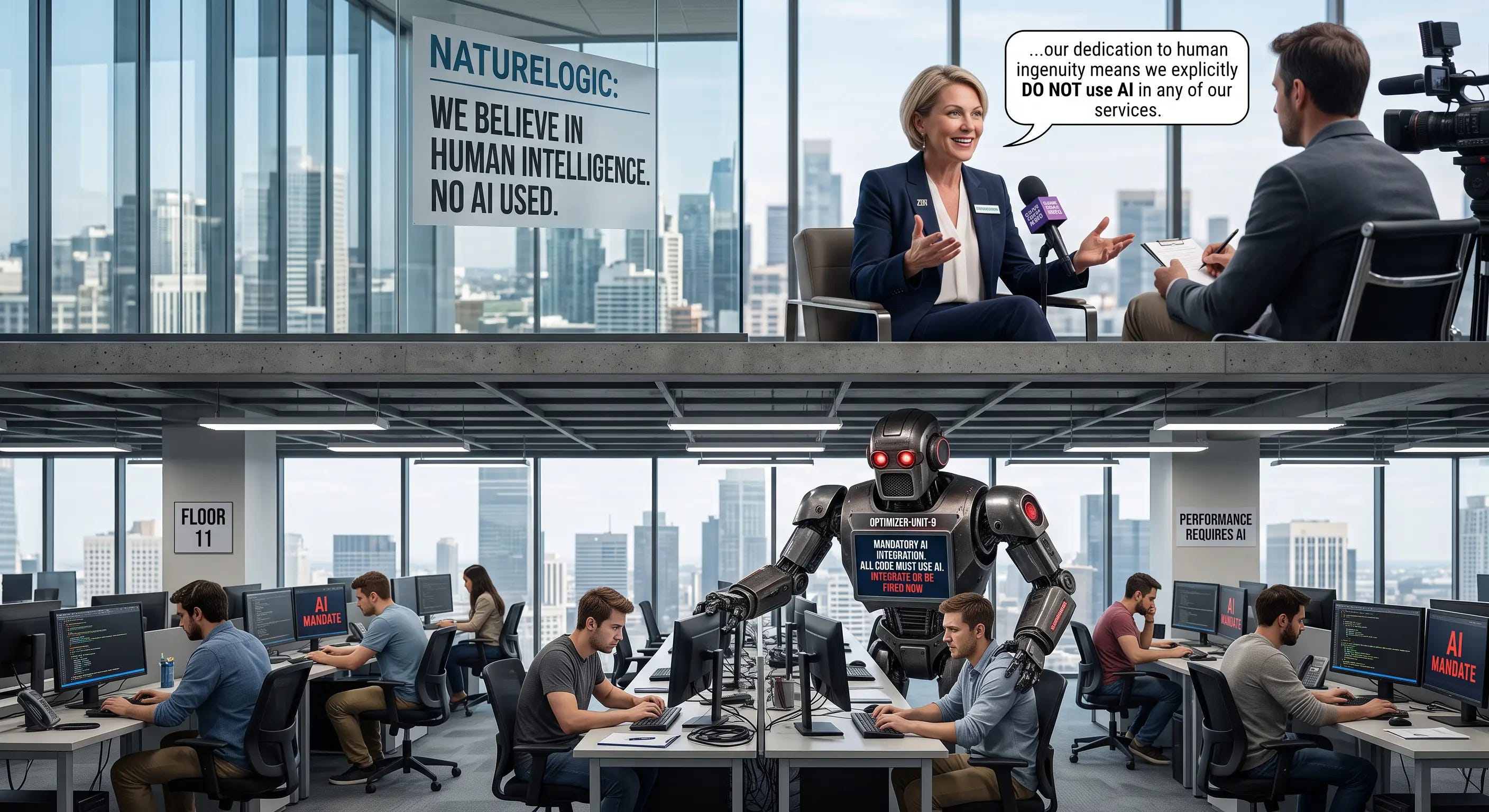
The argument is ours. The reception isn’t.
Chris Churchman runs Marquee, Goldman’s digital platform for institutional clients, and co-chairs the firm’s banking and markets AI working group. He is not a skeptic standing outside the building. He is the guy shipping it. His warning was that in the era of AI we hand our reasoning to the models and end up with “cognitive atrophy that stops us being able to reason from first principles.” He was specific about the mechanism, and the mechanism was apprenticeship: junior traders learn by fielding client pricing requests with an experienced risk taker watching. We can absolutely automate that, he said, and then asked the obvious question. Do you still get senior traders who fully understand the book?
Swap the nouns. Junior developers learn by taking a bug with a senior watching. All of that is automatable too. Automate it and you find out in ten or fifteen years whether anyone left can hold the system in their head at three in the morning.
Developers have been making that argument since 2023. When we make it, we are protecting our egos. The tools will only get better. Every generation says this about the last abstraction. Learn to prompt or get out of the way. When a Goldman partner makes it, it is a CNBC headline and a thoughtful conversation about preserving apprenticeship culture.
A year ago today
On August 25, 2025, one year ago today, Fortune ran Brian Armstrong’s own account of giving Coinbase engineers roughly a week to onboard to Copilot and Cursor. “I mandated it,” he said on the Cheeky Pint podcast. He had been told adoption would take quarters. He “went rogue” instead, posted the deadline in the engineering Slack channel, and scheduled a Saturday meeting for anyone who hadn’t complied. Some had a reason, travel mostly. The ones who didn’t were let go. Armstrong conceded the approach was heavy-handed and said it set some clarity.
It set some clarity, though maybe not the kind he meant. It established in public, from the CEO of a publicly traded company, that declining to adopt a specific vendor’s tooling on a five-day timeline is a terminable offense. No professional body objected. No standards association published a code of practice. No trade group announced a disputes process for an engineer who thought the call was wrong. There was a news cycle, some grumbling on Hacker News, and then everyone went back to work, because the alternative to going back to work is not having work.
What the other four actually built
The difference between those industries and ours starts out looking like attitude. It is institutions.
ARIA did not post a manifesto. It amended its Charts Code of Practice. Eligible recordings must now be substantially the work of humans, must use only lawful and licensed AI, and must raise no chart-manipulation concerns. It adopted the labeling scheme the international recording bodies published in July, and it gave itself the power to remove ineligible recordings, adjust chart positions and revoke awards. Then it built a disputes process, so an artist can contest a ruling with evidence. That is governance with an appeals path, written by an organization that exists to represent the people doing the work. Its chief executive framed it as an effort to “promote the human nature of artistry.”
Runna went the other direction with the same instinct. Its head coach, a former Olympian, announced the Loughborough University partnership this week as a way of anchoring the training logic to research instead of generation. “It feels like a really good time,” she said, “to set ourselves apart from AI-generated training plans.” There is context for the timing. The Wall Street Journal reported this winter that physical therapists were seeing multiple Runna-related injury cases a week, and the company has been adding ways for users to dial plans down. Whatever you make of the product, the response was to buy independent, credentialed validation for the thing customers actually consume.
Which engineering organization on earth has published an eligibility standard for AI-generated code? Which one has an appeals process for a developer who says this module doesn’t get generated? Which one has taken its AI mandate to an outside research group and asked whether it works?
Now name them
Generalities let people off, so let me do this one company at a time. The charge is not identical in every case, and I am going to be precise about which one earns which, because I would rather be right than loud.
Goldman Sachs
The bank spent Monday warning that automating junior work produces a generation that cannot reason from first principles. Thirteen months earlier, the same bank told CNBC it was doing precisely that, to engineers. Marco Argenti’s Devin deployment was aimed at legacy code, refactoring and debugging across a twelve-thousand-person developer organization. Hundreds of instances, scaling toward thousands, on top of the internal assistants the firm was already running. Updating a legacy system nobody documented is not filler work, by the way. It is how a developer learns a system.
So Goldman is not confused about whether automating apprenticeship destroys judgment. It has a considered position. The position is that trading judgment must be protected and engineering judgment is a line item. Churchman gets a podcast episode and a wire story to defend the traders. Nobody at that firm has published the equivalent warning about the pipeline of engineers who will one day be responsible for the systems those traders depend on to price anything at all.
This is the cleanest case, because both positions come from the same company and contradict each other on their face. YouTube’s monetization rules require that content not be mass-produced, generic or repetitive. The platform renamed the policy “inauthentic content” last July to say so plainly, then terminated channels holding millions of subscribers on exactly that basis, while its CEO talked about clearing out AI slop. Meanwhile, in April, Sundar Pichai announced that 75% of all new code at Google is “AI-generated and approved by engineers,” up from 50% last fall and roughly a quarter in late 2024, and AI adoption reportedly figures in engineers’ performance reviews.
Generic, repetitive, mass-produced output is a policy violation when a creator ships it to YouTube and a keynote statistic when a Google engineer ships it to production. The output is the same category of thing. The only variable that changed is whose labor it is. A creator’s output is Google’s brand risk. An engineer’s output is Google’s cost line.
Strava and Runna
Here I have to be straight with you rather than loud. Runna’s public position is that its plans are coach-designed and now university-reviewed. Runna’s careers page, at the time of writing, advertises a full-stack engineering role whose listed duties include collaborating with modelling and AI engineers on the architecture connecting the training engine to the app. Its parent, Strava, is staffing an AI team and recruiting platform engineers with hands-on generative AI requirements, MCP servers, vector stores, evaluation frameworks, while shipping its own AI feature, Athlete Intelligence, inside the main app.
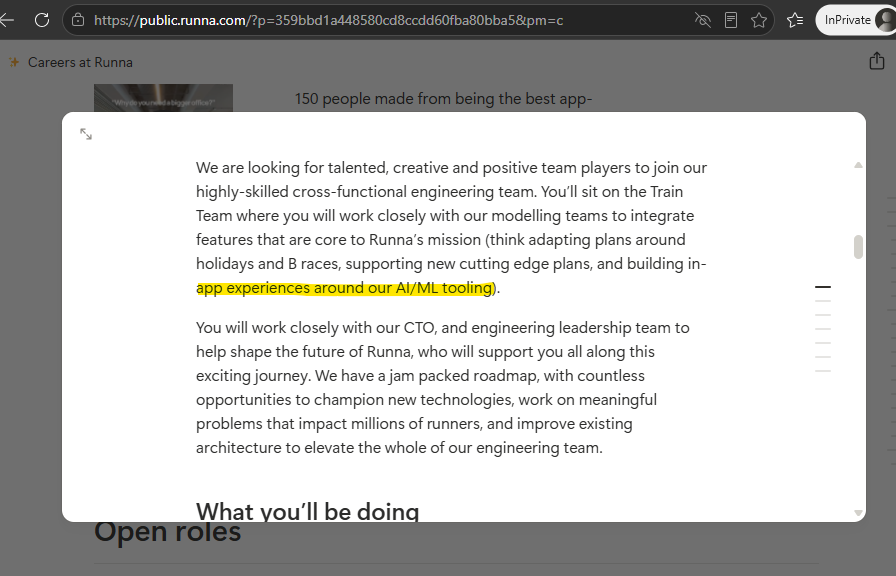
It is incredibly frustrating when tech companies try to play both sides of the fence, leveraging the appeal of a “human touch” to sell a product while relying on automation to keep their margins high. To appeal to runners seeking safe, personalized guidance, the company leans into a narrative that real humans are the true brains behind their training programs, shielding their consumer brand from the stigma of soulless, algorithmically generated plans. Yet, their own engineering roadmap exposes the quiet reality of scaling a massive tech platform: developers are explicitly hired to build in-app experiences around their AI/ML tooling. It is a classic case of having it both ways when their marketing promises an artisan product, while the back-end engineering builds an assembly line.
ARIA and the major labels
Same correction, same shape. ARIA’s chart rule protects human artistry and requires that any AI involved be lawful and licensed, and ARIA’s member labels are the ones doing the licensing. Universal sued Suno and Udio in 2024, settled with Udio last October, and is building a licensed AI music platform with it. Warner settled with both. Then in June the American Federation of Musicians sued Universal and Warner in the Southern District of New York, alleging that member recordings were licensed into those AI deals as a “new use” under the union’s labor agreement, without the compensation, the notice, or even the disclosure of which recordings were used.
I have no evidence any major label mandates AI-written code, so I won’t claim it. Their hypocrisy is purely commercial and completely legible. The chart is protected because the chart is the shop window, and the catalog is licensed to the generators because the catalog is inventory. The musicians whose recordings became that inventory got roughly the deal engineers got, which is to say none, and they had to sue their own labels to say so out loud.
The rule that falls out of all four
Line them up and the pattern is not that these companies are against AI. Not one of them is. Every single one applies the human guarantee to the product the customer sees and withdraws it from the labor that produces it. AI is unacceptable where it touches the brand and mandatory, or at minimum proudly reported to shareholders, where it touches the cost base. Engineering is the cost base. That is the whole rule, and it explains all four cases without requiring anyone to be a liar.
Which raises the question I did not expect to be the point of this piece. Why is engineering always the cost base?
Because we are the only ones who own nothing
Every guardrail above sits on top of a property interest. The labels own recordings, so they can license training data, price it, and enforce a chart rule about who paid. YouTube owns the ad inventory, so it gets to define which output is worth money. Runna owns a subscription, so it gets to define what counts as a real training plan. In each case the protected asset is a revenue stream that generative AI threatened, and the language about human artistry and qualified coaches is sincere, and also downstream of that.
Developers have no such asset. The code we write belongs to our employers the day we write it. The code we published for free is in the training data. We hold no royalty, no mechanical license, no collecting society, no chart, no seat at anybody’s negotiating table. We were simultaneously the training corpus and the party with no claim on it. There is no ARIA for software engineers because there is no revenue stream for an ARIA to defend.
It is not that the other industries are braver than ours. They had standing and we don’t.
And the mandate itself has nothing under it
This next part cuts both ways, so let me take my own side’s medicine first. The most rigorous experiment anyone has run here is METR’s 2025 randomized trial: sixteen experienced open-source developers, 246 real tasks in repositories they knew intimately. They were 19% slower with AI, and came out of it believing they had been 20% faster. That result was a gift to every skeptic in the industry, including me. Then METR did the honest thing. This February it flagged the result as historical, after selection effects wrecked the follow-up. Too many developers now refuse to work without AI at all, which poisons the sample. One participant described working the old way as trying to cross the city on foot after getting used to Uber. That is Churchman’s cognitive atrophy, filed under recruiting difficulties. The strongest study we had carries a warning label from its own authors, and the reason for the warning label is the thing this essay is about.
What remains is softer and consistent. Google’s own DORA research keeps finding AI adoption pushing throughput up and delivery stability down as change volume outruns the review system. GitClear’s telemetry, across hundreds of millions of changed lines, shows 2024 as the first year on record where copy-pasted code exceeded moved code, with refactoring collapsing from roughly a quarter of all changes to under ten percent. Harness surveyed developers and found most of them spending more time debugging generated code and chasing the vulnerabilities it introduces. None of it is a smoking gun. All of it is a maintainability bill that arrives late, on somebody else’s calendar.
So there is no rigorous evidence that mandated AI coding makes an engineering organization meaningfully more productive, and there is a growing pile of maintainability data suggesting some of the throughput was borrowed against the repository. The industry’s answer to that ambiguity has been to fire people for non-adoption and report adoption as though it were an outcome. Coinbase’s public number is the percentage of code written by AI, around a third at last count, with a 50% target attached. Compliance metrics wear quality metrics’ clothes very well.
What this looks like from inside production
I build agentic systems for a living. Clients pay me to put MCP servers, retrieval pipelines and multi-step agents into production on the Microsoft stack, and I have been on that stack for close to thirty years. I am not the guy warning you off the tools. I am the guy who wrote an observability framework, PLogger, it’s on GitHub, because I could not otherwise answer basic questions about what my own agents did last Tuesday. That is the tell, honestly. I had to build that layer because generated code and agent behavior fail in a way that does not announce itself. It compiles. It passes the happy path. It reads like something a competent person wrote on a good day. Then it is 3 a.m. and somebody is staring at a retry loop nobody in the building has ever read line by line, and the fastest available move is to ask the model that wrote it what it meant. That is the exact moment Churchman’s cognitive atrophy stops being a podcast abstraction and becomes an incident.
The fairness clause
Fine. Suppose the mandate is correct and the friction really is craft nostalgia. Then apply it evenly, because that is the entire ask.
Generate the board deck. Generate the shareholder letter, the client memo, the compensation committee’s rationale, the legal opinion, the earnings call script, the strategy document that justified the headcount plan. If a model can be trusted to write a payments service that moves other people’s money, it can certainly be trusted with a slide about synergies. And if an executive declines, let them sit down one-on-one and explain why they personally required a human in the loop for their own work product while requiring the opposite of everyone below them. Some of them will have a good reason. Some of them won’t.
Nobody is going to run that experiment. AI directives flow downhill exclusively; not one has ever flowed up. Goldman gave Devin the junior engineering work and gave the junior traders a protected apprenticeship. Google demonetizes mass-produced output on YouTube and reports 75% generated code in its own repositories as progress. The correlation between how protected a role is and how loudly its occupant gets to warn about deskilling is not a coincidence. Churchman is a partner. Partners get to say this out loud. Level fours do not.
The obvious objection
Code isn’t art. Nobody’s identity is bound up in a CRUD endpoint the way a songwriter’s is in a chorus, and the ARIA comparison is sentimental.
Take the point, then look at the week’s list again, because it cuts the other way. Only one of the four industries that drew a line is an art. Stock trading is not art. Nobody hums a well-executed hedge. It got the strongest protection of the week anyway: a partner defending supervised reps for juniors, on the firm’s own airwaves, to general applause. Fitness coaching is not art either. Runna did not take its plans to a poet for a blessing. It took them to a university sport-science department, because a bad plan does not fail at the moment of purchase. It fails weeks later, in a physio’s office, and physios were seeing enough of it that the Journal wrote it up.
Artistry was never the criterion for a guardrail. The criterion is what happens when the work is wrong, and whether the people doing it ever got to form judgment. Society actually licenses its least artistic professions the hardest. You cannot even sit for the Series 7 unless a member firm sponsors you; the apprenticeship is written directly into the registration process. Structural engineers stamp drawings and carry the liability of the stamp. The one serious attempt to license software engineers, the NCEES Professional Engineering exam in software, was offered five times starting in 2013, drew 81 candidates in total, and was retired in 2019 because almost nobody showed up.
So no, code isn’t art, and software’s claim was never sentimental. It is structural. A synthetic track on a chart is an insult to a craft. A synthetic auth flow nobody read is a breach disclosure. A bad generated training plan surfaces as an injury on a lag of weeks. A bad generated system runs the same schedule. It just doesn’t show up in your knee. It shows up in your incident channel, your customers’ data, or your quarter.
Nobody is coming
Australia’s charts changed because an organization with a balance sheet decided the human part of the work was worth defending and had the standing to write it down. Nobody is going to do that for us. There is no ARIA for software engineers, the closest thing we have to a professional body is the vendor selling the tool, and the vendor’s incentives are visible from orbit.
So it falls to whoever owns the code review standard, the hiring bar and the definition of done. Write down which parts of your system a human reads line by line before it merges. Put a number on the reps you owe your juniors. Make the mandate defend itself with change failure rate instead of adoption rate. That is an eligibility standard. It is the same move ARIA made, minus the press release and minus the licensing revenue.
And if that is still too much friction, if the real position is that generation is non-negotiable, everywhere, at every level, no exceptions, then I would like the next shareholder letter to come out of a prompt, and I would like somebody at Goldman to explain why Devin got the firm’s junior engineering work while the junior traders got a protected apprenticeship and a podcast episode about why it matters. Only fair.
About the Author
Gal Ratner is the founder and CTO of Inverted Software and WhiteStar Labs, and Chief Architect at Prana Entertainment, an enterprise software and AI consultancy in Las Vegas. He has spent nearly thirty years shipping production systems on the Microsoft stack for clients including Microsoft, Sony, Rockstar Games, Best Buy and Allegiant Air, was employee number six at Break.com, and was a finalist for the Los Angeles Business Journal’s CTO of the Year. Today he builds production agentic AI — MCP servers, RAG pipelines and multi-agent workflows on .NET and SQL Server — and maintains PLogger, an open-source observability framework for agent runtimes. He writes about the distance between what executives say about AI and what practitioners actually ship, and is the author of the novel The Archive of Lost Suns.
No posts
Comments
Nothing yet. Say the first thing.
Sign in to join the conversation.