
There was a stretch of years between 1999 and 2015 when I trained in the same rooms as Rich Piana and thought nothing of it. Gold’s in Northridge first, then Venice, then North Hollywood - After we came back from Austin, but that is a different story. He was one of the biggest human beings in a building full of big human beings, which in that particular ecosystem earned you a glance and not much more. It did not occur to me, or to anybody else racking plates around him, that we were standing next to the beginning of a marketing career.
He died in 2017 at forty-six. Nine years on, his face is still on product in supplement shops, his videos still surface in my recommended feed, and the company he founded is still shipping out of Florida. What happened in between had almost nothing to do with lifting. It is the most instructive content marketing campaign of the last fifteen years, it was run by a man with no agency, no media budget, and no credential, and the marketing industry has spent a decade writing case studies about brands that did a tenth as well.
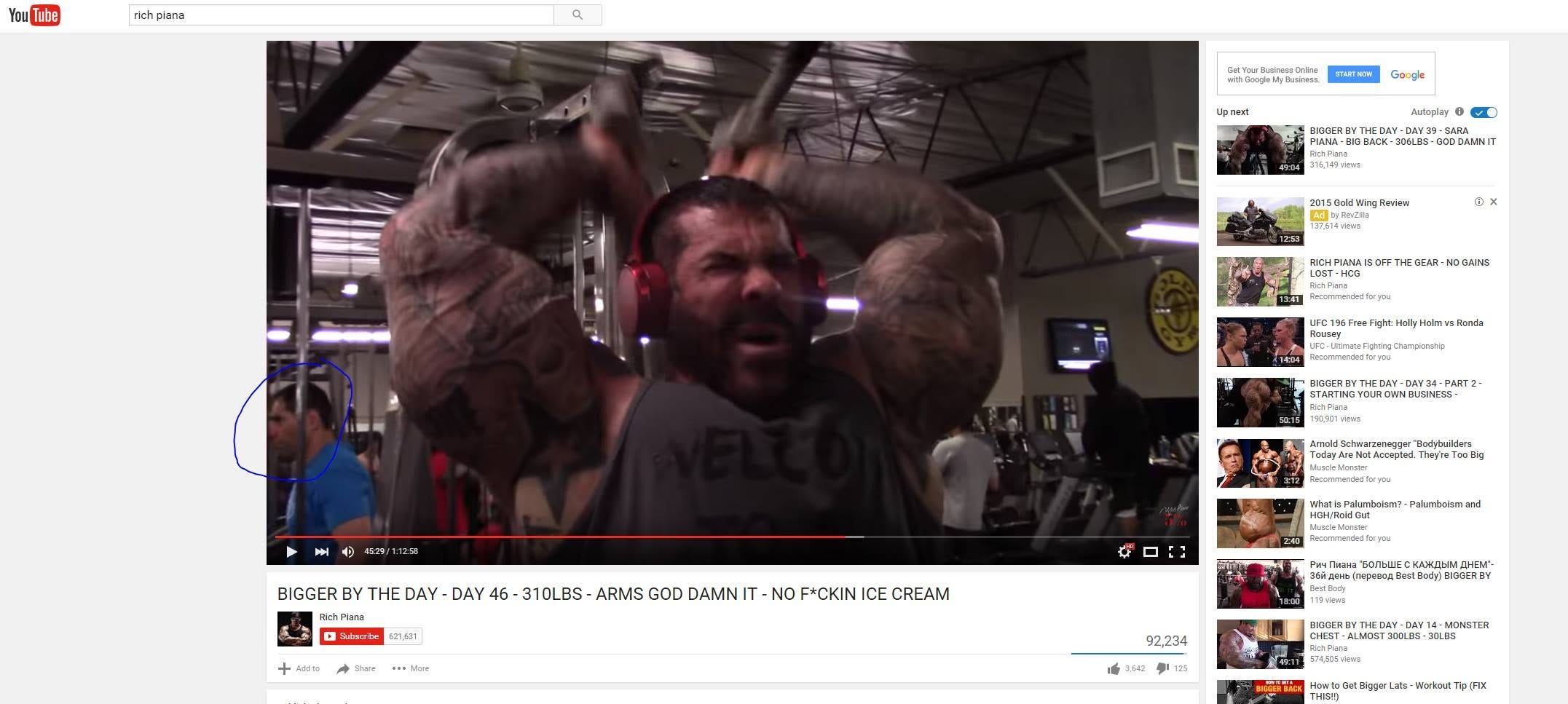
Piana never earned an IFBB pro card. He never competed at the Mr. Olympia. He won NPC Mr. Teen California in 1989 and NPC Mr. California in 1998, and in a sport organized entirely around sanctioned achievement, that is a resume that ends with you selling personal training sessions out of a strip mall.
By the middle of the decade, the line at his booth at the Arnold Sports Festival in Columbus was long enough that the fire marshal had to get involved. Christian Duque, who covered the expo circuit from the trade side and watched it happen, put the queue at four and a half blocks. This was at a show named after Arnold Schwarzenegger, in a hall containing actual Olympia competitors, and the crowd was standing outside in March for a man the sport’s own hierarchy did not formally recognize.
That gap is the entire story. Somewhere between 2011 and 2015, the audience stopped being downstream of the credential and became the credential.
The part of the biography that marketers skip is the part that made everything else possible. Before he was an internet figure, Piana did stunt and bit work in Los Angeles — Planet of the Apes, Scrubs, Malcolm in the Middle, The Parkers. He bought California real estate ahead of the boom, pulled roughly eighty percent of the equity out, and moved it into Texas rental property. He day traded. By the time the fitness content started to matter, he was already financially independent of it.
That is not a footnote. Most brands produce bad content because they cannot afford to produce good content slowly. The pressure to convert this quarter is what turns a content program into a promotional calendar, and nobody in the history of the internet has subscribed to a promotional calendar. Piana could absorb the four and a half years his channel needed before it produced anything commercially significant, because he was not eating out of it. If your content operation has to pay for itself in ninety days, you are not running a content operation. You are running discount announcements in a nicer typeface.
He spent the early 2010s as the face of Mutant, a Canadian supplement brand. By industry standards it was a good deal, and he used it to learn the entire machine from the inside — how products get formulated, where the margin actually sits, and what a brand is really buying when it buys an athlete.
Then he left. At the 2013 Arnold he was standing in a ten-by-ten booth for his own apparel line, Love It Kill It, positioned diagonally across the aisle from the company he had just walked away from. 5% Nutrition followed in 2014.
The sequence is the lesson. Rent your audience to somebody else for exactly as long as it takes to learn what they are doing with it, then stop renting. Every creator-founded brand of the last decade runs some version of this, and most of the people running it could not tell you where the pattern came from.
The campaign that made him ran from late 2015 into early 2016, and structurally it is close to perfect.
The premise was a number with a deadline: thirty pounds in three months. Not a theme, not a content pillar, not a brand narrative. A specific, falsifiable, publicly declared outcome that he could visibly fail to hit, with the failure guaranteed to be documented in the same feed as the attempt.
He shipped it in episodes. Week one, day four, week five. Individual installments passed five million views, including footage that consists in large part of a man being weighed. All of it was free. The supplement named Bigger By The Day, the apparel, and the packaged twelve-week program all arrived afterward, named for a thing the audience was already trying to do.
Week one opens at four meals a day and fifteen minutes of cardio. That restraint is deliberate, and it is the most underrated decision in the whole campaign. The entry point is low enough that a viewer can start the same afternoon, which is how an audience becomes participants instead of spectators. People spun up their own logs and followed along in real time.
Everything a content marketer needs is sitting in that structure. A declared outcome with genuine exposure. Serialization, so each installment sells the one before it and the one after it. An entry point the audience can copy on day one. Present tense, with the ending unknown. A product named after demand rather than a demand manufactured for a product.
The three-month bound deserves its own note, because it is the part almost no content program adopts. The campaign had an ending built into the premise, which gave it an arc, a climax, and a payoff — the things serialization actually requires and the things an open-ended content calendar can never have. A calendar just continues until somebody stops funding it. A season that ends is a season you can run again.
Set that against what most companies ship. Past-tense case studies where the outcome was never in doubt. Disconnected posts that accumulate into nothing. A finished cathedral presented to people who wanted to know how to lay a brick. Nobody subscribes to a feed. People subscribe to an unresolved ending.
The proof that this was a format rather than a lucky stunt arrived in June 2016, roughly six months after the first series wrapped. The follow-up was called Better By The Day, and the premise was inverted. Instead of gaining thirty pounds he would cut all the way down to two hundred and forty, in eight weeks instead of twelve. Same engine — declared number, hard deadline, documented in serialized episodes — pointed in the opposite direction.
Two details in the trade coverage matter. Stack3d reported at launch that the first episode ran fifty minutes and was approaching a million views within days, with episode two already out behind it. Bigger By The Day had needed years of accumulated channel to reach numbers like that. Better By The Day got there immediately, on the strength of the format alone, because the audience had already been trained to show up for the shape of the thing. And he shortened the season while lengthening the episodes, which is what somebody does when they have stopped guessing and started tuning.
That is the point at which a campaign became a machine. The goal turned out to be interchangeable. What was not interchangeable was the declared number, the deadline, the episodic release, and a name close enough to the last one that the audience knew what they were getting before they clicked. 5% has been filling that slot ever since, including a later season built around a different athlete chasing three hundred and seventy pounds. The format outlived the man who designed it, because the format had a shape.
Piana’s early videos were not well made. His first upload, in April 2011, is an interview with a woman who had beaten up a man in the gym parking lot, shot on whatever was within reach.
The production did improve, and by the Bigger By The Day era it was genuinely competent — Duque’s observation years later was that the videos held up, which is why teenagers kept finding and watching them long after. But the causation only runs one way. The idea justified the camera. The camera never once rescued an idea.
Marketing departments have this inverted at enormous scale. The budget goes to the production company, the lighting package, the color grade, and the agency, and what comes out is a beautifully finished artifact answering a question no customer asked. A forty-thousand-dollar shoot of nothing is still nothing. A phone recording of a genuinely interesting attempt at something hard will beat it, and if the attempt works you can afford the lighting next quarter.
Everything above this is mechanics, and the mechanics only pay off if the underlying thing is something a person cannot stop consuming. This is the requirement most marketing departments quietly decline to meet.
Work out what actually made the Piana material unmissable and it reduces to three properties, none of which cost money. There was real jeopardy — he had announced a number he might not hit, in front of everyone, with no way to quietly delete the attempt afterward. There was a visible progress indicator, because in his case the body was the dashboard and you could see the delta week over week without anybody having to narrate it. And he shipped the parts other people cut: day four with the strain showing, the footage that made him look worse rather than better. Separately from the campaigns, he also said things about his own drug use that nobody else at his level would say, and when somebody is willing to say the unsayable you keep watching, because you have no idea what is coming next.
Notice what is missing from that list. Hooks, thumbnails, retention editing, a content calendar. Episode one of Better By The Day ran fifty minutes and pulled close to a million views inside a week, which is not a number you reach by trimming dead air. He earned the runtime.
Most business content is built to be skippable, and it is not an accident. It gets written so that nothing in it could embarrass anyone, reviewed until every claim is unfalsifiable, and published with the explicit goal of causing no problems. That process reliably produces something nobody can object to and nobody can finish. Risk aversion is the actual root cause of boring content, and no production budget or distribution spend repairs it, because the damage was done in the approval chain rather than the edit.
The test is simple and most companies fail it. Would anybody consume this if it were not about you? If the only reason to keep reading is that the reader is already a customer, what you have is a newsletter. Nothing wrong with a newsletter. It will not build anything.
There are two ways to make people unable to look away, and they age very differently. There was a version of fitness internet that ran on antagonism. Aziz Shavershian was posting to YouTube from 2007 and had a serious following before Piana had an account, and he ran deliberate rage bait — by the Guardian’s account he created accounts to troll himself so the anger never cooled, and converted an anonymous page promising to fight him into an advertisement for his protein brand the moment it hit the like target. It worked. It also did not survive him.
Piana went the other way. The entire 5% construct is affirmative: it names the share of people willing to do whatever it takes, and it invites you to count yourself among them. It is a membership offer, not an insult, and his interaction with fans was relentlessly encouraging in a subculture that mostly is not.
Antagonism is cheap to start and expensive to maintain, because outrage has a half-life and holding the same attention next month requires escalating. Affirmation is slow to start and nearly free to maintain, because people who feel recognized by a brand come back without being provoked. If you are picking a register for a business you intend to still own in five years, this is not a close call.
Attractive people have sold products since there was an advertising industry and they will keep doing it, and any marketer who claims otherwise is either lying or has never opened a conversion report. Casting is a performance decision. It should be made on whether it moves the number, and a casting process optimized for a checklist rather than for effect is not more virtuous, it is just worse at its job.
With that said, Piana is a poor exhibit for the attractiveness argument and a superb one for something more useful. He was not handsome. He was three hundred pounds of tattoos and dyed hair with a face that made strangers adjust their route on the sidewalk. What he had was distinctiveness, and distinctiveness has a considerably better return than beauty for one blunt reason: beauty is commoditized and available to anybody with a casting budget, while being instantly identifiable in a thumbnail is not.
Fans bought plastic gallon water jugs from him at roughly ten times what the jug was worth because it carried his logo. That is not a physique premium. That is a distinctive brand asset doing precisely what a distinctive brand asset is supposed to do. So the practical question is not whether your people are good-looking. It is whether a customer scrolling at speed can identify you from a two-hundred-pixel crop with the name removed. Most brands cannot pass that test and have never thought to run it.
He spent six figures on expo booths. Not on media — on floor space, and on being physically inside it, signing and photographing and talking for as long as the line lasted.
It is the least scalable thing in the entire playbook and it is the reason the rest of it worked. Content built the parasocial credit. The booth collected on it. Somebody who has stood in line for two hours to shake your hand does not become a customer, they become a partisan, and partisans handle your distribution for free and defend you when the industry comes after you.
The industry did come after him. Rich Gaspari attacked him in Generation Iron 2 as a bad influence, and used the phrase false gurus for the social media generation generally. Piana returned fire with allegations about Gaspari’s own products. That fight reads clearly now as what it was — a sanctioned hierarchy realizing it had been made irrelevant by somebody who never applied for its permission — and the audience sided with the man who had spent years actually talking to them.
Your raving fans are a much smaller number than your follower count and they are worth more than the rest of it combined. Find out who they are and give them disproportionate access. Not a discount code. Access.
5% Nutrition states on its own site that Piana’s videos were flagged, banned, and censored across nearly every platform. The response was to move the canonical library onto their own domain, where the episodes sit today with the products adjacent to them.
This is the part your engineering leadership already understands and your marketing department frequently does not. Reach is rented. Archive is owned. A business that has placed its entire marketing function inside somebody else’s ranking system has accepted a dependency with no SLA, no support contact, and no appeals process, and it will learn the terms of that dependency on the worst possible morning. Use the platforms hard, the way he did. But the canonical copy lives on infrastructure you control, with the transaction sitting next to it.
The channel opened in April 2011. Bigger By The Day landed in late 2015. The breakout campaign was four and a half years into the program.
The title is the thesis. Small daily increments, logged in public, meaningless individually and undeniable in aggregate. It is also the precise thing every content program abandons around week six, when the numbers are still bad and somebody senior asks what the return has been so far.
Thirty pounds in three months was not achievable from the inputs shown in the videos. Piana was unusually candid about anabolic use in general — more candid than anyone else operating at his level, and that candor was the foundation of his entire differentiation. But the flagship campaign documented a process while the actual mechanism sat outside the frame, and a viewer following the free content could not reach the advertised outcome.
That failure mode is endemic in business content, and almost nobody producing it thinks of themselves as dishonest. You publish the growth curve and the process narrative and leave out the funding round, the acquired list, the parent company’s ad budget, the enterprise contract that closed before the campaign started. Every sentence is true and the whole thing is useless to the person reading it. When the causal input is not in the content, the content is entertainment.
What is worth copying is the architecture. Declare a real outcome with a date attached, let people watch you risk it, and then let the thing end — a campaign with a finish line is one you can run a second season of, and an open-ended calendar is one you will quietly abandon. Build it so the goal is swappable and the structure is not. Serialize, so the work compounds instead of resetting every Monday. Make the first step small enough that the audience can take it alongside you. Publish in present tense before you know how it ends. Be the recognizable thing rather than the attractive thing. Spend absurd, unscalable hours with the small number of people who genuinely love what you do. Keep the archive on your own domain. Then wait considerably longer than feels reasonable.
And underneath all of it, the requirement none of the mechanics can substitute for: make the thing genuinely difficult to stop consuming. In practice that means publishing work you could be embarrassed by, which is exactly why so few companies manage it.
What is not worth copying is the distance between what the content showed and what actually produced the result.
He was a guy in a gym in Northridge. He built one of the best content marketing operations of the decade with a camera, a declared number, and about five years of patience, while the industry that is professionally supposed to be good at this was busy buying programmatic display.
Gal Ratner is the founder and CTO of Inverted Software and WhiteStar Labs, and Chief Architect at Prana Entertainment in Las Vegas. He has spent close to thirty years shipping production software on the Microsoft and .NET stack for clients including Microsoft, Sony, Rockstar Games, 2K Games, Best Buy, and Allegiant Air, and was employee number six at Break.com back when the internet was still working out what content distribution actually was. These days he builds production agentic AI systems — MCP servers, RAG pipelines, SQL Server vector search — and writes about the distance between what technology executives announce and what actually ships. He trains Brazilian jiu-jitsu under Sergio Penha, rides motorcycles, co-hosts Edge Grip Podcast, and wrote the novel The Archive of Lost Suns. He was racking plates at Gold’s Northridge before Rich Piana had a YouTube channel.
No posts
Comments
Nothing yet. Say the first thing.
Sign in to join the conversation.