
On October 28, 2025, over a hundred community leaders and stakeholders gathered at the Japanese Cultural Center of Hawaiʻi for an unprecedented conversation about technology, education, and community values. The Tech Career Pathways Summit, presented by the Chamber of Commerce Hawaii and sponsored by the CIO Council of Hawaiʻi, brought together education, industry, and community leaders for meaningful dialogue about building Hawaiʻi’s tech future.
Hawaiʻi is actively shaping its tech future. As the tech industry transforms through artificial intelligence, our island community navigates these changes while strengthening what makes us unique: our cultural values, our commitment to our culturally varied local communities.
University of Hawaiʻi President Wendy Hensel opened the summit with a keynote emphasizing the alignment between K-12 education, post-secondary institutions, and the rapidly evolving tech industry. The focus centered on building sustainable pathways that serve our community’s needs.
The morning sessions featured powerful presentations on career pathway development from Christine Beaule of the University of Hawaiʻi and Stacie Higgins from Hawaiʻi P20 Partnerships. Their work on developing frameworks for career development across education to career represents years of collaborative effort to ensure Hawaiʻi students have clear pathways into tech careers.
Dr. Patrick Sullivan, Founder and CEO of Oceanit, shared insights on innovation and entrepreneurship, highlighting Hawaiʻi’s legacy of ingenuity, from ancient Polynesian navigation to modern aerospace engineering. Hawaiʻi competes in tech while staying true to its values.
The afternoon panel, moderated by Seiichi Nagai from CivicNexus, featured technology leaders including:
David Takeyama (Oceanit)
Donny Shimamoto (Intraprise TechKnowlogies)
Holly Araki (First Insurance Company of Hawaii)
Taheirah Kalahiki (First Hawaiian Bank)
These industry leaders provided real-world perspectives on how the technology landscape is shifting workforce needs and what skills tomorrow’s professionals will need.
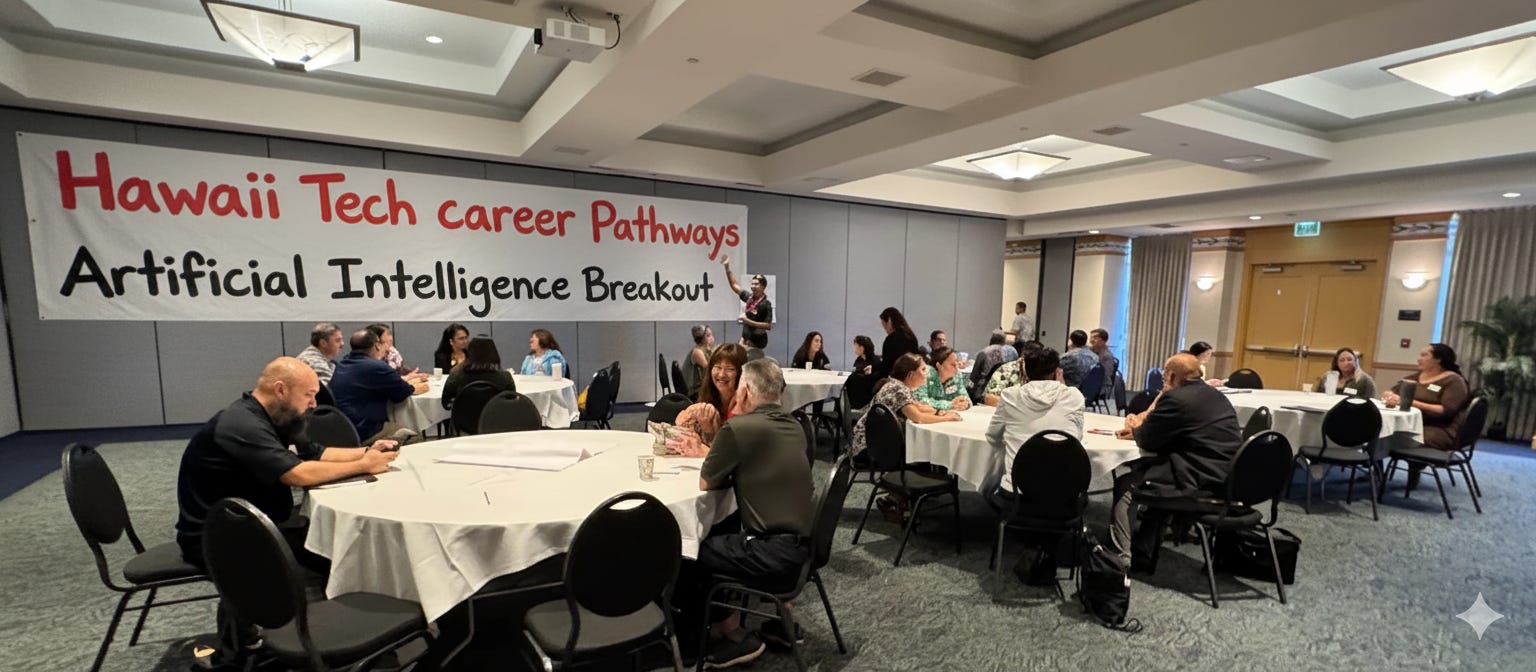
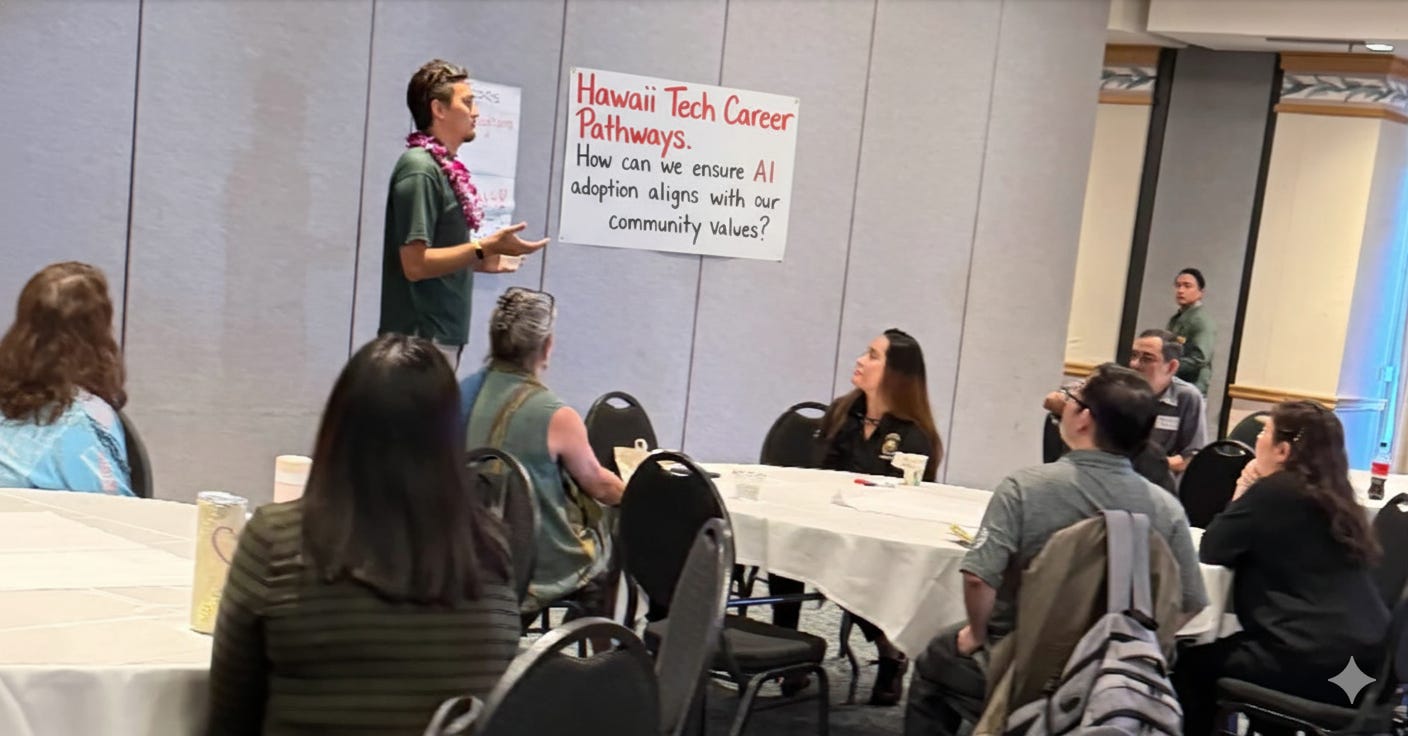
During the 11:20 AM - 12:00 PM breakout sessions, I facilitated “AI Considerations,” exploring how companies and educational institutions are meeting the challenges of this rapidly growing technology. We grounded the conversation in Hawaiʻi’s unique context with practical, actionable discussions.
How has AI changed the way your organization operates?
I asked participants to think concretely: “Think about the admin tasks, lesson planning, meeting summaries, drafting emails. What specific tool do you use, and how many hours did it save you last week?” The responses revealed that AI is already embedded in daily operations across education, nonprofits, and businesses, often in ways people don’t fully recognize.
What promising uses of AI are underutilized in our community?
This question opened eyes. We discussed personalized learning for students and automating reporting for nonprofits. The key insight: AI can free up staff time for deeper community connection while reducing paperwork burdens. One educator shared how AI could help create culturally relevant lesson plans that honor Hawaiian values while meeting modern standards.
What potential AI applications should we avoid or approach with caution?
This generated critical discussion. Given Hawaiʻi’s unique cultural context, we explored what happens when a globally-trained AI model produces a culturally inappropriate or inaccurate response and how to safeguard against bias in training data that may not represent or understand Hawaiian language, values, or cultural practices.
Participants shared real concerns: AI systems that mispronounce Hawaiian names, algorithms that don’t understand the concept of hanai (informal adoption), or chatbots that give advice contradicting Hawaiian cultural practices. The consensus was clear: we need human oversight from people who understand our community.
How can we ensure AI adoption aligns with ethical and community values?
The final question brought everything together. When AI saves a company money, we asked how to ensure that profit stays in the community and how to maintain human oversight, the Aloha, or care, as the final check before an AI decision is implemented.
This question has practical applications: schools can evaluate AI tutoring systems for place-based learning integration, and banks can assess AI loan officers for understanding of island economic realities.
The summit excelled through its community focus. Lord Ryan Lizardo from the Chamber of Commerce Hawaii, Gregory Hester from the CIO Council of Hawaii and Ulu-HI Tech, and Alan Ito from the University of Hawaiʻi created space for honest conversation.
The entrepreneurship track, led by Nicole Cacal from TRUE Initiative and Shaunak Mali, emphasized that entrepreneurial thinking extends across education and industry as an essential mindset. Sandra Fujiyama from PACE (Pacific Asian Center for Entrepreneurship) shared how they’re cultivating this mindset in the next generation.
Meanwhile, the workforce opportunities breakout, facilitated by Vanessa Rogers from Chamber of Commerce Hawaii and Umma Berkelman, identified critical gaps in our local tech ecosystem and highlighted areas of greatest opportunity for growth.
Based on the photos and notes gathered from the breakout sessions and poster pads created by workshop attendees, this section compiles a series of AI-assisted deep research reports expanding on the key themes that emerged during our discussions.
Want to share these 20+ page AI Deep Research reports? Use this button below.
To extend our collective insights, I conducted additional research using multiple AI systems, each offering a unique analytical perspective:
Google Gemini – View Gabriel’s 30+ page Deep Research Report
ChatGPT 5 – View Gabriel’s 20+ page Deep Research Report
Anthropic Claude – View Gabriel’s 20+ page Claude Report
You’re invited to review and explore each of these AI-generated analyses. Together, they illustrate how modern AI tools can synthesize complex human discussions into actionable, evidence-based insights for our community.
The summit generated concrete next steps:
Pathway Alignment: Continued work on aligning K-12 curriculum with post-secondary programs and industry needs
Cultural AI Guidelines: Development of best practices for AI deployment that honors Hawaiian values
Community Oversight: Creation of review boards that include cultural practitioners and community members
Skills Development: Targeted programs to prepare students for AI-enhanced careers
Local Innovation: Support for Hawaiʻi-based AI solutions that understand our unique context
As Sophia Wibholm from the Chamber of Commerce Hawaii facilitated the share-out sessions, a theme emerged: technology enhances human connection. AI creates more time for what matters, mentoring students, building relationships, serving community.
Hawaiʻi’s approach stands out through thoughtful evaluation. We ask: Does this serve our community? Does it honor our values? Does it create opportunities for our keiki (children) and strengthen our ʻohana?
The full Hawaiʻi Tech Days of Fall 2025 line-up continues the conversation started at this summit. These events form part of an ongoing effort to build a tech ecosystem that’s uniquely Hawaiian.
Educators can consider how AI tools might free them to spend more time with students. Industry professionals can explore how their AI implementations could benefit the broader community. Students can know that Hawaiʻi needs their talents and pathways are being built specifically for them.
The Tech Career Pathways Summit proved that Hawaiʻi’s tech future is something we’re actively creating. By bringing together 138+ stakeholders from K-12 education, post-secondary institutions, and industry, we’re ensuring that technology serves our community values.
This is tech with Aloha. This is AI with cultural competence. This is Hawaiʻi demonstrating that innovation and values work together powerfully.
About the Summit: The Tech Career Pathways Summit was presented by the Chamber of Commerce Hawaii and sponsored by the CIO Council of Hawaiʻi, with support from Ulu-HI Tech and the University of Hawaiʻi System. Special thanks to the Japanese Cultural Center of Hawaiʻi for hosting.
Connect: To learn more about Hawaiʻi’s tech ecosystem, visit CIO Council of Hawaiʻi, Ulu-HI Tech, Chamber of Commerce Hawaii, and Hawaiʻi P20 Partnerships.
No posts
Comments
Nothing yet. Say the first thing.
Sign in to join the conversation.