
Universities and school districts across the country are hemorrhaging budgets on AI consulting fees. Administrators convene emergency meetings. External “experts” fly in with AI generated PowerPoint decks and five-figure invoices. Policy documents multiply. Meanwhile, the most effective, honest, and dynamic resource for transformation sits in every classroom: the students themselves.
In Hawaii, we’ve built a model that transforms AI adoption from fear and restriction to guided innovation and unprecedented efficiency. Our approach earned a shoutout in Ann Auman’s extensive 11-page feature in Hawaii Business Magazine exploring how various orgs and initiatives are tackling AI literacy across the islands. Our students are now heading to the national stage to share what we’ve learned: the path forward requires empowering and trusting the bright young minds already present in schools.
I lead this work with ‘Iolani’s EdTech Director, Faye Furutomo, and in this opinion piece, spoken as just myself, a middle school born and raised teacher in Hawai’i, I hope to inspire you to take the first step to support your own school or organization.
Effective AI adoption starts with a cohort of curious students.
At ‘Iolani School, we established the Digital Literacy Ambassadors (DLA) as an active, fluid group drawing students from every corner of campus with interests in English, History, Art, Math, Computer Science, and everything in between. This diversity is intentional and critical. These students, led by EdTech Director Faye Furutomo and emerging technologies teacher Gabriel Yanagihara, function as our key Advisory Board and serve as early adopters for emerging technologies. They’ve become our single greatest resource for driving complex change management, sparking necessary conversations about AI, and providing a safe, trusted environment to rigorously test, evaluate, and refine AI usage.
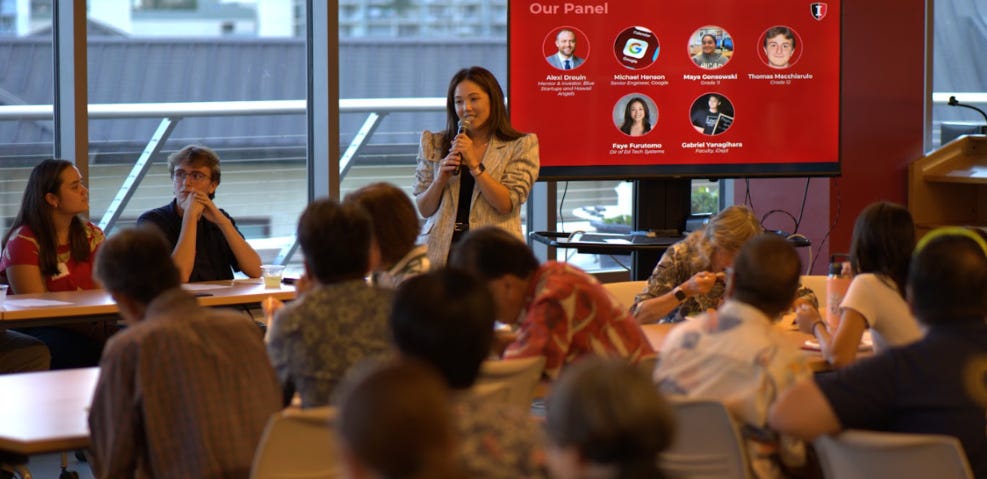
The group now numbers dozens of students, each one a peer mentor who has helped us train faculty and staff on new tools, accelerating new tools and accelerating campus-wide literacy far faster than any administrative rollout could achieve. They present to departments, advise on policy, and serve as living bridges between the digital native experience and institutional adaptation.
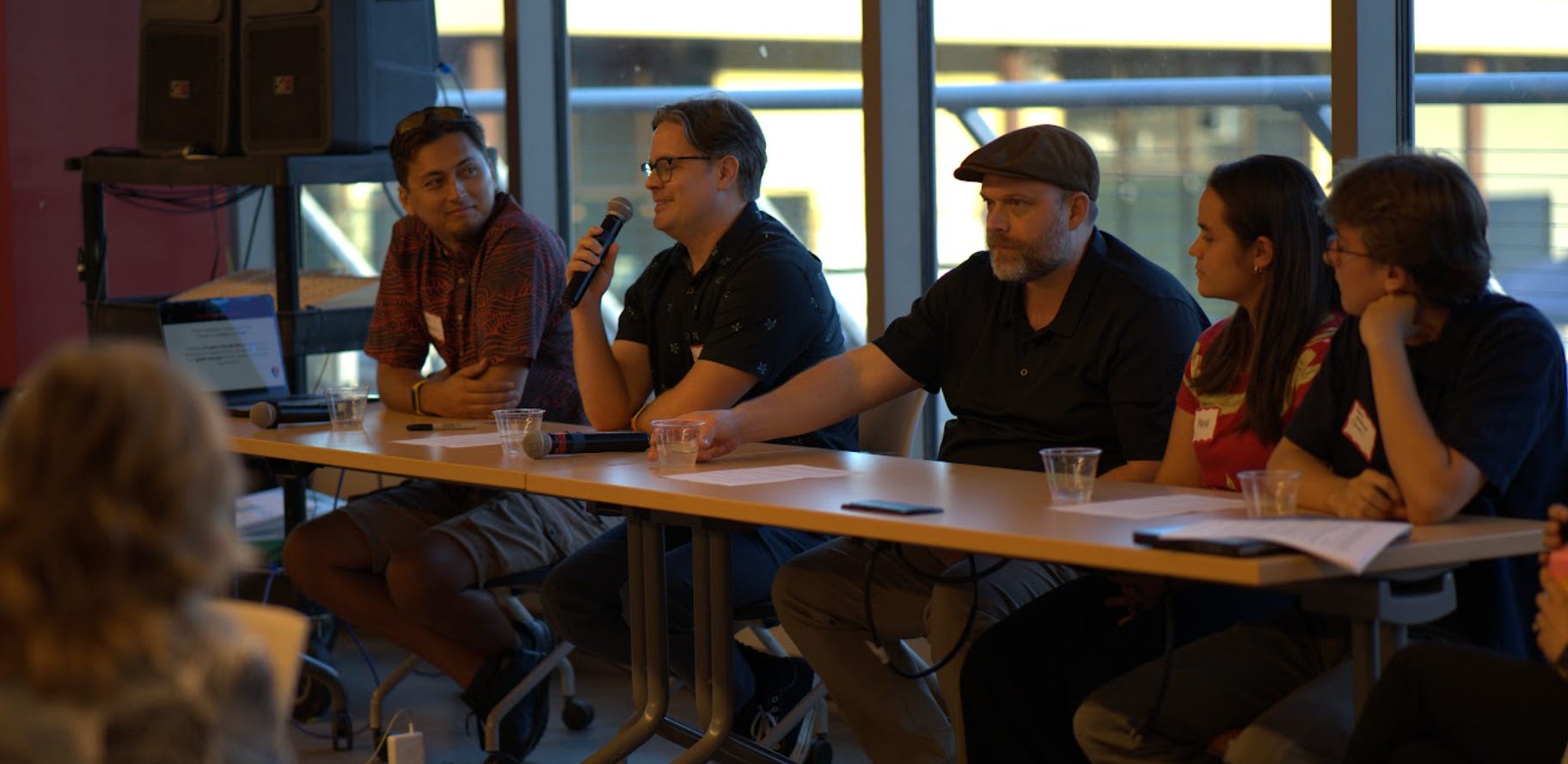
Hiring an outside consultant checks a box on an administrative to-do list. Building a genuine, functioning working group of students requires trust, sustained commitment, and willingness to share power. The long-term impact favors the harder path.
A teacher or staff member, especially one with long tenure and deeply ingrained practices, can dismiss a highly-paid outsider with a single comment mentioning the “mainland”. They can nod politely during professional development, then close their classroom door and continue as they always have. This resistance compounds in tight-knit communities like Hawaii, where external advice often meets cultural skepticism and where the distinction between insider and outsider carries significant weight.
Students change everything. When teachers face a human student—an actual young person they’re responsible for educating—the conversation transforms. Fear of job replacement, resistance to extra work, and dismissal of the technology as just another passing fad all fade.
When a student stands in front of a teacher and says, with genuine vulnerability, “I need help learning in this age. We need to figure this out together,” something profound happens. The teacher’s core desire to help that student, to fulfill their fundamental mission, overrides every professional excuse and institutional barrier. Centering students in the conversation reframes the entire adoption effort as a collective necessity to support student success—an urgent educational imperative emerging from the classroom itself.
From day one, the transformative power of the DLA has rested on one non-negotiable principle: complete transparency exists between how students actually use these tools and how we understand their usage.
This trust goes both ways and runs deep. We create space for exploration. We build environments where students can share their real AI usage without fear. We’ve built something rare in educational settings: a space where students tell us the unvarnished truth.
Students share exactly how they’re using AI—what tools they’re using, and most importantly, why they’re making the choices they make. This immediate, honest feedback enables us to develop the most effective methods for addressing behaviors through understanding root causes and designing better learning experiences. When a student explains they used AI to complete an assignment because they struggled with the material and felt too intimidated to ask for help, we’ve identified a pedagogical problem that requires a pedagogical solution.
This radical transparency has yielded insights no consultant could ever provide. We’ve learned which assignments inadvertently incentivize AI misuse because they emphasize product over process. We’ve discovered which types of assessments actually measure learning versus those that merely test compliance. We’ve identified the precise moments in the learning journey where students feel most vulnerable to taking shortcuts.
The DLA students have become invaluable partners in institutional evolution—diagnosing problems, proposing solutions, and serving as peer educators who can reach their classmates with a credibility no adult could match.
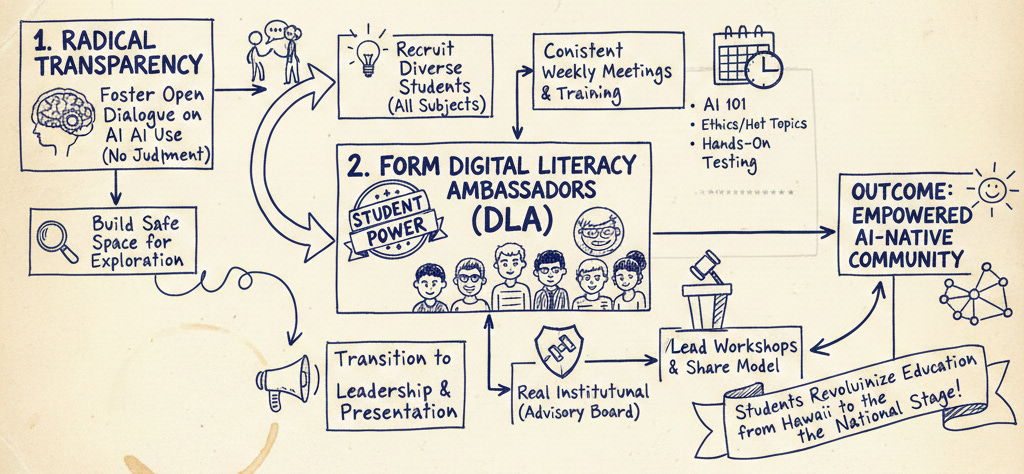
Creating a Digital Literacy Ambassadors program requires commitment and strategic structure, but the framework is accessible to any institution willing to invest in student leadership. Here’s how Director Furutomo and I structure this powerful, student-led working group from the ground up.
Create a clearly defined club space or advisory group focused explicitly on Emerging Technologies and AI Literacy. The purpose must be clearly defined as an advisory board and testing ground—a group with real institutional influence and responsibility.
Focus recruiting efforts on curiosity and character over technical credentials. Actively pull students from diverse backgrounds, deliberately seeking voices from beyond the typical STEM pipeline. This diversity ensures the group reflects the real spectrum of AI usage across your entire student body. An English student brings different questions and concerns than a Computer Science student. You need both perspectives at the table.
The recruitment pitch should emphasize opportunity for leadership, meaningful impact on school policy, and the chance to develop expertise in technology that will shape their future regardless of their intended career path.
Weekly meetings are essential. Consistency builds momentum, deepens trust, and creates a predictable space where students know they can experiment safely. Dedicate this time to testing tools and to foundational training on AI literacy that equips students to think critically about what they’re using.
Your curriculum should include three core components:
AI 101: What AI actually is, how it works (emphasizing that it’s prediction and statistics), and where training data comes from. Students need to understand that when they interact with ChatGPT, they’re prompting a statistical model that predicts the next most likely word based on patterns in its training data. This demystification is crucial.
Responsible Use: Create space for rigorous debate on hot topics—bias in algorithms, deepfakes, misinformation, data privacy, over-reliance on AI assistance, and the ethics of AI-generated content. Facilitate these discussions with open questions, letting students grapple with genuine complexity. Then collaboratively establish school-specific ground rules for ethical use that students feel ownership over because they helped create them.
Hands-On Testing: Rigorously test and evaluate new tools as they emerge. Is Magic School AI actually useful for teachers, or is it generating busywork? Does Perplexity provide better research scaffolding than traditional search for certain tasks? What are the actual safety guardrails in various platforms? Students should document their findings, assess educational value, and make recommendations based on real usage.
Once trained, activate the student superpower by giving them real leadership responsibilities with genuine stakes. Our DLA students rapidly evolved from test users to institutional leaders, and this progression is where the magic happens.
Campus Leadership: DLA students now serve as key resources for staff training sessions. They demonstrate tools to faculty, answer technical questions with patience, and help departments craft AI policy guidelines that actually make sense to both teachers and students. When a math department wants to understand how students might use AI in problem-solving, they invite DLA students to a department meeting for a frank conversation.
Local Influence: Our students have presented their work and shared their model at major local events like Hawaii’s Schools of the Future Conference, guiding conversations with educators from other schools across the state. They’ve spoken on panels, led workshops, and advised district-level administrators. The credibility they bring—as actual students navigating these tools daily—makes their guidance invaluable.
The Student-Led Model is Working Across Hawaii: The Digital Literacy Ambassadors are not an isolated experiment. The underlying principle—empowering students to lead the conversation—is already proving successful and replicable in other communities across our islands.
We are continually inspired by other educators and schools who champion this approach. For example, Jon Pennington and his students consistently showcase impressive, high-level AI-integrated projects and innovation at conferences, demonstrating what young people are already accomplishing with these tools. Additionally, Justin Lai actively supported the educational conversation with student voice by hosting student events during Honolulu Tech Week and the Swell AI conference.
This local network of student leadership confirms the core thesis: investing in students, giving them real agency, and providing a platform for their work creates a powerful, decentralized engine for AI literacy and campus-wide change management that works in diverse school settings, grade levels, and resource pools.
The digital divide is real. AI tools—particularly the more sophisticated versions with robust safety features and proper data protection—often sit behind paywalls that create stark access gaps. Free versions of AI tools frequently lack the necessary guardrails to protect student data and prevent misuse, leaving schools serving many communities with an impossible choice: accept risk or fall further behind.
To combat this inequity, I’m working with Ken Hiraki, the executive Director of the Public Schools of Hawaii Foundation and Russell Park and his cohort of future Educators, with the support of the Board of Education Chair Roy Takumi, to pilot AI literacy training specifically designed for future educators—the students who will themselves become teachers.
EDITORS NOTE: In an earlier draft I used “voice to text” to map out my original ideas and misinterpreted Ken's position. It's been fixed. 🤙 Apologies for any confusion!
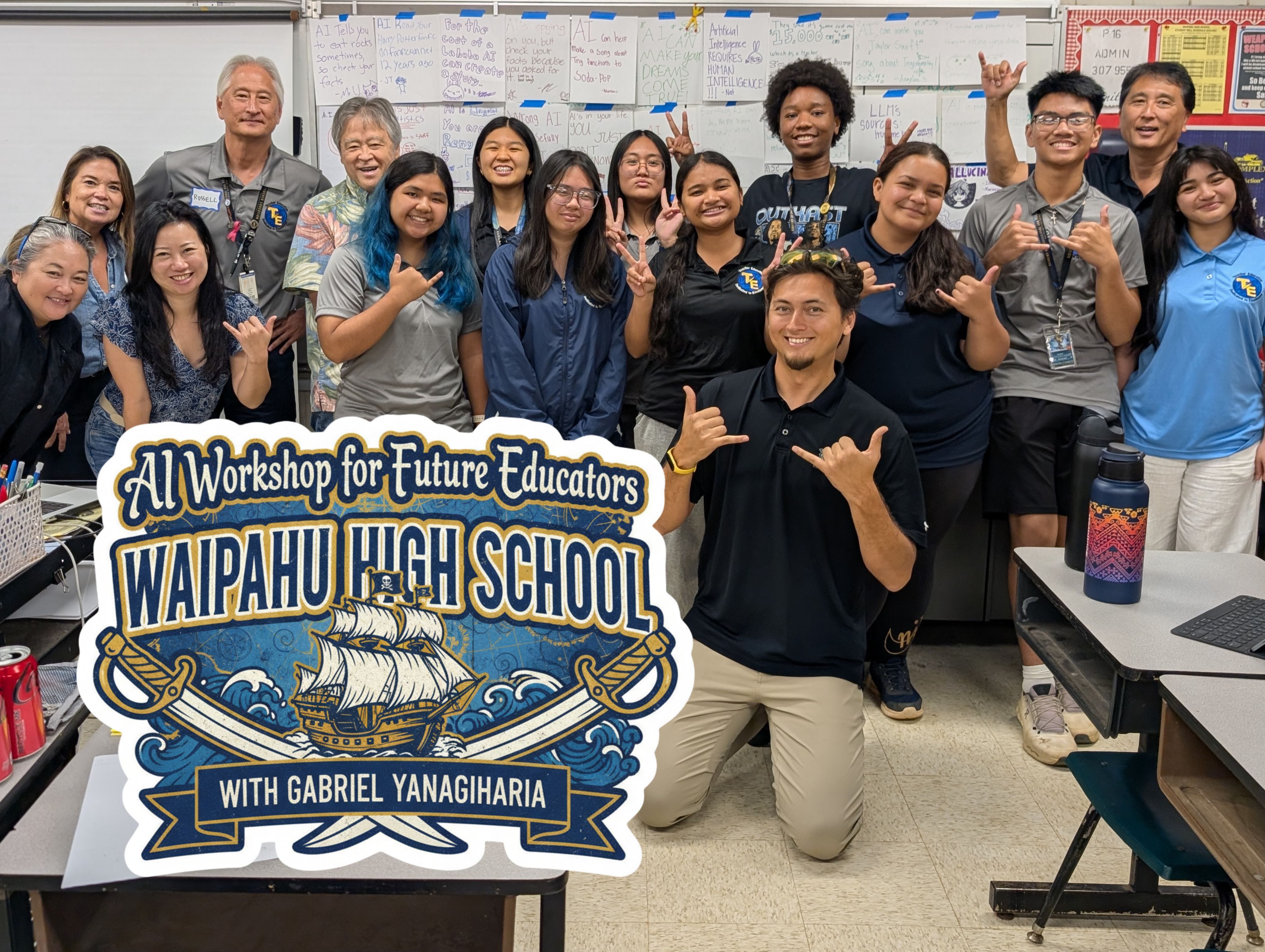
On Veterans Day, November 11, 2025, we spent the day at Waipahu High School delivering a full-day Future Educators AI Bootcamp that ran from 8:00 AM to 2:30 PM. This pilot was driven by Ken Hiraki’s theory that teachers might be more receptive to fully utilizing AI if their own students—future educators themselves—received the training and develop into AI native educators, rather than receiving yet another mandate from a DOE central office.
The theory proved correct. Assistant Superintendent Beth Higashi, and others attended portions of the training and witnessed something remarkable: students not just learning about AI, but actively creating comprehensive resources to teach it to others.
The training agenda moved methodically through three major components. We began with AI 101: What is AI and how does it work? Students learned that OpenAI’s ChatGPT and Google Gemini and others are statistical models making predictions. They explored where training data comes from, understood the concept of Large Language Models (LLMs), and grasped why AI can confidently state incorrect information (what researchers call “hallucinations”).
We used Google’s Quick Draw and Teachable Machine to make these concepts tangible. Students built their own simple AI models, training them to recognize faces. Watching an AI they’d trained themselves successfully identify patterns made the underlying mechanics clear.
The second component focused on debating hot topics: the helpful and harmful potential of generative AI. Students engaged deeply with difficult territory. They debated misinformation and the challenge of AI-generated content that sounds authoritative without accuracy. They discussed bias in training data and how AI can perpetuate or amplify societal prejudices. They confronted the reality of over-reliance—the risk of outsourcing thinking to machines and atrophying critical cognitive skills. They examined deepfakes and the erosion of “seeing is believing” as a reliable epistemological foundation.
Students connected AI ethics directly to their lived experience—their social media feeds, their academic work, their future careers. When you’re a future educator, questions about whether students should be allowed to use AI for homework aren’t hypothetical; they’re urgent, practical matters you’ll need to navigate within a few years.
The final component was the most ambitious: developing an AI lesson and comprehensive website. Students used Magic School AI—an educational platform designed specifically for K-12 contexts with appropriate safety features—to generate lesson plans, create teaching materials, and design assessment strategies. They used Canva’s AI features to design visual resources. They deployed Google Sites to build a navigable, professional website which I will be launching with them soon.

The critical outcome exceeded our expectations. In a combination of just two hours using generative AI tools and four to six hours of instruction, these students—many of whom had limited prior experience with AI—successfully built out a comprehensive resource website and AI literacy curriculum suitable for deployment across the entire DOE system.
Think about what that means: in less than a full school day, students created what would traditionally require a curriculum development team months to produce. The resources they generated—lesson plans, discussion prompts, policy frameworks, student-facing tutorials—were immediately usable, contextually appropriate for Hawaii, and designed by people who understand the student experience.
This effort serves as a viable prototype that can seed in other schools. Schools can adapt and deploy student-created resources that are already field-tested, culturally responsive, and authentically grounded in youth perspective.
The model is simple and replicable: identify students interested in teaching careers, provide them intensive AI literacy training, empower them to create resources for their schools, and support them as they professionalize and spread these essential skills throughout the system.
Want to run a workshop like this on your campus or organization? Share this with someone who can make that happen.
Our student leadership model extends beyond Hawaii’s shores. It’s positioned to influence the national conversation about the future of learning, and that influence is happening right now.
Several ‘Iolani students from grades 9-12 are preparing to represent Hawaii at the NextGen Roundtable National Deliberation in Houston, Texas, from December 3-6, 2025. This gathering brings rigor and substance. Students from across the country will critically examine the role of AI in shaping their educational and professional trajectories.
The theme—”From Classrooms to Careers: How AI is Shaping Our Paths”—cuts to the heart of why student voices must lead this conversation. These young people will inherit the systems we’re building right now. They’ll enter workplaces transformed by AI, navigate careers that haven’t been invented yet, and face ethical questions we can barely formulate. They’re the stakeholders with the longest time horizon and the most at stake.
During the roundtable, students will deliberate with peers from diverse geographic, socioeconomic, and cultural backgrounds. They’ll hear from expert panels representing technology, education, ethics, and industry. They’ll explore multiple perspectives on AI’s societal impact, wrestling with questions that don’t have easy answers: How do we balance AI’s efficiency gains against the risk of deskilling? How do we ensure AI augments human creativity rather than replacing it? How do we build guardrails without stifling innovation?
Most importantly, they’ll learn civil discourse facilitation skills developed by Stanford’s Deliberative Democracy Lab. These skills—how to hold space for disagreement, how to surface underlying values, how to build shared understanding across difference—are precisely what our polarized society needs. When these students return to ‘Iolani, they’ll lead similar roundtables at school, training other students in deliberative dialogue and multiplying the impact of what they’ve learned.
This is student-led change at scale: students facilitating the conversations, setting the agendas, and ensuring that the national discourse on AI in schools is grounded in classroom reality.
We’re demonstrating—in the most public way possible—that the most effective path forward requires empowering and trusting the bright young minds already walking our hallways.
Institutional leadership often mistakes expense for seriousness, believing that significant investment in external expertise signals commitment to change. The AI revolution is revealing this as a costly misunderstanding.
Students are already using AI—with permission, without permission, with guidance, without guidance, with institutional support or finding their own path. They’re experimenting, discovering, making mistakes, and developing intuitions about what these tools can and cannot do. The question centers on whether educators will engage with students about AI.
Every dollar spent on consultants who’ll conduct needs assessments and deliver professional development could instead fund the Digital Literacy Ambassadors already on your campus. Every hour spent in adult-only committees drafting AI policies could include students at the table sharing how they’re actually navigating these tools.
The path forward is clear: Look inside your institution for answers. Look at the young people in your hallways with fresh eyes—as partners in transformation, as experts in the lived experience of learning in an AI-saturated world, as leaders who can guide institutional change more effectively than any consultant.
Build your Digital Literacy Ambassadors program. Give students real responsibility and meaningful authority. Trust them to tell you the truth, even when that truth is uncomfortable. Empower them to teach, to advise, to create policy, to represent your institution at state and national levels.
The future of education will be built by students and educators working together, experimenting honestly, failing safely, and learning collectively.
And that future is already walking your hallways—if you’re willing to invite it to the table.
Thanks for reading Emerging Tech by Gabriel Yanagihara! This post is public so feel free to share it.
No posts
Comments
Nothing yet. Say the first thing.
Sign in to join the conversation.