
Recent reporting on the international art market has increasingly focused on a question that, only several years ago, remained largely confined to conversations among dealers, advisors, auction specialists, artists and other professionals working within the trade: whether the economic structure of the contemporary commercial gallery remains sustainable.
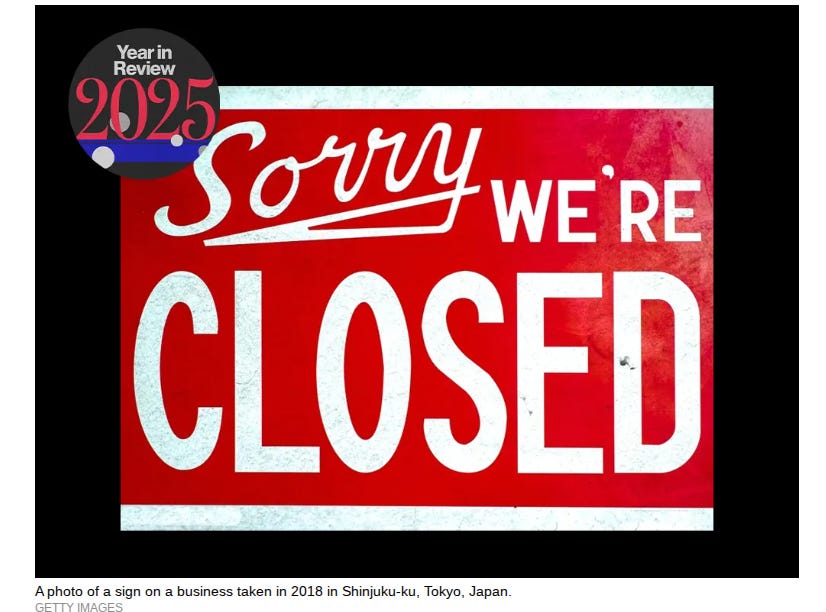
That question became particularly immediate for me when I encountered recent reporting in Artnet News concerning the changing conditions of the gallery sector and, subsequently, an ARTnews article reporting that two veteran London galleries, BEERS London and Sid Motion Gallery, would call it quits.
The news was striking not simply because two established galleries were closing, but because only a few weeks earlier, in my professional capacity as a Senior Advisor at an auction house, I had been speaking directly with one of those galleries regarding potential consignments to the secondary market.
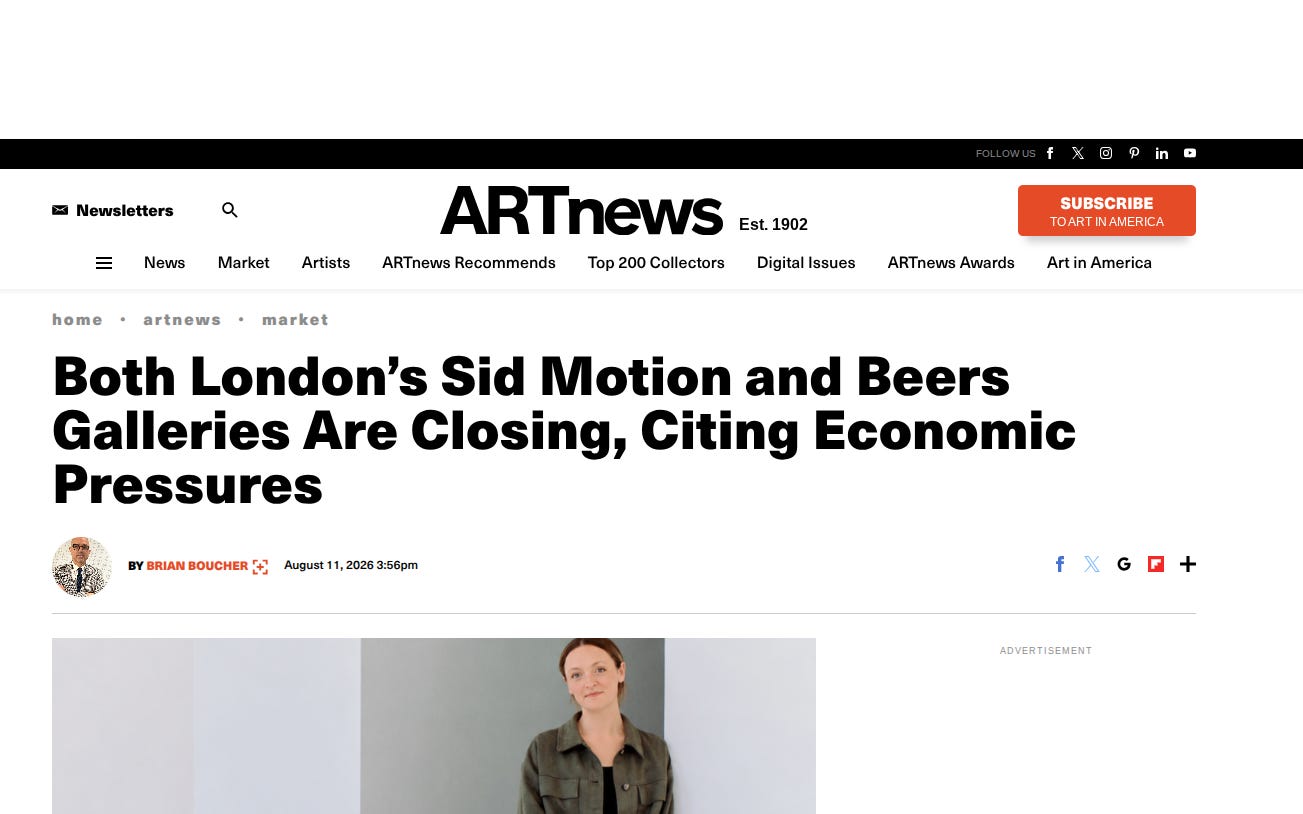
(The headline was not shocking)
The identity of the gallery is deliberately unimportant here. Professional relationships between galleries, collectors, advisors and auction houses depend upon discretion, and nothing discussed during that conversation suggested or disclosed an impending closure. What is relevant is the nature of the conversation itself. I had contacted the gallery from Florida as part of my ongoing work identifying potential consignments and developing relationships beyond the immediate geographic boundaries of the American market.
What began as a discussion of artworks and possible secondary-market opportunities gradually expanded into a broader exchange concerning the state of the European art market, the particular pressures facing London, the relationship between the primary and secondary markets, and the financial realities confronting mid-sized contemporary galleries.
Reading the subsequent news of the closures caused me to reconsider that conversation, not because it had somehow anticipated what was going to happen, but because it demonstrated how deeply structural economic questions have entered the ordinary professional discourse of the art trade. Conversations that might once have concentrated primarily upon artists, exhibitions, inventory, collectors and future projects increasingly include discussions of operating costs, market contraction, fair expenses, geographic shifts in collecting, liquidity and the viability of existing business models. The economics of maintaining the infrastructure through which contemporary art is exhibited and sold have themselves become one of the central subjects of the contemporary art market.
This development deserves consideration beyond the immediate circumstances of any individual gallery. Gallery closures inevitably generate declarations that the art market is in crisis, just as extraordinary auction results periodically produce assertions that the market has returned to extraordinary strength. Neither conclusion adequately describes an industry composed of multiple overlapping markets operating at different price levels, in different geographic regions and according to very different economic structures. Indeed, Artnet’s 2026 reporting presents London as a particularly contradictory example. The United Kingdom remains one of the world’s most significant art markets, and London retains extraordinary institutional, commercial and cultural infrastructure.
The most vulnerable position within this environment may be what I think of as the fragile middle of the art world. Public attention tends to concentrate upon the extremes of the system. At one end is the artist’s studio, still surrounded by the cultural mythology of individual production and creative independence. At the other are multinational galleries, major auction houses, international art fairs, institutional collections and spectacular transactions involving works valued in the millions or tens of millions of dollars. Between those poles exists a substantial network of small and mid-sized galleries responsible for much of the developmental work through which artists acquire sustained markets, critical attention and institutional recognition.
These galleries perform functions that extend considerably beyond the retail sale of artworks. They identify artists, finance exhibitions, cultivate collectors, facilitate relationships with critics and curators, publish catalogues, arrange transportation, participate in fairs, place works into collections and frequently support artistic practices for years before those relationships become economically profitable. They also provide a form of intellectual and curatorial continuity that is difficult to quantify financially. A serious gallery does not merely sell an individual object; it constructs a context within which a body of work can be understood, evaluated and situated within a larger cultural history.
The economics of the art fairs also demonstrate the problem particularly clearly. Participation at a significant domestic or international fair can require tens of thousands of dollars before a single work has been sold. Booth fees represent only the beginning of the financial exposure. Freight, insurance, specialized handling, travel, hotels, staffing, installation, entertainment and other logistical expenses can substantially increase the investment.

While working as a Gallery Director 2021-2023 at a blue-chip, I was already having conversations with colleagues at other galleries about significant year-over-year declines in sales. At the time, some individuals described reductions and losses approaching 40% - 50% percent year to year. In subsequent years, I heard individual dealers describe even more severe contractions, in certain instances reaching 60%, 70% and up to 80% losses year over year.
Of course on a daily walk around at the art Fairs no one would admit this, these are conversations with trusted colleagues in back rooms and zoom calls.
These figures require qualification. They are not presented here as comprehensive statistics describing the global art market. They are anecdotal accounts communicated to me by professionals describing the circumstances of their own businesses.
Yet anecdotal evidence has an important function when considering an industry whose aggregate statistics can obscure enormous differences among sectors. A market report may indicate a percentage decline in overall sales. It cannot fully communicate what that contraction means to a gallery owner deciding whether to renew a lease, retain an employee, finance another exhibition or commit $50,000 or $100,000 to participation in an international fair.
The broader evidence nevertheless suggests that these private conversations reflect structural pressures extending well beyond isolated businesses. In June 2026, Pace Gallery announced a substantial reduction of both its roster and staff. Its chief executive, Marc Glimcher, characterized the existing gallery model as fundamentally broken and argued that galleries were making compromises to sustain a system that no longer functioned effectively. The importance of this development lies partly in the scale of Pace itself. Financial pressure and the need for structural reconsideration are therefore not confined to emerging or mid-sized galleries.
This distinction is critical because the contemporary art market is not a unified economic organism. The primary market for an emerging painter operates differently from the market for established postwar art. A multinational gallery has resources unavailable to a founder-operated program, while simultaneously carrying expenses unimaginable to a small dealer. An auction house operates under another model entirely, as do private advisors, online platforms and independent dealers. Strength in one sector can coexist with contraction in another.
My current work within the secondary market has made the permeability of these categories increasingly apparent. Galleries, auction houses, advisors and collectors are not isolated participants occupying separate economic territories. They interact continuously. A gallery may represent living artists while simultaneously holding secondary-market inventory. A collector may approach an auction house directly or through an advisor. A dealer may determine that particular works are better suited to auction than continued retail presentation. Estates, private collections and longstanding gallery inventories circulate between these sectors as market conditions change.
The conversation I had with London only weeks before reading the closure announcement was an ordinary example of this increasingly interconnected system. From Florida, working within an American auction environment, I was discussing potential consignments with a contemporary gallery operating thousands of miles away.
This is also why I hesitate to describe the present moment simply as an art-market crisis. The available evidence is more complicated. Artnet’s 2026 Intelligence Report, for example, indicates that fine-art auction sales increased in 2025 after the weakness of the preceding period, including renewed strength at the upper end of the market.
At the same time, reporting on smaller and younger galleries has continued to describe substantial pressure, particularly when expensive fair participation produces insufficient sales. Recovery at the top of the auction market can therefore coexist with serious financial stress within the middle of the gallery sector.
This unevenness may ultimately prove more consequential than a generalized downturn. The question is not simply whether money remains within the art market. It clearly does. The question is where that capital is circulating, what kinds of art it is purchasing, through which intermediaries those transactions occur, and whether enough of that capital reaches the organizations responsible for developing artists before they become economically secure.
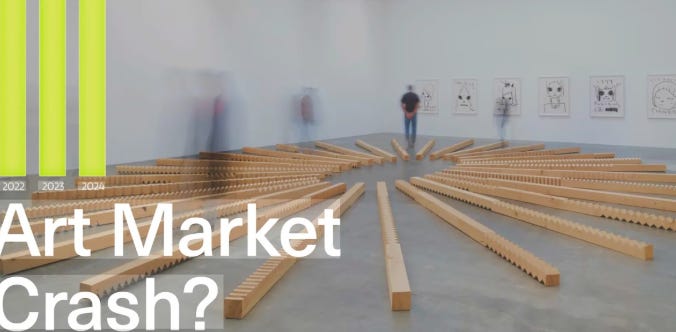
If the middle of the gallery system contracts substantially, the consequences will extend beyond the disappearance of individual businesses. Digital platforms, advisors, independent dealers, auction houses and artists themselves are all capable of facilitating transactions. Selling art is not necessarily the function most difficult to replace. More difficult to replace is the sustained developmental role historically performed by galleries: financing exhibitions, building critical narratives, introducing artists to curators and institutions, cultivating collectors over time and supporting bodies of work before the market has determined their value.
For those of us who have worked across different parts of this ecosystem, the current moment requires observation before proclamation. My experience as an artist, gallery director, advisor and now a professional working within auction and secondary-market contexts has repeatedly demonstrated that the art world appears remarkably different depending upon where one is standing. Artists, dealers, collectors, curators, advisors and auction specialists can experience the same market simultaneously and reach very different conclusions about its condition.
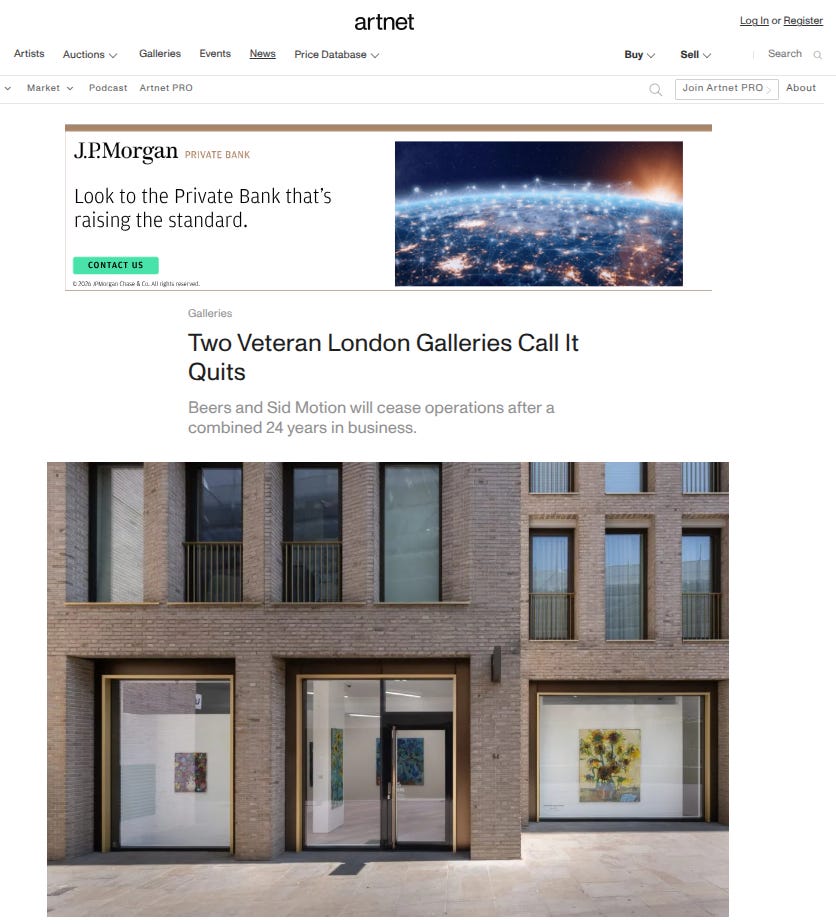
This is ultimately what stayed with me after reading the recent reporting from London. Only weeks earlier, what began as a professional conversation about potential consignments had evolved into an exchange about the economic pressures shaping contemporary galleries and the relationship between primary and secondary markets. Then two established London galleries appeared in the industry news as businesses ending their current operations. The sequence does not suggest privileged knowledge of what was coming, nor should it. What it demonstrates is something more useful: these structural questions are no longer theoretical discussions taking place at the margins of the art business. They have become part of its ordinary daily operation.
The art world will continue to produce artists, exhibitions, scholarship, collectors and transactions. Art itself is not dependent upon any single commercial structure. What remains uncertain is the institutional and economic configuration through which artists will be supported, contextualized and brought into sustained relationships with collectors and institutions.
The question facing the contemporary gallery, therefore, may no longer be simply whether the traditional model can survive another market cycle. The more consequential question is what the gallery must become in order to remain economically viable while continuing to perform the cultural, intellectual and developmental work that made it indispensable in the first place.
-Edited 8-14-2026
No posts
Comments
Nothing yet. Say the first thing.
Sign in to join the conversation.