
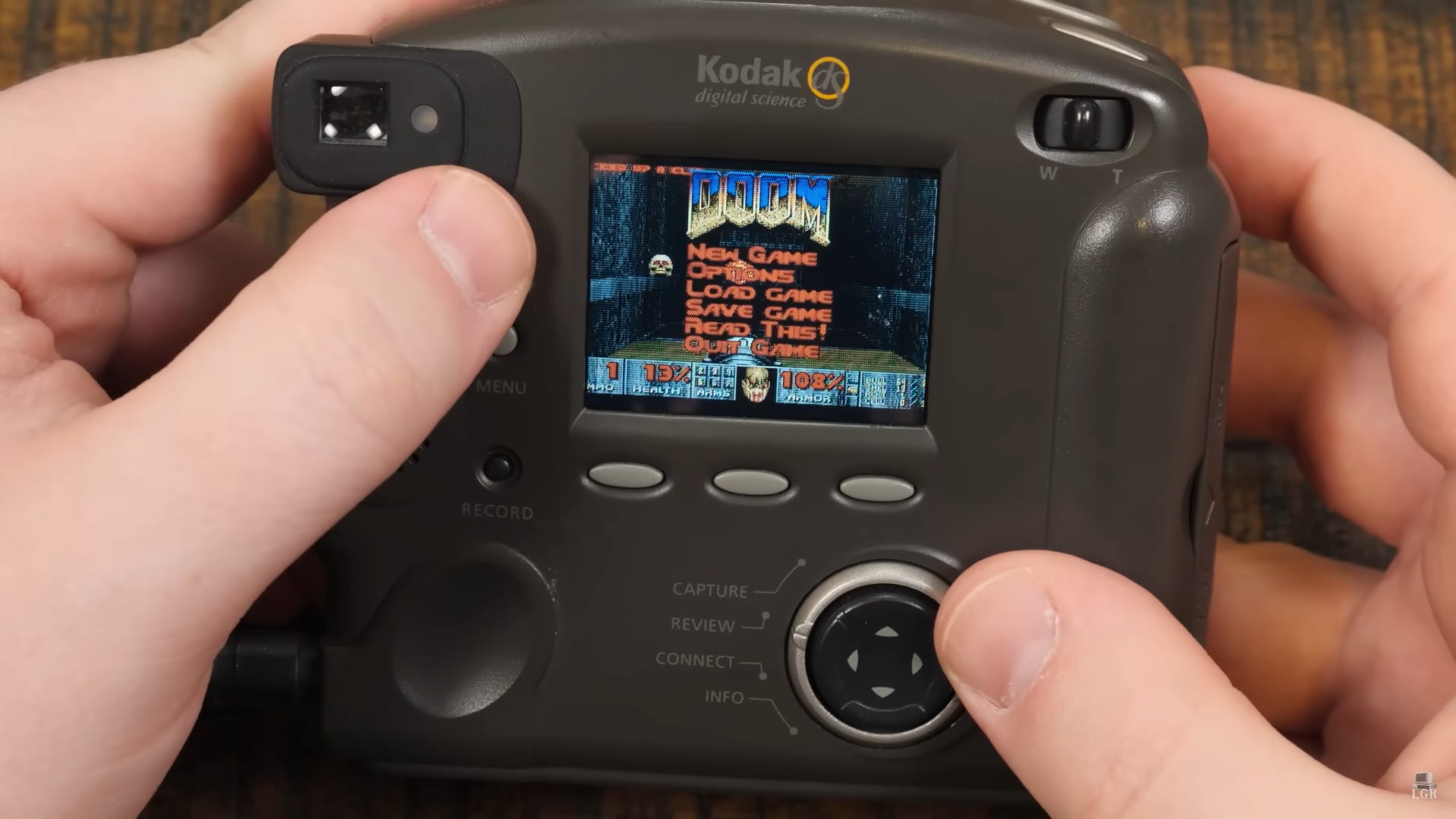
It’s hard to overstate just how popular Doom was when it came out, in 1993. The hyper-violent computer game about a space marine slaughtering legions of demons was literally installed on more computers than Windows 95. Using an innovative first-person 3D perspective, the game helped launch an entire genre, the first-person shooter.1 It was also a technical marvel: for years after its release, the question “But can it run Doom?” was a sign of a quality for a new computer and, as computer technology continued to advance, the answer was almost always, “Yes”.
It quickly became a meme. Every time there was a new operating system or a new video game console, someone would inevitably make Doom for it, either an official release or something made by “hackers.”
Over the three decades since, the meme has kept going, but things have gotten… sillier. Samplings from the r/ItRunsDoom subreddit and the CanItRunDoom.org website include people getting Doom running on a Kindle, a graphing calculator, an electric toothbrush, an Apple Watch, a smart refrigerator, and even a Porsche 911 sports car (with the car horn used as the “shoot” button). Just last month, someone got Doom running on ChatGPT, cause why the fuck not.

Part of the credit for the “Can it run Doom” movement is owed to the game’s original programmer, John Carmack, who made the unusual decision to release the game’s source code on the internet for free. We’ve already touched on the value of open-source in this newsletter, and it’s something we’ll keep returning to. In the gaming world, open-source helps to nurture a community of modding – grassroots efforts to tweak games to add new features, new visuals, or whole new gameplay modes. Modding breathes new life into old and obsolete games. It introduces them to new audiences and helps keep them lively and playable for years (or decades) after release.
I’ll explain.
In our modern world, there are computers, even in places you don’t expect them. MRI scanners, machine lathes, weapons systems, and oil rigs all require incredibly fine control, which can only be achieved with a special-purpose computer, a bespoke, customized computer, made just for this purpose. They’re designed and built to integrate with all the electrical and mechanical components that surround them, and can only ever work as a part of that system, to carry out their one specific task. (They actually can’t run Doom.)
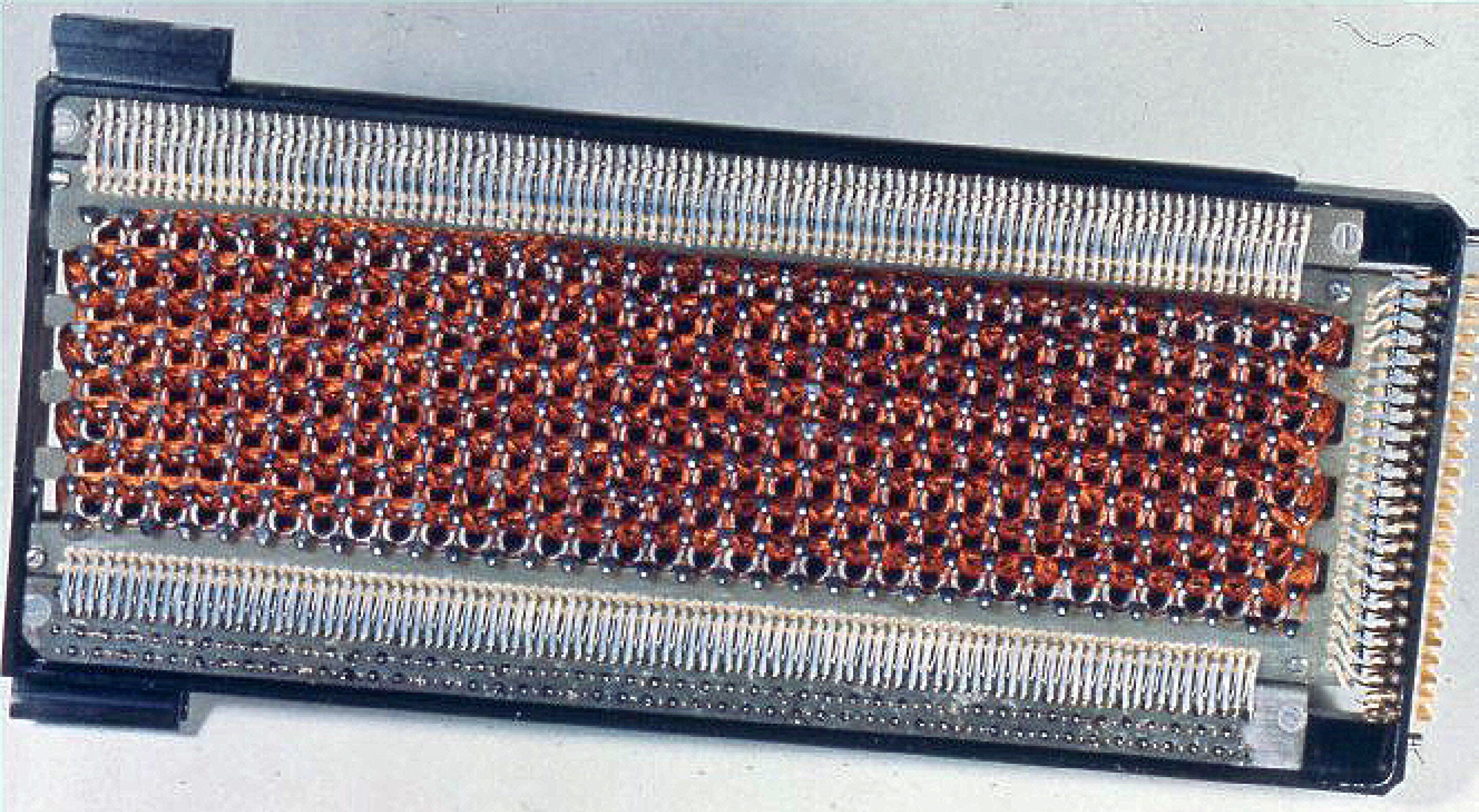
In the very early days of computing, every computer was a special-purpose computer, built special to solve one particular problem. These electro-mechanical behemoths used circuits with mechanical relays (then vacuum tubes, then transistors) to create logic gates that could redirect the flow of current, depending on user input. If you ever wanted one of these early computers to solve a different problem than the one it was wired for, it would require just ripping out all the wires and starting over.
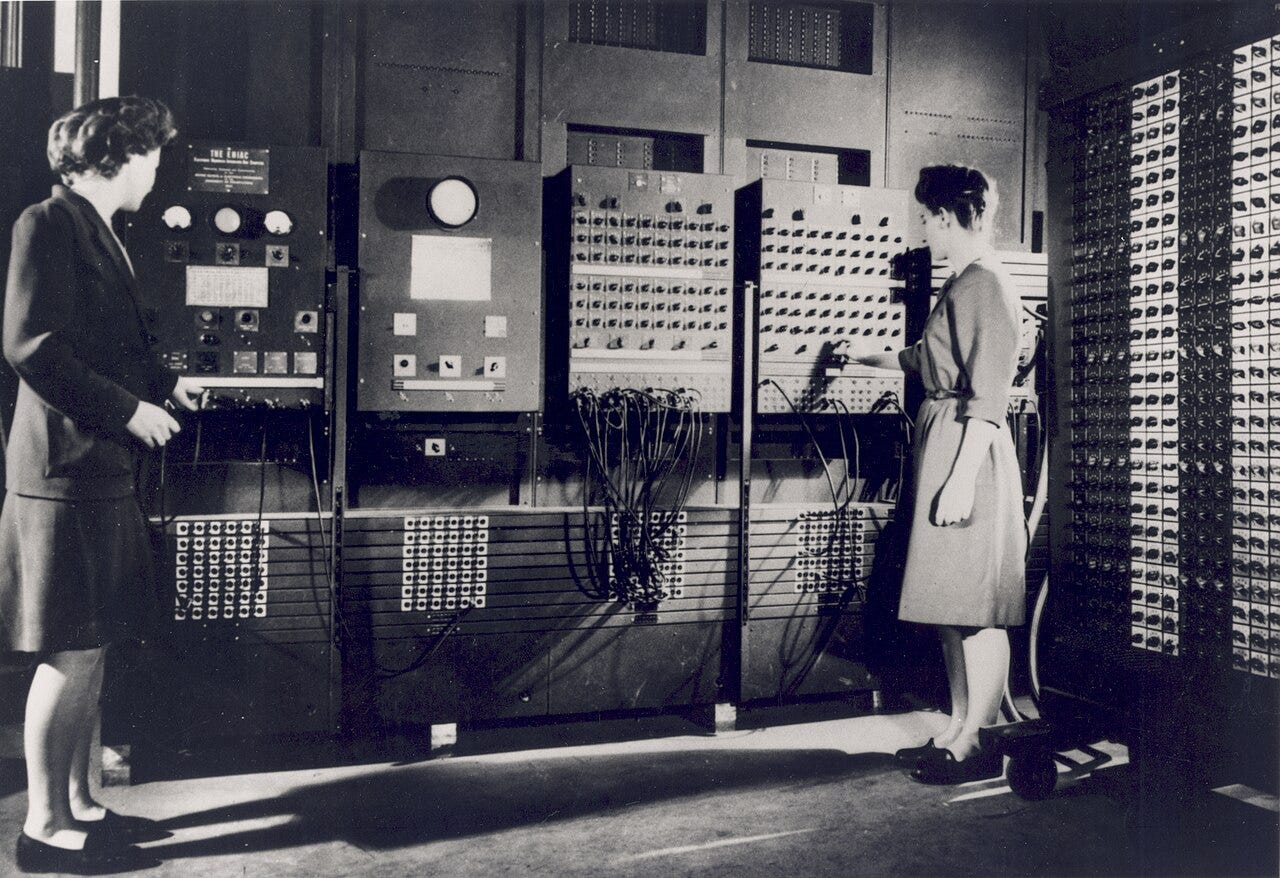
Soon, a new type of computer came about: the general-purpose computer. The first was ENIAC, completed in 1946. It still contained incredibly complicated wiring to serve as logic gates, but it also had the ability to a read a set of instructions, which we would call a “computer program.” Using punch cards, programmers could instruct ENIAC which parts of its internal circuitry to use for any one operation – essentially allowing it to rewire itself in real time.
The end result is that ENIAC could, theoretically, run any program. If you could write it using logic and mathematics, ENIAC could do it. The only limit was time and power.
Over the next decades, general-purpose computers would become even more standardized. These days, your laptop, your phone, and your touch-screen refrigerator all have the same basic components: memory (to store data and programs), a central processor (to read that data and run those programs), and inputs and outputs (to communicate with the user). And, as general-purpose computers have gotten more and more ubiquitous, they increasingly all contain the exact same components and run the exact same programs.
It’s been your job your whole life, and you’re very good at it. Then, one day, you’re told to design a fridge with a fully-functional touchpad display on the front. Theoretically, you could learn a brand-new set of skills and design a brand-new special-purpose fridge computer from the ground up, but maybe it makes more sense to buy a motherboard, install a free operating system like Linux, and hire a teenager to write a bit of code to make it look like a brand-new system.
Oh hey… doesn’t Doom run well on Linux?2
Why am I prevented from running programs that I purchased, without first signing up for an account? Why are features locked away behind administrator access that I don’t have? Don’t I own this thing?
As it turns out, while all that freedom is good for users, it’s directly counter to the interests of the large corporations who want to sell us things, control our activity, and keep us locked in their walled gardens. And so, they fight back. Modern devices come preinstalled with a host of malicious programs that subvert user control, under the innocuous name “digital rights management.” DRM is what prevents iPhones from running apps that don’t originate form the Apple Store and locks you out of your copy of Photoshop if your subscription expires.
Legislation like the US’s Digital Millennium Copyright Act3 creates significant legal consequences for breaking copyright, and in particular, the software copyrights held by large tech companies, including making it illegal to crack DRM’s digital locks.
Meanwhile, novel-length Terms of Service agreements that users are forced to sign before accessing any new computer or software add strictures far beyond what’s in the law. They restrict users against performing basic functions and sometimes grant the company the ability to remotely shut down devices on a whim.
If this doesn’t qualify as malware, I don’t know what does.
“We make computers that are designed to run all programs,” says Cory Doctorow in Information Doesn’t Want to be Free, “then we add software that watches what that computer's user does at all times, and that secretly kills any process any program that does something” unwanted. A modern computer “comes out of the box treating you, its owner, as an attacker, and does everything it can think of to stop you from seeing its inner workings.”
It’s funny that we’ve turned “hacking” into a dirty word, meaning “to use the computer in a way it wasn’t intended,” when the only thing a computer is intended for is to perform logical operations. Your fridge is built with the ability to run Doom... but it might require a hacker to make it happen.
Doom wasn’t the first first-person shooter, but its phenomenal popularity spawned countless imitators, and it pioneered new techniques for displaying 3D graphics on a home PC that helped make those games possible. For years, games in this genre were simply called “Doom clones,” before someone came up with the term “first-person shooter.”
In the fridge example, they actually got Doom Eternal running, which is the game’s sequel. That game was released in 2020 and built for modern gaming hardware - and a fridge can run it! Just to give you a sense of how powerful modern integrated computers are.
Canada has its own internet copyright laws, like the 2015 Copyright Modernization Act, but in internet law, as with so many things, Canada unfortunately tends to just follow along with whatever the US says.
Comments
Nothing yet. Say the first thing.
Sign in to join the conversation.