
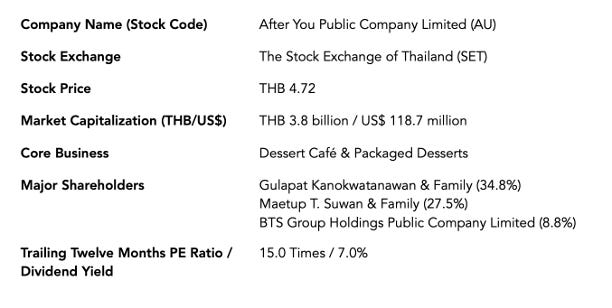
Cousins Gulapat “May” Kanokwatanawan and Maetup T. Suwan founded After You in 2007, opening their first small store in Bangkok’s trendy neighborhood of Thonglor. The brand is positioned as an upscale dessert café, offering high-quality products at premium prices.
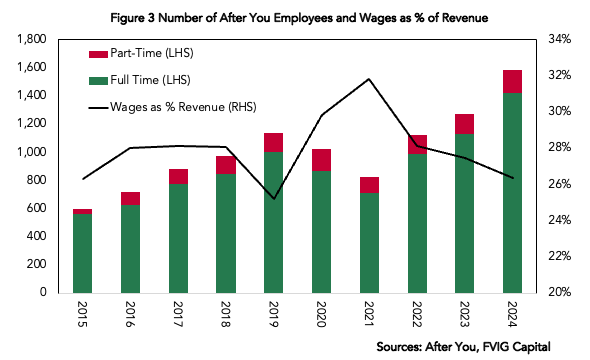
To maintain consistent product quality and customer service, all 60 After You dessert cafés in Thailand are company-owned, with 90% of the company’s staff employed full-time.
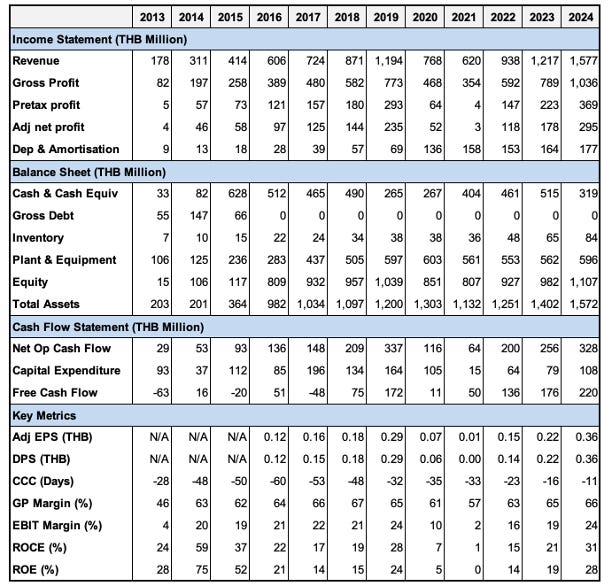
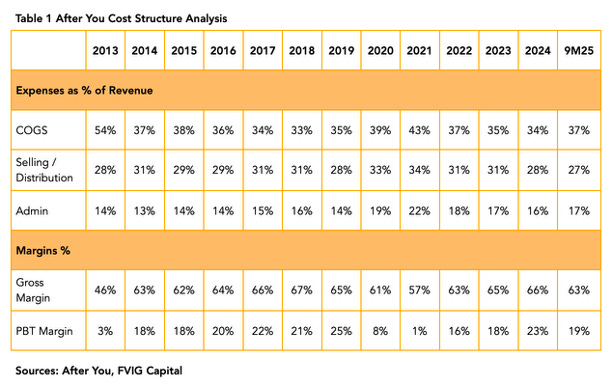
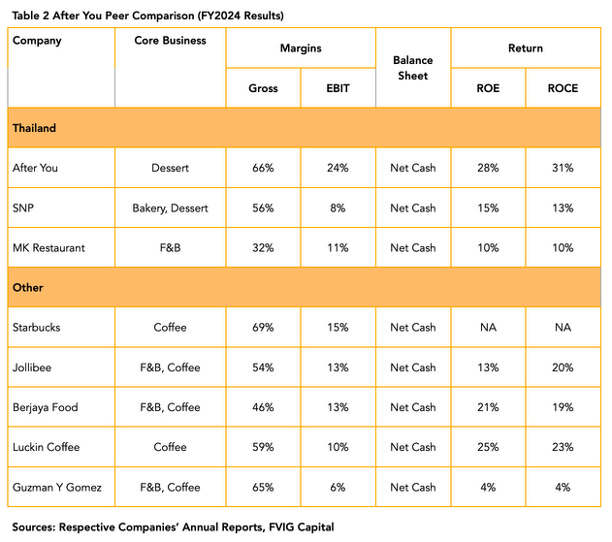
Consistent gross margins of 62%+ and PBT margins of 18%+ are-best in-class globally.
After You suffered from low table turnover and stores are often busy only at certain times of the day or week, resulting in long queues and requiring large and costly store footprints.
It solved the sales bottleneck problem by expanding the range of packaged desserts products for takeaway in 2018 by utilising its newly built and expanded central kitchen.
The strategy proved timely: when Covid-19 hit, After You remained profitable and cash flow positive by relying on packaged dessert sales.
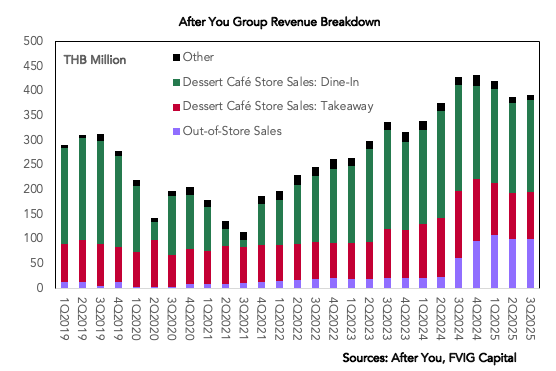
After You expanded its sales channel in 2024 by distributing packaged desserts via 7-Eleven stores. Total packaged dessert revenue surpassed in-store dessert revenue for the first time in the twelve months to September 2025.
After You delivered record revenue and earnings per share in 2024. While revenue is on track to reach another new high in 2025, net profit is set to fall due to lower gross margins, driven by a greater mix of third-party sales to convenience stores and a further drop in higher-margin in-store dining.
As a result, After You’s share price is near all-time lows despite improving long-term fundamentals.
Sweet Tooth
Cousins Gulapat “May” Kanokwatanawan and Maetup T. Suwan founded After You Dessert Café in 2007. The initiative was led by dessert obsessed May, who had published several volumes of dessert recipe books (‘May Made’) before founding the Company. The brand is positioned as an upscale dessert café, offering high-quality products at premium prices. It listed on The Stock Exchange of Thailand’s Market for Alternative Investment with a market cap of THB 3.3 billion in December 2016.
After You has strictly focused on desserts for the 18 years it has been in business, offering no savory food items (e.g. fried chicken). May leads product development and no item is approved without her final ‘okay’. To maintain quality at scale, its 10,200 sqm central kitchen in Sinsakhon Industrial Estate (40km southwest of Bangkok, first phase in 2016) supplies stores with raw materials, semi-prepared foods, baked goods, snacks and packaged desserts for takeaway.
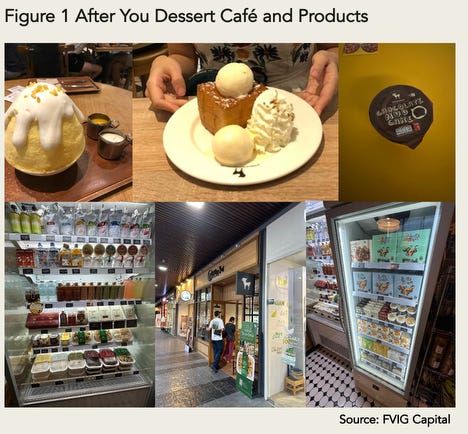
Dessert prices, which include flagships “Shibuya Toast” (available since inception) and “Kakigori shaved ice” (introduced in 2015) alongside pancakes, waffles, and cakes, range from THB 95 to 395 (US$2.90 to US$12.20). Beverages (iced/hot chocolate, coffee, tea) are priced between THB 110 to 155 (US$3.40 to US$4.80). See figure 1 for a highlight of After You’s stores and product offerings.
Given the premium pricing of its products, the majority of After You dessert café’s are located in Bangkok, whose average monthly household income of THB 40-50K (US$1.2-1.5K) is double or more than that of other Thai provinces. Accordingly, its core customers are the urban affluent Thai population and foreigners. About 70% of After You’s customers are locals, with the remainder consisting mostly tourists from Southeast Asia and China.
Path to Scale
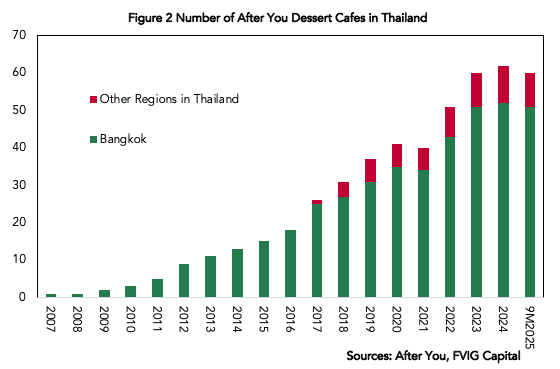
Since opening its first small store in the trendy Thonglor neighborhood of Bangkok, total number of stores has grown to 60 - see figure 2. After You maintains tight control over its brand by operating all 60 dessert cafés as company-owned stores to ensure consistency in both food quality and customer service. Indeed, most of its frontline store and central kitchen staff are employed on a full-time basis which improves the ability to uphold high standards - see figure 3.
After You dessert cafés were on average larger prior to the pandemic, at up to 150 square meters with 30 tables and 25 workers. Larger stores required an investment of up to THB 10 million and had a payback period of up to two years. While After You charges premium prices and desserts are high-margin by nature, it suffered from low table turnover and stores are often busy only at certain times of the day or week, resulting in long queues and requiring large and costly store footprints.
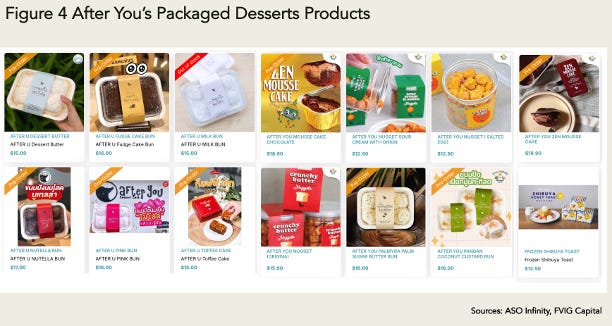
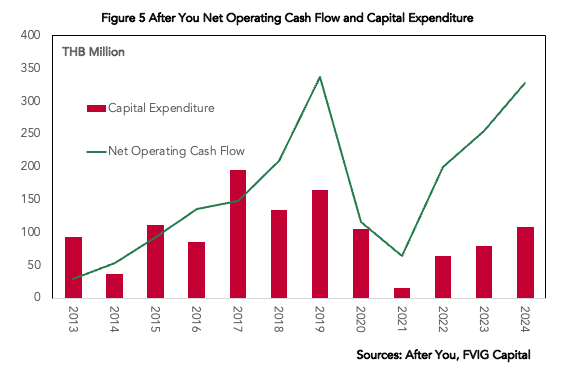
The sales bottleneck problem was solved by utilising its central kitchen to expand the range of packaged desserts products for takeaway - see figure 4 for an overview of After You’s packaged products. Covid-19 dine-in restrictions accelerated After You’s pre-existing packaged dessert strategy, allowing it to adapt quickly to the rapid change in operating conditions and, in turn, maintain profitability and positive operating cash flow throughout the pandemic - see table 1 and figure 5.
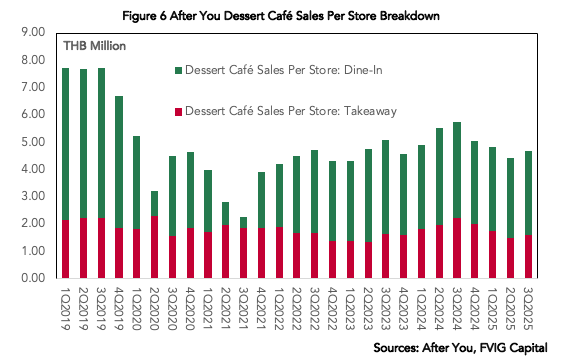
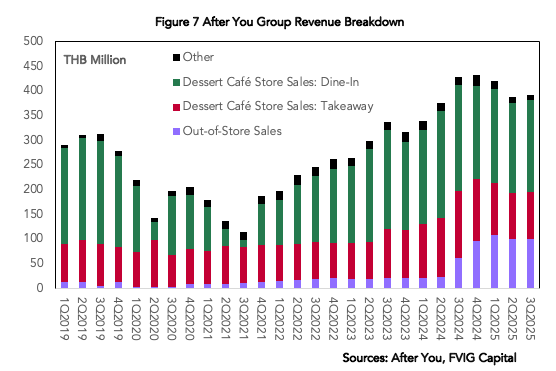
The average size of post-pandemic dessert cafés shrank, as newer stores were optimised for takeaway sales. Consequently, while the average dine-in sales per store fell, packaged sales per store has held steady - see figure 6. Total sales of packaged desserts accelerated following the partnership with 7-Eleven in July 2024. In the twelve-months ending September 2025, total packaged dessert revenue (i.e. via in-store and 7-Eleven) surpassed in-store dining revenue for the first time in the - see figure 7.
Up and Down
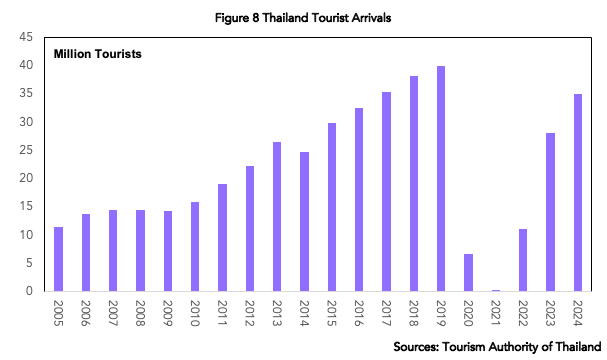
The growth in out-of-store packaged dessert sales not only drove record revenue and net profit in 2024, but also mitigated the year-on-year decline in 2025 dessert café sales (both in-store dining and takeaway), a drop caused by worsening domestic economic conditions and tourism numbers that are still trailing their pre-pandemic peak (figure 8).
While revenue is on track to reach another new high in 2025, net profit is set to fall (down 19% year-on-year in 9M2025) due to compressed gross margins (table 1), driven by a greater mix of lower-margin sales to convenience stores and a smaller share of higher-margin in-store dining. Its share price has weakened considerably as a result, to near all time lows. Is this justified?
Building Blocks
It is inevitable that an upscale dessert cafe would experience a slide in store sales during an economic downturn and still-in-recovery tourism market. The fact that it can still grow its overall top-line in such conditions is testament to management’s quality. Furthermore, 9M2025 gross margins of over 62% with PBT margins above 18% still places it as best in-class globally - see table 2.
It has an established track record of careful experiments to minimise potential losses in building the business. This includes opening After You pop-up stores for marketing and testing a particular locality, figuring out which coffee store operating model would be best (mass market Mika Coffee Roasters in 2019, specialty coffee stores Songwat Coffee Roasters in 2023 and One Day in Copenhagen in 2024) and slowly scaling Luggaw fruit shops (fruit juice, sliced fruit, fruit salad, preserved fruit) to tap into the health conscious crowd. The coffee brands and Luggaw have synergies with the core After You business through scaling of costs and cross-selling opportunities
There is a lot of care for the After You brand. Having only company-owned stores and 90% of staff employed on a full-time basis is not the norm for a F&B business at its scale. After You franchises have/will only be granted overseas and requires a meeting with and approval by the co-founders. So far franchises have been established in Hong Kong (closed) and Cambodia, with Dubai and Indonesia to open by end 2025. It has deliberately slowed overseas franchise expansion despite strong demand, especially from Southeast Asian countries where brand awareness is high.
After You’s new model for overseas expansion involves engaging interested franchisees to become distributors of its packaged dessert products first. A franchise will be considered should the distribution partner succeed in scaling the sales of After You’s products. This is smart because:
It saves significant management time and effort (e.g. provide training to overseas franchisors)
It allows faster entry to new markets (Distribution agreement simpler than franchise agreement)
Less brand risk (Poor store execution will damage brand. But if distribution fails, stop selling)
Faster to scale (Takes time to prove franchise store viability before expanding. Distribution is highly scalable)
Helps improve central kitchen utilisation and drive lower raw material cost from scale.
In all, it is a low-risk with potentially high-return strategy i.e. not much to lose, but a lot to gain. The Philippines will be the first country where After You sells its packaged products through a local distributor, with agreements for Malaysia and Vietnam under discussion. The Company is also for the first time in its history opening a savory restaurant by 1Q2026 for trials, similar to its coffee and fruit store ventures - all of which are built on the solid base set by After You Dessert Café.
The F&B business is unforgiving in nature with very low barriers to entry. After You’s long track record of profitable growth is built on protecting its premium brand by focusing on the basics: quality food and great service. Having the scale, no debt and ample cash, with pricing power and an efficient cost structure, provides it with significant opportunities for growth. The Thai economy and tourism industry will recover over time, and the markets of Southeast Asia and China provide a huge runway for both its franchise and packaged desserts businesses.
While it is indeed facing near-term headwinds, the long-term tailwinds are compelling. The direction of After You’s share price is not reflective of its fundamentals. At FVIG Capital, we will continue to monitor developments closely and provide updates as After You continues to perfect its recipe.
Disclaimer:
This report is published by FVIG Capital for informational and educational purposes only and does not constitute investment advice or a recommendation to buy or sell any security. The views expressed are those of the author(s) as of the date of publication and are subject to change without notice.
FVIG Capital, its affiliates, and/or their associates may hold positions in the securities discussed. While every effort has been made to ensure accuracy, no warranty is given as to the completeness or reliability of the information contained herein. Readers should conduct their own due diligence before making any investment decisions.
Comments
Nothing yet. Say the first thing.
Sign in to join the conversation.