
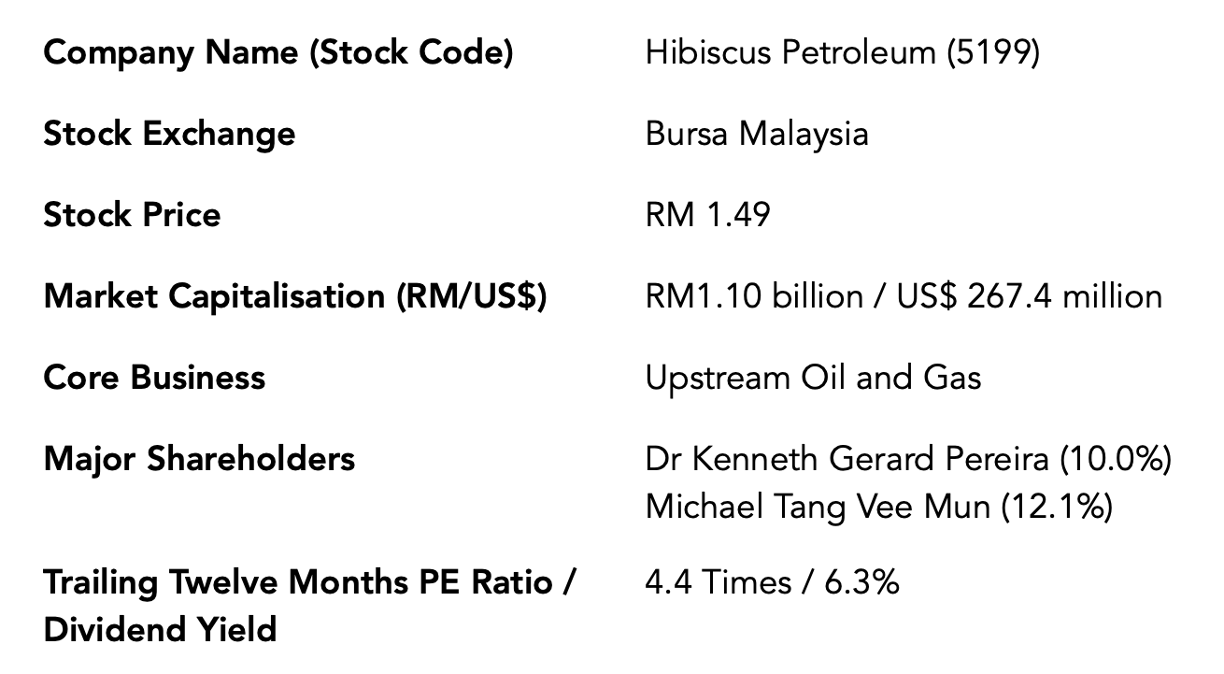
Malaysia’s first listed independent oil and gas (O&G) exploration and production company founded by Dr. Kenneth Pereira. Listed as a special purpose acquisition company (SPAC) in July 2011 on Bursa Malaysia, raised RM234 million with a market capitalisation of RM314 million.
Initially acquired interests in exploration assets (Middle East, Norway, Australia) amidst a high oil price environment. Oil market downturn provided the opportunity to acquire producing assets at attractive valuations with payback periods of less than 1 year:
March 2016: acquired 50% operating interest in Anasuria Cluster in United Kingdom’s North Sea for US$52.5 million from Shell and Exxon
March 2018: acquired 50% operating interest in North Sabah Production Sharing Contract (PSC) located offshore Sabah, East Malaysia, from Shell for US$25.0 million
Successful transactions with global oil majors, demonstrable track record as a capable operator, a low oil price environment and majors’ marginal asset rationalisation drive led to the opportunity to acquire PSC operating interest in PM3 CAA assets from Repsol for US$212.5 million in January 2022. PM3 CAA comprises:
60% of Kinabalu PSC located offshore Sabah, East Malaysia - oil production
35% of PM3 CAA located offshore peninsula Malaysia - oil and gas production: introduced natural gas to Hibiscus’ portfolio at scale.
In October 2024, Hibiscus acquired 37.5% operating interest in Block B Maharajalela Jamalulalam (MLJ) field located offshore Brunei from TotalEnergies for US$259.4 million.
As MLJ is a predominantly gas asset, natural gas represent 49% of Hibiscus’ product portfolio after the acquisition. MLJ provided Hibiscus exposure to the LNG market.
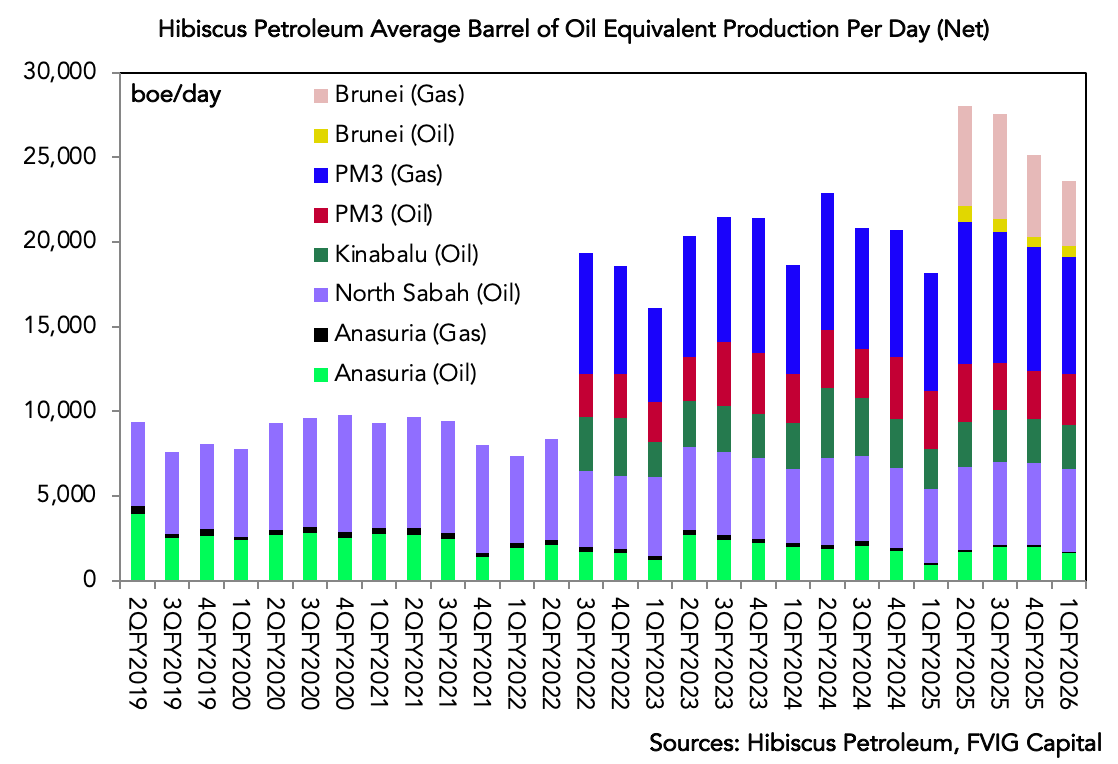
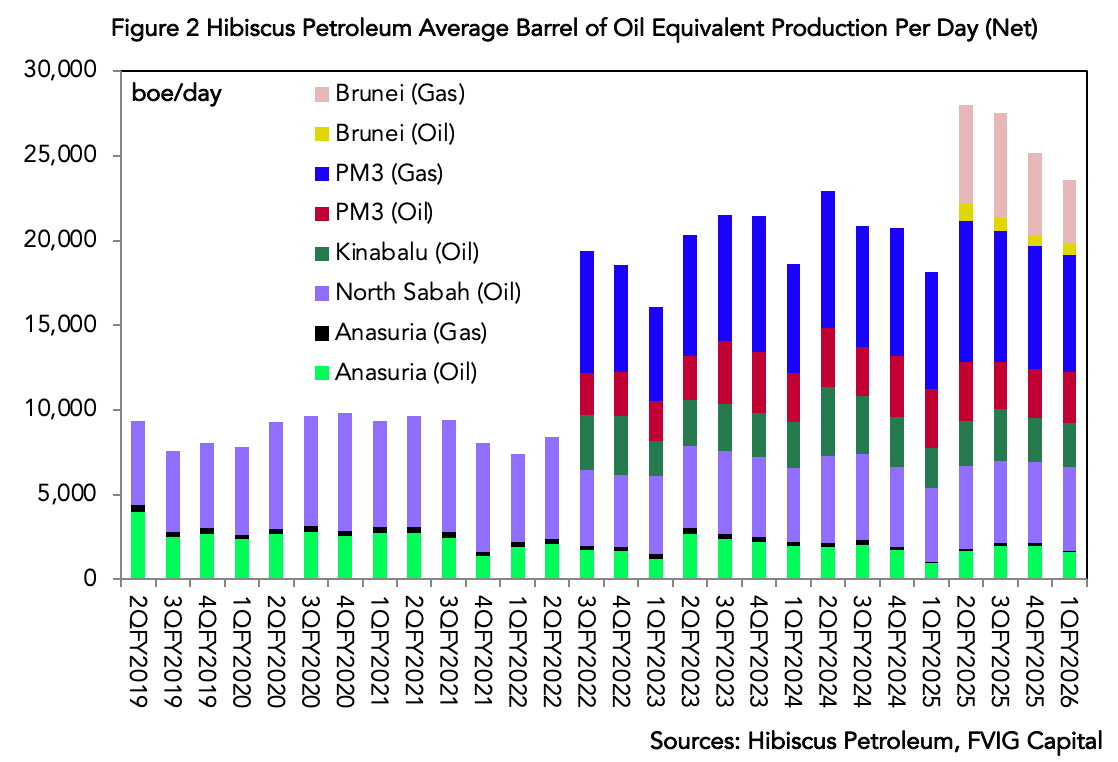
Hibiscus transformed from an upstream exploration business with zero production to producing more than 25,000 barrel of oil equivalent (boe) per day in FY2025 in a span of a decade. It is on track to achieve 35,000 boe per day in 2026.
Despite its operational capabilities, diversified asset base, strong capital allocation track record and substantial production upside over the immediate to long-term, Hibiscus’ stock price is at five year lows, trending in-line with the price of crude oil.
Its Always Darkest Before Dawn
The topic of Dr. Kenneth Pereira’s MBA thesis was on how to build an O&G services company in Malaysia, and his Doctorate was on what it takes for smaller O&G exploration and production companies to survive. His academic background, together with decades of O&G experience at Schlumberger (field engineer), Sapura Energy (executive roles) and Interlink Petroleum (MD) meant he was well prepared to found and lead Hibiscus Petroleum, Malaysia’s first listed independent O&G exploration and production company in 2010.
Hibiscus initially considered private equity funding for its venture, but sought alternatives as key decisions would need investment committee approvals. Fortunately, Malaysia’s Securities Commission had just approved the SPAC structure for fund raising, allowing Hibiscus to list on Bursa Malaysia in July 2011, raising RM234 million at a market capitalisation of RM314 million. Hibiscus was Southeast Asia’s first SPAC listing and is the only SPAC in Malaysia (five in total) that survived. Crude oil was in a bull market at the time of Hibiscus’ listing - see Figure 1
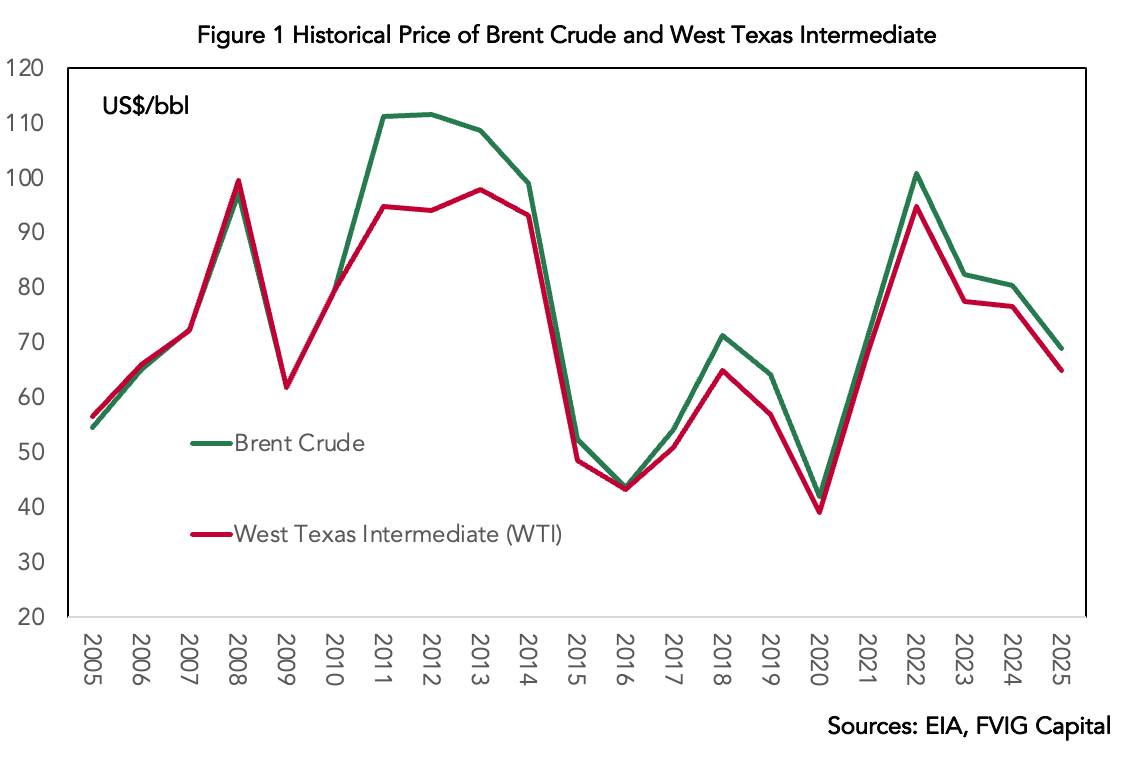
While such an environment is great for raising funds, it also has the effect of elevating the valuation of O&G assets. Malaysia’s SPAC rules however requires the vehicle to acquire an asset within 3 years of listing. Hibiscus thus built stakes in exploration assets in Australia, Norway and the Middle East in the years following its public market debut, hoping to benefit from a sizable pay dirt from one of its bets. The oil price crash in 2014, spurred primarily by surging output from the US’ shale industry, rendered Hibiscus’ exploration strategy obsolete.
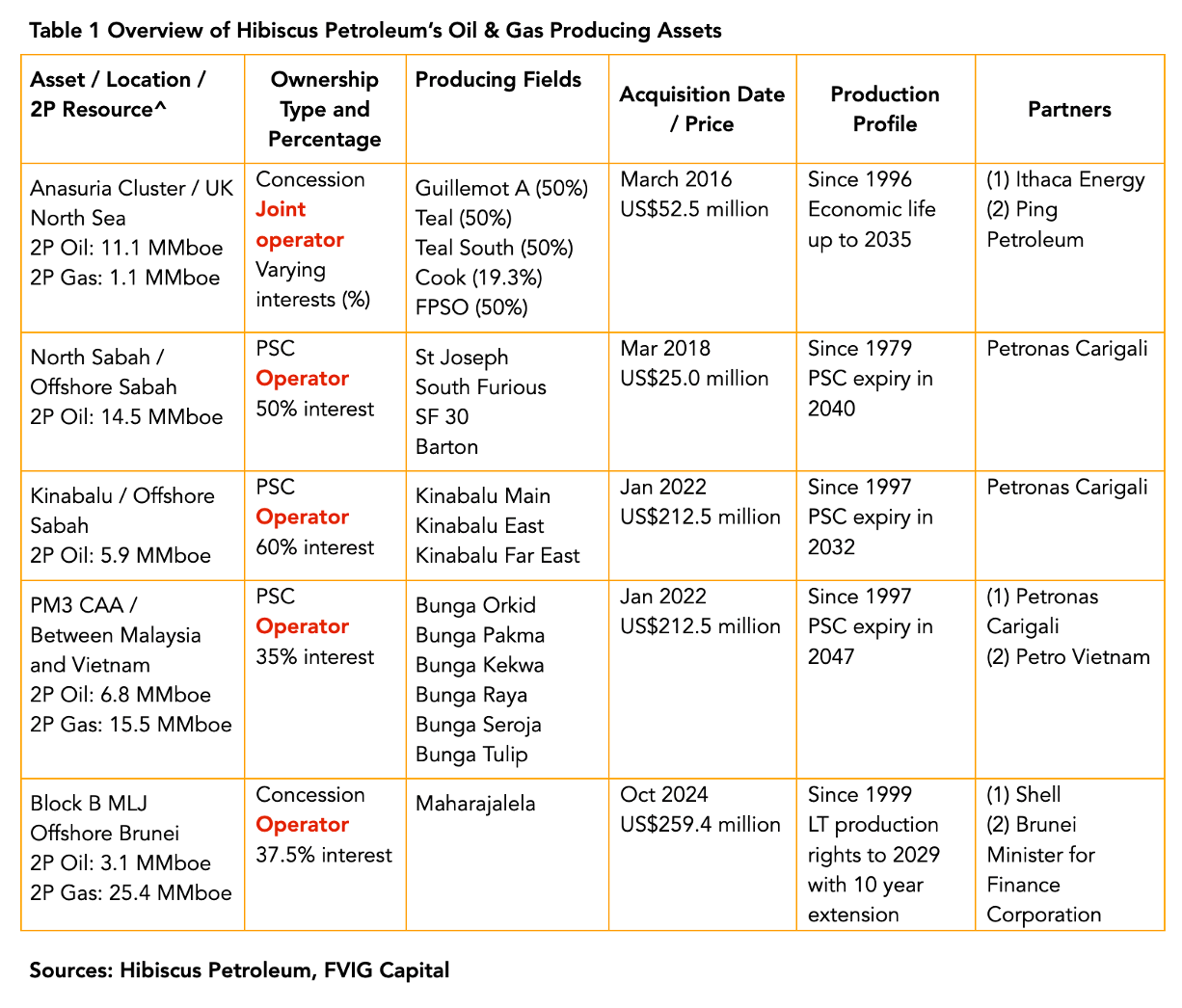
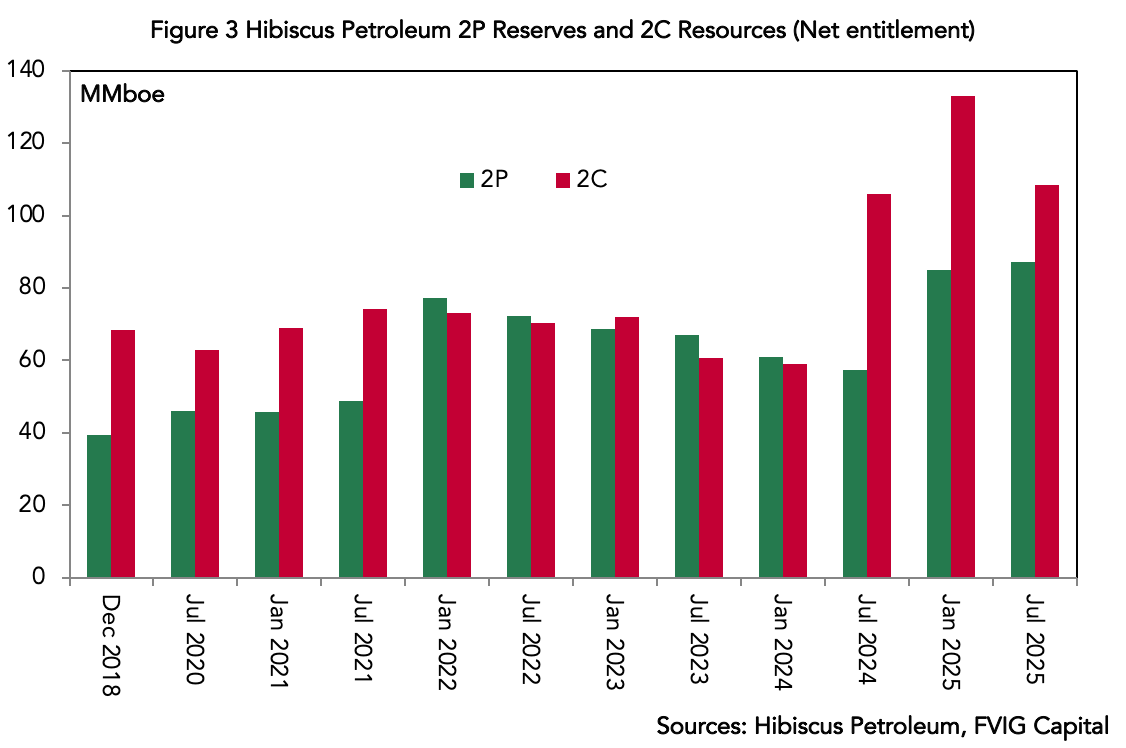
Nevertheless, the oil market downturn gave Hibiscus the opportunity to acquire undervalued producing assets, which entails far less risk to developing new ones (construction risk, cost overrun, building in foreign countries). Indeed, a decade of shrewd and strategic acquisitions across four countries saw Hibiscus grow its daily production from zero to more than 25,000 boe per day, with net 2P and 2C resources of more than 87 and 110 million boe respectively, sufficient for 15 years of production - see Table 1, Figure 2 and Figure 3
Value Investing
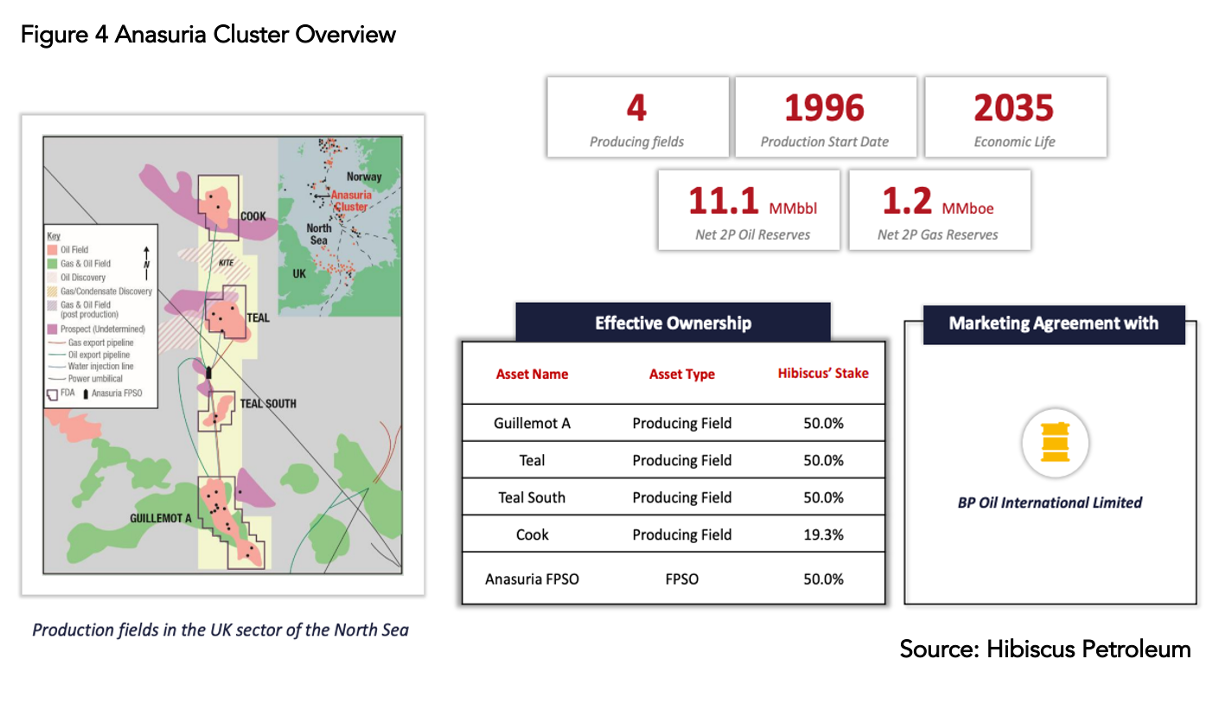
Within two years of the 2014 oil crash and amidst market gloom, Hibiscus successfully acquired a 50% operating interest in Anasuria Cluster in United Kingdom’s North Sea for US$52.5 million from O&G giants Shell and Exxon. The 3,000+ boe per day producing asset (majority oil) provided Hibiscus immediate cash flow after it completed the acquisition in Mar 2016, a major transformation for the company.
Equally important are assets gained that are not reflected on the balance sheet: competent technical teams trained by Shell, experience navigating a demanding environmental and health and safety regulatory regime as an operator, deep understanding of how to negotiate with an oil major (including red lines and clauses), and a proven record of completing a deal with an oil major. The last point is crucial, as it establishes credibility and opens the door for future potential acquisitions from oil majors looking to sell.
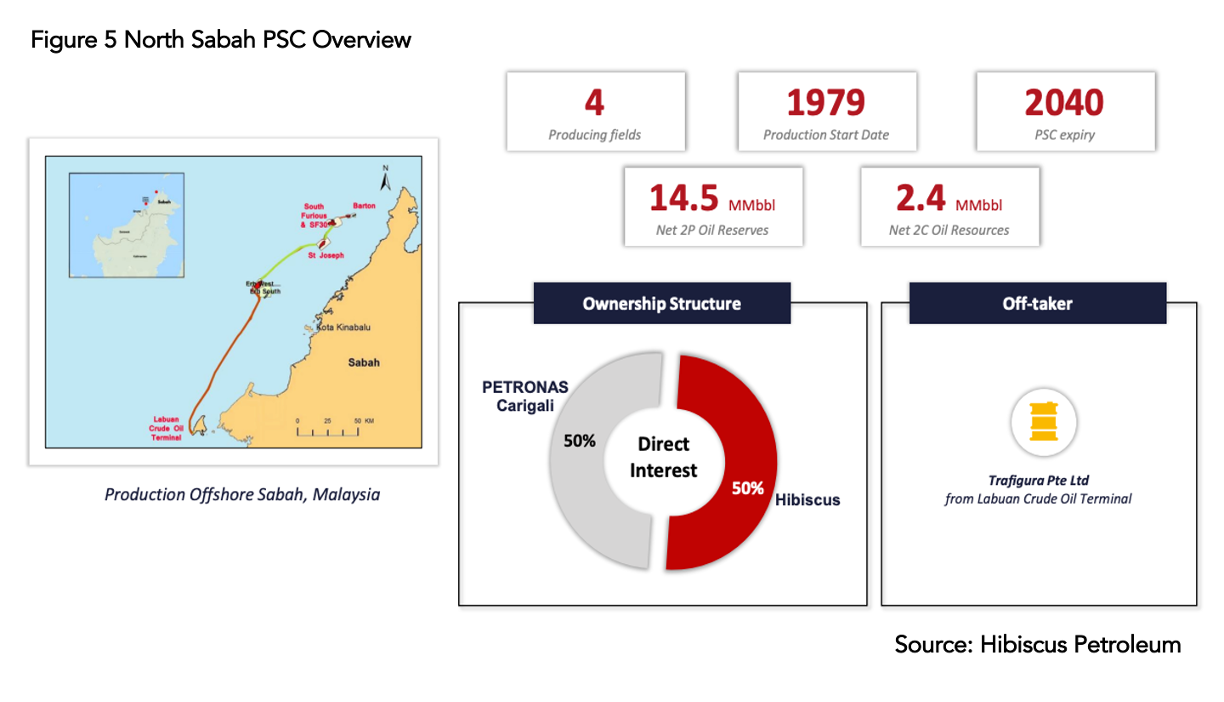
Indeed, just two years later, Hibiscus again acquired another asset from Shell: a 50% operating interest in North Sabah PSC located offshore Sabah, East Malaysia, for US$25.0 million. The asset at the time was producing over 5,500 boe per day (net), significantly lifting Hibiscus’ cash flow. The low prices of Anasuria and North Sabah PSC allowed Hibiscus to recoup its capital in less than one year. Key details of both assets are as per Table 1 above and Figures 4 and 5 below
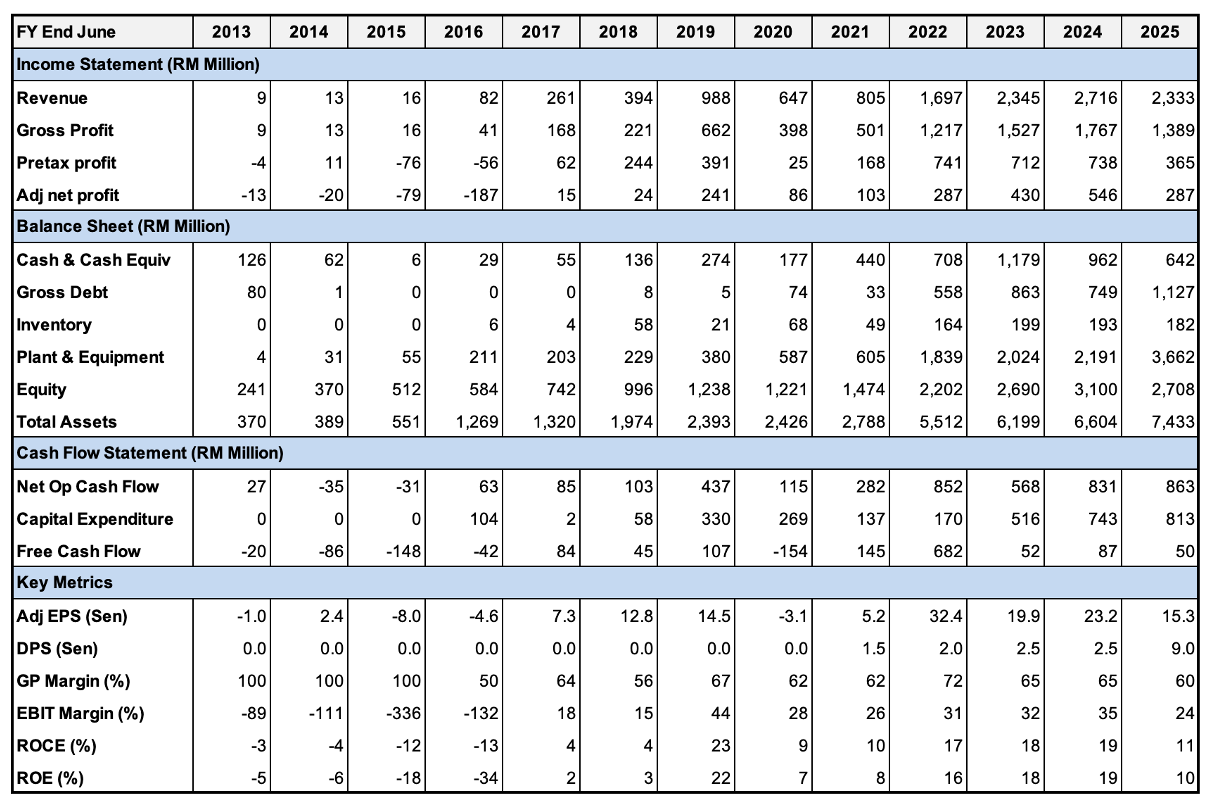
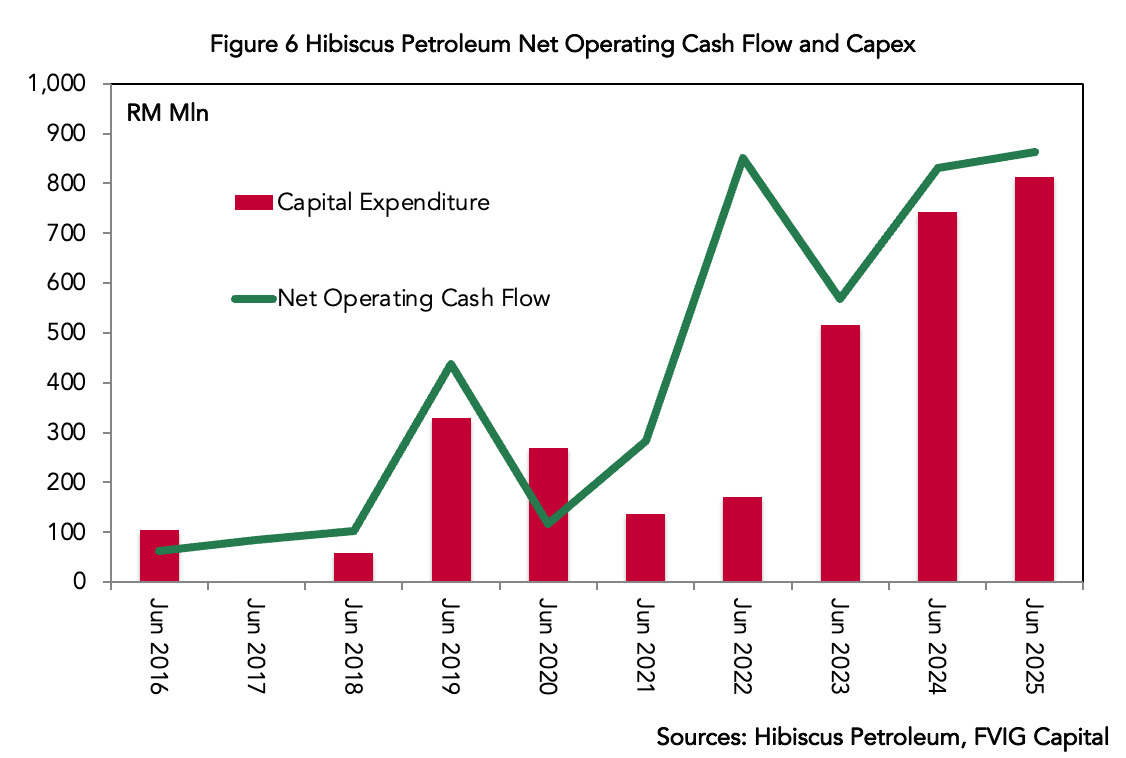
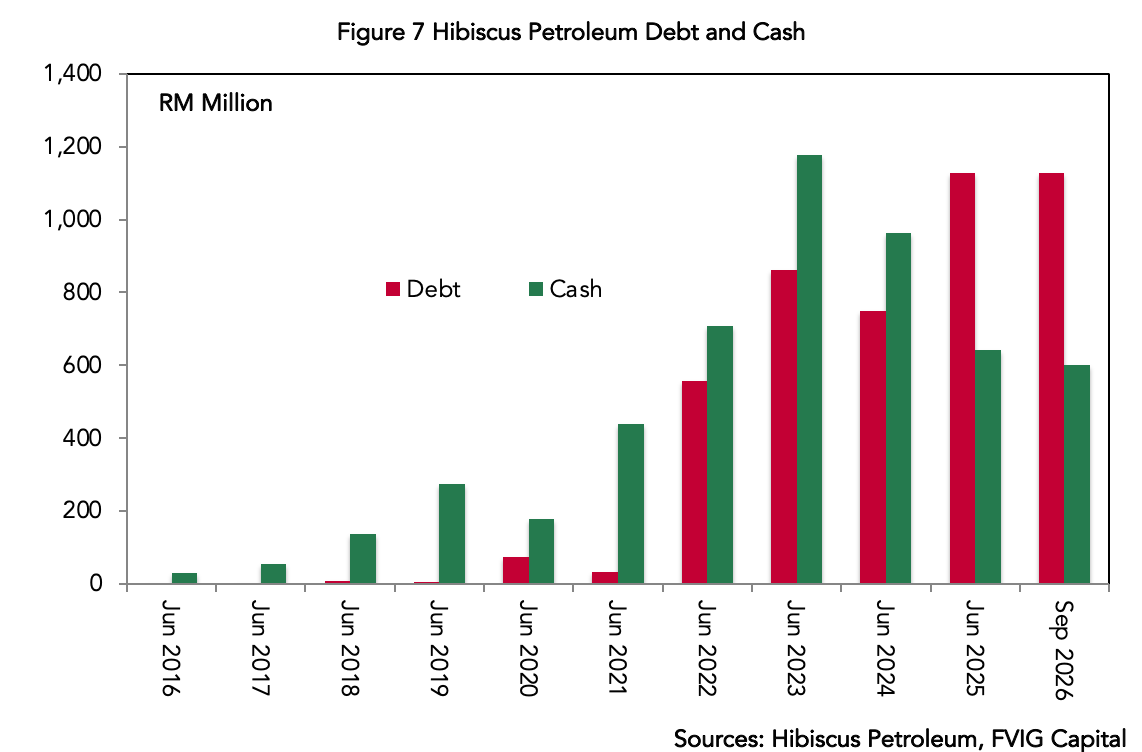
The rapid pay back period and free cash flow from Anasuria and North Sabah PSC meant Hibiscus was able to build up cash on its balance sheet, reaching more than RM400 million in FY2021 - see Figure 6 and Figure 7
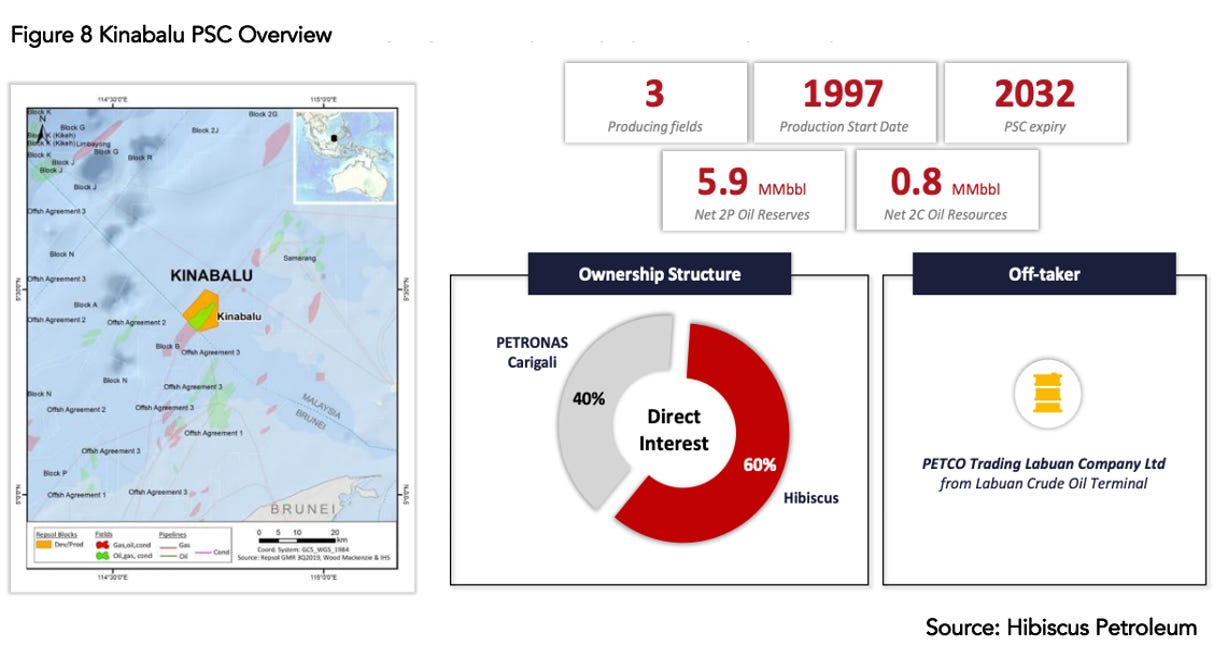
As such, Hibiscus was well prepared to leap on the opportunity presented during the Covid-19 downturn, successfully acquiring PM3 CAA from Repsol for US$212.5 million in January 2022. The acquisition gave Hibiscus operating control on its 60% ownership of Kinabalu PSC located offshore Sabah, East Malaysia - see Figure 8 - and 35% ownership of PM3 CAA located offshore peninsula Malaysia. The deal was transformative for Hibiscus, as PM3 CAA’s 12,000+ boe per day (net) more than doubled Hibiscus’ production, with natural gas becoming a major contributor towards the group’s revenue - see Figures 9 and 10
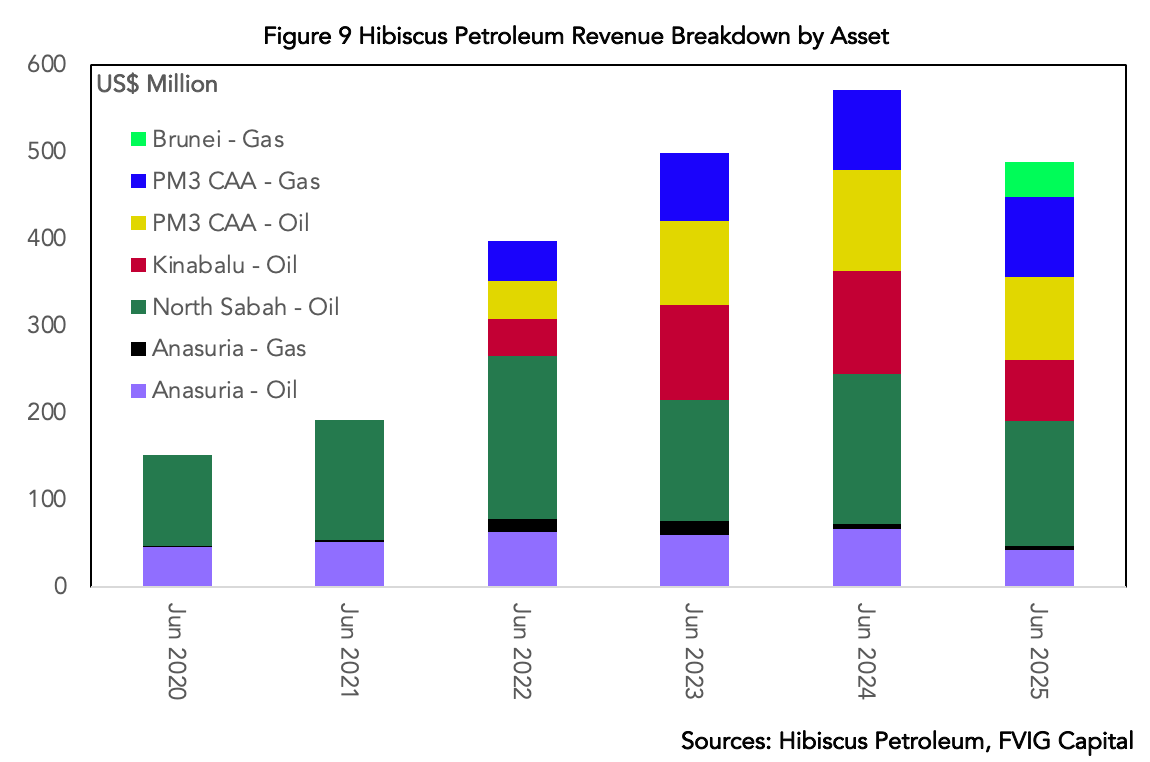
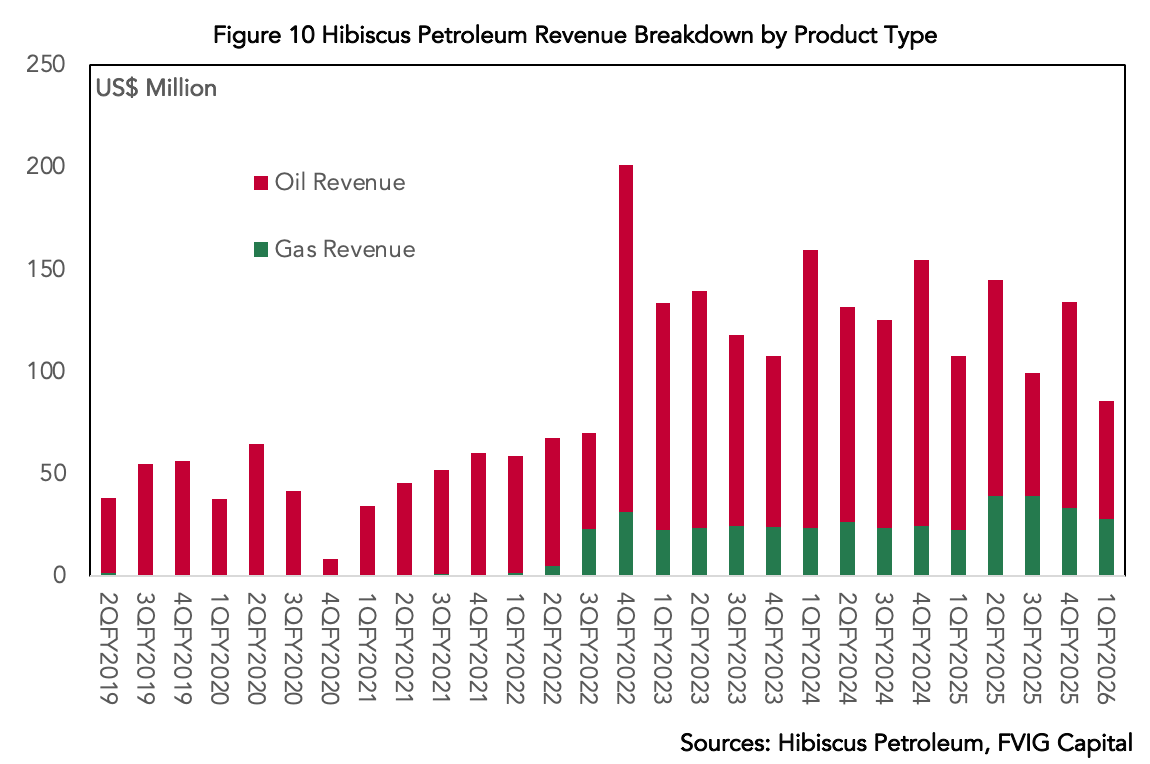
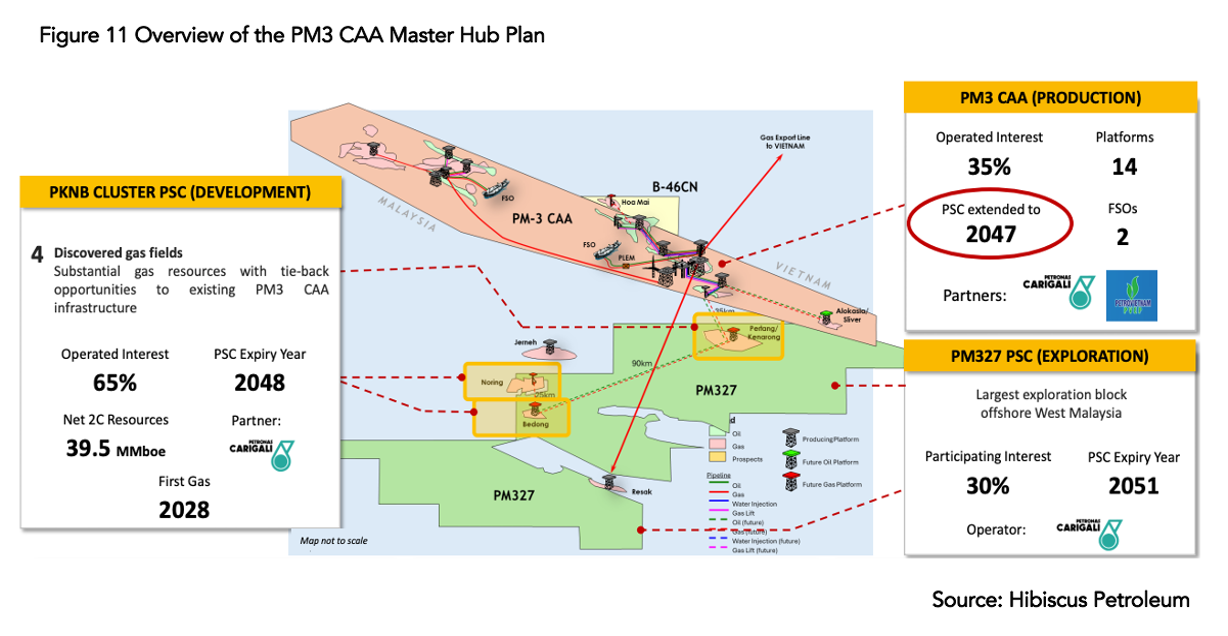
PM3 CAA’s attractive valuation and favorable oil prices over 2022-2023 also meant that Hibiscus recouped its capital from the acquisition in 3 years. More importantly, in April 2025, Hibiscus announced the extension of PM3 CAA’s license expiry date by 20 years to 2047. The extension provides the foundation for Hibiscus to develop the nearby PKNB gas fields (2C 39.5 million boe, 65% participating interest and operatorship) that was awarded by Petronas in July 2024, forming a key component of its PM3 Master Hub Plan - see Figure 11
Time to Build
In June 2024, Hibiscus announced it had entered a conditional Share and Purchase Agreement to acquire TotalEnergy’s 37.5% operating interest in Block B Maharajalela Jamalulalam (MLJ) field located offshore Brunei for US$259.4 million. As more than 80% of MLJ’s 7,800+ boe per day of production comprise of gas, the acquisition further bolstered natural gas to represent 49% of Hibiscus’ production portfolio.
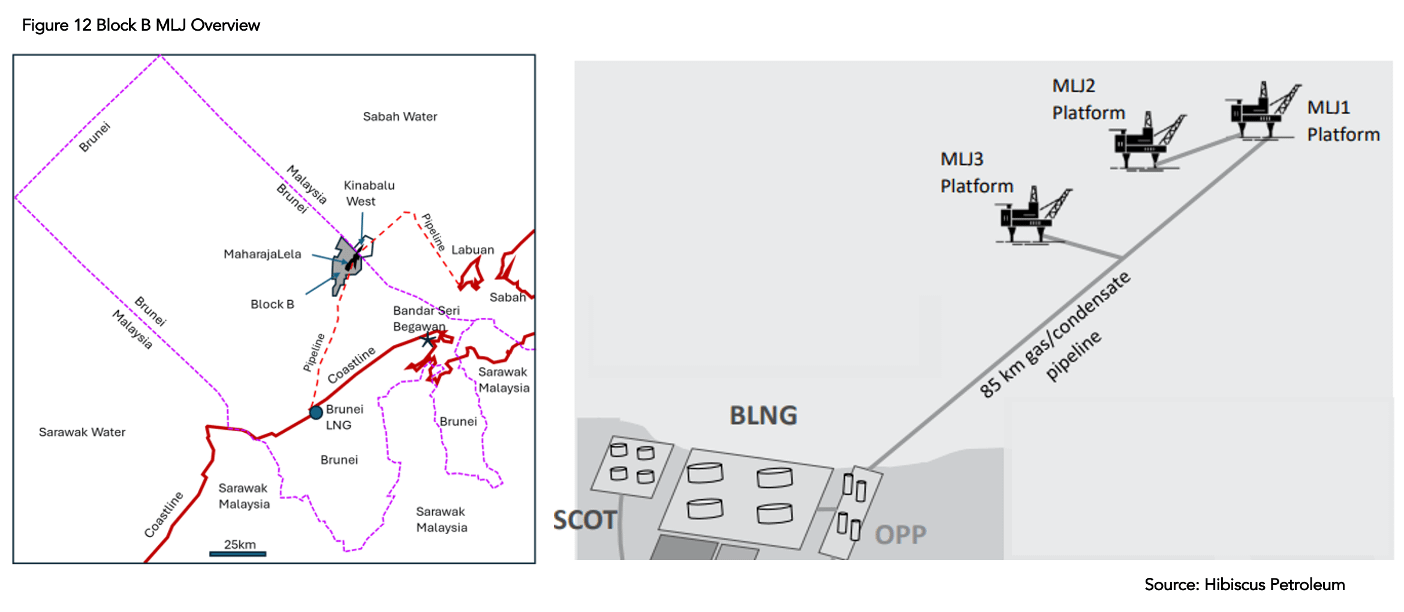
While PM3 CAA’s natural gas is transported via pipe for onshore use in Peninsular Malaysia (power generation) and Vietnam (power generation and fertiliser), MLJ’s gas is processed at Brunei LNG plant where it is super-cooled into a liquid state for export. Hence, MLJ provides Hibiscus with exposure to Asia’s LNG market. The price paid for MLJ of more than 7 times FY2023 net profit of US$32.8 million means that its payback period is more than double that of PM3 CAA.
The premium paid for MLJ is predicated on establishing Hibiscus as one of the key stakeholders in Brunei’s O&G industry, which contributes more than 85% to the country’s annual fiscal revenue. Hibiscus is thus positioning itself as a ready and able domestic partner as the Brunei government promote the development of an industry that is key to its survival. Similar to PM3CAA hub strategy, there’s significant potential to improve the utilisation of MLJ’s infrastructure - see Figure 12
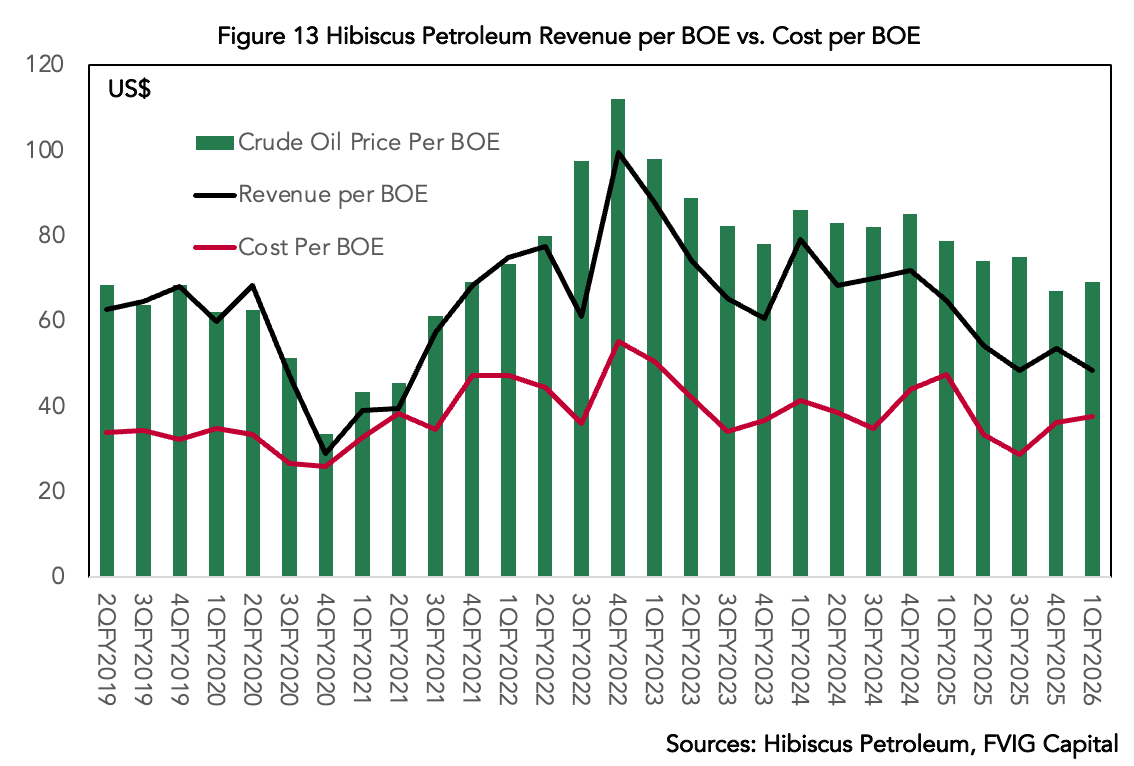
Hibiscus has a strong track record in executing the tie-in new resources to hub strategy. Apart from PM3 CAA, it is also amidst tying newly developed Teal West to Anasuria’s infrastructure (Figure 2), which is a major contributor towards growing its production by 21% to 35,000 boe per day in 2026. Its technical strength has led to successful extensions over the life of assets such as Anasuria cluster that was initially expected to end in 2025 but instead will continue producing to 2035 and its operating capabilities has seen it maintain operating costs at around US$40-45 boe - see Figure 13
The building blocks are in place for Hibiscus to achieve its goal of 70,000 boe per day in 2030. But despite the robust fundamentals, its share price hovers near 5-year lows, which reflects the weak oil price environment (Figure 1). Will oil prices stay weak forever ? Is the age of oil over ?
Supply and Demand
“Ben van Beurden (Shell’s ex-CEO) says the scale of the challenge to reduce emissions became clear during Covid, when global shutdowns only made a roughly 5 per cent dent in the total. “People started realising that this is actually a much bigger challenge. Unless we have big pandemics every year, we are not going to get anywhere with this” he says.”
- Financial Times, “Inside the failed green revolutions at BP and Shell”, 11 December 2025
Despite energy efficiency initiatives across swathes of industries, oil consumption continues to rise around the world, even in China, the world’s largest adopter of Electric Vehicles. World oil consumption is on track to reach a new record of 104 million barrels a day in 2025 - see Figure 14
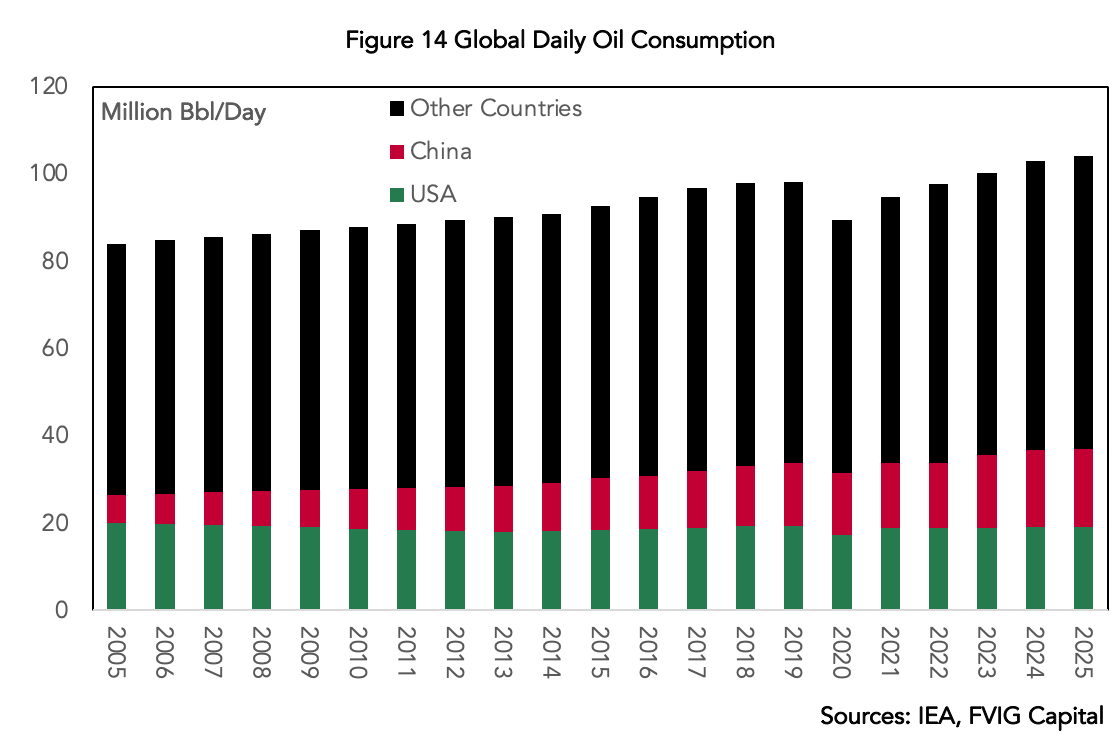
Although the US remains the world’s largest consumer of oil at 19 million barrels a day, volume has remained largely unchanged over the past 20 years. Indeed, emerging economies like China (18 million barrels a day) and India (6 million barrels a day) are the major drivers of demand as energy consumption rises in tandem with economic development.
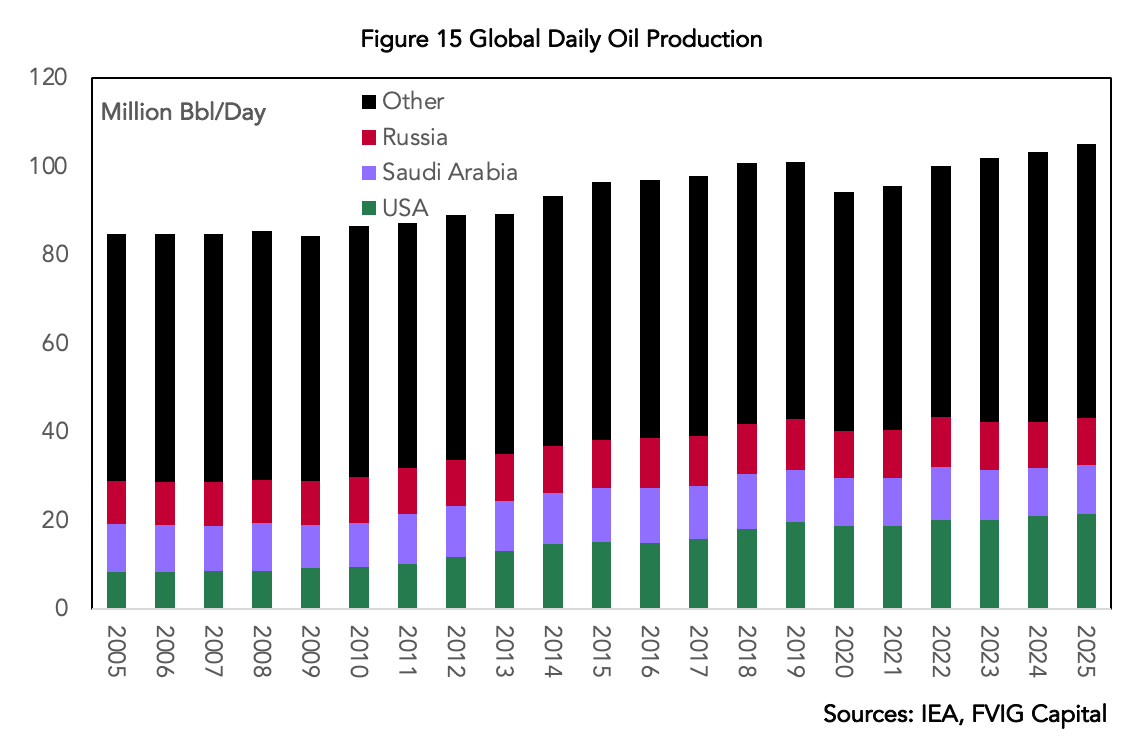
The rise in oil demand has largely been met by exports from oil majors such as Saudi Arabia, Russia and Canada that used to be key suppliers to the United States. While Saudi Arabia (11 million barrels a day) and Russia (10 million barrels a day) outputs have stayed flat in the past 20 years, US oil production have more than doubled over the same period to 21 million barrels a day, making it the world’s largest oil producer and turning it to a net oil exporter - see Figure 15
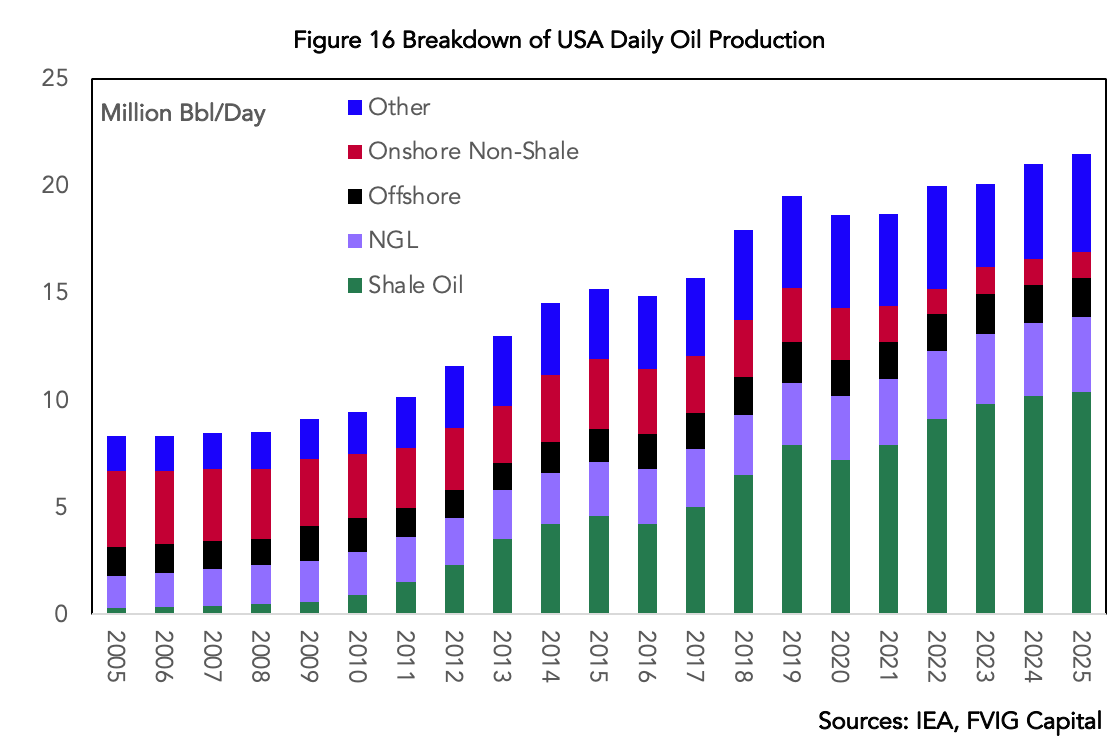
The advancement in horizontal drilling technology unlocked significant shale oil resources which underpinned the surge in US production and caused the 2014 plunge in oil prices - see Figure 16
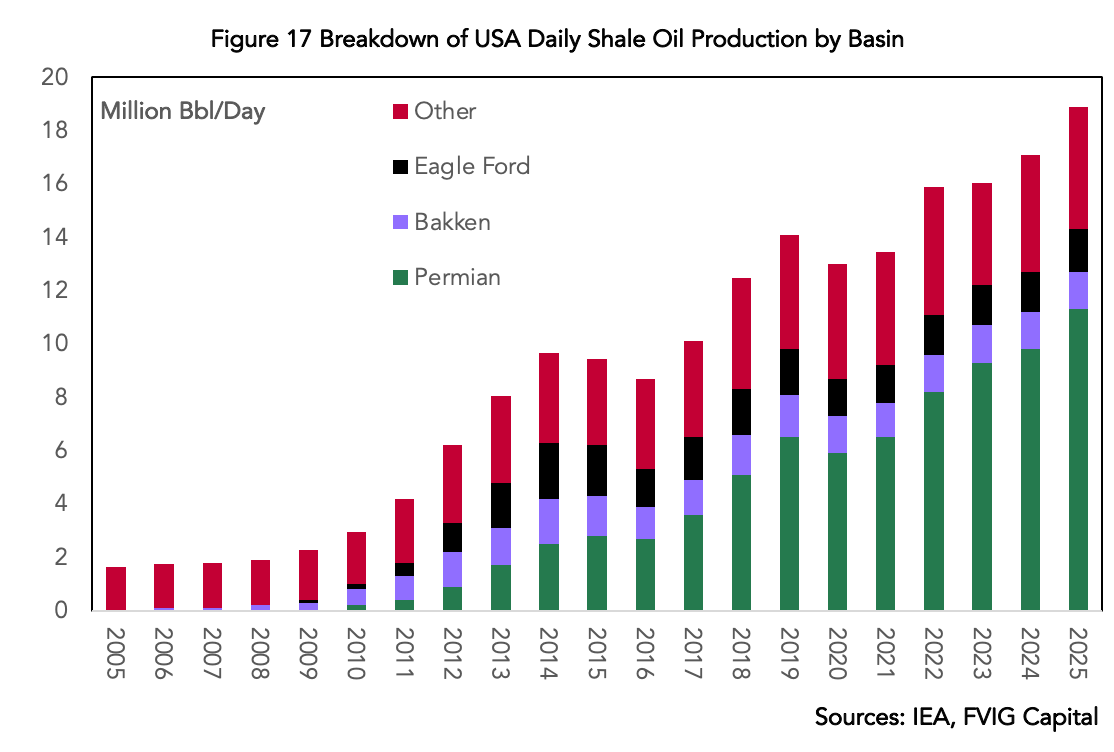
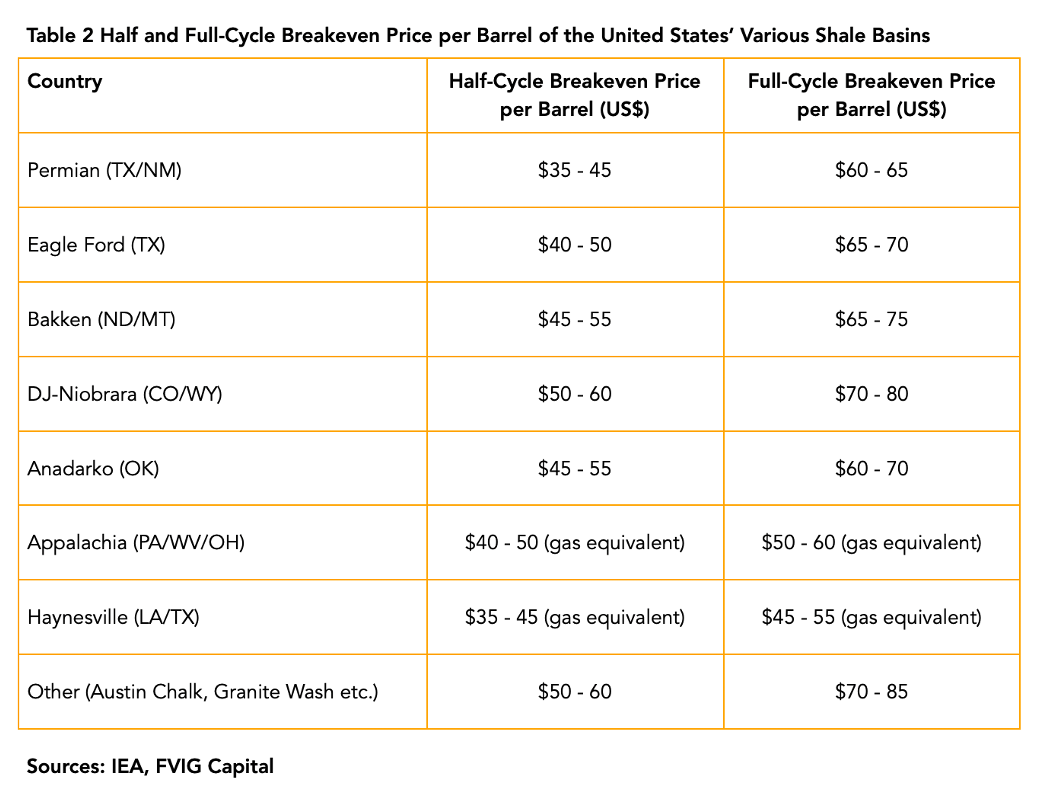
Around 2/3 of the source of shale oil in the US are produced in the Permian Basin due to the high resource productivity and relative lower cost compared to other shale regions - see Figure 17 and Table 2
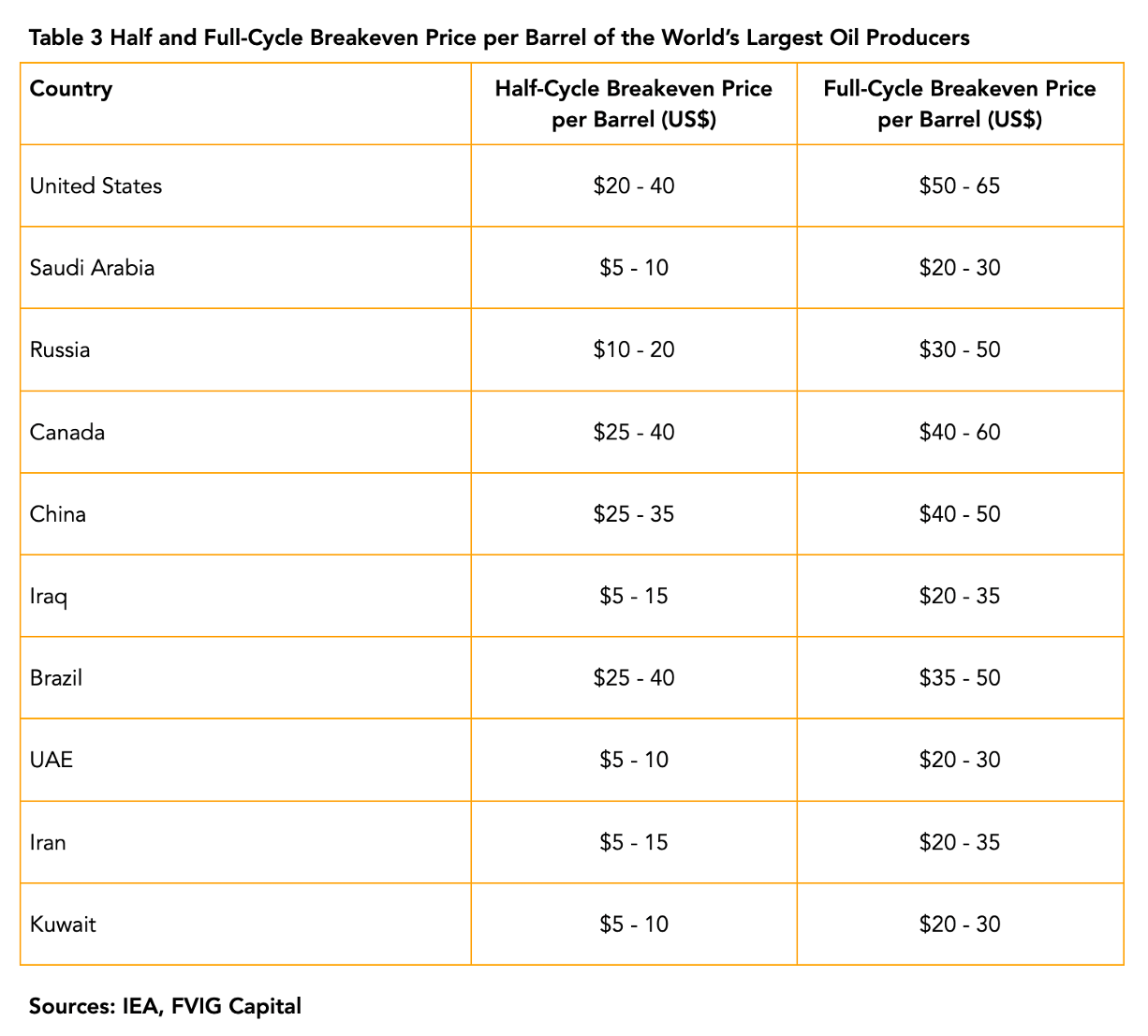
Unlike conventional oil fields, US shale oil output typically fall by at least 50% after the first year of production, with 60-80% of recoverable volume produced within the first three to five years. Operators must drill continuously to grow their production volume, making US shale cost relatively higher than onshore conventional oil. As such, the high proportion of shale in total production places the US as a relatively high cost producer amongst the world’s largest producers - see Table 3
The decision on whether to drill new wells meanwhile requires the oil price to be more than the full-cycle breakeven price per barrel, which is the oil price required to cover all costs (exploration, drilling, operations, overheads, land, financing and profits). Thus, in a weak oil price environment, it is the US production that will fall first as drilling activity for new wells fall. Indeed, US shale oil output is expected to be flat in 2026.
Matter of Time
Given the oil market’s supply-demand fundamentals, oil prices are unlikely to fall below US$50 per barrel. Even if it does, is unlikely to remain there for a prolonged period: as long as emerging countries’ demand, in particular China, grows, the market will self-adjust towards the US’ marginal cost of production (Table 3), which is above that of Hibiscus’ all-in-cost per barrel (Figure 13).
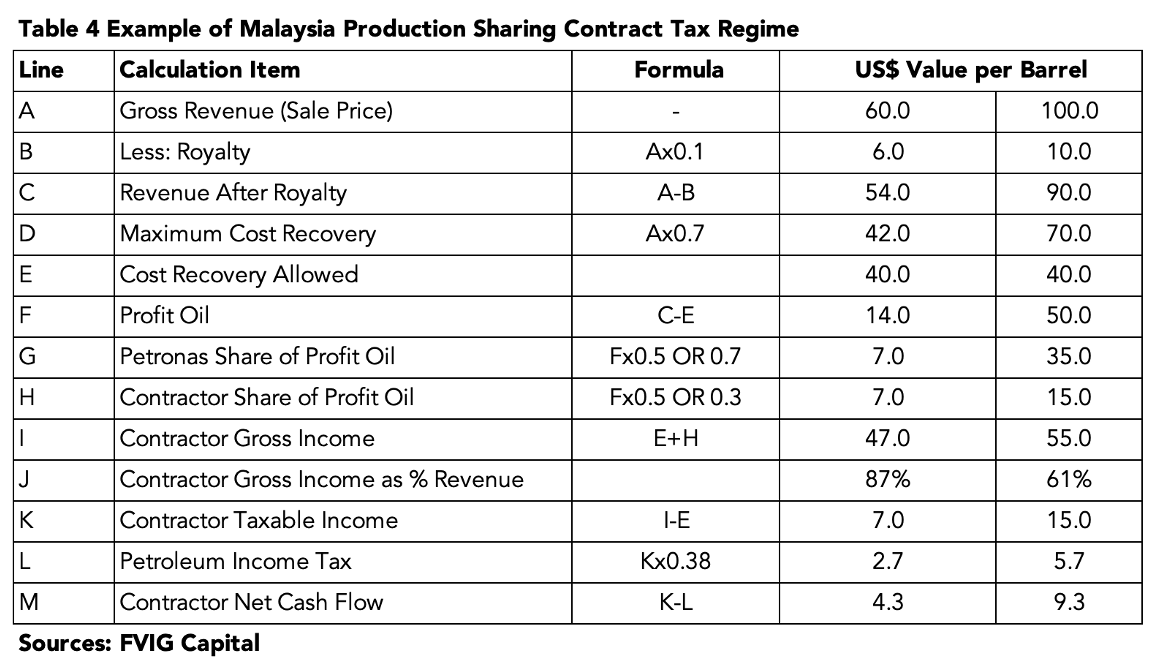
Malaysia’s PSC regime minimises the downside to ensure contractors like Hibiscus’ costs can be recouped when oil prices are low, but takes a larger share of profits when oil prices are high - see Table 4
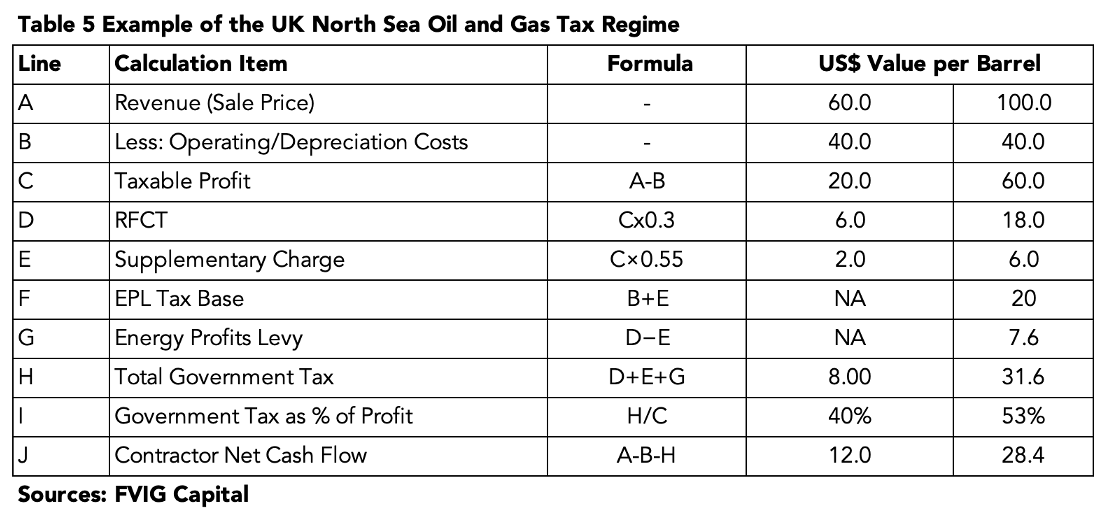
The UK’s tax regime meanwhile encourages capital investment to reduce taxes, and increases the % share of profits at high crude prices and reduces the % share at lower crude prices - see Table 5
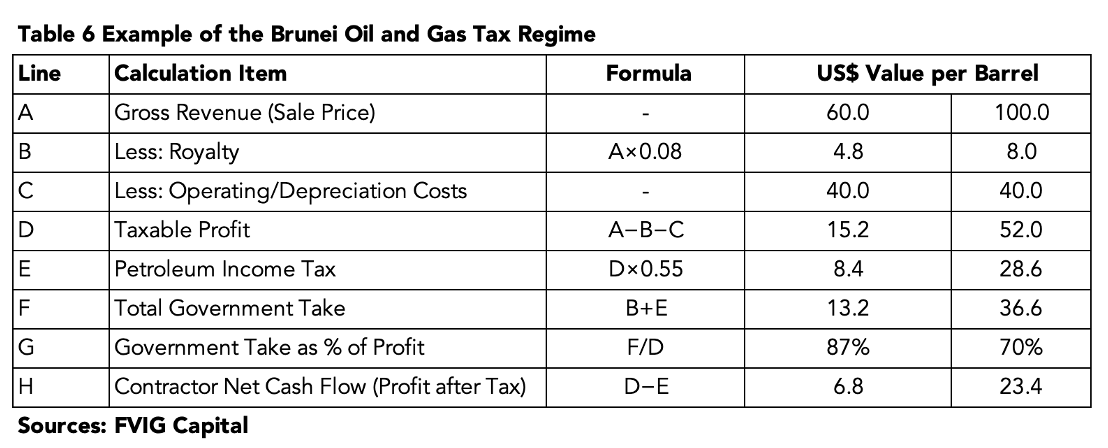
Brunei by comparison is flat regardless of crude oil price levels - see Table 6
Hibiscus’ all-in cost per boe and the multiple tax structures across the different geographies resulted in its net profit ranging from US$5.50 per boe when oil prices were low (FY2025) to US$18.30 per boe when oil prices were high (FY2022). If we assume Hibiscus can only earn US$5.00 per boe indefinitely, then this would deliver around US$60 million in free cash flow per year, or around 4.4 times its current market cap. The NPV of this free cash flow is US$550 million, or around double its market cap.
In other words, there is already significant margin of safety even assuming a prolonged period of a weak oil price environment. It bought around 9% of shares outstanding at average prices of between RM1.80 to RM2.16 per share over 2024-2025 that were subsequently canceled. Should oil prices rise again, there is significant upside potential. At FVIG Capital, we will continue to monitor developments closely and provide updates as Hibiscus navigates its way through the cycle.
Disclaimer:
This report is published by FVIG Capital for informational and educational purposes only and does not constitute investment advice or a recommendation to buy or sell any security. The views expressed are those of the author(s) as of the date of publication and are subject to change without notice.
FVIG Capital, its affiliates, and/or their associates may hold positions in the securities discussed. While every effort has been made to ensure accuracy, no warranty is given as to the completeness or reliability of the information contained herein. Readers should conduct their own due diligence before making any investment decisions.
Comments
Nothing yet. Say the first thing.
Sign in to join the conversation.