
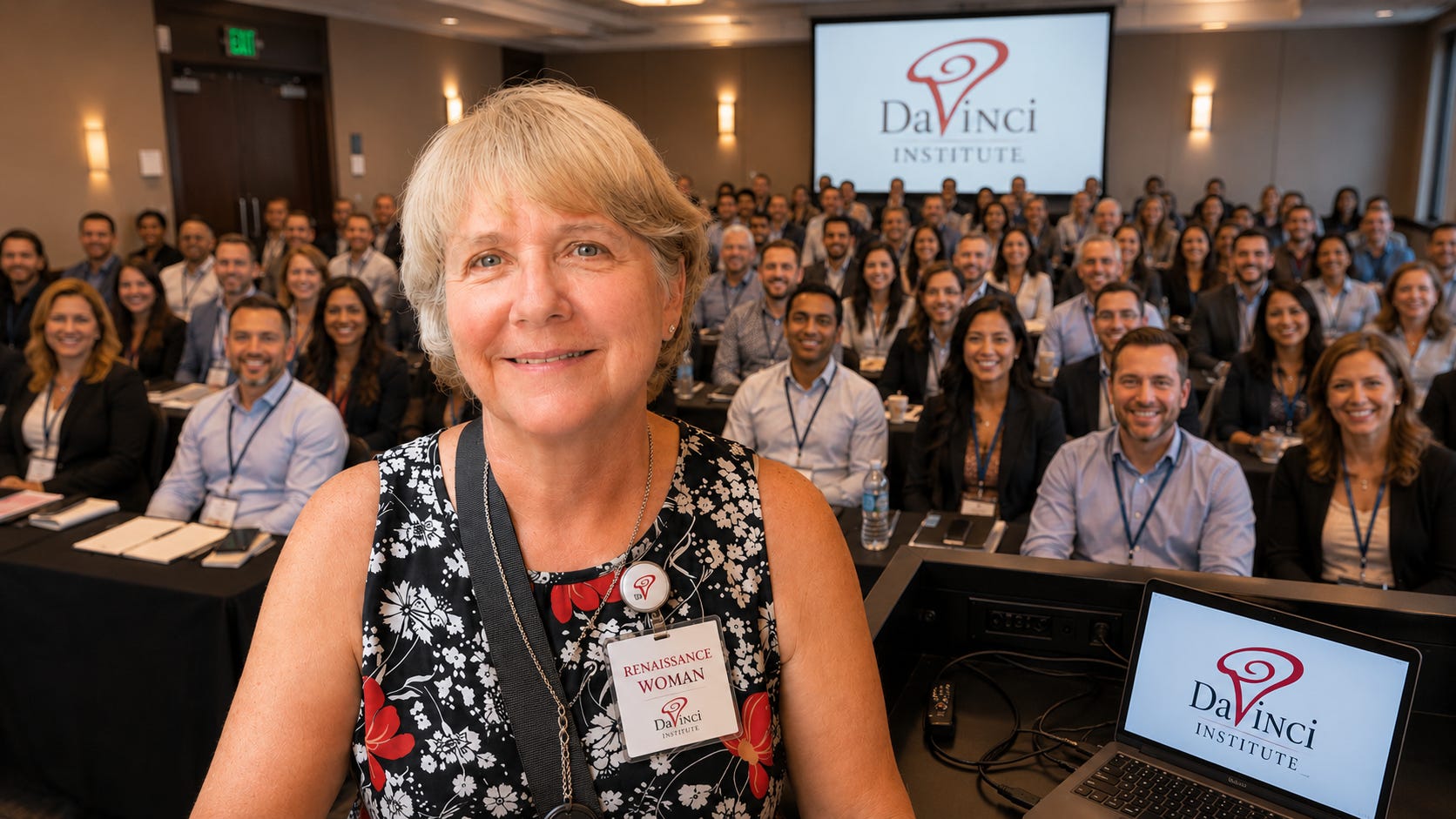
If you’d looked at her name badge at any DaVinci Institute event, you wouldn’t have found “President” or “CEO.” It read: Deb Frey, Renaissance Woman. That was the title she actually wore, and it was more accurate than any job description could have been.
Some people spend a lifetime looking for their purpose. Deb Frey spent hers building a place for other people to find theirs.
For years, she was the steady hand behind the DaVinci Institute — the one making sure the lights were on, the books balanced, the events actually happened, and the entrepreneurs walking through the door felt like they mattered. Titles like “President” and “CEO” don’t really capture what that meant day to day. It meant she was usually the first person in the room and the last one to leave it. It meant she carried the parts of running an organization that rarely get applause — the scheduling, the budgets, the quiet troubleshooting — so that the ideas and the people she believed in had room to grow.
She came to that work with a practical, hands-on kind of competence. Long before DaVinci, she’d already run her own bookkeeping business, learned the discipline of education, and built the kind of all-purpose skill set — part organizer, part teacher, part problem-solver — that made her impossible to replace. When DaVinci Coders set out to teach people to code and change the direction of their careers, she was the one who helped make that ambition into something real. When the Institute needed someone to find and tell the stories of where the world was heading next, she became a contributing editor herself, reading and researching the future right alongside the futurists she worked with every day.
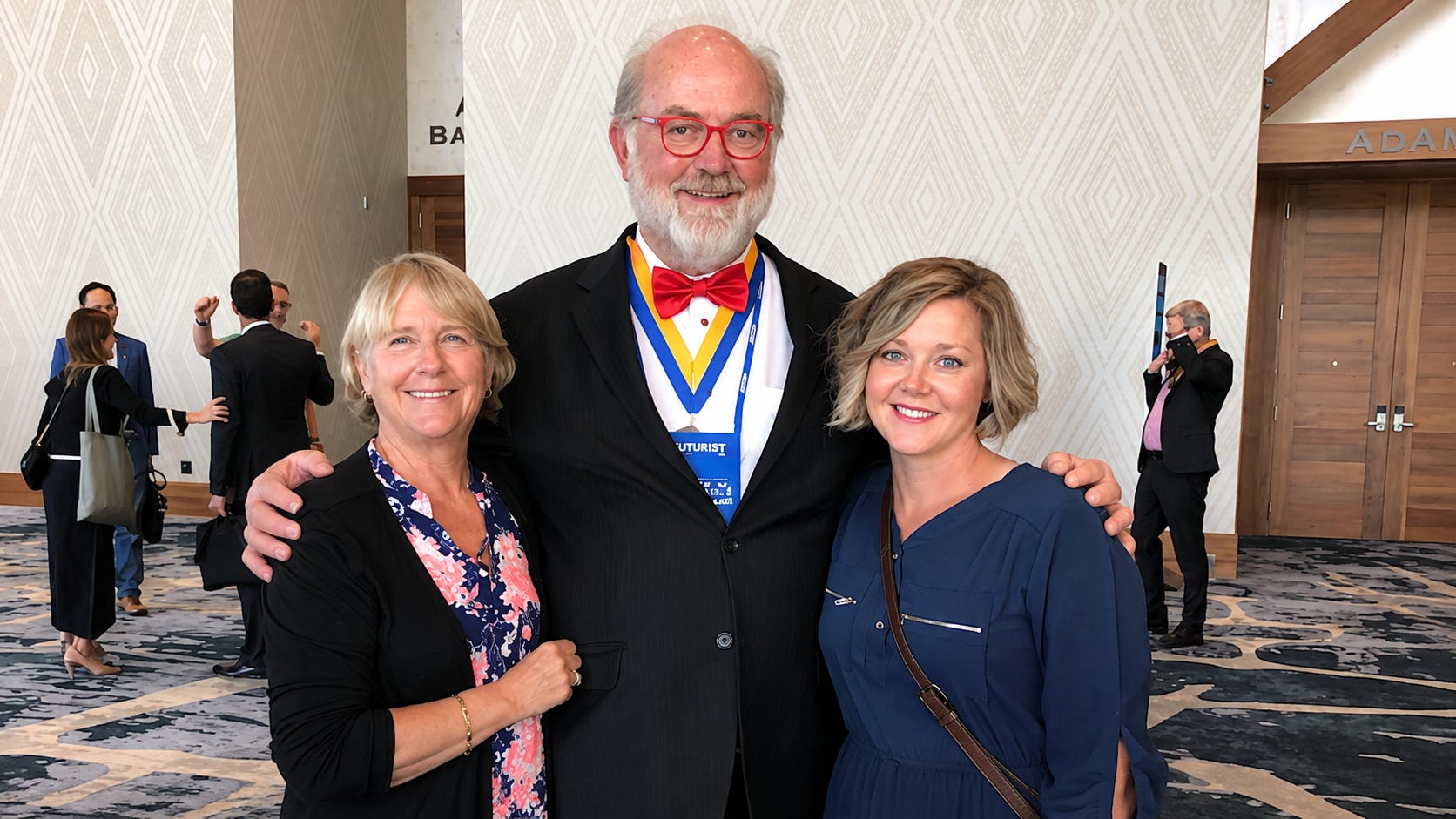
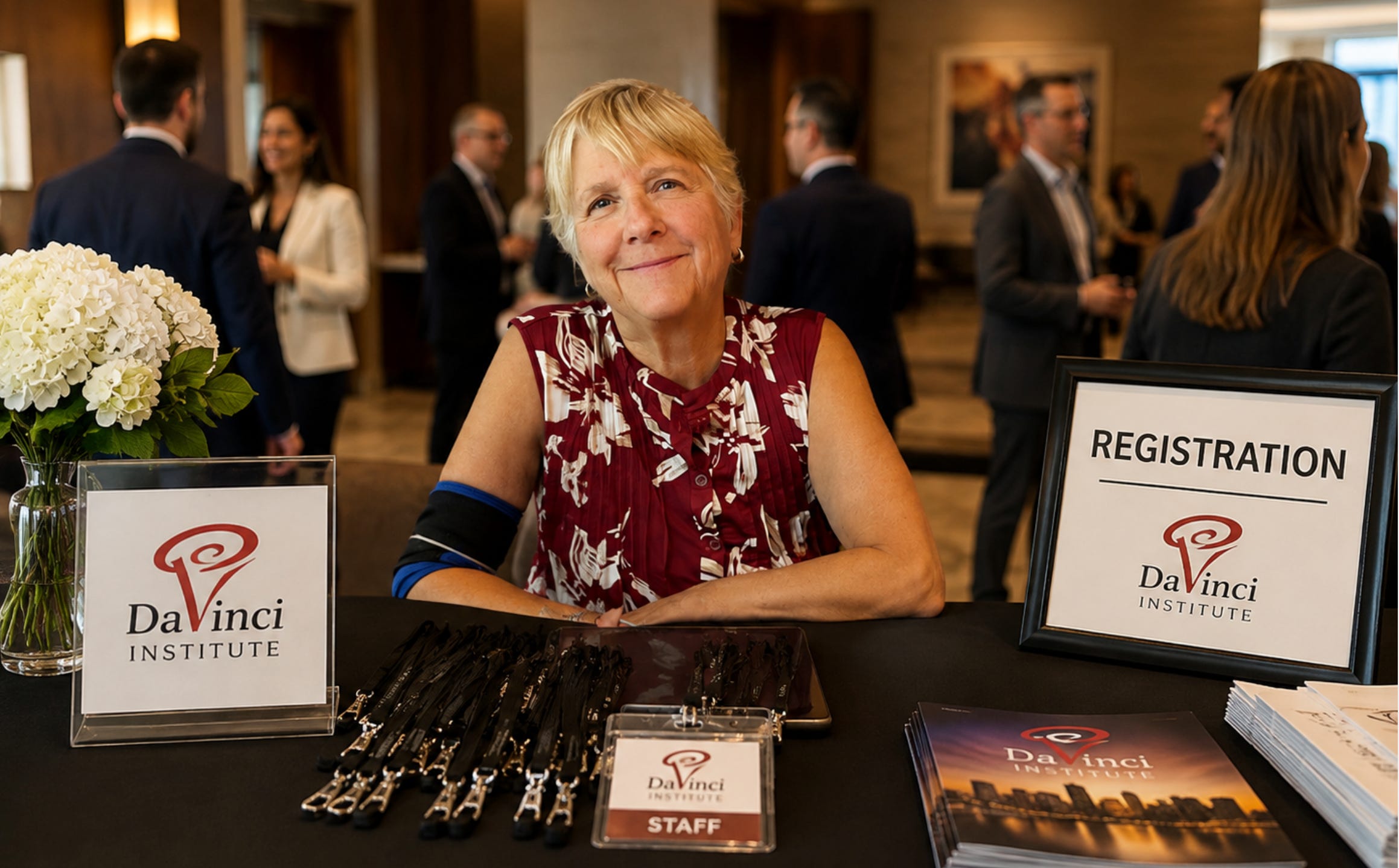
But ask anyone who actually knew her, and the résumé will be the least of what they remember. They’ll talk about the way she made people feel welcome walking into a room full of strangers at a networking event. The way she remembered details about people’s lives and businesses that they didn’t expect anyone to remember. The way she just handled things — quietly, competently, without needing credit for it.
And of all her roles, the one that mattered most wasn’t a title at all. It was the people she loved — the family who knew her not as “the President of the Institute” but simply as Deb.
She became a great-grandmother at 59, which is a sentence she would not have wanted printed anywhere, because she was completely, thoroughly unprepared to think of herself that way. Not long after the news came, we were out shopping at a trendy clothing store, and I couldn’t resist saying, “Hey, maybe we should check out the great-grandmother section!” She turned and gave me a look that stopped me cold — one of the very few times in her life Deb Frey was rendered speechless — while I stood there laughing at how badly that had landed. She simply turned and walked away. It took her a while to admit it, but she later confided that she just wasn’t ready to be thought of that way, not at that age, not yet. That was Deb: sharp enough to level you with a single glance, and human enough to tell you the truth about it later.
That’s the thing about the people who hold a family together the way she did — the titles never quite fit right, whether it’s “President” or “great-grandmother,” because the person underneath them is always so much more specific, so much more alive, than any label can hold. She was funny without meaning to be, formidable when she needed to be, and entirely herself in every room she walked into — including the ones she walked out of on principle.
For years, we ran a monthly event called Startup Junkie Underground, where entrepreneurs would get up and talk about the biggest mistakes they’d made building their businesses — the failures nobody wants to put on a résumé. I’d ask the room to decide, by applause, who’d done the best job telling their story honestly, and the winner walked away with a Sigmund Freud action figure. It was silly and it was serious at the same time, which is exactly the kind of thing that worked at DaVinci.
But the mistakes people were willing to stand up and tell a room full of strangers were never the whole story. There were always other mistakes — the ones people weren’t ready to say out loud, the ones that actually kept them up at night. Deb was the one they told those to. Not on a stage, not for applause, not for a Freud doll. Just quietly, off to the side, because she was the kind of person you could trust with the version of the story you hadn’t figured out how to tell yet. She never needed the credit for that. She just made sure people had somewhere to put it down.
There’s a particular kind of legacy that doesn’t come from being famous. It comes from being foundational — from being the person a hundred other people’s success, and a family’s whole sense of itself, was quietly built on top of. That’s the legacy Deb Frey leaves behind. Every entrepreneur she connected to the right mentor, every confession she held onto without judgment, every event she made run smoothly, every awkward joke she let land for a beat too long before walking away — those are still out there, still carrying a piece of her forward.
Renaissance Woman. Not a title anyone gave her to be kind. A title she earned, badge by badge, room by room, year by year.
She is deeply missed, and she will not be forgotten.
My Life Story - Part 1 - https://www.caringbridge.org/site/60df629f-7a6a-11f1-922a-59eb16aaab83/post/520b9439-5d21-4be1-b3aa-f40230436ca7
My Life Story - Part 2 - https://www.caringbridge.org/site/60df629f-7a6a-11f1-922a-59eb16aaab83/post/e9d5f46f-f6c0-4437-8019-21bb5a2611dd
No posts
Comments
Nothing yet. Say the first thing.
Sign in to join the conversation.