
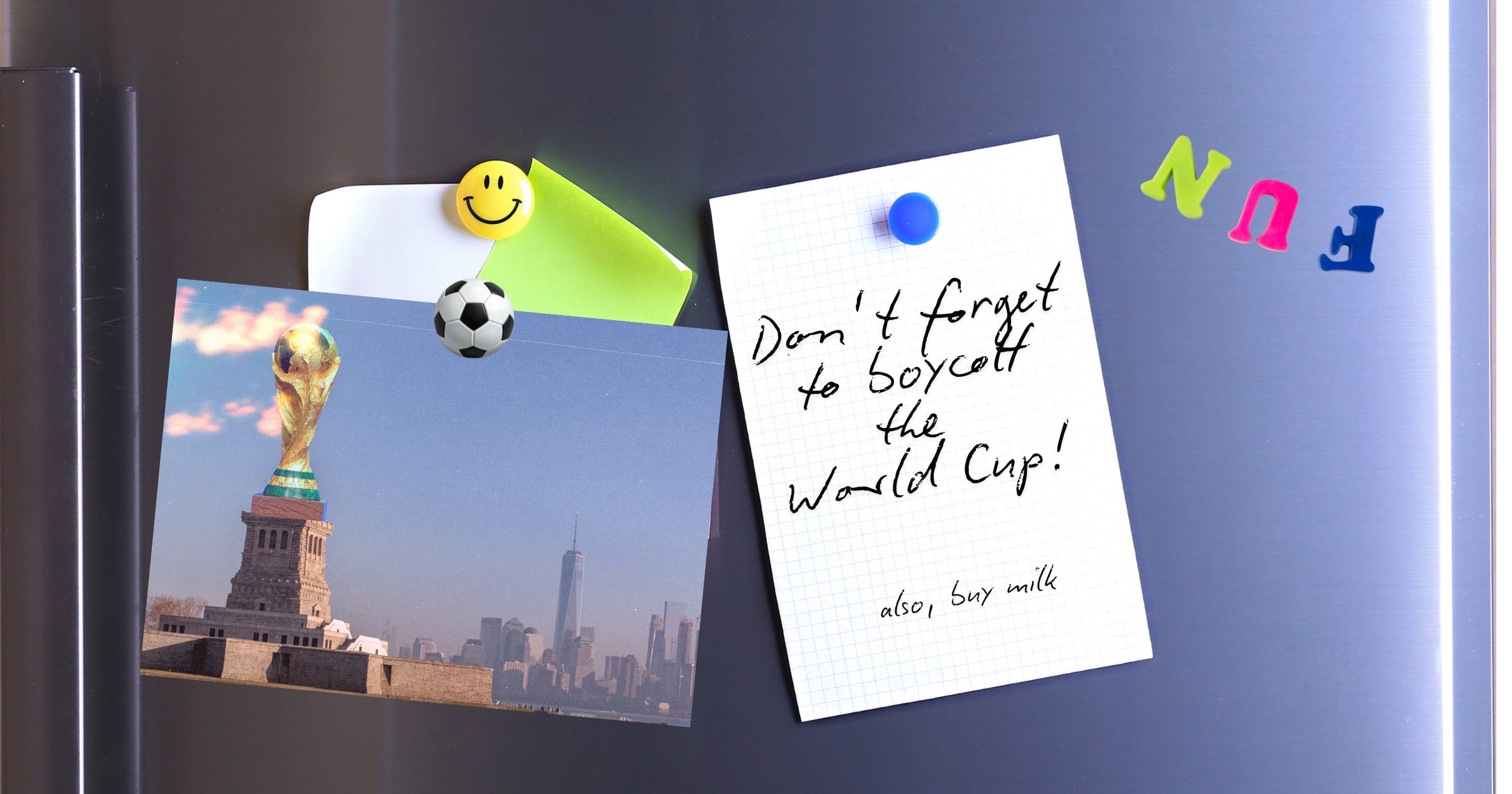
The World Cup kicks off this evening and will dominate headlines for the next few weeks. In the United States – one of the three host nations – the show seems to be sputtering already. Sporting enthusiasm appears more directed towards whatever is going on with basketball in New York. But this evening, Mexico will open this edition with a game against South Africa that should prove to be everything that makes the tournament special. Vibrant, fervent, global.
Of course, football fans have already been subjected to a huge amount of moral compromise as we head into the 2026 World Cup. Last week, a Somali referee, Omar Artan, was denied a visa to enter the US, despite being a FIFA approved official. He has now returned to Somalia, and FIFA - led by the utterly spineless Gianni Infantino – has shown little support for a man who should’ve been experiencing the pinnacle of his chosen career. “We don't control everything,” Infantino responded, lamely. The situation is even more acute with the Iranian players and fans travelling to the tournament. Iran have relocated their training base to Mexico since the onset of their conflict with the US and Israel, but tensions are enormously high. They kick-off their tournament in Los Angeles next Monday (against outsiders New Zealand) and it will be interesting to see how that match unfolds.
I am deeply sympathetic to people who are boycotting this tournament. The United States (which is the dominant co-host, with 11 host cities compared to Mexico’s 3 and Canada’s 2 (not to mention that the US will host all matches from the quarterfinals onwards)) has turned the greatest sporting event on earth into a tawdry spectacle. From the imposition of geopolitical grievances to the insane ticket prices (and bizarre refusal to create adequate travel infrastructure), it is a tournament that feels instinctively alienating. At least in Qatar (another example of FIFA’s prizing political power over the traditions of the game) there was a sense that the host nation was wholly invested in the tournament, what it could offer the region. Here, the United States and its President seem unconcerned about hosting the World Cup. It is just part of their complacent global hegemony.
But I won’t be boycotting the tournament, not least because I have a newborn baby who will likely help me with the strange kick-off times (many of the games are airing at 2am or 4am here in Europe). More than anything, I love World Cups. I love the football and the sense of national pride they (sometimes) engender. I love seeing England win and still dream that, in my lifetime, I will see an Englishman lift that iconic trophy. So, fully in the expectation that I will let myself down, I wanted to reissue a guide I wrote a couple of months ago, which is intended to offer an ethical framework for engaging with such a corrupted spectacle.
I like this tip because it accords with my current plans. But the way that America generates revenue from the tournament is almost entirely bound up with it being a major tourism opportunity (ticket sales, for example, go straight to FIFA’s coffers). Officials in the US have already said that ICE will be a “key part of security” during the tournament, which ought to make any visitors feel anxious (especially those from nations like Iran, Egypt and the many Latin American countries who have qualified). Not travelling to the United States for the tournament avoids America profiting too directly from things, and negates the chance that games will serve as a covert opportunity for immigration crackdowns.
Again, this is easier to achieve for me, personally, given that I live in the UK where the games will be shown free-to-air on the BBC and ITV. But it’s important to avoid FOX, who have acquired the US rights to the tournament and who will be looking to make a lot of money from advertising during the games. US viewers can, instead, watch games on Telemundo (owned by NBC) and they may even learn some Spanish (“gol!”) words. If they require English language commentary, I suggest investing in a VPN and making a little trip to London, where they will also be greeted by commentary teams who don’t think that Clint Dempsey is a possible GOAT contender.
It is natural that people are calling this the US World Cup or the American World Cup or USA ‘26. But not only does this play into the Americacentricity of the Trump regime, it also elides the hard work of Canada and Mexico (the latter of whom will provide the most vociferous fans at the tournament). Instead, we should all start referring to it by its natural alphabetical order: the Canada, Mexico and US World Cup.
There will be enormous pressure during the World Cup weeks to indulge the American nonsense of calling the game ‘soccer’. The fact that they’ve been drawn in a group with Australia – also ‘soccer’ heathens – should allows us to cauterise the wound, containing it to Group D. The US has been attemptinga process of global soccerfication for decades, and it’s never caught on. But they will undoubtedly see this tournament as another opportunity to push that agenda and make themselves seem like a major international force in the game. Whether you’re some bloke down the pub or a former player working as a pundit (I know at least one ex-pro subscribes to this newsletter), retain your integrity and call the game ‘football’.
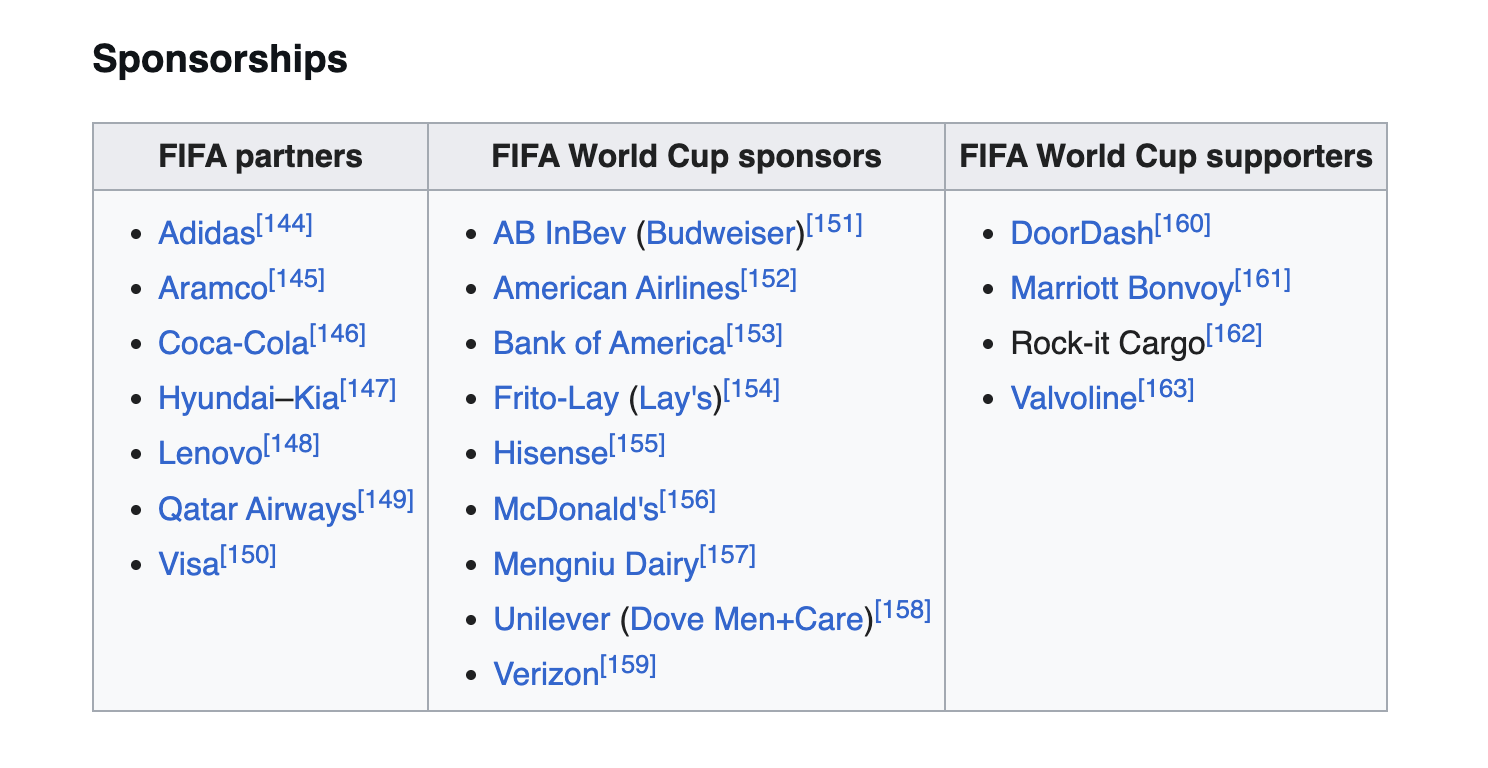
You’re already not watching on FOX – well done you – but you should also attempt the practice of ‘unvertising’, which constitutes actively punishing the companies that advertise at the World Cup. Not the ones, necessarily, who are purchasing ad space on ITV or SBS or Bell Media, but the ones who have banners and billboards in and around the stadia, who are partnered, directly, with the tournament. This revenue goes to FIFA, not the US government (mercifully), but they are still funding an organisation that, a few months ago, awarded Donald Trump the FIFA Peace Prize and which has operated as a reputational laundry for some of the worst countries in the world. Punishing these companies by actively supporting their competitors (drinking Pepsi rather than Coke, staying at a Hilton rather than a Marriott, driving a Dacia rather than a Hyundai) sends a small commercial message.
The world’s most polluting companies have come up with a brilliant idea to allow them to keep polluting: they purchase carbon offset credits from poorly regulated forestry projects in the developing world. Helping to fund a few trees in Indonesia keeps the oil flowing in Saudi Arabia. Genius! And we can do the same with ‘cultural offsets’ to stem the flow of American soft power. Firstly, avoid the big American blockbusters hitting cinemas during the tournament (Spider-Man: Brand New Day, for example, or Toy Story 5). Instead, for each game you watch, offset the football with a cultural product from one of the nations involved in the fixture. Find yourself watching Brazil v Morocco? Don’t stress, just go watch The Secret Agent after. Tuned into Netherlands v Japan? Wash the Arlington glare out your eyes with Shoplifters. Accidentally enjoyed 90 minutes of Belgium v Iran? Counterbalance this with 104 minutes of It Was Just an Accident.
If you haven’t already left the website formerly known as Twitter, then football is probably the thing keeping you there. Try as they may, neither Bluesky nor Instagram quite gets the game like the racist weirdos on X. The World Cup has long been a major event in the lives of social media companies (the last final was a significant event in the early days of Elon Musk’s ownership of Twitter) and this tournament will be bigger than ever. It will also be undercut by a flow of AI slop and signal boosting by bot farms. Brilliant football content will be interspersed with unhinged fascist daubings, on a scale never before seen. And with Elon Musk in charge, the surge in traffic will doubtless be used to push the anti-globalisation, anti-progressive agenda which has seeped in. Leave X behind and forge your own social media community on a platform that feels fractionally less repugnant.
For 90 minutes (barring “the interval”, as my other half calls it) the football does the talking. There might be political slogans on training jerseys, controversies over rainbow armbands or laces, and the occasional geopolitical flare-up on the pitch (the USA could well face Iran on July 3rd) but, generally speaking, the football exists in isolation. Before the games, however, there will be photo ops for local politicians and dignitaries, softball video packages about cowboy culture in Dallas and alligators in Miami, and, after the game, opportunities for everyone involved to ruminate on “what a great tournament it’s been” in front of placards bearing the logos of the sponsors who’ve made it all possible. Save yourself by exposing yourself to as little of this as possible and repeating that old schoolyard mantra: games begin and end on the referee’s whistle.
Donald Trump is not going to shy away from the tournament for fear that opposing fans will boo him. He might not make it to Mexico City for the opening match, Mexico v South Africa, (though, if he does, he’ll get a hell of a reception) but he’ll be there on June 12th in LA for the USA v Paraguay. And he’ll definitely be there, on July 19th, at the MetLife Stadium to inveigle his way into the finalists’ spotlight, like Salt Bae in Doha. He wants us to talk about America, and so we should. But we should use this as an opportunity to decry the rise of authoritarianism, of nationalism and nativism, and to highlight the devastating legacy of America’s foreign excursions. If the spotlight has to be on America, then it shouldn’t be on Marvel movies or Hamilton or the double cheeseburger, it should be on the murder of Alex Pretti, the children in cages at the US border, the drones buzzing around the Middle East.
Fundamentally, I intend this guide to exonerate people from a feeling of complicity. America – like Qatar and Saudi Arabia – has utilised the callowness of FIFA to colonise the world’s game. For real football fans – and critics of the Trump administration – to cede that ground would be a real error. The number of people boycotting this World Cup is never going to make a dent on the tournament’s margins, and the increasing noise from bots and AI on social media will make it impossible to ascertain the true success or failure of the event. We are not strong enough to resist the lure of football and we ought to embrace that. Make this tournament about football, about narratives on the field, the execution of power from one penalty box to the other. This is a game that offers a lingua franca for the entire world (I was taking a cab in Morocco recently where, without a shared language, I simply said to my driver “Brahim, eh?” and he shook his head and muttered obscenities in Arabic). The fact that Americans have never really understood it – even as they’ve tried to buy it or rebrand it – is because they believe in American exceptionalism, whereas football represents the world as a communal undertaking. It is borderless, it can be played at MetLife Stadium in front of a crowd of 80,000 fans and another billion watching at home, or it can be played with jumpers for goalposts in the ruins of Gaza. It can’t be stolen, and it’s not for sale.
Which is, in short, why I will be watching the World Cup when it kicks off tonight and how I’ll be trying not to feel too gross about it.
I’m on Bluesky, follow me and we can talk about football there.
No posts
Comments
Nothing yet. Say the first thing.
Sign in to join the conversation.