
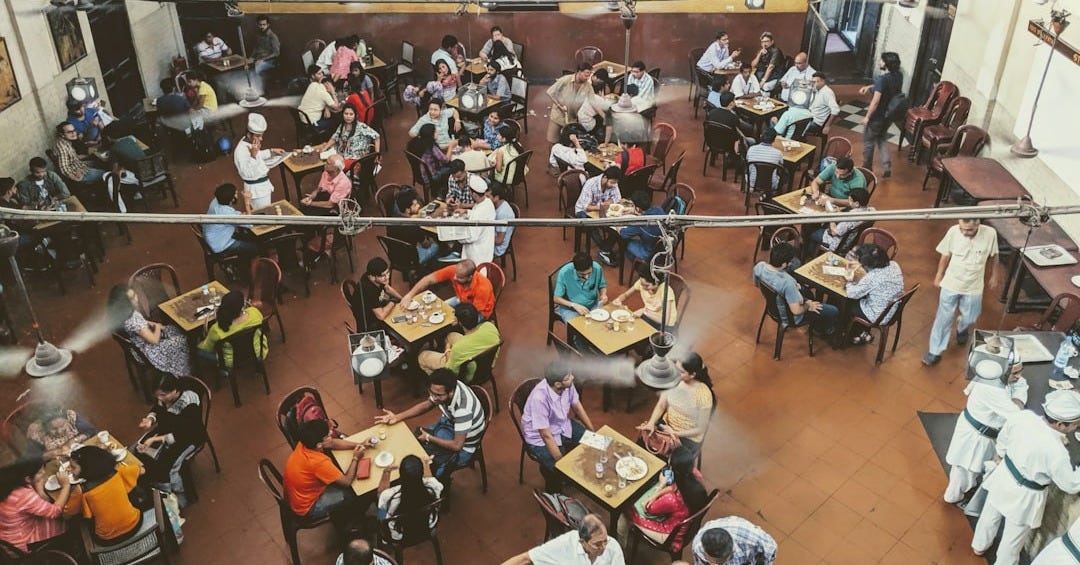
What would happen if we thought of restaurants as infrastructure, part of the fabric of our societies? Necessary for our collective well-being, health, and sense of belonging?
I have been obsessed, for a while, with the question of infrastructure that unlocks a sense of possibility for us all, a sense of collective flourishing. I keep returning to questions of belonging, of common ground, of the opposite of isolation and insularity. What do we need to build, fund, and design to make this possible?
So I was intrigued when I came across Carly Trisk-Grove’s work. She’s based in the UK, where she’s set up The Public Plate, a model for what she calls public restaurants as a way to address social isolation and how cost prohibitive eating out (and eating well — good, healthy meals) can be in the UK.
If you’ve been following my work for a while, you’ll know I keep returning to questions of food, because shared meals are where I’ve had the clearest glimpses of belonging building in recent months. There’s data that literally shows that when negotiations between parties with competing interests happen over meals, they result in more value for everyone involved. There’s something so deceptively simple, so powerful about breaking bread and passing steaming hot bowls of food to each other.
Carly’s model is basically the canteen model — she told me about turning to lokanta’s, or ‘tradesman’s restaurants’ in Istanbul for inspiration. It reminded me of Amma’s canteens in India, which also offer affordable meals at scale and have been written about as a public space where people across different social groups ate together and worked alongside each other.
In many ways, it reminded me of dining halls at university, where we all stacked our trays with affordable meals and sat at long tables, often next to groups of people we didn’t know well. There were a few hundred of us who shared this dining hall, and so you were always bound to recognise familiar faces. Eating together, then, was often a social experience.
Carly’s model relies on local restaurants supported by scaled infrastructure to reduce costs and enable healthy meals and restaurants where people can linger and engage with each other.
A few things that stood out to me, from a conversation with Carly:
She doesn’t see locally rooted businesses and scale as opposing forces
The point is to root the restaurants in the local community while using scale to increase efficiency and reduce costs. “Centralised food production, shared administrative support, and patient finance enable locally run restaurants to focus on delivery,” Carly explains.
“As the network grows, scale creates efficiencies, through; shared production, procurement, and support. Crucially, those efficiencies aren’t extracted as profit; they are reinvested across the system: keeping meals affordable, paying farmers fairly, and creating good jobs. Investors are repaid through the steady cashflow of the network, not through a sale, allowing the model to scale without ever losing its purpose.”
So much of what she’s describing, I imagine, is how chain restaurants are able to scale. But this time, focused not on grab and go fast food but instead a place where people can spend time together and eat healthy. It’s taking a model that works elsewhere and reimagining it, to optimise for a different set of metrics.
There’s a role in this model to not just serve healthy, affordable food but also build infrastructure for belonging
“At a time when much of our social infrastructure has disappeared, across both the public and private sectors, from Sure Start centres to bingo halls and department store cafés, hospitality, if structurally redesigned, can take on a new role,” Carly explains. “It can become essential social infrastructure: commercially viable, socially transformative, and capable of strengthening our networks at scale.”
At a time when loneliness and isolation remains pervasive and third places — not home, not work, but somewhere else to hang out — are closing down (in England and Wales, one pub a day closed closed permanently in 2025) or remain hard to access without paying a lot, there’s something she’s touching on.
But while there’s a lot of power in having the physical infrastructure, a literal place to hang out, I wonder if that’s enough to cultivate a sense of belonging? I think about a few of London’s markets where I often bought lunch during the workweek. I’d perch on a picnic table in the market and gobble down my sandwich or burrito: affordable, accessible food in communal eating spaces. And also, there was nothing there that made me feel like I belonged.
“In public restaurants, staff will understand that their primary role is to be hosts, creating an environment where everyone feels welcome,” Carly says. “What we love about pubs is the feeling they create, let’s bring that into public restaurants. Pubs foster belonging not just through their local focus, but because they feel universally accessible: most people feel comfortable in the space, and with no table service, interactions happen naturally rather than transactionally.”
In recent weeks, I wrote about supper clubs and apps that brought together strangers around a dinner table: different models for using food as a way to cultivate belonging or bring people together. The problem, I found was that there wasn’t recurrence.
In Carly’s model, the public restaurants are built for regulars and rooted in local communities. They have a business model that makes sense, a reason for people to visit and pay, and a physical home for the community. The final piece will be designing a model where people have a reason to turn to each and start a conversation, a reason to keep talking.
No posts
Comments
Nothing yet. Say the first thing.
Sign in to join the conversation.