
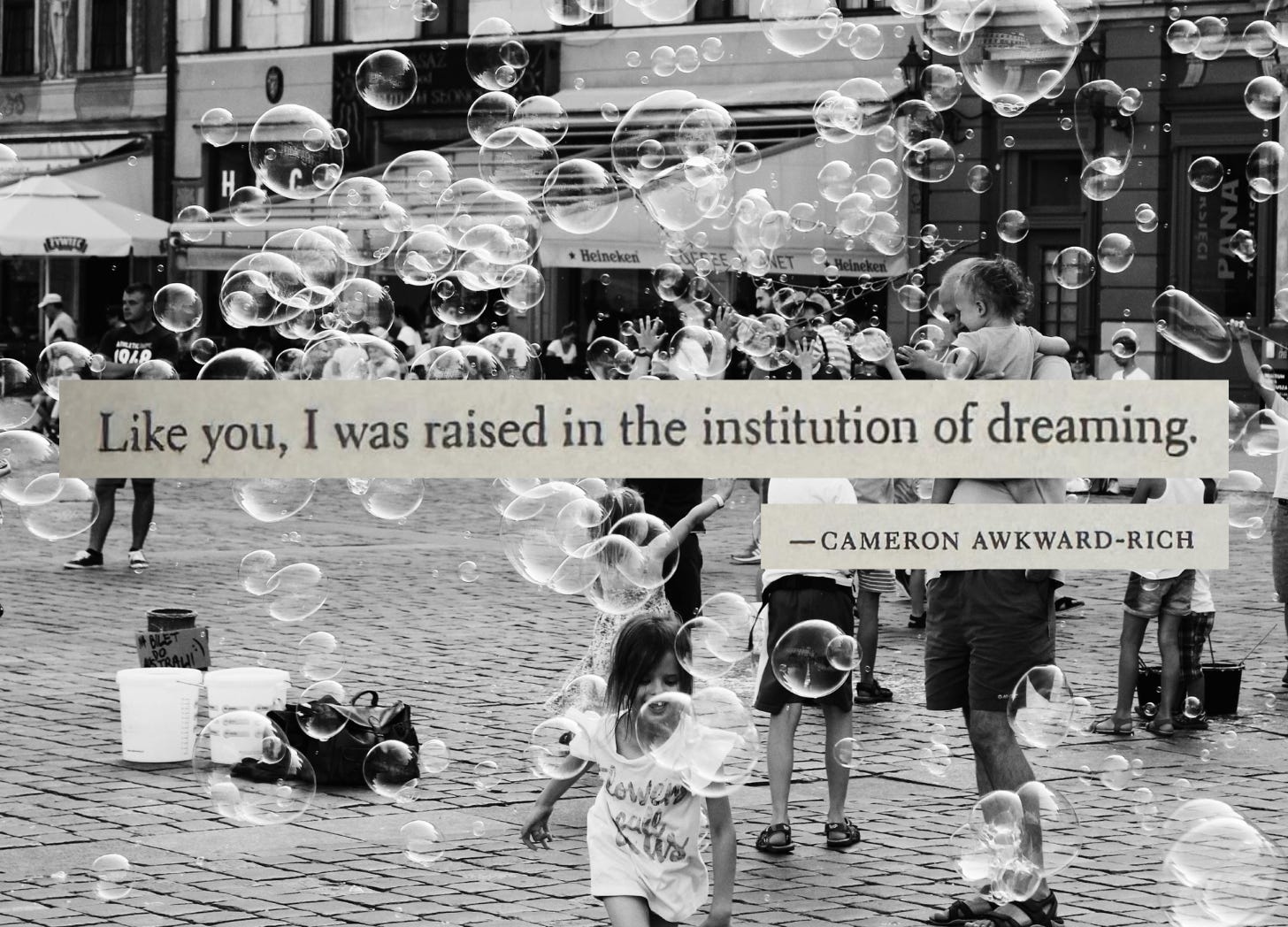
Where do you go to dream? I’m asking an honest question here.
We wake up every morning to headlines of missile strikes and peace talks / peace un-talks, of the chess board of the world making moves we cannot control, and I am hungry for containers for dreaming. If we want to build a better world, we have to have places we can dream it first. I realise there is no single institution or place in my life that encourages me to hope, to dream, that is oriented around the future and possibility.
It’s rich to think of dreaming in a world like this. I read headlines and comment sections, and the world is on fire and everyone is angry at everyone else. I read LinkedIn posts and everyone has all the answers. But I am not looking for explainers or escape hatches: I’m looking for… hope.
A way to orient toward possibility even when the world feels hopeless. Not just hope for me, but for all of us. This, I imagine, the purpose of churches and mosques and temples: they’re homes for belief. Is prayer not a ritual in staying rooted in hope?
But in our modern, secular world, where do we go to dream together?
Our phones give us each a universe of our own that we carry in our pockets and purses, which increases insularity and calcifies the bubbles we live in. Each of us carries not only a story now about who we are and where we’re going, but also where we see our world going.
While the narrative of what our world is and the truth of simple facts has become a contested battleground, we have nowhere to turn for orientation or direction, either.
So often, when we talk about loss of trust and how truth itself feels harder-than-ever to discern, we talk about the ground we’re standing on. And if we can’t agree about where we are now, how can we agree on where we’re going?
At bare minimum, this increases insularity. At worst, it means we’re all moving in different directions. I don’t actually think most of us want different futures for the world, but I do think shared orientation and shared dreaming sets the rules of the game, it names the scope of the system and the north stars we’re aiming for. It focuses energy, aligns us all, and makes us belong to the same whole.
I went looking for data to validate this, but I couldn’t find any good proxy. Collective dreaming isn’t the same as investment in the arts, it isn’t quite the same as a society with third places. It’s partly about ritual, partly about the collective, partly about orientation. And how do you measure the impact this has (or the lack of it has) on GDP?
So all I have, instead, are anecdotes from my own experience and examples I keep finding. For years now, I’ve been collecting examples of containers for collective dreaming. Every time I encounter one of them, I find myself drawn in and unable to turn away.

1. Sport is perhaps the most powerful home we have for collective dreaming.
Where we sit together and watch 90 minutes at a time as people kick around a ball. Where we root for each other. Where we hold our breath and think, no, this one time, we can beat the odds. Where little kids from Senegal and Argentina, from France and from Egypt see themselves reflected in possibility.
If we have any modern cathedrals for collective dreaming, they are our stadiums and our pitches. When the world falls in love with Simone biles or Alissa Liu. When little kids around the world in Messi and Neymar jerseys cheer and commiserate loudly every week, every four years, and again and again. To be a fan is to show up week after week, month after month, and practice the work of believing. Of dreaming. Of belonging to a story bigger than yourself.
There’s actually research that when people come together in a stadium, their hearts start beating together, a phenomenon called synchrony. It makes people feel more connected.
2. A year ago, I came across Sunshine Cinema and it stopped me in my tracks: documentary film-maker Sydelle Willow-Smith and Rowan Pybus have set up a project where they package a solar panel, a projector, and a USB stick full of films made on the African continent, giving young people across Southern Africa everything they need to set up cinemas in their classrooms, community halls, and villages.
I can’t shake how much I love this project: it’s a literal toolkit for collective dreaming.
In a world where we all carry tiny universes in our pockets, there’s something incredibly powerful about flipping the model on its head. Not personalised, not a feed or a story or a worldview that reflects how we think, packaged and clipped for us to watch alone. But a model built on coming together, sitting in a story together, and then talking about it together.
3. My favourite creator on social media is a woman named Annabelle, who’s cycling from Norway to South Africa.
Most days, she post vlogs on TikTok (and other platforms). She takes you with her on hot sweaty bike rides (she posting from the Republic of the Congo as I write this): the world big and beautiful and abundantly real. Sometimes packages get lost in a maze of bureaucracy in a country she doesn’t live in. Most days, there are smiles and bonjours exchanged with children and shop owners. There are people who stop to give her water. There are mountains and waterfalls and beaches. There is the world, simply as it is, full of wonder, seen as fast as she can peddle.
Part of the wonder of Annabelle’s TikTok videos is the comments section. It’s like a ragtag group of tens of thousands of us, who watch from around the world, cheering her on. We often tell her that she’s our favourite creator. People who have been following for months answer new fans’ questions. It’s a fandom I’ve entered, and in this little corner of the internet, I find myself learning how to dream again, to dream with people from around the world.
Why does it matter? Why do I keep collecting these containers for collective dreaming? Why am I so drawn to the ritualised spaces, not the one-off moments of dreaming? Because they’re maps to the futures we want to build: the collective routine isn’t just about belonging to a whole, it’s also about buying into a shared story of the direction we’re all going in. Without a shared container for our dreams, we can’t coordinate how we innovate, how we invest, and what we build.
If we dream together, we are practiced in imagining and taking leaps of faith. If we’re doing it together, we’re also ritualising the act of belonging together. We get in the habit of being part of the collective. And perhaps most importantly, as we come together and start dreaming together, we all start believing that we have a stake in the same shared dream.
Amy Charlotte Kean on the politics of hope.
“Hope is a team sport. A collective act. Hope needs people. According to research from Cohen-Chen & Pliskin (2025) hope is a crucial precondition for group efficacy. Without hope, even the strongest sense of collective capability fails to translate into action.”
Mary Annaïse Heglar on imagination and the climate crisis, in 2021:
“The climate crisis is a crisis of many things: science, economics, politics, immigration. As the author Amitav Ghosh said, “the climate crisis is also a crisis of culture, and thus of the imagination.” To be clear, that doesn’t mean innovation or invention—we’ve got loads of ideas for solar panels and microgrids. While we have all of these pieces, we don’t have a picture of how they come together to build a new world. For too long, the climate fight has been limited to scientists and policy experts. While we need those skills, we also need so much more. When I survey the field, it’s clear that what we desperately need is more artists.”
Rebecca Solnit’s ‘A Paradise Built in Hell’ about how communities come together instinctively in times of crisis.
No posts
Comments
Nothing yet. Say the first thing.
Sign in to join the conversation.