
The Future Of Where depends on you to keep us going, so become a paid or free subscriber today!
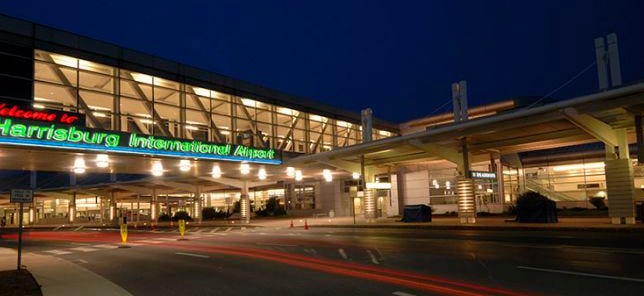
The Harrisburg Airport used aggressive marketing to lure local folks away from BWI, 80 miles away.
The other day I wrote about “small hub” airports and how their passenger boardings are growing much faster than boardings at larger airports (or smaller ones, for that matter). It’s a remarkable trend: Since COVID, passenger boardings at what the Federal Aviation Administration categorizes as small hub airports – everywhere from White Plains to Bentonville to Sarasota – have grown 15% compared to less than 5% for big airports like JFK, O’Hare, Atlanta, and DFW.
But, like most successful economic development efforts, this trend didn’t just happen. It’s the result a deliberate set of steps undertaken by airports, cities, and especially regional economic development organizations. And the way cities and regions go about this is an object lesson in how economic development strategies shape the way places functions.
As I pointed out in my previous post, host cities and regions – especially smaller ones – are in a tough spot when it comes to air service. The United States has around 500 airports. But it only has about 10 viable airlines, dominated by “The Big Four” – United, American, Delta, and Southwest – which together control about 75% of the market. So, in similar fashion to professional sports franchises, cities are constantly competing with each other to attract air service to their airport.
So cities and their economic development organizations are constantly marketing the airlines trying to get service. And almost all of them follow the same steps.
First comes the inevitable “leakage study,” showing how many local passengers are going to other airports.
Second comes a kind of wooing process, where airports and economic development organizations try to win the attention of the airlines and sell them on their markets.
Third comes money: fee waivers from the airports and often direct subsidies (“revenue guarantees”), sometimes from the local community and sometimes from a federal grant program.
And finally comes marketing: selling the actual local residents on the idea of flying out of their local airport, which can be a surprisingly tough sell sometimes.
I’ll dive into these four steps in detail down below, but first I want to address a step that is often overlooked at the front end, which is deciding what economic development goal are you trying to achieve with more air travel. Because some economic activities is highly dependent on passenger air service, while others are not.
Mayors and economic development leaders often try to make headlines with announcements of the latest nonstop flight, claiming it’s a huge step forward for the city and the region. Sometimes the reason for the hulabaloo is clear. Not long ago, for example, I happened to board what turned out to be the first nonstop flight ever from San Diego to Reagan Airport (DCA) and happened upon a party hosted by Mayor Todd Gloria. Given San Diego’s dependence on the Navy and other federal spending, it made sense that it was a big deal for folks from San Diego to no longer have to get from Dulles Airport to the Pentagon or Capitol Hill.

Tweed Airport in New Haven used a leakage study, a tax argument, and a federal grant to help lure Avelo and increase passenger boardings by 1,100 percent.
At other times, it’s not so clear. A few years ago I was privileged to participate in a meeting in Jerusalem between the late Sylvester Turner, then the mayor of Houston, and Benjamin Netanyahu, the prime minister of Israel. Netanyahu’s agenda was big and obvious: He couldn’t get the large energy companies from Houston interested in the natural gas leases in the Mediterranean that Israel controlled, and he wanted Turner to lean on them. Turner’s ask in return? A nonstop from Ben Gurion Airport to George Bush International Airport. This sure seemed like an asymmetrical situation to me.
So step one has to be knowing why you want the flights. If you’re a resort community or a place targeting tourism – and some of the fastest-growing small hubs have been places like Jackson Hole and Bozeman – it’s obvious. Academic research has also suggested, unsurprisingly, that high-income service industries such as law and consulting value nonstop air service and partly for that reason tend to congregate in big metropolitan areas near major airports. But if you’ve got an economy based on goods and manufacturing, the truth is that air service doesn’t matter nearly as much. It’s a mistake to devote a lot of time, effort, and money to pursuing flights just to have them.
That said, let’s look at the four steps in detail – which helps us understand how a particular economic development effort unfolds, one in which lots of cities are in competition with each other for the attention of a few private companies (airlines) they need to succeed.
There’s a kind of chicken-and-egg problem with passenger air service. Academic research suggests that service drives demand (and economic growth), not the other way around. That means you have to prove to the airlines that the demand already exists and they can capture that demand if they come into your (small, local) airport. So the first thing economic development leaders typically do is commission a “leakage study,” showing how many local passengers are using airports farther away.
The other day I mentioned that the small hub airport with the biggest increase in passenger boardings post-COVID is Tweed New Haven in Connecticut, which has seen an eleven-fold increase primarily because Avelo came in. But even before COVID, New Haven officials started making the case by showing that Tweed’s “catchment area” includes 1.5 million residents who make 4 million flights a year – a lot per capita, partly because of Connecticut’s affluence. Furthermore, about half of these passengers traveled to JFK, LaGuardia, and Newark – 75 to 100 miles away through awful traffic in a gigantic metropolitan area – to get a flight. (The public policy argument was that Connecticut was losing revenue to New York and New Jersey as a result.
Similarly, when Chattanooga focused on getting more air service, local leaders commissioned a study that found most local passengers drive two hours to either Atlanta or Nashville to get a flight. Atlanta, of course, is the Delta hub that has nonstop service to practically everywhere, and as Nashville became a hot destination air service improved. (Flights from Atlanta and Nashville were also cheaper than flights from Chattanooga, and passengers often overlook the time and expense of driving a long way in their quest for a cheap ticket.)
So that’s the solution to the chicken-and-egg problem: Proving that latent demand already exists.
With a leakage study in hand, the cities them begin the wooing process. Some of the wooing takes place
Comments
Nothing yet. Say the first thing.
Sign in to join the conversation.