
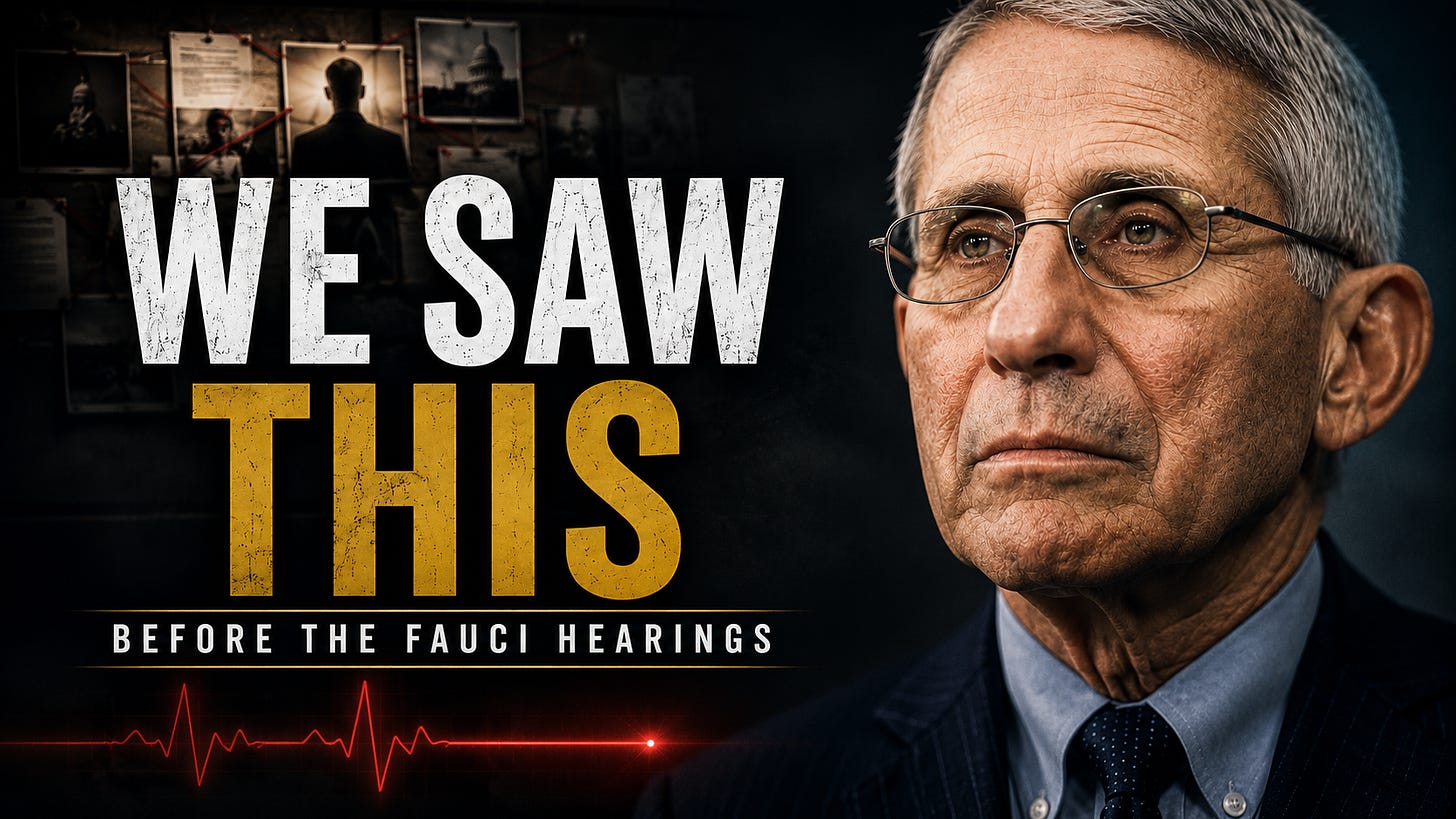
Watching the Fauci hearing, I couldn’t shake the feeling that I’d seen this story before. Not because it proved our remote viewing session from 2021, but because it kept revisiting the very themes our viewers independently described years before many of today’s documents, diary entries, and congressional testimony became public.
That’s what made me stop and go back through the original data.
And honestly...
I came away even more impressed than I was the first time I watched our remote viewing debrief.
One of the strongest patterns had nothing to do with medicine.
It had everything to do with two different realities.
Edward Riordan repeatedly described hidden conversations, conflicting narratives, influential meetings, financial backing, powerful institutional relationships, and the feeling that what was being presented publicly wasn’t the full story.
Five years later, that became one of the central themes of the hearing.
Chairman Rand Paul argued that private communications among scientists reflected uncertainty about the virus’s origins while public statements projected much greater certainty. He repeatedly contrasted what was allegedly being said behind closed doors with what was communicated publicly, referencing diary entries, internal discussions, unpublished concerns, deleted communications, and Freedom of Information requests. Whether one agrees with those conclusions or not, the hearing itself revolved around the tension between private deliberations and public messaging.
That alone caught my attention.
Then Daz Smith's session took the story even further.
His session consistently returned to government funding, covert projects, negotiations, intelligence connections, classified environments, influential organizations, and someone operating inside an unusually complex institutional network.
Years later, much of the hearing focused on questions surrounding NIH funding, gain-of-function research, interagency relationships, possible intelligence community involvement, oversight, classified programs, deleted records, and who knew what—and when. Again, that doesn’t validate every perception, but it is striking how closely the discussion centered on institutional power, funding, and hidden decision-making rather than simply one individual.
Then there was the medical data. This is where the session becomes genuinely difficult to ignore.
Edward Riordan consistently described severe cardiovascular distress. He described damaged heart valves. Irregular heartbeat. Compromised circulation. Blood transfusions. Heart attacks.
Someone physically deteriorating while continuing to work.
Independently, Nyiam Vendryes arrived at remarkably similar imagery.
His session vividly portrayed an opened chest, ribs separated during surgery, pumps, blood vessels, clotting, blocked circulation, emergency intervention, and what appeared to be major cardiac repair.
No one prompted those descriptions. No one told him to look for heart disease.
That imagery emerged independently.
Then Dick Allgire added another layer.
His impressions centered on ICU environments, artificial pumping systems, compromised circulation, blood clots, physiological instability, and repeated references to the eyes and vision.
Three different viewers.
Working blind.
Without knowing the target or seeing one another's sessions.
Three different paths leading toward the same cardiovascular and circulatory imagery. At the time, we had no idea what to make of it.
Fast forward to today’s hearing.
The hearing included references to Fauci's diary documenting his pulmonary infarction, along with questioning about clotting, pulmonary complications, cardiovascular events, vaccine safety monitoring, and reports of adverse medical events. Those subjects became part of the public congressional record during questioning.
That's what really caught my attention. Three independent remote viewers—working blind, without collaboration—all converged on severe cardiovascular and circulatory imagery years before those same categories of medical issues became part of today's public discussion.
Another theme also stood out.
Responsibility.
Edward perceived someone carrying enormous pressure while attempting to maintain control.
Dick described a figure surrounded by institutional forces much larger than the individual himself.
That feels surprisingly relevant watching today’s hearing.
Some senators portrayed Fauci as the central architect of pandemic policy and scientific decision-making. Others argued he was being turned into a political scapegoat for failures involving hundreds of officials across multiple administrations.
Those are very different interpretations.
Yet both acknowledge the same underlying reality:
One individual standing at the center of an extraordinarily complex institutional system.
Perhaps that’s what impressed me most after revisiting this project.
The viewers weren’t describing headlines.
They weren’t naming diary entries.
They weren’t predicting a particular Senate hearing.
They were describing patterns.
Power.
Funding.
Institutional relationships.
Conflicting public and private narratives.
Medical crisis.
Pressure.
Responsibility.
Years later, those same patterns dominate the conversation.
This is why we continue treating remote viewing as an intelligence-gathering tool rather than a crystal ball. Is it accurate 100% of the time?
No.
Remote viewing doesn’t work that way.
But when multiple independent viewers repeatedly converge on the same underlying themes—and years later history begins organizing itself around those same themes—it becomes increasingly difficult to dismiss the data as random coincidence.
That’s why we archive every session exactly as it was originally recorded.
Not because we expect history to validate every detail.
But because, every so often, history catches up to the pattern the viewers were seeing all along.

Today’s article came from intelligence that had been archived years before many of the themes discussed in the hearing became public. That’s exactly what FFG members receive access to every week: remote viewing sessions, strategic analysis, market intelligence, and research designed to identify emerging patterns before they become obvious.
Join during our New Member Summer Event before August 31 to secure your discounted monthly rate through December 31, 2026.

Future Forecasting Group is comprised of the best non-military remote viewing team in the world, with decades of experience and a track record to match.
Disclaimer
This publication is for informational and educational purposes only. Remote viewing data is inherently speculative and should not be interpreted as fact, proof, or actionable advice. Future Forecasting Group does not guarantee the accuracy, outcome, or implications of any remote viewing content. Readers should use critical thinking and conduct independent research.
No posts
Comments
Nothing yet. Say the first thing.
Sign in to join the conversation.