
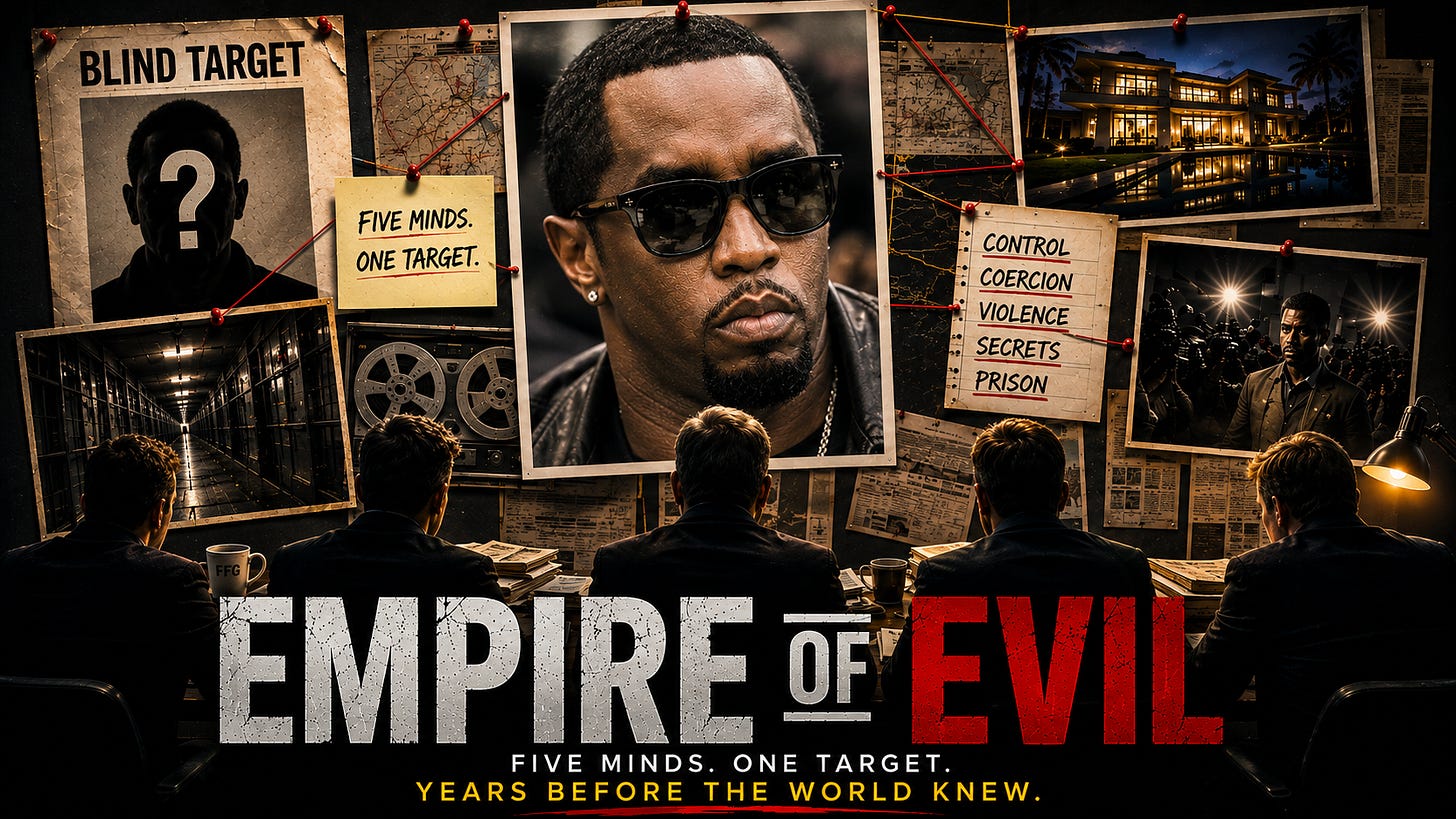
I recently came across another update about Sean Combs' projected prison release date.
Oddly enough, it wasn't the date that stayed with me.
It was the memory of Dick Allgire stopping in the middle of our debrief, overcome with emotion after describing what he had perceived.
In more than two decades of watching remote viewing sessions, I’ve rarely seen Dick react that way.
This target was different.
Our tasking was straightforward:
The future outcome of Sean Combs’ legal situation.
Five experienced remote viewers—Dick Allgire, Daz Smith, Nyiam Vendryes, Edward Riordan, and a fifth viewer we’ll simply call D—worked the target independently under blind conditions.
None of them knew the target.
None of them saw one another’s sessions.
Yet as we compared the data afterward, the same themes began surfacing again and again.
Not identical details.
A shared pattern.
Years later, after the investigation, the testimony, the trial, and the convictions that pattern is difficult to ignore.
One of the first things that stood out wasn’t guilt or innocence.
It was pressure.
Nyiam repeatedly described someone being pursued, captured, prosecuted, and ultimately confined. He sensed a man trapped inside a situation that was rapidly closing around him—a “prisoner’s dilemma” with very few good options.
Edward independently perceived a man standing at a fork in the road, facing decisions that would shape everything that followed.
Daz described someone caught inside a dark, chaotic storm that had been building for years.
Different viewers.
Different continents.
Different sessions.
Yet they kept returning to remarkably similar impressions.
Today, Sean Combs sits in federal prison following one of the most closely watched celebrity trials in recent memory. The jury convicted him on transportation-for-prostitution charges while acquitting him on the government’s most serious allegations. His appeal remains ongoing.
Not complete destruction.
Not complete exoneration.
Something in between.
Looking back that’s much closer to the shape of the outcome our viewers described than either extreme many expected.
The most emotionally powerful session came from Dick Allgire. As he walked everyone through his data during the debrief, the weight of what he had perceived eventually became too much.
He stopped.
He broke down.
And Dick’s session returned again and again to the same disturbing images.
Cameras recording sexual encounters.
Compromising recordings.
Drugs surrounding prolonged sexual activity.
Women who appeared frightened, distressed, or unable to freely participate.
People being controlled through what had been captured.
One theme kept surfacing.
Control.
Years later, courtroom testimony described recorded sexual encounters, extensive drug use, allegations of coercion, and video evidence that prosecutors argued became part of a broader system of manipulation. Jurors also heard testimony involving attempts to obtain or suppress damaging recordings.
That doesn’t mean every detail Dick perceived entered the public record.
Because it didn’t.
But the underlying architecture he described—recordings, drugs, coercion, and control—became one of the defining themes of the trial.
Another pattern quietly emerged across multiple viewers. Very few of them perceived Sean Combs operating alone.
Edward repeatedly sensed planning.
Groups.
Calculated strategies.
People carrying out specialized roles.
Nyiam perceived multiple parties converging on the situation from different directions.
Dick repeatedly described layers of individuals surrounding the central figure.
Interestingly, the trial itself involved assistants, employees, security personnel, investigators, hotel staff, witnesses, and years of testimony describing an entire environment—not simply one isolated individual.
The jury ultimately rejected the government’s racketeering theory.
That matters.
But the viewers consistently perceived something more complex than one man acting entirely by himself.
Whether that reflects the machinery surrounding celebrity, organizational behavior, or something else entirely is a conclusion each reader can decide for themselves.
Perhaps the most interesting convergence wasn’t about what happened.
It was about what didn’t.
None of the viewers clearly described permanent imprisonment. Instead, they repeatedly hinted at something more nuanced.
Daz sensed “an end in sight.”
Edward described “beautiful ruins”—the remains of something that had once been powerful.
Working several years beyond the legal proceedings, D perceived someone who had endured enormous consequences yet still appeared to possess influence and a future trajectory.
At the time, many expected only two possible endings.
Complete acquittal.
Or life effectively over.
Reality landed somewhere in between.
Sean Combs was convicted.
He went to prison.
His reputation suffered extraordinary damage.
Yet Sean Combs legal story continues through the appeals process, and his current sentence remains finite rather than permanent.
Again...
...not exactly what many expected.
But surprisingly consistent with the broader shape that emerged across the sessions.
The easiest way to evaluate remote viewing is to search for individual hits and misses. Personally, I think that’s the least interesting part. What keeps drawing me back are the larger patterns.
Five people.
Working independently.
Without knowing the target.
Yet repeatedly describing the same underlying architecture.
A powerful man losing control.
Recorded evidence.
Coercion.
Pressure.
Capture.
Imprisonment.
A network surrounding the central figure. An outcome that would damage—but not completely erase—everything he had built.
Remote viewing has never been about proving certainty.
It's about recognizing emerging patterns through independent observation, then comparing those observations with reality as it unfolds.
Whether one believes remote viewing is accessing intuition, unconscious pattern recognition, or something science has yet to fully explain, sessions like this invite an uncomfortable question.
When five independent viewers begin describing the same underlying architecture before the public story fully unfolds...
What exactly are they perceiving?
Perhaps that’s worth paying attention to as we navigate this reality.

Today’s article came from intelligence that had been archived years before many of the themes discussed in the trial became public. That’s exactly what FFG members receive access to every week: remote viewing sessions, strategic analysis, market intelligence, and research designed to identify emerging patterns before they become obvious.
Join during our New Member Summer Event before August 31 to secure your discounted monthly rate through December 31, 2026.

Future Forecasting Group is comprised of the best non-military remote viewing team in the world, with decades of experience and a track record to match.
Disclaimer
This publication is for informational and educational purposes only. Remote viewing data is inherently speculative and should not be interpreted as fact, proof, or actionable advice. Future Forecasting Group does not guarantee the accuracy, outcome, or implications of any remote viewing content. Readers should use critical thinking and conduct independent research.
No posts
Comments
Nothing yet. Say the first thing.
Sign in to join the conversation.