
Futi’s World Cup coverage continues with a guest blog from Adam Whittaker Snavely.
Join the futi waitlist to get an app invite very soon.
How do you quantify angst? Is it the number of scratches in a favorite record counted like tally marks? The coffee rings stained into your desk, the scorch marks of dying cigarettes burned into the pavement?
Now blow that up to the national level. What does it look like for a country of millions to experience a dark night of the soul, together?
In Brazil, it looks like this:
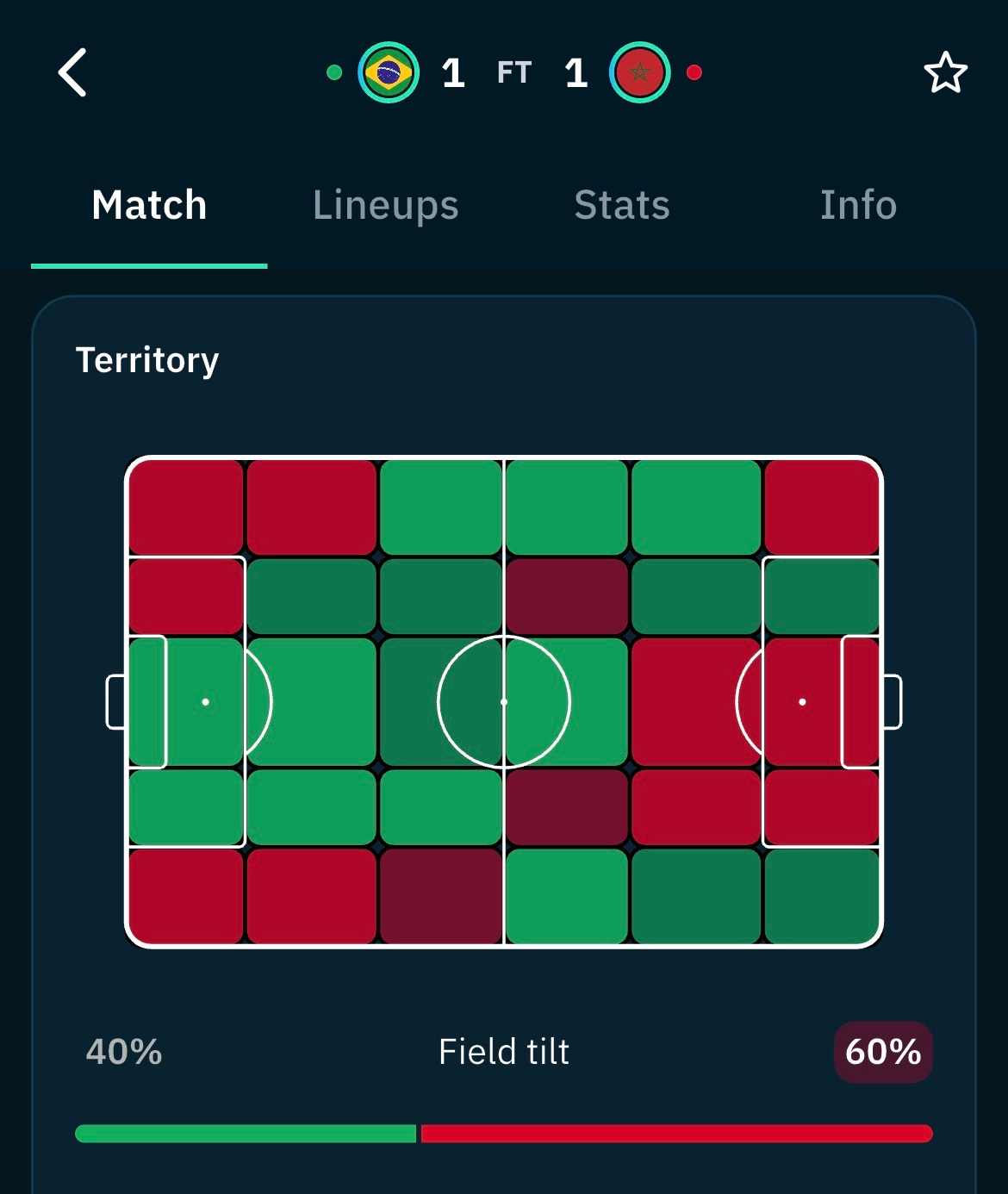
Besieged down the flanks by an opponent capable of lighting-quick ball progression married with moments of individual brilliance, an opponent with the kind of breathless highlights that make people take notice.
You know, kind of like Brazil. The old Brazil.
This is the first World Cup I can remember being alive for where Brazil did not enter as even a dark horse. My Brazilian friends and family are focused fully on 2030, resolved that this team is not the one to bring glory back to the five-time champs. Neymar is a specter brought in largely because he remains the last true, singular Brazilian superstar by reputation, but one dimmed considerably by age, injury, and off-field issues. I have a sneaking suspicion that if he remains injured for the entire tournament, it’s best for everyone involved.
Nobody seems particularly pleased to be watching this Brazil squad. The reaction to the opening 1-1 draw to Morocco is most of what you need to know about Brazilian expectations: a draw against a team that made the semifinals four years ago is not good enough. (Never mind the fact the last time Brazil made it to the semis was over a decade ago and when they got there, that happened.)
Morocco frequently looked more dangerous and, importantly, more fun. Their progression map against Brazil looked like trebuchet fire raining down on a castle from all angles. Brazil’s was comparatively scattered as the team desperately worked to free Vini in the left halfspace. In fairness to them, that did eventually work, because Vini is good. But despite coming away with equal points and looking a bit more game in the second half, it wasn’t a match suggesting Brazil can hang with the best. If it told us anything, it’s that Brazil can only really attack down the left.
A game against Haiti gave the Brazilians more joy, but also, holy shit, these guys only have one idea right now, huh?
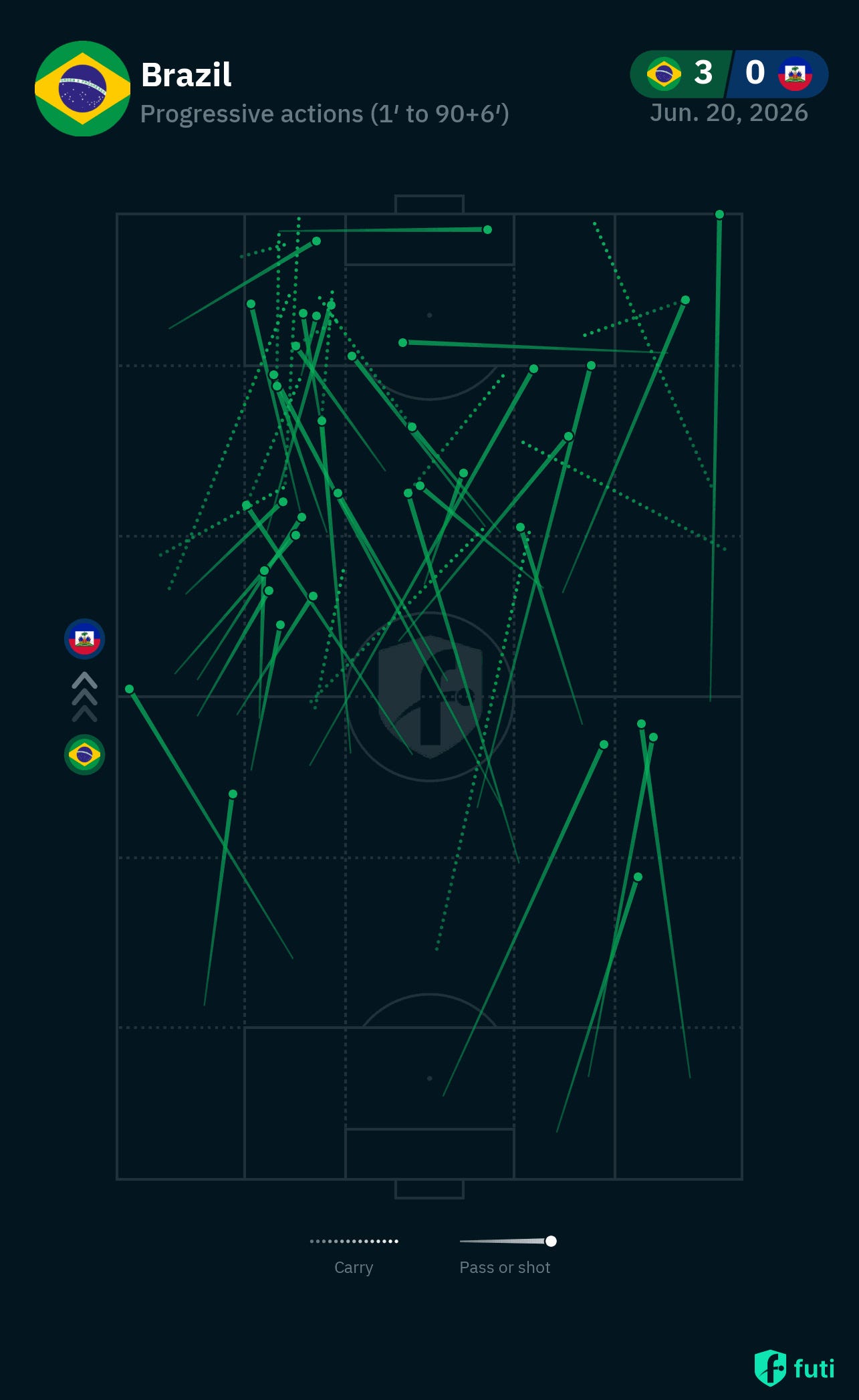
When Vini Jr. gets on the ball in the left halfspace, or when he vacates the left halfspace for another player like Matheus Cunha to run into, good things happen for Brazil. When the ball is basically anywhere else in the attacking half, they give my poor Brazilian mother palpitations.
The degree to which the left halfspace is load-bearing for Brazil is obviously a product of how important Vini is to this team. His goal against Morocco was the type of effort that thumbs its nose at small-sample xG analysis of “good” and “bad” shots. A Brazil team without a player that can pull off a magic trick is no Brazil team.
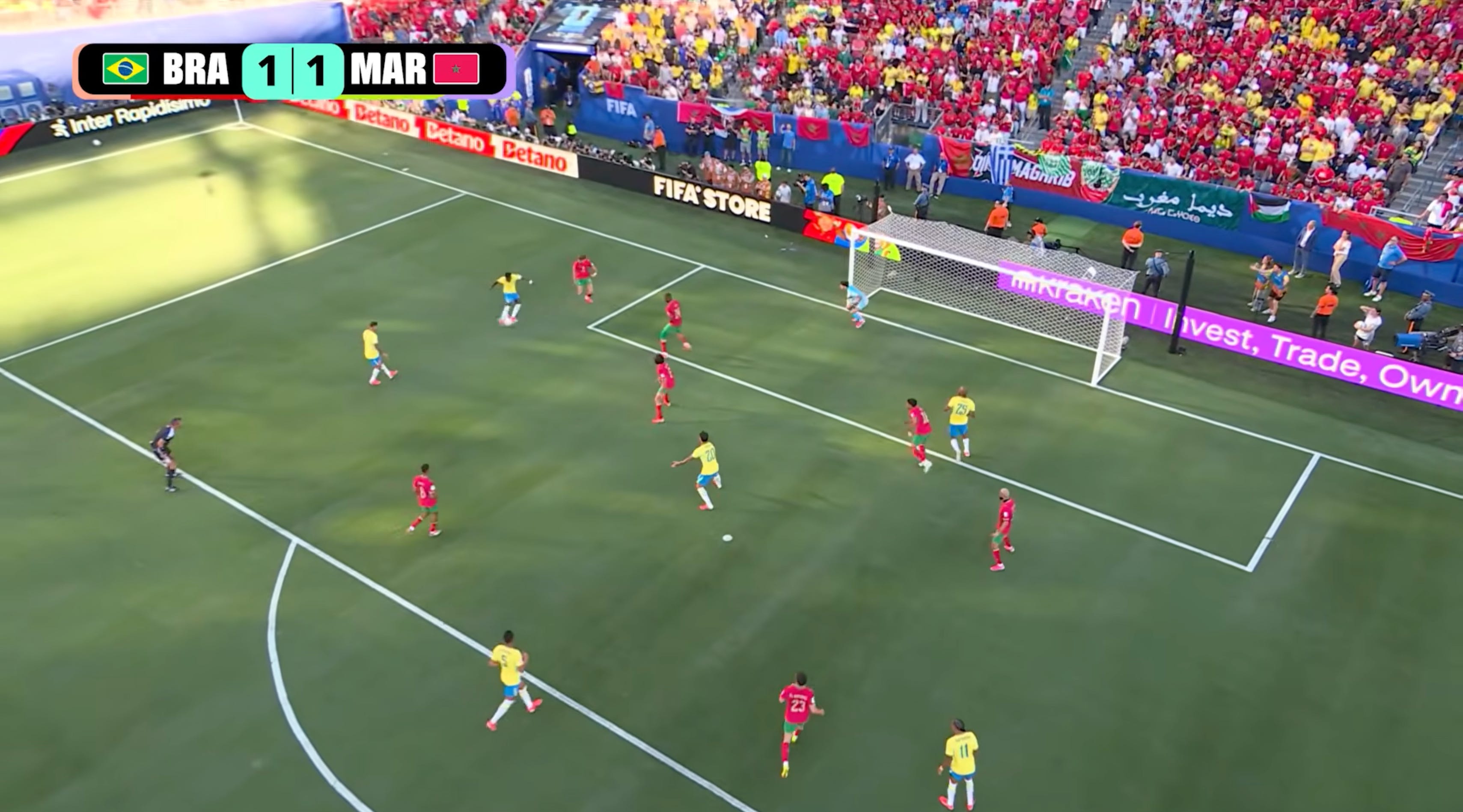
But this team clearly has an overreliance on one player, either on the ball or by dragging defenders around with his off-ball gravity, like he did for his assist on Cunha’s second goal of the night. It wasn’t even a particularly clever Brazil move. Vini simply picked the ball up in transition, dribbled into the center of the field, and Cunha ran right to the space where Vini would usually operate. Paqueta, too, is constantly moving to the left side of the field to combine with Vini and Douglas Santos. The field isn’t tilted at this point; it’s a goddamn ski slope.
Now you might be saying, “Snaves, I hear you. But clearly Vini is the team’s best player, and won’t all that gravity in the left halfspace open up opportunities on the other side of the field?”
Yeah! If you’re Brazil, you should have great players all over the field that can capitalize on less attention!
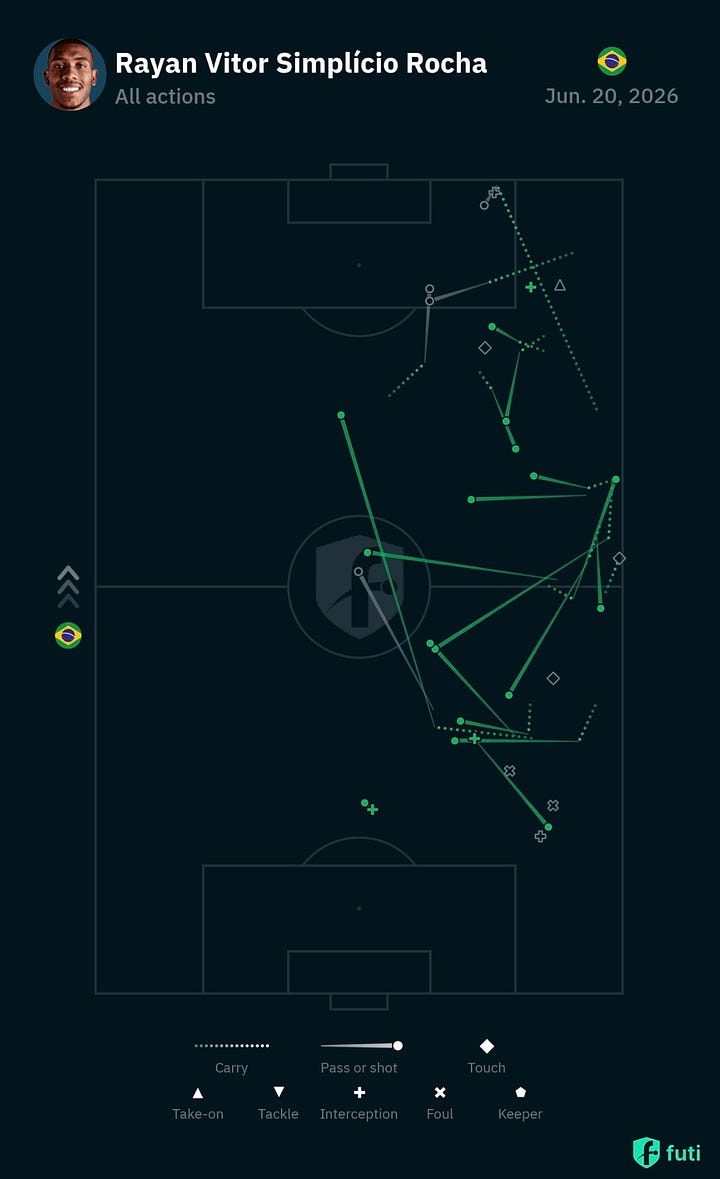
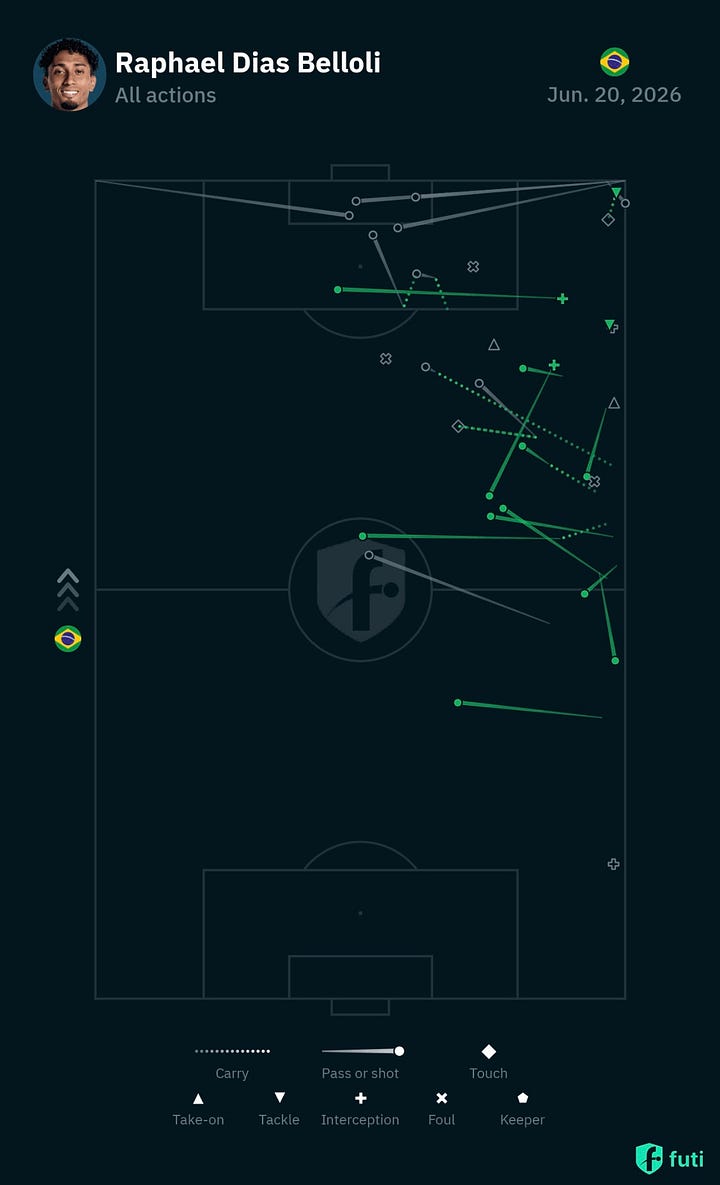
To his credit, Raphinha often worried Haiti’s backline, but he couldn’t time his run and finish a play in the same sequence. Then he picked up a non-contact injury, Rayan subbed in, and there was less hope for the right than in the fall of Berlin.
Early reports say Raphinha’s injury isn’t going to end his tournament, which is welcome news to anyone that watched Rayan struggle to inflict any sort of damage on the Haitian defense. Even if Raphinha comes back at or close to full-strength, though, Brazil is going to have a problem the moment they run into teams that are defensively organized and talented enough to deal with Vini in the left halfspace without trying to overload defenders on that side of the field. Whoever winds up as Carlo Ancelotti’s solution on the right has to prove they’re a tangible threat to score, or at least put a shot on goal while staying onside.
Otherwise, this team is essentially just Vini Jr. walking a tightrope, leaning perilously to the left the whole time.
No posts
Comments
Nothing yet. Say the first thing.
Sign in to join the conversation.