
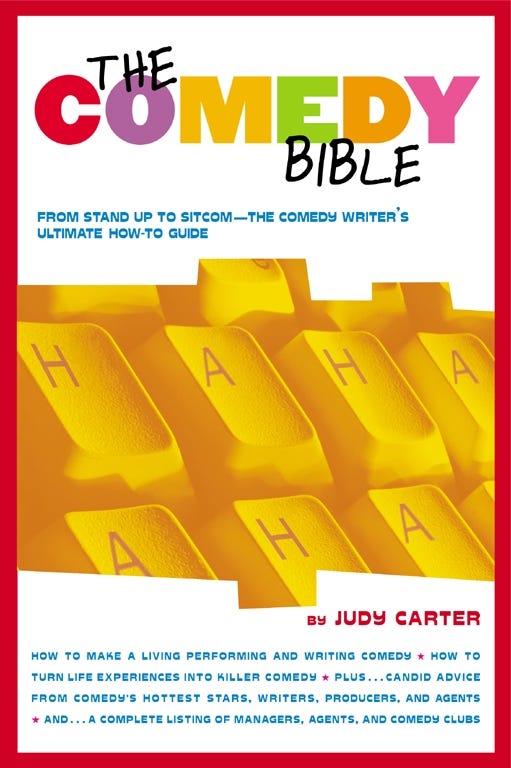
Comedian Ben Rosenfeld typed up a bunch of quotes he underlined from The Comedy Bible by Judy Carter.
A lot of Judy’s tips are basic and formulaic, and this is just a starting point. But you have to know and understand the rules before you break them.
Some highlights:
“Comedy performers and writers can no longer afford the fantasy of waiting to be discovered. Instead they need to discover themselves and become masters of their craft, so that when opportunity knocks they are ready and able to deliver the goods.” (22)
“The more pages you have, the more likely you are to hit on some truly inventive stuff… it’s a numbers game. The more darts you throw, the more likely you are to hit on something.” (38)
“After ten years of teaching, I’ve learned that it’s not always the person with the most talent who succeeds – it’s the one with the most endurance.” (51)
“No one is a natural – you have to work at being a natural.” -Greg Proops (71)
“Thinking in terms of what is weird, stupid, scary, or hard, rather than thinking about what is funny, will free your creative process.” (78)
“A premise is not a description of what happened. It’s a cut-to-the-chase, get-to-the-point, original observation.” (79)
“Comedy isn’t meant to be read. It’s meant to be performed. The laughs are in the execution of the act-outs.” (99)
“No matter how relatable your topic is, if it doesn’t resonate with you, it probably won’t resonate with your audience either. Passion about a topic can’t be faked. The audience can sense if your topic is authentic for you or if it isn’t.” (104)
“Do ten or fifteen minutes up front of likeable material and then go to your vile self.” – Greg Proops (140)
“Rehearsal tips:
– Never rehearse your act without emotion
– Always picture what you are talking about. Visualizing who and what you are talking about makes material more dynamic and immediate
– Don’t practice in front of a mirror or video camera. You won’t be looking at yourself when you perform, so don’t do it while you rehearse.” (154)“Mind Mapping topics: Write your topic in the middle of a page and draw a circle around it. Then quickly draw other balloons containing elements of this topic until your entire page is covered with words having to do with your topic. Then focus on each balloon and write offshoots containing the specifics of that topic. Don’t judge, just draw as quickly as you can.” (183)
“Honing Your Act:
1. On each card, circle one topic.
2. Make sure the topic is relatable.
3. Write an attitude word on each card.
4. Is that attitude expressed by any of the following words: stupid, weird, hard, bugs me, scary?
5. Does each topic have a premise that is written out?
6. Does that premise answer the attitude-topic question? (“Do you know what’s weird?)
7. Do most topics lead to an act out?
8. Does the act-out have the same cast of characters as the setup?
9. Does the act-out exaggerate the attitude?
10. After some act-outs, do you have a mix?
11. Do you follow the mix with another act-out?
12. Do you have a lot of hits on most topics (topic run)?
13. If you have a list of three items, is the third one a turn?” (191)“To get the spontaneity back into your material, picture what you are talking about and feel the attitude as if the event just happened and this is the first time you’re mentioning it.” (192)
“There should never be even one moment when you are onstage and attitude-free. It’s the kiss of death because audiences respond to emotions, not words.” (195)
“When a mishap occurs, such as the mike stand breaks, the lights go out, or there is a puff of smoke from the grassy knoll, acknowledge it. When you call the situation, it puts the audience at ease.” (198)
“If it’s a small crowd, less than fifty people, talk to them because they’ll tend to laugh more in their heads than out loud. That’s especially true if they are spread out in a room. Involving the audience in a conversation reminds them that they aren’t watching TV – you can hear them, and it’s appropriate to laugh out loud.” (198)
“I sit down and write crap for forty minutes. Everybody thinks that they have to write funny, every line. All you have to do is pick a subject and write about that and then pick another subject and write about that. I guarantee you that at the end of forty minutes, you will crank out a funny line because it takes forty minutes for your brain to click over from the dealing-with-life side to the creative side. Then go back to what you wrote and fix it. And the more writing sessions you have, the quicker your creativity will click in.” – Chris Titus (204)
“What often keeps a script from becoming great is that the writer is married to things that are just OK. Just as in writing stand-up, you must be willing to dump not only the things that don’t work but also the things that are just adequate. Adequate won’t get you a job. Only brilliance will.” (261?)
“I fell into the trap of equating fame with success. For so many years I felt like a failure. It didn’t matter if I got a standing ovation, had a great writing day, or even pulled in some big bucks doing comedy – I wasn’t a household name. It took me a long time to realize that success is a state of mind. My critical voice that nagged, “But you don’t have a sitcom,” quieted down as I started focusing on small triumphs – like finding a great premise, writing new material, having a great set. Today I enjoy my career. Only about 1 percent of comics are famous, yet there are a lot of us out there making a fine living from the road, corporate gigs, TV appearances, writing for other comics, speaking, and of course, writing books. Enjoy where you are – today.” (276)
“Be willing to throw out material – even if it kills. If you get a chunk that kills and you do it every show, soon you will depend on that piece. You may even become frightened to perform without it. Take a courageous step and toss it out for a few months, to make room for another piece to add to your stockpile of killer material.” (283)

No posts
Comments
Nothing yet. Say the first thing.
Sign in to join the conversation.