
Disclaimer: Content for entertainment purposes only. Not medical or health advice.
According to the UK Mental Health Foundation, “Anxiety is a natural human response to stress or perceived danger.”1
The definition of anxiety provided by Harvard Health is similar, stating that “anxiety is a normal reaction to stressful situations.”2
Yet, many people feel overwhelmed by the often too familiar feelings of tightness in the chest, heart racing, butterflies in the stomach, sweaty palms, and the brain being flooded by an avalanche of worries in situations that don’t put them in danger in any tangible way.
For some, daily demands, like having to commute to work, answer an email, or complete chores, are enough to trigger this nervous cascade. For others, even ordinarily relaxing activities, like sitting in the comfort of their own home, reading a book, or spending time with loved ones, leave them feeling shaky and on edge.
Of course, past or current adverse experiences—such as growing up in a chaotic home, social alienation or taunting, receiving frequent criticism, or experiencing financial instability—prime the body to experience anxiety, even in ordinary situations, but especially in stressful ones or those that trigger memories of the past. Humans are insanely complex beings, so it would be foolish to claim that the cause of anxiety is entirely physiological.
Yet, anxiety is not just a pathological thought pattern. It is, fundamentally, a biochemical, full-body response, which involves the cardiovascular system, the digestive system, the immune system, the central nervous system and the endocrine system. It’s not all in your mind.
The “chemical soup” that we experience as anxiety generally consists of high adrenaline and noradrenaline levels, high cortisol levels, high lactate levels, high histamine levels, high inflammatory cytokine levels, low GABA levels, and high glutamate levels.
The racing heart, the drop in your stomach, the shakiness, the dry mouth, the cold hands and feet, and the hypervigilance that causes any small movement in your peripheral vision to nearly make your heart jump out of your chest? That’s adrenaline and noradrenaline.3
The restlessness, the endless mental chatter, and the onslaught of intrusive, looping thoughts that arrive faster than you can process them? That’s histamine and glutamate overload, paired with a deficiency of GABA.
The physical exhaustion paired with an inability to relax, the hot sweats, the irritability, the waking in the middle of the night feeling unbearably hot, and the inability to fall and stay asleep? That’s cortisol.
Anxiety is a dysregulation of physiology, and not just unhelpful thought patterns. This is why it can be managed with drugs that alter the physiology, like the benzodiazepines (e.g., Alprazolam/Xanax), beta-blockers (e.g., Propranolol), or even antihistamines (e.g., Hydroxyzine).
These drugs don’t deploy a little mindfulness wizard into your brain who sits there and tells you not to worry. They alter your biochemistry.
Benzodiazepines enhance GABA signalling. Beta-blockers block the action of adrenaline and noradrenaline. Antihistamines block histamine signalling in the brain.
Yet, these drugs (especially the benzodiazepines) are powerful, often leading to crippling withdrawals and numerous side effects.
If, however, anxiety can be prevented by targeting the physiology with drugs, it can also be prevented by holistically restoring constitutional homeostasis.
The goal of holistic treatment in this case is not about embracing the naturalistic fallacy and foregoing pharmaceuticals simply because they’re synthetic. It’s about healing a broken system instead of brute-forcing an outcome. The holistic approach is analogous to helping you run again by treating your sprained ankle as opposed to just giving you anesthetics so that you don’t feel the pain. Most importantly, by restoring physiological homeostasis, you forego the side effects and minimize or omit the lifelong dependence on mood-altering drugs (pharmaceutical or otherwise).
If your baseline adrenaline and cortisol levels are low, your GABA and dopamine signalling is optimal, and fuel is supplied and burned at a steady rate, then you probably can’t even begin to understand why someone would feel nervous jumping off a cliff or talking to someone they find attractive.
Your physiology serves as the lens through which you perceive the world.
Strengthening the physiology can increase our capacity to face and reframe our present and our past, to transform intrusive thoughts into quiet echoes, and to slowly build the ability to face anxiety-triggering situations with a full-body knowing that we can eventually work through them.
This article is very long. I recommend reading it like a book, instead of trying to read the whole thing in one go. The hyperlinks below let you jump straight to specific chapters. Every chapter contains multiple sections with actionable recommendations.
Anxiety Is a Response to Stress…But What Is Stress?
Topics covered include: a general introduction to the relationship between bioenergetics and anxiety
Topics covered include: caloric restriction, ketogenic diets, meal consistency, carbohydrate requirements, overcoming morning food aversion, supportive foods, the role of the HPA axis in anxiety
Anxiety & Mitochondrial Bioenergetics
Topics covered include: micronutrients, light exposure, carbon dioxide, brain metabolism, GABA, glutamate, and the balance between excitation and inhibition, oxidative stress, physical exercise, omega-3s, herbal nootropics
Topics covered include: tools for assessing thyroid function, effects of sex hormones on mood, neurosteroids, effects of food compounds on hormonal balance
Anxiety, Inflammation & The Microbiome
Topics covered include: probiotic supplementation, the connection between immune activation and mood disorders, gingivitis, polyphenols, gut health, the relevance of dietary glutamate
Topics covered include: endocrine-disrupting chemicals, mould remediation, toxic metals, air quality, detox & drainage
Anxiety & Neurotransmitter Balance
Topics covered include: brain chemistry and mood, mood-altering medications, peptides, tips for spotting and avoiding risky interventions
Tying it All Together: The Anti-Anxiety Protocol
Topics covered include: all the contents discussed distilled into a step-by-step guide
A Robust Vessel Supports a Fuller Life
Topics covered include: concluding remarks and my final thoughts about the intersection of physical and mental health
Let’s define the meaning of “stress” to understand why an event or a particular state may register as stressful in the body of one person and not in that of another.
“Everybody knows what stress is and nobody knows what it is”
- Dr. Hans Selye (Founder of the “stress theory” who first incorporated the term into the context of medicine.)
The term “stress” first emerged from the field of engineering to refer to the interaction between a force and the resistance of the material to which this force is being applied to counter or withstand it.
This same definition still applies to living beings, but many are confused about what withstanding or countering stress means in the living state. Most publications moralize stress resilience and equate the ability to withstand stress with mental fortitude. Yet, in reality, the ability of living beings to withstand stress has little to do with mental fortitude and nearly everything to do with energetic resources.
“Effortless” mental fortitude is, if anything, a reflection of a body replete in cellular energy. I’d argue that it’s impossible to create a moral, all-encompassing and absolute scale to classify an event or a situation as objectively “stressful” or “not stressful,” as that perception hinges almost entirely on the biochemistry of a certain individual.
“Stress is an energy problem” - Dr. Raymond Peat
Energy is often equated with fuel (calories). Eating enough calories is indeed at the core of making it possible to generate the cellular energy—in the form of ATP—required to operate, maintain, and repair the physical tissues that we are all made up of.
Yet, it takes far more than just enough calories alone to generate ATP.
Vitamin and mineral intake, oxygen availability, hormonal and immune factors, the presence or absence of mitochondrial toxins, and macronutrient balance and composition are just a few of the pillars upon which the body’s ability to generate ATP hinges.
As one example, the enzyme pyruvate dehydrogenase, which makes it possible for fuel to enter the mitochondria (where the bulk of ATP is produced), requires vitamin B1 and magnesium to function. If these micronutrients are deficient, ATP generation will be thwarted even if adequate calories are consumed.
Cellular energy is the “currency” that pays for every function that the body carries out. It is used to keep the heart beating and the gut digesting. It keeps your hair growing and your skin healing. It’s used to control the sleep cycle, making it easy to fall asleep in the evening and sleep soundly through the night. It is also used to power your brain and to produce, destroy, and balance neurotransmitters, enabling you to form thoughts, to learn new things, to talk to your friends, or to remember where you’re going when you’re walking down the street. All of these functions, both those in the foreground and in the background of your physiology, can be thought of as energy demands.
Demands become stressors when the body lacks the energetic capacity to meet them.
To conceptualize this, think about getting hit with a random bill when there’s plenty of savings in your bank account vs. when there’s not.
The fatter your wallet and the deeper your pockets, the bigger the bill that you can foot without it leaving you in financial ruin.
If you’re rich and your bank account has six figures in it, a random $1,000 bill is peanuts. In that same vein, if you’re well-fueled and your energy generation capacity is robust, then you’ll likely find it easy to keep your cool and stay relaxed even in typically anxiety-inducing situations, like doing a presentation in front of a large audience, meeting a work deadline, or travelling overseas.
Yet, if you’re in poverty, even an unexpected bill for $50 can be Earth-shattering. This is analogous to an individual who is either massively under-fueled or whose energy-generating ability is incapacitated in such a serious way that even lying in bed or watching TV leaves them with inner turmoil that feels like being chased by a tiger.
Your capacity to meet the demands of life hinges on the robustness of cellular energy generation. Impaired cellular energy generation is both the major contributor to, and the consequence of, the physiological imbalances characterizing anxiety.
It’s important to understand that the “stress response” doesn’t kick in exclusively when you psychologically or “logically” perceive something as stressful. Evolutionarily, the purpose of the “stress system” is to keep you alive when resources are scarce, not to emotionally agitate you.
A lack of fuel (not eating, or not eating enough), low blood sugar levels (or blood sugar dysregulation in general), chronic infections, mineral imbalances, hypothyroidism, or harmful bacterial toxins or byproducts of incomplete cellular metabolism can all turn on the stress response, even if you’re just sitting with your feet up in front of the TV.
Your body responds the same to your blood sugar or your blood sodium dropping as it would if a large animal was trying to attack you. The stress system is meant to help you survive when your body senses that your environment is hostile and resources are scarce.
For example, when your blood sugar runs low, the “stress system” (consisting of adrenaline, noradrenaline, and cortisol) fires off to increase fuel availability in the blood and brute-force extra energy generation. These hormones flood your blood with fat from adipose tissue and make the liver dump glucose into the blood to give your body the raw materials needed to make more ATP.
Yet, when these stress hormones are released, they affect a whole host of physiological processes, doing more than just raising blood sugar levels. They also affect your nervous system and perception.
When the stress system kicks in, adrenaline and noradrenaline spike first. Your pupils dilate, your hands and feet get clammy and cold, you get hypervigilant to movement and sounds, and your muscles tense up.
If this spike were to happen in response to an oncoming attacker, it would help you see better in the dark, prioritize blood flow to internal organs and limit the likelihood of bleeding out if your limbs get injured, and get your muscles ready in case you need to escape. Instead, when this spike occurs in response to, for example, not eating enough, you get paranoid about that shadow that you just noticed from the corner of your eye or that weird sound coming from the kitchen, while feeling tense, cold, clammy, and wired.
The body must be well-resourced to keep the stress system quiet, to balance neurotransmitters, to overcome infections, and to increase the threshold at which immune cells fire off. Energy-deprived cells are more likely to “fire off” inappropriately.
Energy-starved neurons have a lower threshold at which they “switch on.” Too many neurons firing all at once is what makes your brain feel like an internet browser with 20 different YouTube tabs playing all at once. Energy-starved immune cells are prone to releasing histamine or inflammatory cytokines in response to minor irritants. Impaired energy generation also lowers the amount of oxygen reaching the brain, and it leaves more glutamate behind, as glutamate would normally be consumed by mitochondria or turned into GABA.
Any factors that raise inflammation, be it gut dysbiosis, environmental toxins, or chronic infections, drain the body of resources or partition resources away from other vital functions (e.g., maintaining the nervous system) towards the immune response. All factors that raise oxidative stress are, similarly, a massive resource sink. Impaired energy production is the consequence.
To fix a broken system, we need to peel back all the layers of this onion and address them one by one.
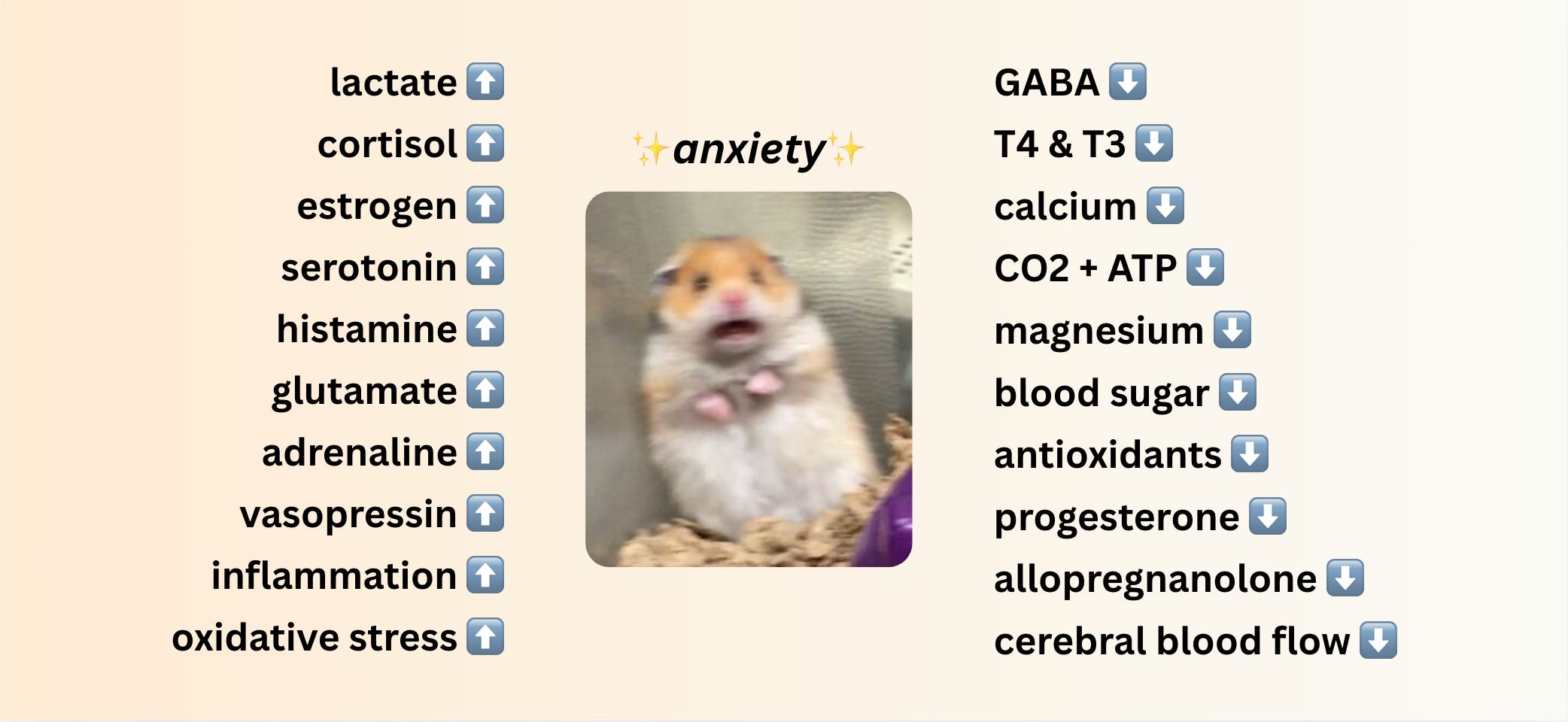
So, how does one go about fixing a broken system?
While, at the core, all the dysfunctional pieces that, physiologically, present as anxiety fundamentally originate from impaired energy production, many people (especially the biohackers) tend to skip over the foundational layers and immediately jump to using compounds that directly alter neurochemistry. If your anxiety is, at least in part, driven by simply not eating enough, that should be addressed before you start thinking about hormones, peptides, nootropics, or GABA-mimicking herbs.
The upcoming sections of this article will go through these layers one by one. Starting with the “basics,” I first cover health foundations and general habits to help alleviate anxiety. As the article goes on, I dive deeper with each section, getting more technical and zooming in closer on neurochemistry and cellular bioenergetics.
Every section comes with related, actionable recommendations.
At the very end of this article, you’ll find an overview of all the actionable information, summarized into a protocol.
Comments
Nothing yet. Say the first thing.
Sign in to join the conversation.