
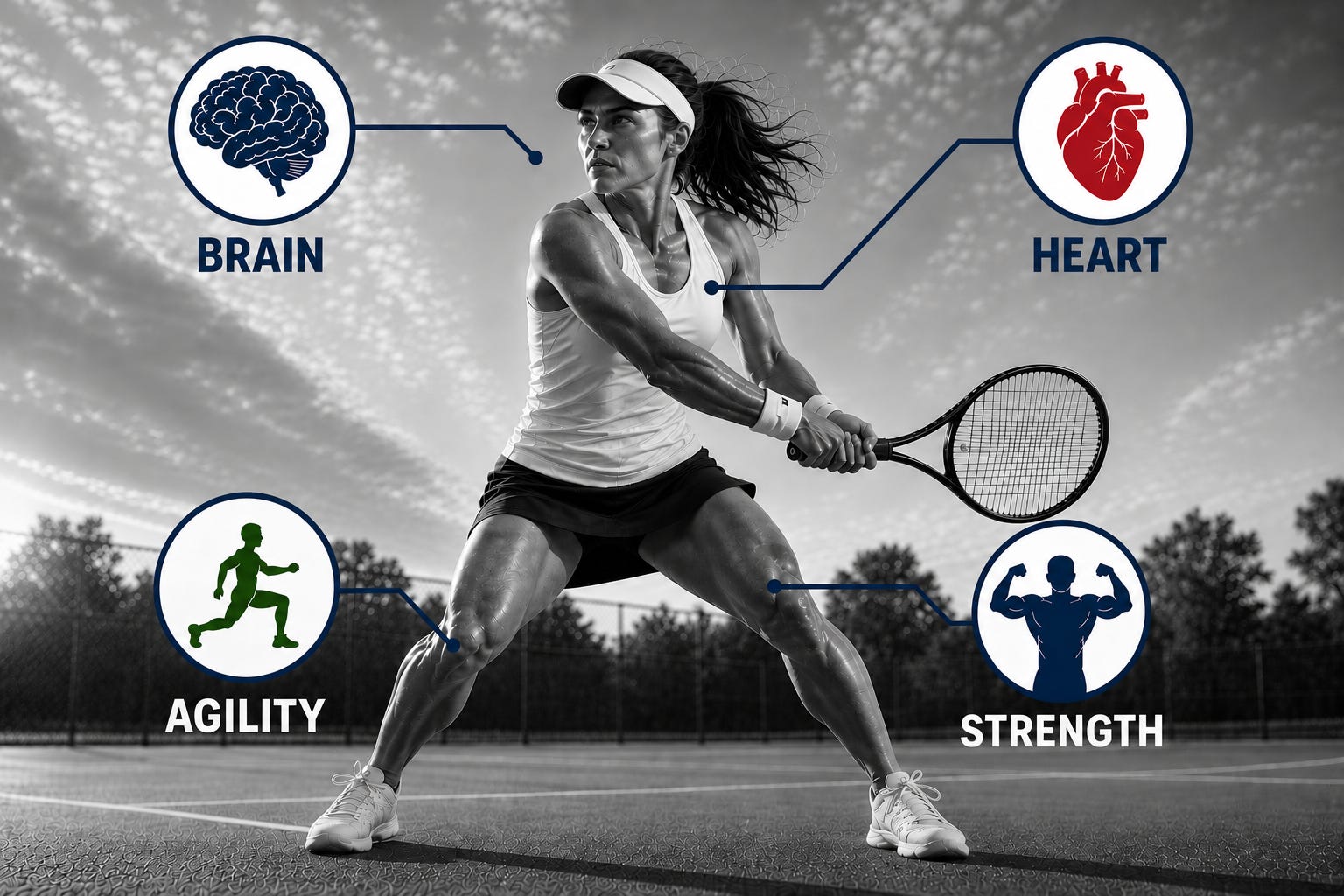
Long-term health is linked to how well people perform on functional tests such as aerobic fitness, grip strength and balance. Any form and amount of exercise, including cardio on a gym machine, is helpful to slow declining scores on these tests as people age. But certain sports, for those who can play them, often work the best.
Sports are such powerful levers for health because they train multiple capacities at once, combining them into one tidy workout. They are the great multitaskers of performance and longevity.
They’re also better motivators for many of us than the prospect of hopping on a machine. Yet, even among people who exercise, the vast majority don’t play a sport. That may not be ideal especially if reliance on a non-sport option makes exercise feel like a chore, since seeing it that way increases the odds of skipping it.
We decided to write this post together because we’re both big believers in sports for fun, physical and cognitive training, and longevity. Here, we look at the functional tests linked to healthy aging, and some of the sports, including our favorite one, that can help move the dial on these tests.
Functional tests predict healthy aging
Research has connected people’s abilities on several functional tests to their odds of staying healthy and living longer. The tests are predictive of healthy aging because they’re particularly good at capturing how well the body’s major systems are working together. Lower performance can signal increased risk of disability or chronic disease many years before these issues develop, when there’s still time to prevent them.
Tests of cognitive processing speed. Research shows that faster processing speed may be an important marker of healthy brain aging. For example, in one study of more than 4,000 people, researchers at Japan’s National Center for Geriatrics and Gerontology found that better performance on tests of processing speed helped predict lower dementia rates several years later.
Running and walking tests. Cardiorespiratory fitness shows how efficiently the heart, lungs and muscles work together during physical activity. Across age groups, better performance on running, walking and cycling tests is consistently linked to more positive health outcomes and lower mortality risk.
Among 122,007 adults referred for treadmill testing and followed for a median of 8.4 years, the least fit quarter had roughly five times the all-cause mortality of the fittest group. Moving from below-average to above-average fitness for your age and sex was associated with 41% lower mortality, which was comparable to the difference between smokers and nonsmokers, and larger than the gap associated with diabetes at 40% and with coronary artery disease at 29%.
Strength tests. Muscle strength doesn’t just mean you can lift heavy objects. It also reflects your level of physical resilience, which is key to longevity. Several studies, including research published in Lancet that covered 140,000 participants in 17 countries, linked high scores on grip strength to better chances of survival over the study period. Other research from a team led by physician and epidemiologist Anne B. Newman at the University of Pittsburgh found both grip strength and quad strength were associated with how long people lived.
Mobility and balance tests. Moving efficiently with stability can reveal how well people are aging; lower performance may point to subtle declines before we’d otherwise notice them. In large studies, performance on such tests—like balancing on one leg as long as you can—have been shown to predict health outcomes.
Doctors use a tool called the Short Physical Performance Battery, or SPPB, which involves balance, walking speed and chair stands, to assess function in seniors. Research has established benchmarks to help “grade” performance on the SPPB, meaning we know which levels track to healthy aging in this population.
Middle-age is another story: there’s no accepted equivalent of the SPPB for people in their 40s and 50s. For now, middle-aged people and their physicians just have to select the most informative tests and use them thoughtfully to figure out how they’re doing. This is one of the gaps that motivated Christin to launch Younger, a 6-month contest that tracks improvements in healthy aging. The contest, which officially starts on September 1, will test middle-aged people (and others) on functional aging metrics, such as grip strength and the sit-to-stand test.
How sports help
To improve at these tests, you have a few options for physical activity. Each approach is better than being sedentary. But if you can find sports you enjoy that are fast-changing and unpredictable, requiring constant adaptation to external conditions, those are the ones that will help the most.
Maybe it seems more intuitive to simply focus on practicing the test itself. To improve grip strength, you could just buy a grip strengthener, for example. This strategy will improve scores but only through practice and familiarity. Recall the tests are linked to longevity because they reflect broader abilities and connections among these abilities. Grip strength is important not because there’s anything particularly meaningful about having beefy hands; rather, it’s a good representation of your overall strength—unless your strength training has only involved the grip strengthener. It’s better to improve grip strength through pull-ups, dead hangs and farmer carries, which train the hands along with the rest of the body, though these moves require heavy equipment and might feel monotonous.
Now consider your go-to cardio machine at the gym. It can provide a great workout, and people should keep doing what works best for them and sustains their interest. But cardio machines have their limits when it comes to improving functional abilities linked to longevity.
Consider the elliptical. It will enhance heart health, making it a great component of your overall training. But if the elliptical is all you do, you’re missing out on other dimensions of fitness. The machine’s guided, supported motion places little demand on balance, coordination and multidirectional movement. It won’t contribute much to lower-body strength or weight-bearing capacity, either.
Which brings us to our third option: sports. Several sports can simultaneously support and develop cognition, reaction time, endurance, strength across the body, balance and coordination—the measures shown consistently to predict healthy aging.
Two cohorts have compared sports against other forms of exercise for mortality. The Copenhagen City Heart Study followed 8,577 healthy adults for up to 25 years, recording 4,448 all-cause mortality events and estimating how much life expectancy each activity was associated with compared with a sedentary reference group. People who played sports lived longer than people who simply exercised.
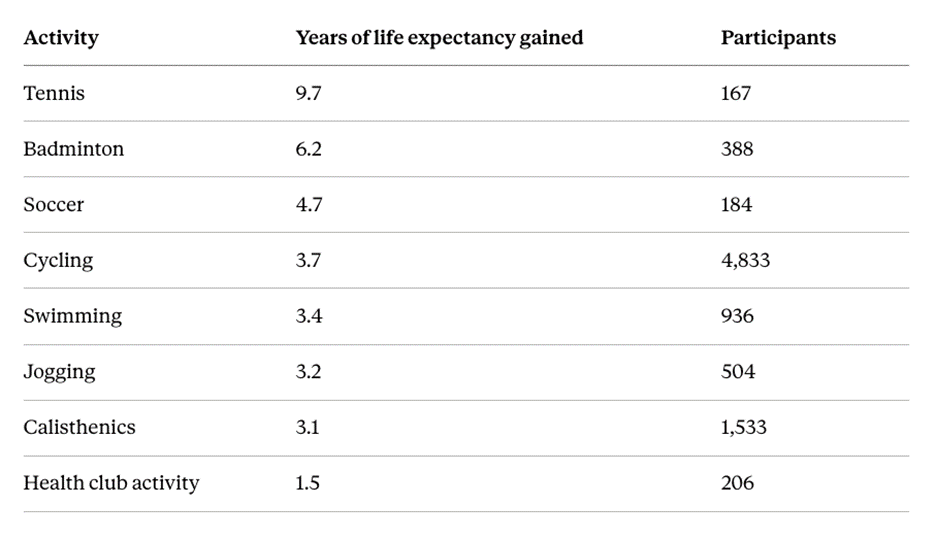
The models adjusted for weekly volume of all leisure-time physical activity along with smoking, education, income, alcohol and diabetes. The health club participants, who used treadmills, stationary bikes and weights, logged the most total weekly activity of any group at just under 10 hours and still had less of a mortality benefit than those playing sports. Restricting the analysis to participants with a university degree still showed tennis had the lowest mortality, which at least partially addresses the concern that the sports rankings are confounded by social class.
A second study, published by British researchers in 2016, corroborated the findings. Both of these studies are observational and not randomized control trials, which means that there may be residual confounding factors that have not been taken into account.
Even with those limitations, the findings point to an important question: How do sports manage to deliver these benefits? Many of them require constant adaptation to changing external conditions. They’re what researchers call open-skill exercise. The ball, disc or puck comes at you from just about every angle, forcing split-second adjustments, all while keeping an eye on the other people you’re competing with. Meanwhile, cardio machines and some other sports (looking at you, golf) provide closed-skill exercise: they occur in stable, predictable environments. Again, they can be beneficial, but because they don’t involve much perceptual uncertainty or quick decision-making, they don’t train as many physical systems.
Open-skill sports are unique for building agility and resilience throughout the body, including the brain. When it comes to performance and longevity, an open-skill sport is like a chef using one cutting board to make five dishes. It’s the Swiss Army knife of human biology.
Although physical activity guidelines from influential bodies like the World Health Organization list sports in their examples of activities, they don’t specifically recommend sports. This absence most-likely reflects the desire to be inclusive, since many people can’t play sports due to disability or low fitness.
For those who can play, though, research shows sports provide important structure that leads to gains on the functional tests. Our favorite example, based on both research and our own experiences, is tennis. Christin played D-1 varsity, and Matt, after competing admirably as the third seed on his middle-school team, has become an advanced player in middle-age. Research shows tennis is effective at improving performance on the above tests, which probably helps explain why it’s the sport linked to the biggest margin of life expectancy, 9.7 years longer than sedentary people, in the Copenhagen cohort study.
Yet, tennis doesn’t stand alone; some other sports work to train multiple systems as well. In 2026, researchers at Sheffield Hallam University in South Yorkshire published a review analyzing 16 sports interventions. They found the sports improved sit-to-stand, walking speed and timed-up-and-go performance, compared with control groups lacking structured training.
Sports may also be easier to sustain because the workout is embedded in an interactive game, boosting motivation, participation and sense of community. Game design elements result in increased physical activity, according to research led by Mitesh Patel of the University of Pennsylvania’s Perelman School of Medicine. (Studies here and here also show that gamified competitions held at gyms drive higher gym attendance.)
Some of us love the familiarity of a cardio machine and have no trouble using it several times per week. But data suggest many other people get bored and opt out. When exercising at gyms without gamification, members’ annual attrition rate is about 30%.
Here is more evidence for sports, including tennis, that can help boost motivation, physical function and long-term health.
Tennis
Tennis appears to have the largest mortality benefit of any sport in observational studies. This may be because it has multiple health benefits at once. Tennis improves aerobic capacity, grip strength, and reaction time, which are all independent predictors of lifespan and healthspan. A study of adults between 62 and 75 compared 20 people who had played tennis at least twice a week for a decade against 23 people who had walked, swum or run at least twice a week, plus a group doing no structured exercise. The tennis players had faster reaction times than the closed-skill exercisers. Tennis also is played outside, reaping the benefits of sun exposure for brain health and circadian rhythm entrainment, and it usually involves social time when played with friends. Social connection is important for mortality and for brain health. Lastly, tennis is arguably a form of cognitive training, as the strategy for winning each match is a puzzle to solve.
It is lucky for Christin that she grew up playing tennis given her increased Alzheimer’s genetic risk and family history as tennis is linked to better brain health in a few studies. Fifteen sports science students aged 18 to 22 completed four weeks of accuracy-focused tennis practice, half an hour once a week, roughly 500 hits per session. They improved on a test of cognitive control and on a spatial visualization test. A 12-month study of 32 children aged 6 to 11 assigned them either to keep playing once a week or to increase to four times a week. The high-frequency group improved more on working memory.

Matt’s grandmother died from complications of dementia. He doesn’t know if he inherited any risk, but based on the family history, he views tennis as a piece of his long-term brain-health strategy.

Although there is no randomized control trial showing Alzheimer’s prevention in people assigned to tennis playing, it’s a good bet the result of such a trial being positive given the relationship of all of the components that tennis trains to dementia risk abrogation.
Racquet sports
In addition to tennis, other racquet sports similarly train hand-eye coordination, reaction time and strategic decision-making. The smaller playing areas of racquet sports like ping-pong and pickleball, for instance, demand less cardio and lateral movement, but they can still build important capacities linked to longevity.
The British cohort study noted above points to the unique benefits of racquet sports. The researchers followed 80,306 adults for about nine years and found racquet sports associated with 47% lower all-cause mortality and 56% lower cardiovascular mortality, while finding no significant association for soccer or running.
Researchers in Austria published a large review in 2026 suggesting gains in health from ping-pong. In various ages and settings, ping-pong was associated with physical fitness, balance, agility and cognitive benefits like better visual-perception skills and executive function.
The evidence for pickleball is newer and less extensive than the table-tennis literature. But some studies point to comparable benefits. For example, a 2026 study comparing 14 older pickleball players with 14 nonplayers found better balance and leg strength among players, while no significant differences were reported in aerobic fitness, grip strength or cognition.
Soccer
Although the British cohort study found soccer wasn’t linked to significantly lower mortality, other research suggests soccer can help people mindful of healthy aging with improving their functional performance. In 2022, researchers in the UK and Finland ran a soccer intervention in 13 men aged 62 to 78 who already had a physically active lifestyle. At the end of the 12 weeks, their functional movement improved significantly, as they showed better performance at the 30-second chair stand, 8-foot timed up and go, and 6-minute walk test. A control group keeping their typical exercise habits, without any soccer, saw none of these benefits.
Another 12-week intervention, this one by researchers in Germany and Denmark, studied soccer in people over 60. Looking at balance before and after the intervention, they found the soccer players improved, whereas balance stayed the same in a control group. The soccer group also increased in measures of mental well-being.
Strength may be another payoff reaped from soccer. In a randomized trial from 2023, people ages 55 to 70, played soccer with fewer players on a smaller field, twice weekly for 10 weeks. The players improved their explosiveness—how quickly they could extend the lower leg forward from the knee. Following the 10 weeks, the players also substantially increased how long they could sustain fast walking.
Soccer’s benefits may extend to populations with illnesses. In a trial of men averaging about 67-years-old with prostate cancer who were receiving androgen-deprivation therapy, 12 weeks of recreational soccer, two to three times weekly, added about 20 pounds to the pushing power of their inner thighs. In another group receiving usual care for prostate cancer, without soccer, there was less improvement, about 15 pounds. The soccer players also gained lean muscle mass.
Basketball
Compared with soccer, basketball adds more frequent jumping, upper-body coordination and rapid start-stop movements, while soccer emphasizes sustained running and foot-based control. Both sports build cardio fitness, speed, balance and explosiveness. Both are great multi-dimensional trainers for people of all ages.
In 2024, researchers in Greece published research into basketball as a health-enhancing activity for people who were previously inactive. Forty men and women, ages 40 to 55, practiced basketball drills twice per week, with and without the ball, for three months. The drills included dribbling, passing, stopping and pivoting. A range of measures improved significantly such as flexibility, balance, strength, timed up and go, and resting heart rate. (Other metrics such as hand grip strength didn’t change.)
Overall, this research shows older age and even illness don’t preclude the effects of sports on several key attributes of physical performance.
As much as we love the multi-dimensionality of sports, it’s important to recognize they don’t cover everything. Racquet sports, soccer and basketball provide excellent training for cardio, balance, agility and cognition, but additional strength training as people age will help to preserve muscle and bone health.
The best activity remains the one that you can keep up. Adherence accounts for more of the difference between exercise programs than the design of the programs does. That said, sports add dimensions that simple exercise alone does not have. They train several capacities at once, and they do it socially and with gamification. Of all the sports, tennis is linked to the greatest mortality benefit and in small studies, may even improve cognition.
No posts
Comments
Nothing yet. Say the first thing.
Sign in to join the conversation.