

George Washington’s life reveals something history classes often miss: it tells us about attitudes toward aging in the 18th century, and how some people, including Washington himself, were challenging them even back then.
Most Americans are familiar with Washington’s heroism in commanding the Continental Army to victory in the Revolutionary War. Many have also learned about Washington’s initial reluctance to accept the presidency, as he wanted to stay retired at Mount Vernon. His age and declining health, he told people, made him unfit for the role.
This past week, watching a Netflix docuseries called the American Experiment with a history fanatic named Miles (my 11-year-old son), the narrator revealed something that hadn’t dawned on me: when Washington was telling people to leave him and his crumbling, ancient carcass alone at Mount Vernon, he was 56-years-old.
Dude was middle-aged!
Even in the 18th century, 56 wasn’t actually that old for a prosperous guy like Washington who’d survived the era’s biggest hurdle, infant mortality. Even so, 56 was commonly regarded as old,1 and Washington referred to it as an “advanced age.”
Well…doesn’t that sound familiar. Strikingly modern, in fact. Many people in their 50s still behave—and are treated—like their most consequential years are best viewed in the rearview mirror.
Of course, staying healthy in one’s late 50s was more challenging in Washington’s day than our own. Disease was widespread, with medicine offering little protection. Presidential job duties entailed physically punishing travel. And if you saw the recent movie Young Washington, you know how much Washington had already gone through: battered by war, the stress of bullets punching holes in the brim of his tricorn hat (according to the movie’s account, at any rate), smallpox at age 19, repeated malarial fevers and dysentery. Oh, and chronic infections robbing him of most of his teeth. Although I’d say Washington erred in describing his age as “advanced,” his biological age may very well have been.
However, we all know what happened next. Washington didn’t wither away at Mount Vernon or accept the presidency merely to limp around pathetically taking three-hour naps through cabinet meetings and using his veto power exclusively to keep Alexander Hamilton off his lawn.
Much the opposite, he led the nascent country with vigor. He embraced the daunting task of building a brand-new executive branch. He faced down public pressure to keep America out of France’s war on Britain. He toured the states to strengthen national unity, even riding out at age 62 to oversee troops during the Whiskey Rebellion.
Looking at what Washington accomplished, he was a midlife superager and then some. Even before becoming a highly-engaged president at 57, much of what we remember Washington for happened in midlife. He won at Yorktown at 49 and presided over the Constitutional Convention at 55.
And it wasn’t just his abundant energy that dispelled his own and others’ beliefs about inevitable decline in middle-age. Washington also gained the emotional maturity and cognitive insight to begin recognizing the tragic flaw that would forever mar his legacy and American history.
We all know what this was: Washington was a slaveowner. In midlife, though, he started wrestling with slavery’s moral contradictions.
Young Washington depicts him as hell-bent on joining the upper echelons of Virginian society—the very planter class that embraced slavery without reservation. No surviving records from Washington’s 20s and 30s suggest he had any qualms about the institution. In fact, he expanded his number of slaves to over 100 during these years.
Only when Washington entered his early 40s, during the Revolutionary War, did he begin to express concern over the contradiction between fighting for liberty and slavery. By the mid-1780s, he privately told colleagues like Robert Morris his desire to see slavery abolished.
This doesn’t absolve Washington. His participation as a lifelong slaveowner was an atrocity. His moral change was profoundly incomplete.
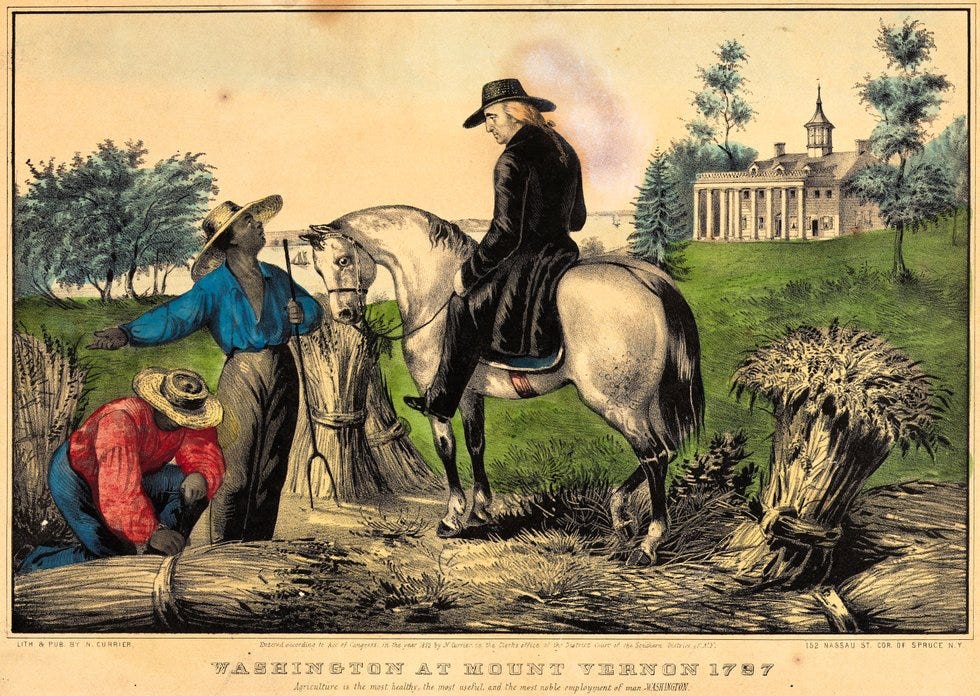
However, his internal conflict first sprouted in midlife, and research has since shown how this life phase corresponds with autonomy from society’s prevailing values. Shamefully, Washington continued to support slavery as president—signing the Fugitive Slave Act, among other pro-slavery moves. His own personal independence and growth did have one practical consequence, albeit too little, too late: in his will, he provided for the emancipation of his 123 slaves after his wife’s death.
Another example of middle-aged insight: While young Washington held that leaders could govern without ideological divisions, his idealism later yielded to hard-won acceptance that factions were inherent to a free society. His balanced views were influential in helping to manage the dangers of extreme partisanship.
By the end of Washington’s presidency, he was 65 with a milelong list of health problems like rheumatism, painful hippopotamus dentures, failing vision and hearing, and a bout of pneumonia in 1790. So…not quite the smooth sailing envisioned by modern longevity bros.
As his physical health unraveled, though, Washington’s last months as president provide one more example of increased self-awareness at the tail-end of midlife: he accepted his biological limits and had the maturity to willingly walk away from a third term, setting another important precedent for the nation’s future.
Young Washington is a coming-of-age tale with entertaining battle scenes. It gives a window into a part of his life few people knew about. But a different movie could show how Washington wasn’t just a courageous soldier and effective leader. Far from a static, flawless marble monument, he was a deeply conflicted man who evolved after young adulthood, as he came to reflect on who he was, his biggest mistakes and his potential. He’d never heard of growth mindset or positive aging beliefs, but his life speaks to both paradigms. Young Washington was okay as flicks go, but I’d rather see Middle-Aged Washington.
Brit Horace Walpole complained young people viewed him and Gothic castle as the same age. He was 58.
No posts
Comments
Nothing yet. Say the first thing.
Sign in to join the conversation.