
Football’s boring. The same teams always win:
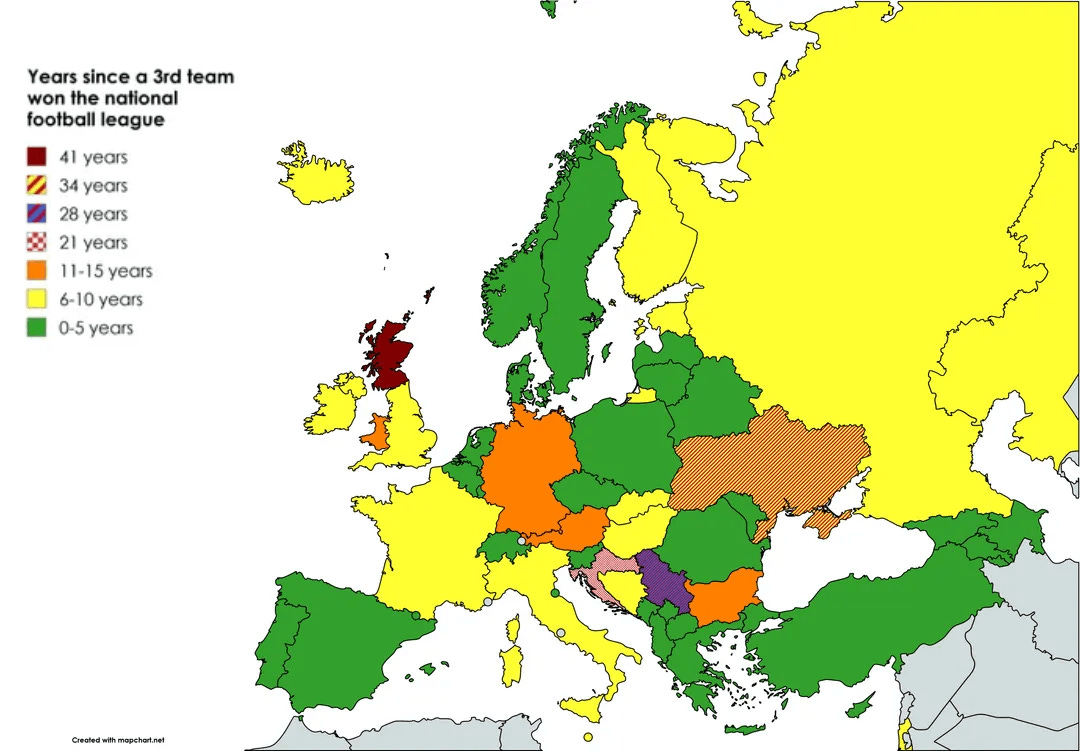
(Credit: xikia on Reddit; 2025/26 season winners not shown)
Concentration of winners is a widely understood problem. The reward for being good at football is money, so success at the club level becomes entrenched. Teams finishing at the top of the pile can run bigger squads and poach the best talent. Money flows passively up the triangle year after year, which is bad for the majority, most of whose games will matter only to their own fans. And while regime change is possible, it’s usually only brought about by an infusion of external investment or by catastrophic mismanagement.
Stock market concentration causes nearly as many arguments as football. Corporate success breeds success as money flows passively up the triangle, goes one popular theory. The highest-valued companies entrench their lead by poaching the best talent and taking advantage of a lower cost of capital. Regime change is possible, but it’s usually only brought about by an infusion of external investment or by catastrophic mismanagement.
All except one of these points have been done to death. The less considered aspect is what market concentration means for the majority of stocks. One thing it means is that performance matters only to their own fans, writes UBS analyst Sean Burns:
Rising concentration has pushed more market exposure into a narrow group of mega-cap growth stocks, while correlations across the broader universe have fallen toward historically low levels. The result is a market that is narrow at the index level but highly dispersed beneath the surface, making diversified portfolios less able to replicate benchmark behavior.
The Magnificent Seven and Broadcom account for a third by weight of the S&P 500. This small group of tech mega-caps determines index-level returns, while the broader universe of stocks does its own thing. Each share price bakes in that day’s vibes about AI, defence spending, weight-loss drugs, interest rates, Hormuz, etc. In place of a single dominant risk factor pulling the market in a single direction are bifurcations between potential winners and losers across dozens of distinct categories.
Perhaps this sounds like how stock markets always work. It’s not. UBS’s Burns looks at beta, a measure of price volatility relative to the broader market. The chart below shows a recent explosion in the number of stocks exhibiting negative beta, meaning they move inversely to the market:
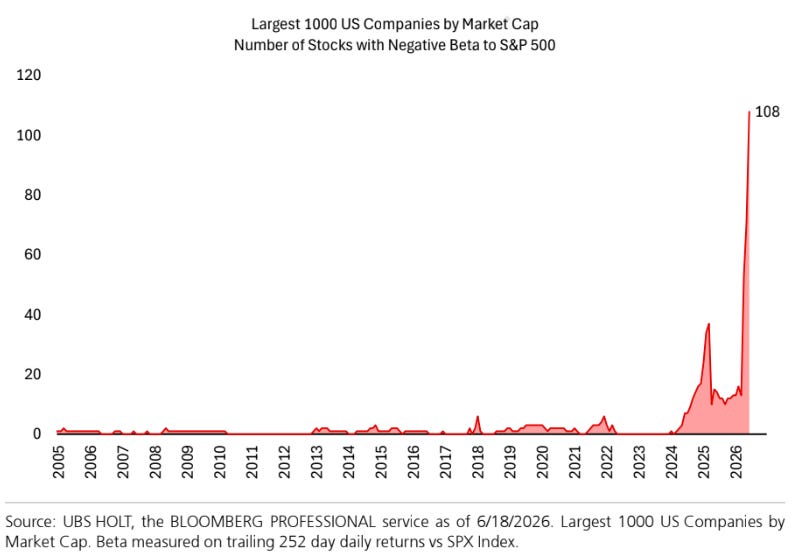
A stock with a beta of one will move in line with the market. The current beta for the top-eight US stocks is 1.23. The remaining 492 stocks have a beta of just 0.87. For anyone trying to manage a portfolio, in practical terms, this sucks. They can either match the tech mega-caps at their market weight or accept a portfolio that’s defensive by accident. Burns calls it “the unavoidable arithmetic of diversification in an undiversified benchmark”.
Why not compensate by buying some stocks that amplify index performance? Screening the US for betas above 2.5, they’d have a choice of just 23 stocks out of 1000, most of which are involved in racy stuff like semiconductors and crypto. The counterweight would be to sell negative-beta stocks like Walmart, Exxon Mobil, Johnson & Johnson, Costco, Procter & Gamble and Coca-Cola. If the idea is to reduce tech exposure, it won’t work.
Punishment awaits any portfolio that doesn’t look like the index, says UBS. Clever stock picking won’t deliver outperformance like it once did, not just because it’s hard, but because it means allocating cash away from the dominant eight. What’s being penalised is diversification itself.
Contrived jeopardy is how football tries to keep things interesting. Whereas title wins are only for the elite, the also-rans can scrap for cup qualification slots and scramble to avoid relegation. Clubs can rarely slip into mid-table obscurity.
Maybe index setters should try the same trick? Using the English Premier League rules as the proxy, the S&P 500 could eject the bottom 15 per cent of stocks each year. Automatic relegation wouldn’t capture the broad sweep of the asset class or the economy, but, since indices no longer do that effectively, anything is worth trying. The alternative is for a lot of fund managers to go the same way as Wimbledon FC.
○ Do US insurers arbitrage capital regulations with private ratings? Probably.
○ Asking advice from ChatGPT on how Strategy might dig itself out of the hole it created using advice from ChatGPT.
○ The stocks doing the earning are mostly not the stocks doing the rallying.
○ Want to diversify away from AI? Tough. You basically can’t.
○ There’s a lot to enjoy in CME’s regulatory lawfare against the CFTC.
○ Low-income countries are often reluctant to restructure sovereign debts. Stephen Paduano considers why.
○ Mag-Seven is over. It’s time for The Three AImigos.
○ Anthropic’s latest star hire has put a one-in-three chance of AI exterminating humanity.
○ Kevin Warsh “is throwing the reaction-function baby out with the dot-plot bathwater”.
○ How much might it cost to nationalise Thames Water? Maybe not that much.
○ Mr Market hasn’t given a fig about Keir Starmer.
○ From Goldman Sachs, some updated Brexit impact estimates.
○ Oh no, the dart-throwing monkeys are picking stocks again.
○ Salt batteries could be revolutionary. Could.
○ The travails of crypto-exposed, Cathie Wood-backed Mongolian football league powerhouse Brera Ilch FC.
○ To change a bank’s risk culture, pay them a visit.
○ Electric vehicle sales went up with fuel prices.
○ SoftBank did an investor presentation as only SoftBank can.
○ We mark the occasion of the UK’s fixed income consolidated tape going live.
○ Via Liberty Street Economics, how a risk-off market rattled synthetic stablecoins backed by perpetual futures arbitrage. (We noted the risks a year ago, incidentally.)
○ Rod Dubitsky has a short note on how BDCs benefited from a 2020 rule change that “downgraded the consequences of misvaluation”.
○ Adam Bonica’s On Data and Democracy newsletter takes a look at how the world’s first trillionaire stands on the shoulders of anyone who’s prepared to believe six impossible things before breakfast.
○ “The only trait that consistently predicted objections to remote work was narcissism”, says this New York Times guest essay ($)
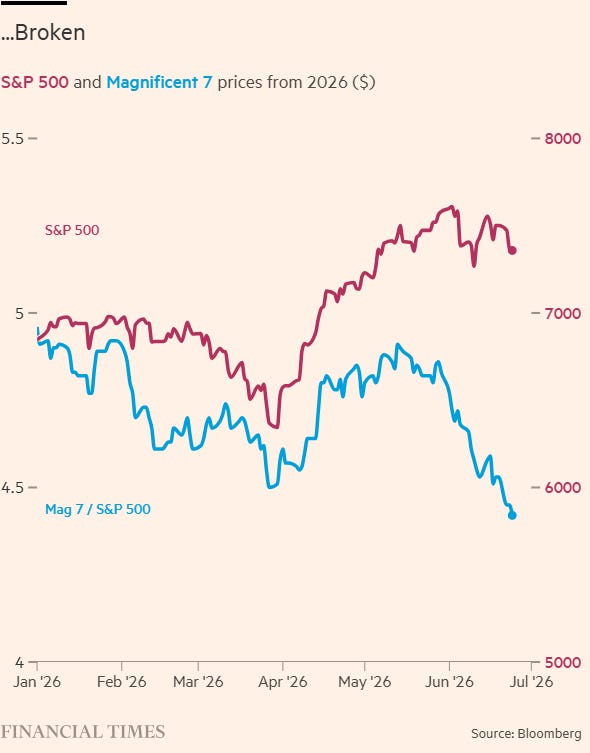
○ The Unhedged team look at whether the rough second quarter for US mega-caps marks a turning point in market leadership.
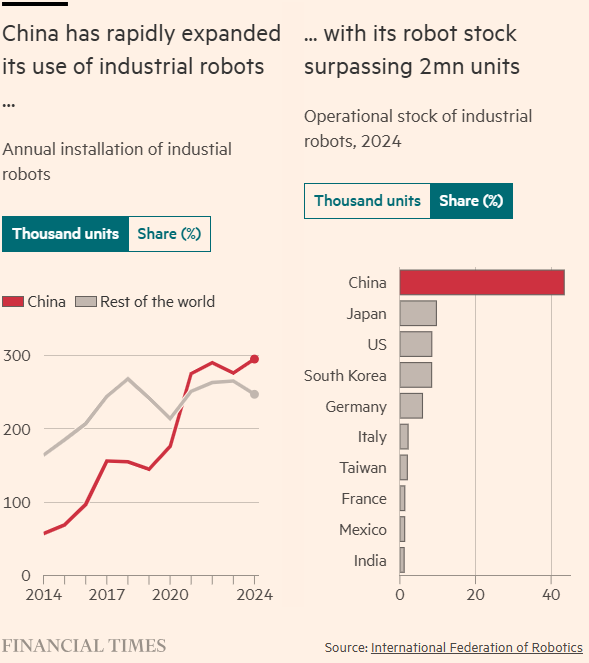
○ China’s solution to a shrinking workforce has been to build a new one.
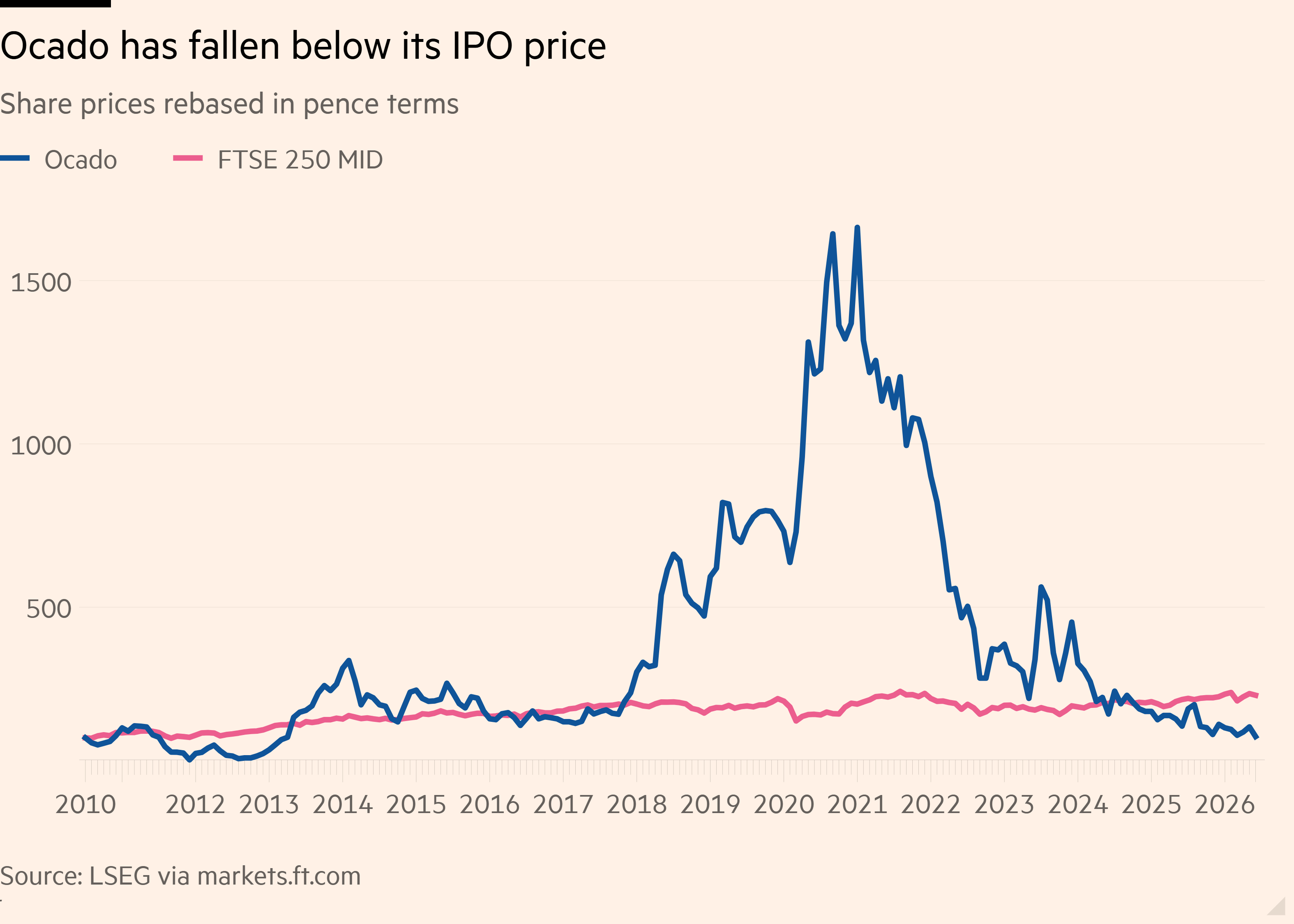
○ Having failed with grocery delivery and robot systems licensing, Ocado’s latest way to reach breakeven looks likely to be a parting of ways with co-founding CEO Tim Steiner.
No posts
Comments
Nothing yet. Say the first thing.
Sign in to join the conversation.