
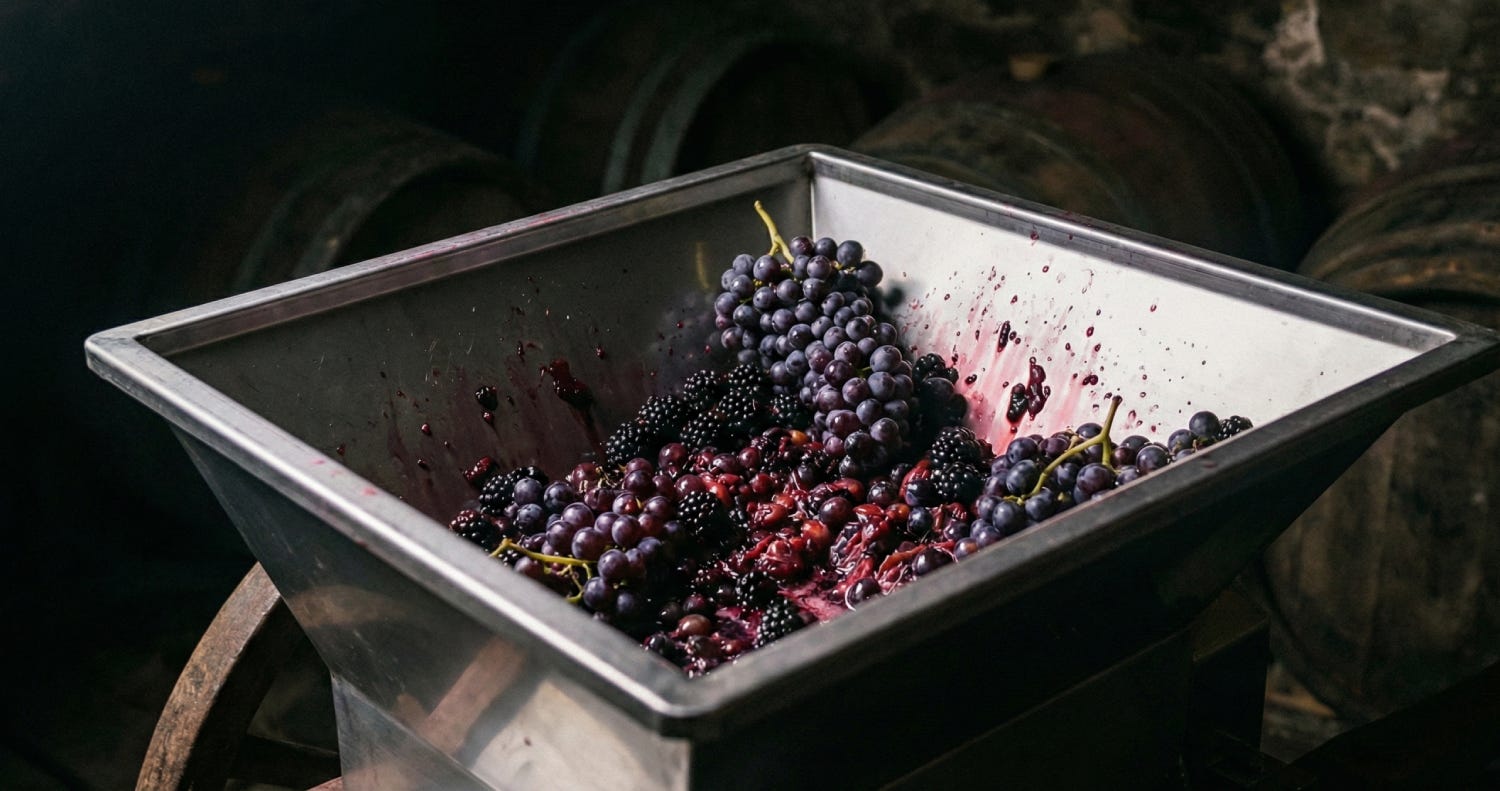
There’s a stubborn line drawn in the sand between “real” winemakers and the rest of us. On one side: grapes. On the other hand, everything else: berries, stone fruit, rhubarb, dandelions. The grape people don’t say it out loud, but their silence speaks volumes. Fruit wine is the weird cousin nobody invites to Thanksgiving.
But that line isn’t just arbitrary, it’s backwards. If you throw grapes and fruits into the same fermentation vessel and let them figure things out together, you’ll make better wine than either could produce alone. Co-fermentation doesn’t just combine flavours. It creates compounds and stability that neither substrate can achieve on its own. The grape purists haven’t been protecting quality. They’ve been leaving it on the table.
If you’ve made blackberry wine, you’ve watched your gorgeous, almost-black must turn into something resembling weak tea over six months. The pigments in berry wines are flighty. They oxidize. They polymerize into a brown sludge that settles to the bottom of your carboy, like regret. Grapes have something berries need, a solution that’s been hiding in plain sight.
This happens because berry anthocyanins, the pigment molecules responsible for all that dramatic colour, aren’t particularly stable on their own. They exist in equilibrium between colored and colourless forms, constantly flipping back and forth depending on pH and temperature. Worse, they’re vulnerable to oxidation. Every time you rack, every bit of headspace, every stray oxygen molecule nudges those anthocyanins toward browning.
Grape wines have this problem too, but they’ve evolved a solution: tannins. Grape tannins bind with anthocyanins over time, forming stable polymeric pigments that resist oxidation and stay red (or purple, or blue-black) for years. Berry wines have anthocyanins. What they don’t have is enough tannin to lock down those colours.
You see where this is going.
When you ferment berries alongside grape skins, or even just grape-derived tannins in the form of raisins, something remarkable happens in the first hours and days. The anthocyanins from your berries don’t just float around waiting to fade. They find partners.
Copigmentation is the technical term. It describes the non-covalent stacking of anthocyanin molecules with colourless cofactors, such as flavonols, hydroxycinnamic acids, and other phenolic compounds, abundant in grape skins. These cofactors act like bodyguards. They surround the anthocyanin, physically protecting it from oxidation and shifting the equilibrium toward the colored form.
The visual result is immediate. A co-fermented wine looks more intensely colored than either component would alone. Not additively, synergistically. The colour hyperchromism (fancy word for “looks darker than it should”) can boost perceived colour intensity by 30-50% compared to wines made from the same materials fermented separately and blended later.
But here’s what matters for the home winemaker: that enhanced colour is also more stable. Copigmentation is the first step toward those long-lived polymeric pigments. You’re not just making wine that looks good on bottling day. You’re building colour that survives.
Colour isn’t the only thing berry wines lack. Structure, that sense of grip and weight on the palate, comes from tannins binding with proteins on your tongue. Blueberries have some tannin. Elderberries have quite a bit. But most fruits? They’re all flesh and juice, soft and sweet and structurally thin.
Fermenting with grape skins solves this. The tannin extract, alongside everything else, integrates into the wine’s matrix from the beginning. This isn’t like adding grape tannin powder at the end (which can taste bolted-on, awkward, like a minivan with a hood scoop). Tannins that extract during fermentation have time to polymerize and soften, binding with proteins and polysaccharides released by dying yeast cells during sur lie aging.
The integration matters. A plum wine co-fermented with a handful of raisins develops grip that feels native, not applied. The tannins don’t overwhelm the fruit; they frame it, the way a good frame makes a painting look finished. So the chemistry works. But there’s also a philosophy here, one that predates modern winemaking entirely.
Commercial winemaking obsesses over control. Single varieties. Precise blends. Everything measured, every variable isolated.
Field blends predate all of that. Before varietal purity became a marketing category, farmers planted what grew and harvested what ripened. A September afternoon might yield early-ripening grapes alongside late-season plums alongside blackberries still warm from the sun. Into the crusher they went. Together.
The result wasn’t chaos. It was terroir in the most literal sense, a snapshot of a place and a moment, unrepeatable and unreproducible. You fermented what the land gave you.
For fruit winemakers, this philosophy opens doors. Stop thinking of your ingredients as primary and secondary. Stop worrying about which fruit should “star.” Harvest your plums and your remaining Frontenac grapes on the same warm Saturday, crush them together, and ferment the whole mess. The plum’s perfume and the grape’s tannin will find each other. They’ll build something neither could build alone.
This works especially well when working with small quantities. That half-bucket of wild grapes you scavenged? Not enough for wine on its own. But toss it in with your main blackcurrant ferment, and suddenly it’s not waste, it’s infrastructure. The grapes provide the structural scaffolding. The currants provide everything else.
Comments
Nothing yet. Say the first thing.
Sign in to join the conversation.