
This is The Great Books Project in Anthropology. I am on a quest to rediscover the classics and their insights into the human condition as a salve to the contemporary technological, social, and political threats to our humanity. Lest we forget.
Email me your recommendations: frontalobe.substack@gmail.com
The Abyssinian Journey by Marcel Griaule
Griaule, Marcel. (1929) 1991. Les Flambeurs d’hommes. Paris: Gallimard
Griaule, Marcel. (1929) 1935. The Abyssinian Journey (trans. E.G. Rich) London: J. Miles
Beginning: My faulty impression | Chapter One| Chapter Two | Chapter Three | Chapters Four and Five | Chapter Six (Part 1) | Chapter Six (Part 2) | Chapter Seven and Eight
================
The Book Review Guideposts: The Rhetorical Sandwich
While reading early modern ethnographies or monographs, I shall use these tropes to evaluate and appreciate the literary and scientific work of the forefathers of anthropology.
The Opening Trope
Writing using referentiality (realist) or evocative (literary)
The chapters are written as parts of the whole (holism)
The Closing Trope
My initial impression of the travel book by Marcel Griaule, one of the first French ethnographers who went on field after training under Marcel Mauss, remains the same. With my contemporary sensibilities, I would not personally read this for literary entertainment. It is difficult to be enamoured of this work because he wrote in the third person and we know so little of his actual thoughts, ideas and analysis. Thus, it was difficult for me to find myself continually fully immersed into the journey. This was an example of the empirical descriptive mode of transmitting knowledge.
This writing experiment attempts to transmit authentic information and experience to the reader by way of minimal interpretation. The assumption is that the less interpretation there is, the more transparent it is for the reader to judge the events accordingly. Rather than an immersive experience, the reader is forced to use this distant lens to ascribe a greater weight of truth-telling because he can ultimately be the judge to what is happening. Therefore, Griaule need not cover up any of the harsh conditions on both sides of the field—he was the White Man, a person who sits atop the horse while meeting new interlocutors, a person who cannot stomach the stale bread that they had to eat daily or the slaves that even his Abyssinian contacts hired, how they treated them, or the fear and dislike of the subjects of the King himself because he taxed them too much. Those that simply see colonialism (with a big C) here miss the nuanced local, sometimes oppressive, realities happening on the ground, too. We read a lot of terrible conditions for the sake of research.
This writing style allows for interpretation and re-interpretation from his peers and contemporary readership as we shall see in the coming weeks.
It is unsurprising that the rhetoric that Griaule uses (or the impression that the translator made in this instance) to convince his reader of his ethnographic authority rests on recognisable Christian key themes of suffering (Cavalry) and eventual redemption as his opening and closing tropes.1 This is effective bread sandwich for the otherwise bland middle filling using ‘scientific’ empirical reporting. Remarkably, despite his interest in deep knowledge of the sacred, secret knowledge and ritual, spiritually is not a question he tackles. This is fairly common for those that investigate religion or beliefs. It is just much easier to account for what can be seen on the outside—performance and other observable patterns such as repetition. In doing so, spiritually is left for things and experiences outside of our governable senses—such as, why they never shot the hippopotamus during a hunt. If only they asked that question, perhaps we might get a different answer from all the priests and ritual specialists they talked with.
It took decades—until the end of Marcel Griaule’s life for him to pierce the veil of knowledge among the Dogon. His legacy is a step ladder moving from the external observations using his early experiences in Abyssinia to publish about masks and games as prelude to finally entering the interal world of the Dogon in Mali. His Abyssinia fieldwork in 1929 provided the foundation to the larger and extensive Mission Dakar-Djibouti field expedition that took two years between 1931-1933.
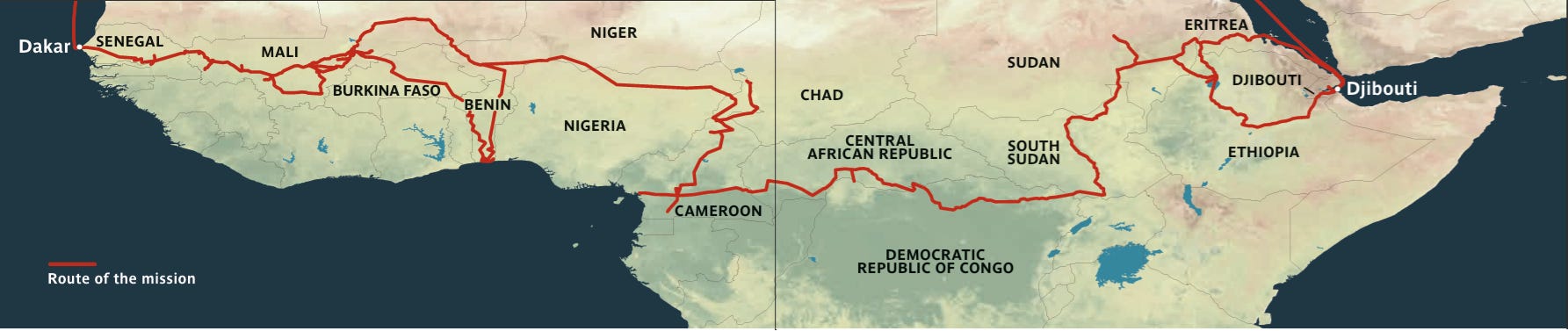
From the small to the grand, this extensive French expedition produced numerous contributions in multiple fields. But also fodder for criticism in Africanist and the discipline of anthropology until today. His work on The Abyssinian Journey will be overshadowed by his later works on the Dogon of Mali.
The Dogon of Bundiagara in Mali is a community nestled in the highlands with residential hamlets embracing the cliff sides. Griaule and all successive ethnographers were fascinated by the extensive use of masks for ritual and what’s behind them.
His interest in the Dogon follows his second fieldwork, the extensive Mission Dakar-Djibouti, with several other trips in 1935 to 1939 in Mali, Cameroun and Chad. After the War, several visits continued between 1946 to 1956. That wouldbe his final visit since he succumbed to his illness and died. His findings culminated in a summary of his understanding into the hidden knowledge of the Dogon in the work, Conversations with Ogotemmêli. All is not lost since he trained and collaborated on the next generation who continued and expanded other shared research interests and questions on other fields such as art, linguistics, archaeology, ethnobotany, and ethnozoology.2 A research vessel, a kind of mobile laboratory was even set up at the river of the Niger to continue investigations beginning 1955.
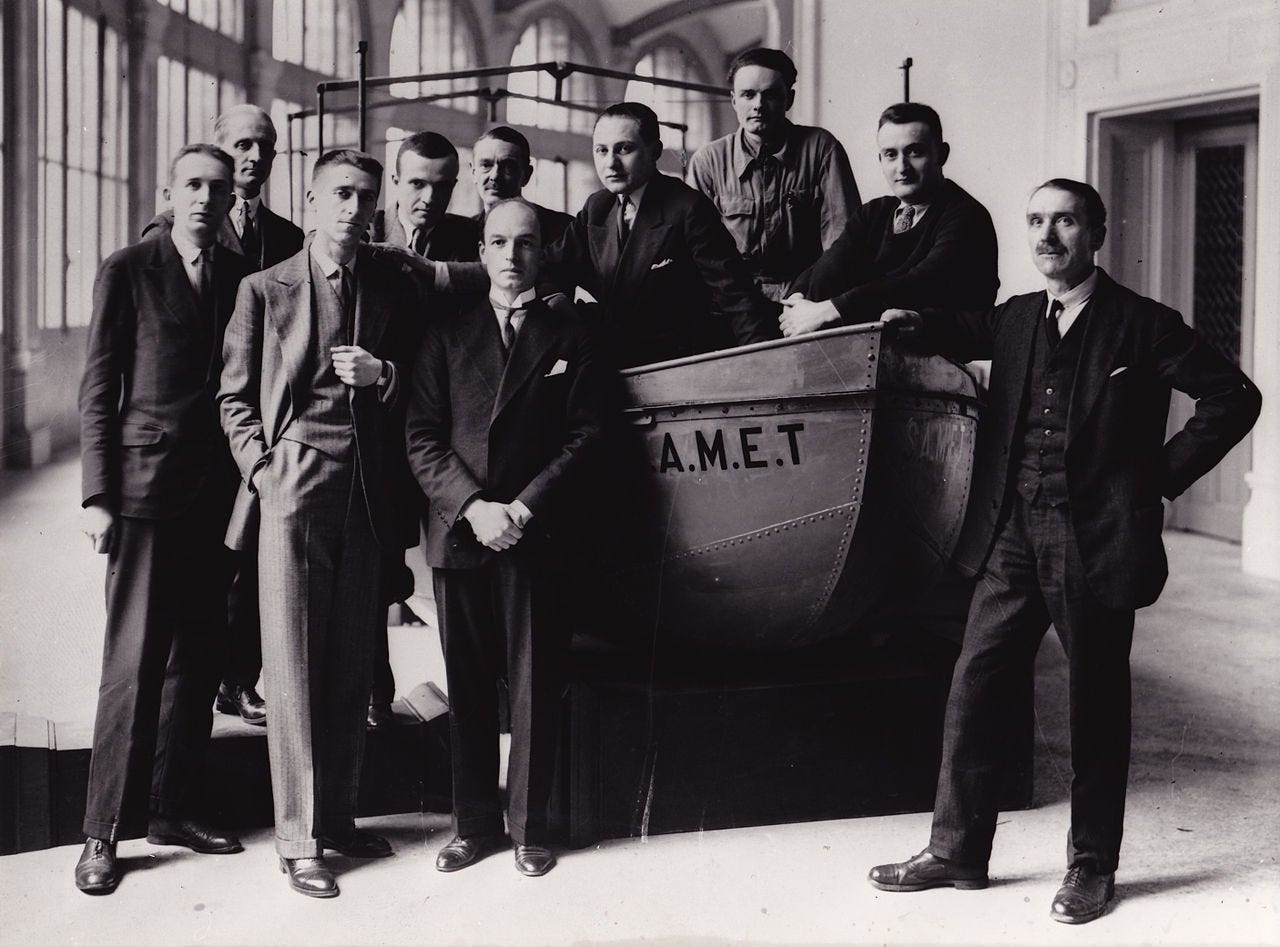
Griaule’s legacy may be mapped in two phases according to Africanist scholars—before his book on the Conversations with Ogotemmêli, originally published in 1938, and those that came after it. His early study on the Masks of Dogon characterise his first long fifteen years of research. This early phase was characterised by his descriptive writing of what informants call ‘simple knowledge’ cluster or la parole de face. His interview with the sage Ogotemmêli was characteristically different both in writing and the level of knowledge. Here, he sheds his academic descriptive approach to one that worked for him with communicating to his general reader—an informal tone, reminiscent of his book on the Abyssinian Journey. This approach is in contrast to its contents, what his primary informant agreed to share with him called la parole claire, or secret knowledge.
I think the interest is quite common among anthropologists at that time, a search for a pre-colonial African civilisation. African art has already achieved high culture status and admiration in France even before the fieldwork but has even soared higher with research into the Masks of Dogon. A longing to understand a deep culture beneath every day life is one he first explored in Abyssinia and continued in Mali with his search for a pre-colonial African philosophy foregrounding their civilisation. A belief system ordering every day life is reminiscent of Pierre Bourdieu’s search of the structure/practice undergirding Moroccan culture. In his work with Ogotemmêli, Griaule attempts to connect the Dogon cosmology and creation myths to cultural features such as textiles, basket weaving and to the larger institutions of kinship, family life and political life.3 It begins with the creation story, defined by the Nummo Pair creative spirits, much like water, as the source of life. It continues to the description of the celestial skies by way of a basket that describes the cosmic organisation.
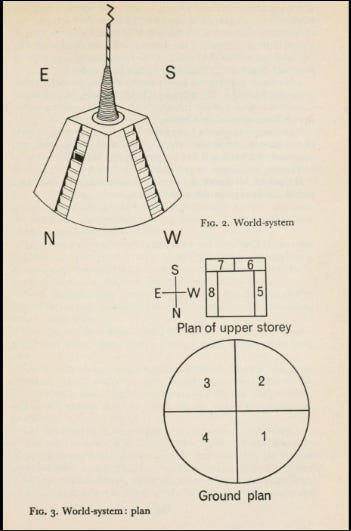
Unlike his disengaged narration in Abyssinian Journey, I really quite find this translated work rather engaging with Ogotemmêli leading the charge and teaching Griaule about the secret ways. The tables of power seemingly has turned and Griaule seems to have become a student after all these years! Life in the village is interspersed with some quite interesting details about the creation of man by the Nummo as explained by the cowrie shells arranged in front of Griaule.
The Nummo’s womb had transformed a man’s bones into coloured stones…so as to form the outline of a skeleton laid out flat on its back in the place where the body has been [bottom of the tomb], with its head to the north.
Griaule, p. 50
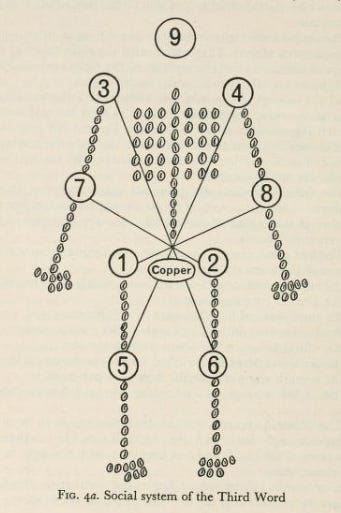
Whithin this illustration, the order of the gender is defined as a relationship of position and location in which the males are the upper part and the females occupying the lower part (such as the forearm assigned to females and the males as the thighs).
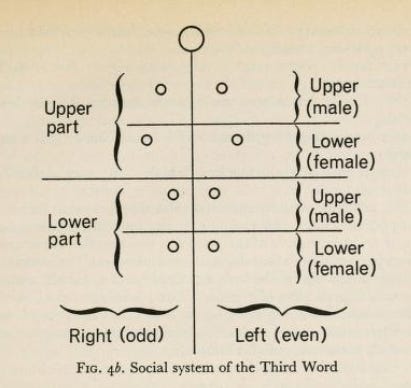
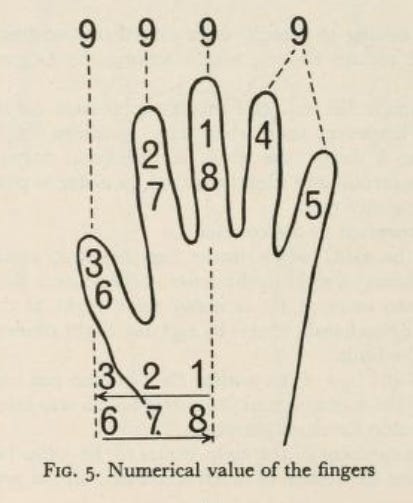
This logic also follows the alternating physical composition of the fingers on the hand to structure the number the days of the week. Within this framework, Ogotemmêli’s creation myths also matches the Dogon’s eight ancestral families. The family ranking determines who the ideal marriage partners are. In what would be life’s symmetry, these matches total into the number 9 which is the rank of chieftainship.
Had I known that this work is not just about ritual chants or anything of that sort, I would have lapped this up.4 I am a sucker for ethnographic detail that describes mythmaking and its correspondence to culture and real life! This is why I was attracted to studying mortuary ritual practices, the last bastion before modernity and post-modernity completely erases unique beliefs. The work also includes information on basketry, weaving, house layout and construction, ritual and sacrifice, bodily composition, and it seems endless and I am just halfway on the book. Every anthropologist who go to the field dreams of a key informant who can spell out everything in a culture. This reads like that—a specialist who outlines every single cosmological relationship with every day life. I now understand why this work not only had a big impact on African scholarship but also on the general readership that continue to visit the Dogon area and build a tourism culture there.
It is this neat correspondence to cosmological order and culture that Dutch ethnologist, Walter E.A. van Beek picked apart. Van Beek was part of a multi-disciplinary team, focusing on ecology, who settled in the drier highlands. Although he attested that he did not set out to study the Dogon, it was inevitable that he had to deal with the previous work several decades after Griaule. His fieldwork in the late 70’s and 80’s was contemporaneous to the second generation of anthropologists continuing Griaule’s work such as Germaine Dieterlan. She published and co-authored with Griaule about a mythical trickster figure, the opposite of Nummo, called The Pale Fox.
A critique of a prominent dead anthropologist is sure to garner a measure of fame for any anthropologist (as one of the responses lobbied against him).5 Indeed, this has gone below my radar because this was largely limited to the African studies circle which should not have been the case. What Van Beek raises here is the discussion regarding the nature of evidence but also the methodology leading to knowledge in Anthropology. This is why it remains important to read these (the gossip/insider aspect is too tempting to ignore as well).
In a nutshell, Van Beek disproves most everything that you have read previosuly. It started out innocently curious exercise since Van Beek had always been interested in ritual. Thus, it didnt take long for him to try to track and verify Griaule’s findings. Without going to extensive details one by one, Van Beek found that none of his informants, priests, or villagers knew about the creation myths outlined by Ogotemmêli or any of its real-life counterparts or equivalences. He scoured other African cultures and found no correlation or similar data to match up to what the sage mentioned. Is it valid to have secret knowledge when the rest of the folks had no idea about what he was talking about? None of Ogotemmêli’s successors and descendants knew about the myths he mentioned except perhaps his circle that has long passed.
Could this be an elaborate hoax on Griaule? One story going around is that perhaps Ogotemmêli was playing a harmless game on him. However, Van Beek’s criticism comes at a time that Griaule is no longer alive to contest these accusations. No mention of journals or fieldnotes were made during the course of his criticism or responses so I do not know if those exist to corroborate or refute. It seems the predominant appraisal is that Griaule was extrapolating his own knowledge and understanding such as (especially when it came to naming and describing Sirius star sigu tolo or pô tolo, and the associated star companions èmè ya tolo). Van Beek argues that no one outside of Griaule’s informants know about this or its relevance to daily life. According to Van Beek his informants attest that if these are relevant, it is “tèm” or that everybody knows about it. The reason for secrecy, he argues, is less about exclusivity of knowledge but rather of shame, accusations of witchcraft and sorcery. The astronomy misdetail is one such discrepancy he highlights. Though the creator spirit Nommo exist, the other god figures were missing. There are a lot of details Van Beek raised but you get the gist.
My main point here is that, just like some of the responses pointed out, Van Beek is several decades too late (50 years) to ask Griaule. It was not clear what the responses of the Griaule school since Van Beek did have a French translation and sent it to Dieterlan and was available to be read by other colleagues who have since retired. From what Van Beek shared, none of them contradicted his findings but he is expecting them to defend Griaule’s data. Jacky Bouju of University in Provence Aix-Marseille agreed with Van Beek’s position and positions this work in its extreme as “intercultural fictions”, a literary work.
What remains interesting are the responses from prominent people in the field that highlight problems in methodology.
What could be the potential methods that can be used to disprove Griaule taking into account historical changes, different informants, villages, and time? (Mary Douglas, E. Redaux, Claude Meillassoux)
why did Van Beek not use the two films available since 1938 (au pays Dogon and sous les masques noirs) for verification, authenticity, or objectivity?
why did Van Beek not clearly state his methods? such as the life histories of his informants?
Is this an exercise in the question of truth or trust? (Ian Crawford)
What about the work of other anthropologists and linguists following Griaule such as Calame-Griaule on linguistics, Le Boeuf’s body-house connection, Paulme’s ethnography? or even Daniel Forde organising workshops on the topic? (Mary Douglas)
How do we separate Ogotemmêli from the anthropologist himself? (Claude Meillassoux)
The best take that I have read so far was from another African scholar, Andrew Apter who had a much more nuanced position. He contradicted a predominant view that much of Griaule’s observations did not exist or has ever existed in Dogon. He argues that secret knowledge la parole claire is not a fixed set of knowledge but one that was fluid. This was what he has seen among the Yoruba in Nigeria similar to the Dogon in which they had secret knowledge. Rather than pierce it, Apter opted to study the surrounding mechanisms that maintain the secrecy. The result is that he started getting multiple responses ranging from surface level interpretation to symbols (e.g. blessings) to forbidden themes (e.g. division or bloodshed) relevant especially to royal political institutions and ritual practice. This means that secret knowledge must change as local relations also change. It would not be a surprise that Van Beek never found the same corpus of knowledge 50 years ago.
Like a lot of these debates, these questions remain unanswered in Anthropology more generally, especially to specific methods on evaluating work decades after. I thoroughly enjoyed one great example that this was done on the Nuer of Sudan. Dr. Sharon E. Hutchinson revisited the research done by E. Evans-Pritchard but the key differences include not recovering or reconstructing a pristine culture untouched by the colonial administration as was the typical approach of anthropologists quickly documenting a disappearing way of life. This meant that Hutchinson included the realities of inter-cultural war, the presence of guns, child soldiers, the pressures of the nation-state, and the commodification of their valued cows. I read her ethnography, Nuer Dilemmas, for pleasure almost twenty years ago and it has stayed with me because it was so good. It doesn’t completely discount Pritchard’s work but paves the way of seeing the Nuer without filters. There is value in keeping both types of records in conversation with each other.
Just because Van Beek did not see these realities on the ground meant that as Apter argues, secret knowledge change as the social conditions shift. Reading more and more of Griaule’s other works demonstrates how a historical record of an older way of life remains valuable for critique but also a description of a way of life that may no longer be in practice today. Typically, anthropologists admonish that no culture really dies because they adapt. Traditions still die and practices are forgotten. It is part of the job of an anthropologist to document those as closely as possible with the flaws of the observer and observed with the clarity necessary for any judgement to be given.
The impact of Marcel Griaule on anthropology and African scholarship begins from The Abyssinian Journey. This was our first peak into how he approaches research and writing. The explorer/hero persona he wishes to convey are genre specific that not just establishes his authority but also initiates the reader into another travel genre that is ethnographic. He uses the suffering trope of a hero to communicate not just his physical survival but also the success of a science/exploratory enterprise.
This was essential to fund the grander two year Mission Dakar-Djibouti in 1931-1933 that began the long commitment of Marcel Griaule to the Dogon of Mali. His work on Ogotemmêli capped his dedication to unlock the secret knowledge and cosmology of the Dogon. This is where his legacy truly shines by the amount of criticism and review that continues up until today. The questions critics raise haunt the field of anthropology and deserve further discussion.
Further Reading:
Apter, A. (2005). Griaule’s Legacy: Rethinking “la parole claire” in Dogon Studies (L’héritage de Griaule: repenser la Parole claire dans les études dogon). Cahiers d’Études Africaines, 45(177), 95–130. http://www.jstor.org/stable/4393464
Borofsky, R. (1997). Cook, Lono, Obeyesekere, and Sahlins: CA* Forum on Theory in Anthropology. Current Anthropology, 38(2), 255-282. (overview of the debate on interpreting the historical figure of Captain Cook and re-reading the archives)
Bourdieu, Pierre. 1972 [1977]. Outline of a Theory of Practice. Cambridge: Cambridge University Press.
Clifford, James. 1983. Power and Dialogue in Ethnography: Marcel Griaule’s Initiation in George W. Stocking, Jr. (ed.), Observers Observed: Essays on Ethnographic Fieldwork, History of Anthropology Volume 1. Wisconsin: The University of Wisconsin Press. pp. 121-156.
Ferguson, R. B. (2015). History, explanation, and war among the Yanomami: A response to Chagnon’s Noble Savages. Anthropological Theory, 15(4), 377-406. (This is one of many responses to Chagnon which is typical of the anthropologist’s position to cultural representation.)
Griaule, Marcel. 1938 [1948]. Conversations with Ogotemmêli: An Introduction to Dogon Religious Ideas. Oxford: Oxford University Press (a fun informal and easy read of cosmology with daily life)
Hutchinson, Sharon E. 1996. Nuer Dilemmas: Coping with Money, War, and the State. Berkeley: University of California Press (highly recommended for pleasure reading)
Shankman, Paul. 2009. The Trashing of Margaret Mead: Anatomy of an Anthropological Controversy. Madison: University of Wisconsin Press (my first encounter to the harsh criticism against Mead that deserves to be read)
Van Beek, Walter E.A., Bedaux, R. M. A., Blier, S. P., Bouju, J., Crawford, P. I., Douglas, M., Lane, P., & Meillassoux, C. (1991). Dogon Restudied: A Field Evaluation of the Work of Marcel Griaule [and Comments and Replies]. Current Anthropology, 32(2), 139–167. http://www.jstor.org/stable/2743641
The ongoing draft and outline of our project are available on our main page.
If you got this far, I appreciate it! If you find reading this worthwhile, it greatly helps my cause if you can share. My tip jar is open, but this newsletter will always remain free.
Contribute to my library access!
If you are new here, we have just concluded reading David Graeber’s Debt: The First 5,000 Years. My first slow read here on Substack in 2023 was David Graeber’s The Dawn of Humanity. Unique among his peers, Graeber asked the big questions in anthropology—how did people organise themselves and what were the values and choices they made. Sadly, except for a few scholars, we have stopped boldly asking who we are, why we are different, and where we are headed. We are changing this now.
Re-read the previous post:
As a Catholic anthropologist, I do not think he is deliberately styling himself as the Messiah or that the White Man is one. Far from it, he is unashamedly styling himself or the ethnographer as the quintessential explorer and researcher par excellence—a marketing tool necessary to attract the next funding which they successfully did for the Mission Dakar-Djibouti and visibility of the Musee L’Homme.
They would be for better or worse called the Griaule school, with some snark added from some critics.
Thanks to the Internet Archive, it is a wonder to read the translated version in high resolution. Just open a user account and everything is at your fingertips!
The most cited is Pierre Bourdieu’s Kabyle house in Algeria with gender demarcation of inside/outside from his work, The Outline of a Theory of Practice. Bourdieu captured the generative structures of language with the environment, calendar, planting season, and gender division within the village. This is what defines French structuralism.
Comments
Nothing yet. Say the first thing.
Sign in to join the conversation.