
This is The Great Books Project in Anthropology. I am on a quest to rediscover the classics and their insights into the human condition as a salve to the contemporary technological, social, and political threats to our humanity. Lest we forget.
Email me your recommendations: frontalobe.substack@gmail.com
Phantom Africa by Michel Leiris
Leiris, Michel. 1968. L’Afrique fantôme. Paris: Gallimard
Leiris, Michel. 2017. Phantom Africa (trans. Brent Hayes Edwards). India: Seagull Books
Tristes Tropiques by Claude Lévi-Strauss
Lévi-Strauss, Claude. (1949) 1993. Tristes Tropiques Paris: Plon
Lévi-Strauss, Claude. (1949) 1969. World on a Wane (Tristes Tropiques) (Trans. J. Russell). Boston: Beacon Press
================
The Book Review Guideposts: The Rhetorical Sandwich
While reading early modern ethnographies or monographs, I shall use these tropes to evaluate and appreciate the literary and scientific work of the forefathers of anthropology.
The Opening Trope
Writing using referentiality (realist) or evocative (literary)
The chapters are written as parts of the whole (holism)
The Closing Trope
I almost had a creative burnout from reading The Abyssinian Journey of Marcel Griaule. I now realise that reading it in a vacuum is a disservice and is unhelpful towards understanding the full context of both the writer, the subject, and the historical context. This time, I will try to read these two books side by side and see the contrasts. This has also produced a pleasurable side effect of finding pleasure (not the tyranny of deadlines) in reading once again.
The Africa that I traversed in the period between two World Wars was no longer the heroic Africa of the pioneers, nor even that from which Joseph Conrad drew his magnificent Heart of Darkness, but it was also quite different from the continent we see today awakening from a long slumber…working toward its emancipation. From this perspective, I am tempted to believe, must be sought the reason that the only thing I found there was a phantom.
Leiris, p. 63
Introduction |
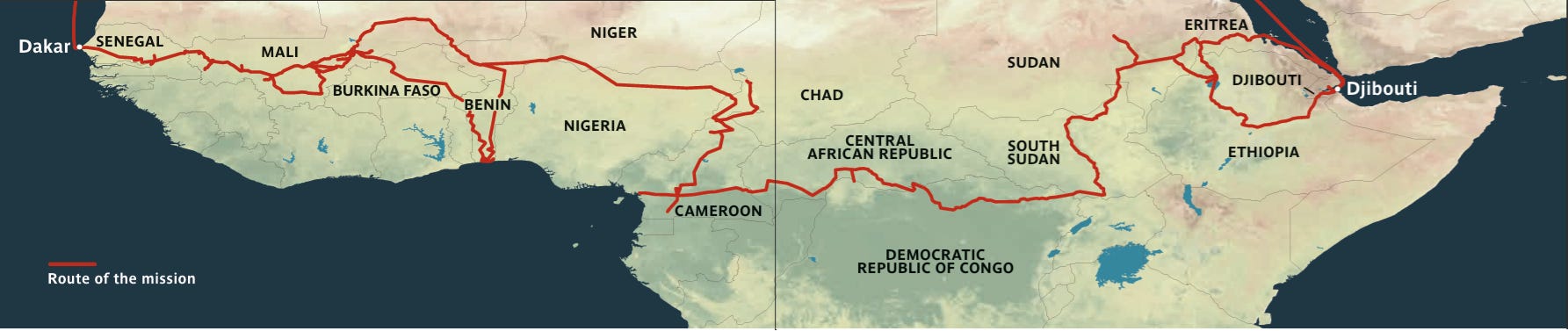
In contrast to the absence of the self of Griaule in his accounts, Phantom Africa is the opposite. It is the direct publication of Michel Leiris’s journals that he kept, almost day to day, of the Mission Dakar-Djibouti field expedition from 1931 to 1933. In here are his thoughts, words, and observations. In effect, the chaos of change in Africa also belies the turmoil of personal growth of Leiris in his career, but also in his manhood. His later works in poetry and scholarship, for which he would be recognised, drew from this two-year expedition traversing the West to the East of the African continent. The translator of the English edition, Brent Hayes Edwards, recommends that we should actually read his personal struggles in Manhood alongside this piece. This work was written in the early 1930s, published in 1939, and republished with additional essays in 1946 during his treatment for mental illness before he became well-known. This memoir preceded his long expedition and informs his personal and career uncertainties in his Phantom Africa journal accounts.
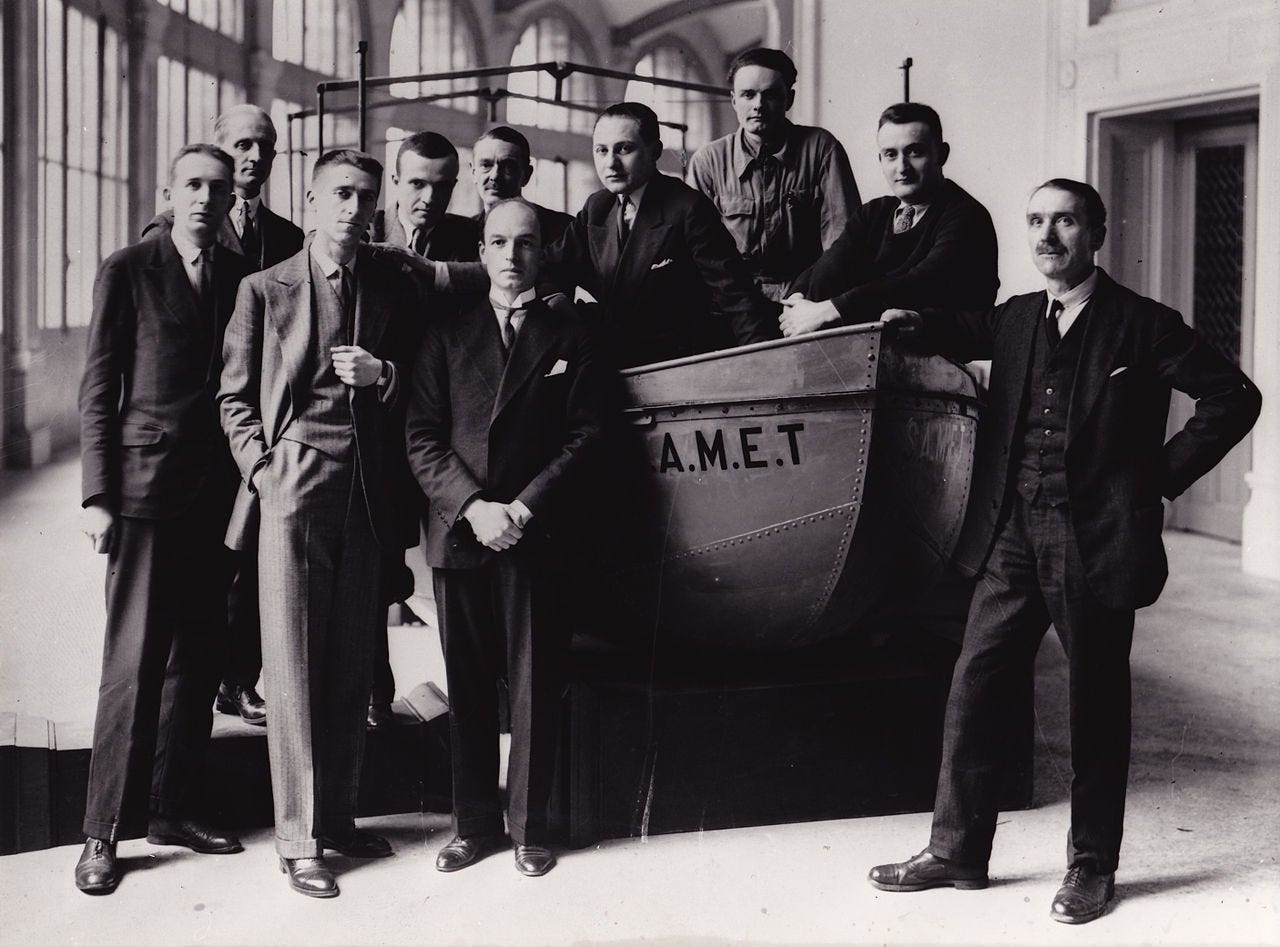
Michel Leiris, recognised as an anthropologist, started not as one but as a writer. This would be an excellent field training to be a researcher if anyone had mentioned it to me during my crucial younger years. It is a privilege to have these early French ethnographers live a long life and look back at their work. Born in 1901, part of the Surrealists group, he passed away in 1990, spanning a period in which the world looked so different by then that the pre-war period feels like an anachronism for us. This meant that through the decades, we see Leiris shift his position on the nature of ethnography and what happened in Africa. Leiris's later reflections solidify his anti-colonial position by 1950, and explicitly stated in his 1981 preface to the English translation.
Some fifteen years later, at the beginning of the process that would lead to what was presumptuously termed “decolonization,” it seemed that the black world—was truly taking shape for me, because circumstances permitted me to think that as a researcher and writer, I could offer—rather feebly—indirect but positive support to those emerging from that black world who were struggling against oppression and asserting their cultural particularity across the globe. Surely, in order to concretize a man from an entirely different part of the world, and in order to gain his recognition—a requirement for the creation of an authentic humanism—I would have to revise my previous understanding of my profession by practicing an ethnography of militant fraternity, rather than one of detached examination or artistic sampling.
More than simply gathering information and objects—as my companions and I have done between Dakar and Djibouti, at times resorting to means that, had we been less certain of acting in the name of the good cause, we would have condemmed—so that our collections, recorded in our archives and preserved in our musems, would attest that unjustly unrecognized cultures have a value in themselves (in addition to having much to teach us), our aim was to furnish the people we were studying with the means to construct a future that would belong to them, and in the meantime to produce unassailable work to support their claims; such were the inspiring goals that I assigned to ethnography a few years after World War II, after I had matured under the trials of the German occupation and been aided by the course that my professional life had taken in the new era.
Leiris, pp. 59-60
Aside from what his work means for anti-colonial activists and scholars, or advocates for a radical museum practice, his eyes and mind’s eye take us back intimately to a time no longer in existence—a double phantom, a shadow left over from momentary fragments of two time periods—Leiris’ 1930s Africa and our own memory of 1940s-1950s, increasingly further away from our AI-driven delirium standpoint. What we have left are Leiris’s notebooks as evidence of regret, adventure, and disappointment.

…[Phantom Africa is] an expression of my disappointment as a Westerner uneasy in his own skin who had foolishly hoped that his long voyage in remote lands—and true contact, via scientific observation, with their inhabitants—would transform him into a different, more open man, cured of his obsessions. In a way, my disappointment drove me, the egocentric that I then still was, to deny through my title a full existence to that Africa where I found many things, but not deliverance.
Leiris, p. 59
He is unapologetic that Phantom Africa is a subjective, half-documentary and half-poetic exegesis of his experience of what he calls the drift, as the “slow erasure due to time’s passing.” This approach meant that Leiris’s work endures to a greater number of readers today. For someone in search of the Great Works in Anthropology, Leiris’s work illuminates the urgency of capturing unfashionable insights but also fragments of human culture prior to rapid disappearance by conquest and hypercapitalism.
Travel and travellers are two things I loathe—and yet here I am, all set to tell the story of my expeditions. But at least I’ve taken a long while to make up my mind to it: fifteen years have passed since I left Brazil for the last time and often, during those years, I’ve planned to write this book, but I’ve always been held back by a sort of shame and disgust. So much would have to be said that has no possible interest: insipid details, incidents of no significance.
Lévi-Strauss, p. 17
Chapters 1-3 |
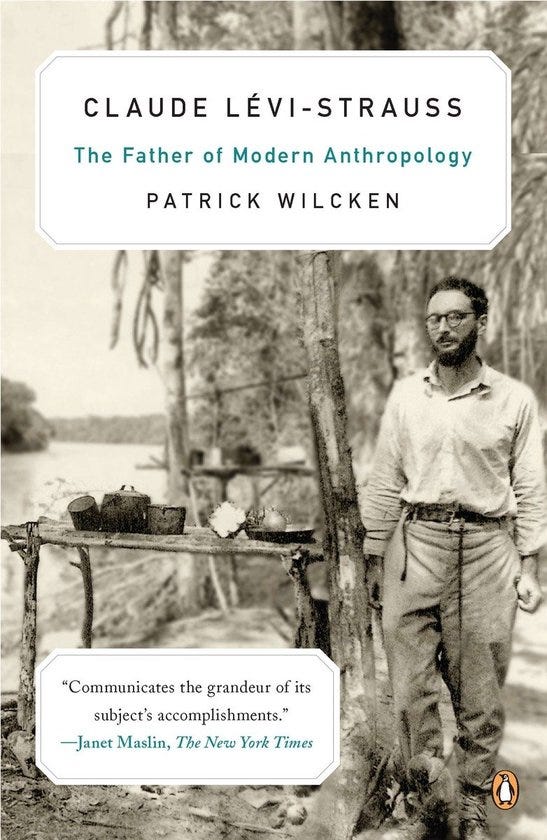
Another phantom and time drift also occur in the Amazon rainforest of Brazil. This work by Claude Lévi-Strauss (1908-2009) reveals his poetic strength that lends authority and also empathy to his ethnographic accounts of the Indians in the Brazilian Amazon. Rather than a diary account, the structure follows what is recognised as the second book in French anthropology, which follows the Rhetorical Sandwich.
I had only known Lévi-Strauss via this theoretical framework, French Structuralism, which argues for a common universal mind and way of thinking (in the simplistic way). It is an answer to the question of why different cultures have the same creation myths and flood myths. He has been portrayed as distant with his abstract view of human culture reduced to linguistics. This book shows Lévi-Strauss as less than a demi-god in anthropology but a nascent ethnographer who found himself an opportunity to practice ethnography.
That one civilization is ending and another beginning; that our world has suddenly found itself to be too small for the people who live in it; these are facts which became real to me, not because of figures or statistics or revolutions but because I happened, a few weeks ago, to make a certain telephone call. I had been playing with the idea of retrieving my youth by a return visit, after fifteen years, to Brazil. The answer was that I should need to book my cabin four months in advance.
Lévi-Strauss, pp. 23-24
Like Leiris, Lévi-Strauss’s phantom Amazon catches him between periods of the World Wars. He situates us with the complexity of travel when alliances in France and across the waters complicate a months-long sea voyage. France was occupied by the Germans (1940-1944) under the sympathetic Vichy government. He could not get a Brazilian visa, so he hatched the idea of going to South America by way of the United States. At that time, there was an opportunity granted to European scholars oppressed by the Germans to travel. He was able to acquire a New School for Social Research in New York visitor entry, which was later promptly cancelled.
For some reason, he did not appear to need a visa in the end but only a reservation made to the same Compagnie des Transports Maritimes office in which he travelled luxuriously prior to the war. This time, the company, recognising him, dissuaded him from buying any ticket because, as Lévi-Strauss later found out, the Capitaine Paul Lemerle was akin to a convict ship. His previous idea of
…sharing the labours of and the frugal repasts of a handful of seamen, sailing hither and yo on a clandestine vessel, sleeping on deck, and gaining in health and strength from the day-long nearness of the sea.
Lévi-Strauss, p. 25
was little more than a cattle train, with three hundred fifty people crammed into a small vessel that had only two cabins and seven couchettes. The nightmare was made intolerable with unlikely ship characters, one of whom is an associate of Lenin, and other mysterious figures. As is common in the opening, personal hygiene tops the list of travel descriptions that wake the reader to the sights and smells of a crowded humanity trying to defecate on two wooden cubicles containing a long wooden trench that protrudes into the ocean at all hours of the day. Trying to shower is also no good with only two douche cabins. His movements and disembarkation were also restricted at times because of his French passport, as they made numerous stops in the Mediterranean, West Africa, before finally landing at Fort de France, the capital of Martinique, the Lower Antilles region. Yes, he had deliriums of ease and escape.
After a month at sea we suddenly glimpsed, in the middle of the night, the lighthouse of Fort de France. And the hope which filled all our hearts was not that of enjoying, at long last, an eatable meal, a bed with real sheets, or a night’s unbroken rests. No: these people who had been used, on land, to what the English call the ‘amenities of civilization’ had suffered more from the unavoidable filth of these conditions—aggravated as these were by great heat—than from hunger, or fatigue, or sleeplessness, or promiscuity, or other’s contempt.
Lévi-Strauss, pp. 27-28
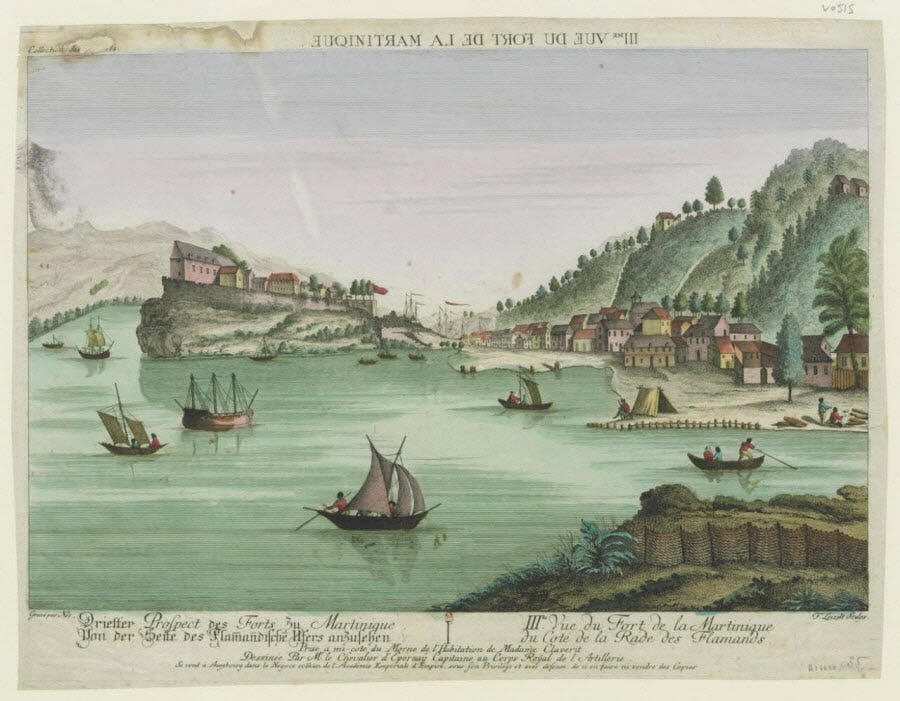
It was not to be. Lévi-Strauss discovered that toilets were no less in existence in the capital than they were on their ship. The nightmare continued on Port de France, rendering him to remark that their sea voyage was an Eden compared to the military reception that they would receive. The garrison was overcome by paranoia about the Allies (enemies) despite not seeing them. Happily, this was only restricted to the morning; by afternoon, they were rambling around the city with Lévi-Strauss ruminating about the state of human society and war. He goes back into his memory bank of the time he almost lost all his research on his return trip back to France on account of stricter rules on artefact collection. Lucky for Lévi-Strauss, a foul up of bureaucratic proportions enabled him to haul his research back to France. Sad for Brazil. It is this same cock up that enabled him to keep his research materials in Customs in Martinique and receive them intact as he landed in Porto Rico under the U.S. flag. Lévi-Strauss returned to the Carribean and later on to his position to the University of Sao Paolo in Brazil.
The twin readings of two different types of books—a diary and a standard second book counter the demand for scientific detachment for two different reasons. In Michel Leiris’s case, he was attempting to show a different type of ethnographic writing practice—what it is exactly is unsure for the moment—but one that is not hinged on the impersonal as a form of knowledge creation. Thus, his decision to publish an unadorned and unedited accounts from his series of diaries hopes to express some of his early ideas about anthropological practice and socio-historical context through unvarnished impressions as a way to reveal truth in the field.
In Claude Lévi-Strauss’s motivation, he is clearly aware that he is writing within the genre of the second book. The structure follows the travel book format though he resists the idea, but his tale of an ethnographic travel is one that explodes the myth of the pristine and isolated tribes. For the world is reeling in chaos and his opportunity came to take up a position at a newly opened sociology position at the University in Sao Paolo, making fieldwork among the Amazonian Indians, merely convenient and expedient (as is common in our field).
None of their encounters are isolated groups of people. In both their disparate works, they witness the old ways that are vulnerable to loss from conquest and rapid industrialisation. How knowledge and personal growth can best be described or recorded is the reason literature writing is a balm for these two authors.
Further Reading:
Leiris, Michel. 1992 [1939, 1946]. Manhood: A Journey from Childhood into the Fierce Order of Virility. Chicago: The University of Chicago Press
Edited:
05/08/26 - Caption provenance for Michel Leiris found in Centre Pompidou and was taken by Man Ray!
The ongoing draft and outline of our project are available on our main page.
If you got this far, I appreciate it! If you find reading this worthwhile, it greatly helps my cause if you can share. My tip jar is open, but this newsletter will always remain free.
Contribute to my library access!
If you are new here, we have just concluded reading David Graeber’s Debt: The First 5,000 Years. My first slow read here on Substack in 2023 was David Graeber’s The Dawn of Humanity. Unique among his peers, Graeber asked the big questions in anthropology—how did people organise themselves and what were the values and choices they made. Sadly, except for a few scholars, we have stopped boldly asking who we are, why we are different, and where we are headed. We are changing this now.
Re-read the previous post:
Comments
Nothing yet. Say the first thing.
Sign in to join the conversation.