
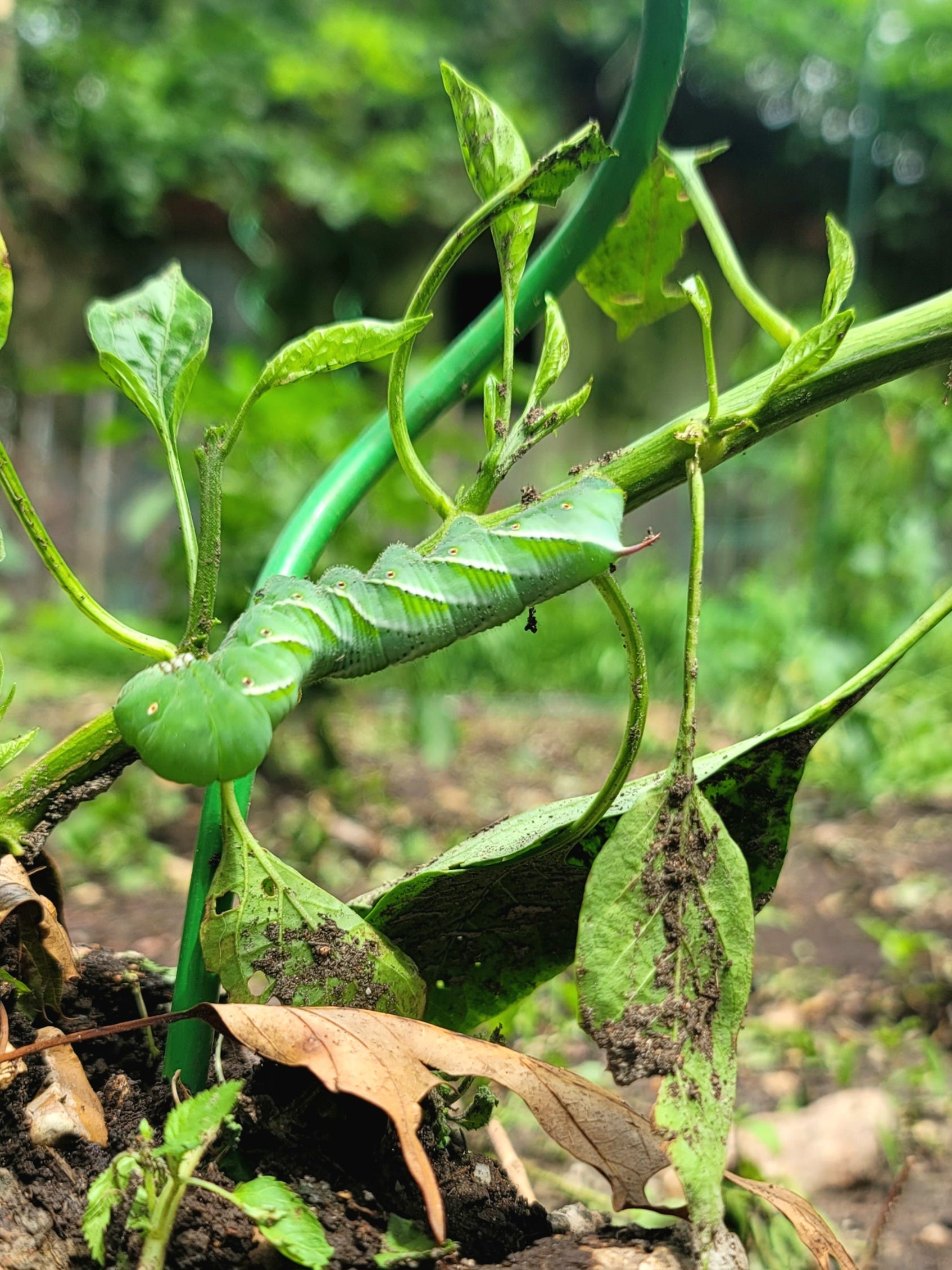
I went to visit our vegetable garden after a severe storm and discovered a hornworm was consuming my pepper plant.
It had already eaten more than half of the plant by the time I found it on there. It was enormous, green, and almost perfectly disguised against the stems and leaves it had been steadily devouring. My first thought could easily have been to pull it off and crush it. It was, after all, destroying something I had planted, watered, and hoped would produce peppers
.
I could have called it a pest and ended the matter there.
Instead, I began looking around the yard for another plant it might eat. Hornworms feed on plants in the nightshade family, and I found what I believed was horsenettle in my yard, a wild cousin of the pepper and tomato so I moved the caterpillar there and left it.
A couple of days later, I went back to check on it. It had eaten nearly the whole plant but it was gone. Looking around I found it had moved to another one and continued on, apparently quite content with the arrangement given to it.
Not long afterward, I found a tiny turtle in the yard. It was so small that it could have disappeared between my dogs’ teeth before I had time to stop them. I picked it up, carried it across the fence, and placed it where the dogs could not reach it.
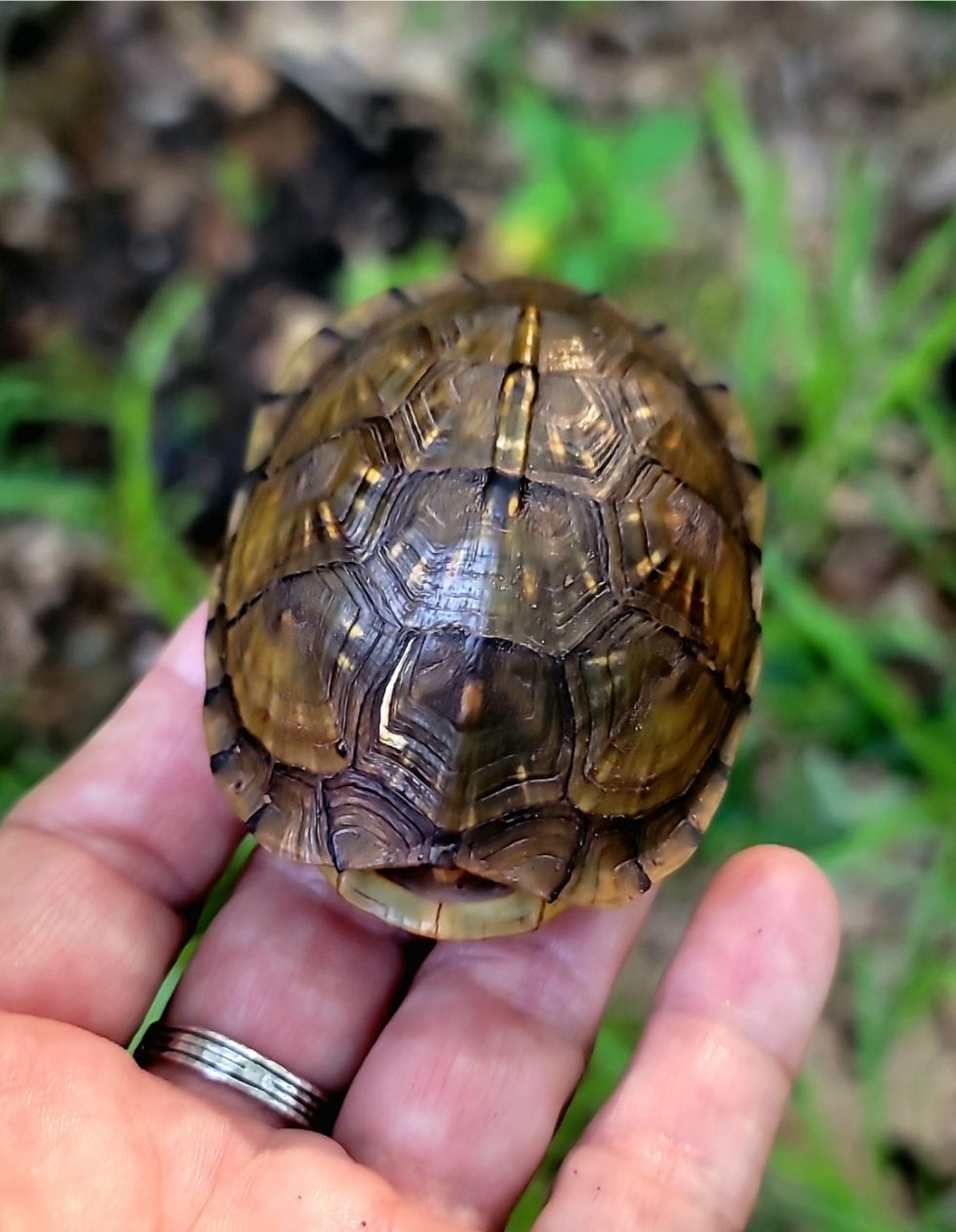
Neither act was remarkable. I did not rescue an endangered species or preserve an ecosystem. I simply moved a caterpillar from one plant to another, and carried a turtle a short distance across a fence. Yet both moments stayed with me long after.
A hornworm was consuming my pepper plant, and a turtle was small enough to disappear between my dogs’ teeth. I had power over both of them. In one case, I could crush it; in the other, I could ignore it. Instead, I moved them. They were small acts, nearly meaningless in the great sweep of the world. Yet they made me wonder whether the soul of humanity still remembers something exile has caused us to forget: we were made not merely to rule the earth, but to care for the household of the King.
In the beginning, humanity was given dominion over the earth.
That word has sometimes been understood primarily in terms of authority, mastery, or control. Yet dominion was not given to humanity in a world belonging to humanity. It was given within a world belonging to God.
The earth is His household.
Humanity is placed within it and given a role. We were to cultivate, guard, order, and care for what belonged to the King. Our authority was never independent of His authority. We were not owners establishing our own will over creation. We were servants entrusted with responsibility within the household of another.
Dominion, then, was not permission to do whatever we pleased simply because we possessed the power to do it.
It was a function.
It was stewardship.
It was responsibility.
And it was dominion over the earth itself, not dominion over one another.
Humanity now lives in exile from the place where that function was first given but we still carry the echo of it within us. We still plant gardens, tend animals, build homes, restore damaged places, and feel satisfaction when something under our care flourishes. There seems to be a deep pull within humanity toward cultivation and guardianship, as though our souls retain some memory of what we were made to do.
Yet exile has distorted that impulse.
The desire to cultivate become the desire to possess.
The responsibility to protect become an excuse to dominate.
The authority to order become the demand that everything bend to our will.
We no longer stand in the garden beneath the immediate order of the King. We live in a world where survival, fear, scarcity, pride, and self-interest often shape the way we exercise power. We still feel drawn toward our original function, but we often try to fulfill it through the distortion of exile.
Perhaps that is why humanity so easily confuses dominion with control.
Control says that because something inconveniences me, I can destroy it.
Control says that because I have the ability to impose my will, my will must therefore be right thing to do for me.
Control asks only, Can I?
Stewardship asks another question: What has been entrusted to me, and how should I care for it?
That does not mean we can never kill a pest, remove a threat, cut down a tree, harvest a field, or protect what feeds our families. Stewardship is not passive. Cultivation itself requires disruption. We prune, dig, harvest, build, restrain, and sometimes destroy. There are moments when difficult choices are necessary to protect homes, crops, animals, and people.
The difference does not lie only in what we do, but in the spirit with which we do it.
Do we act as owners who believe everything around us exists merely for our use? Or do we act as servants who remember that the earth and all within it belong to God?
My pepper plant wasn’t sustaining my family. I don’t depend on its harvest to survive the winter. I planted it because I could and because I enjoy growing things. The hornworm threatened something I wanted, but it did not threaten my life.
I certainly had the ability to kill it. Perhaps I even had the right to protect the plant I had tended and it had grown. But possessing the right to do something does not always mean that doing it is the only faithful choice.
That small encounter made me wonder how often we exercise power simply because we can. How far do we carry our insistence that something must be done our way? How often do we describe another living thing as useless, invasive, troublesome, or unwanted without first asking whether there might be room for both its life and our responsibility?
The caterpillar did not know that I spared it, and the turtle did not understand why a giant hand lifted it from the grass and carried it beyond the fence about five feet away.
Neither creature thanked me, and neither knew that a decision had been made on its behalf.
But stewardship does not depend upon being recognized by what we care for. The steward answers to the owner of the household, not to the creatures within it.
Perhaps this is also why small acts matter.
They do not prove that we are righteous, and they do not undo the damage humanity has done. Yet they may reveal that something within us still reaches toward the beginning. Somewhere beneath the pride and fear of exile, perhaps the human soul remembers that strength was meant to shelter as well as subdue, that authority was meant to serve as well as order, and that dominion was entrusted to us beneath the rule of a greater King.
I don’t think moving one caterpillar restores Eden. I don’t think kindness toward every creature will always be possible, or that stewardship never requires difficult choices. But perhaps restoration begins, in part, whenever we pause before exercising power and remember that strength was entrusted to us for more than getting our own way. Perhaps every small act of care is an echo of the function humanity once held and still longs to hold again. The earth is not ours. It belongs to God. We are simply the members of His household in exile until restored who were meant to tend what is His.
No posts
Comments
Nothing yet. Say the first thing.
Sign in to join the conversation.