
Before Job ever sits in ashes, his friends begin speaking, and he asks why his life has collapsed, the reader hears a question Job himself never hears in even the end:
“Does Job fear God for nothing?”
That question stands beneath everything that follows afterwards. It’s not a question about Job’s character, but an accusation against the sincerity of his allegiance to God.
Does Job fear YHWH because YHWH is worthy? Or does Job fear Him because his life has been protected, blessed, and made prosperous?
The adversary’s claim is that Job’s righteousness has been purchased because he’s been protected and blessed by God.
Job is faithful because the hedge is around him.
Job worships because his household is secure.
Job fears God because blessing has made that fear profitable.
Take away the blessing, the adversary argues, and the allegiance will disappear.
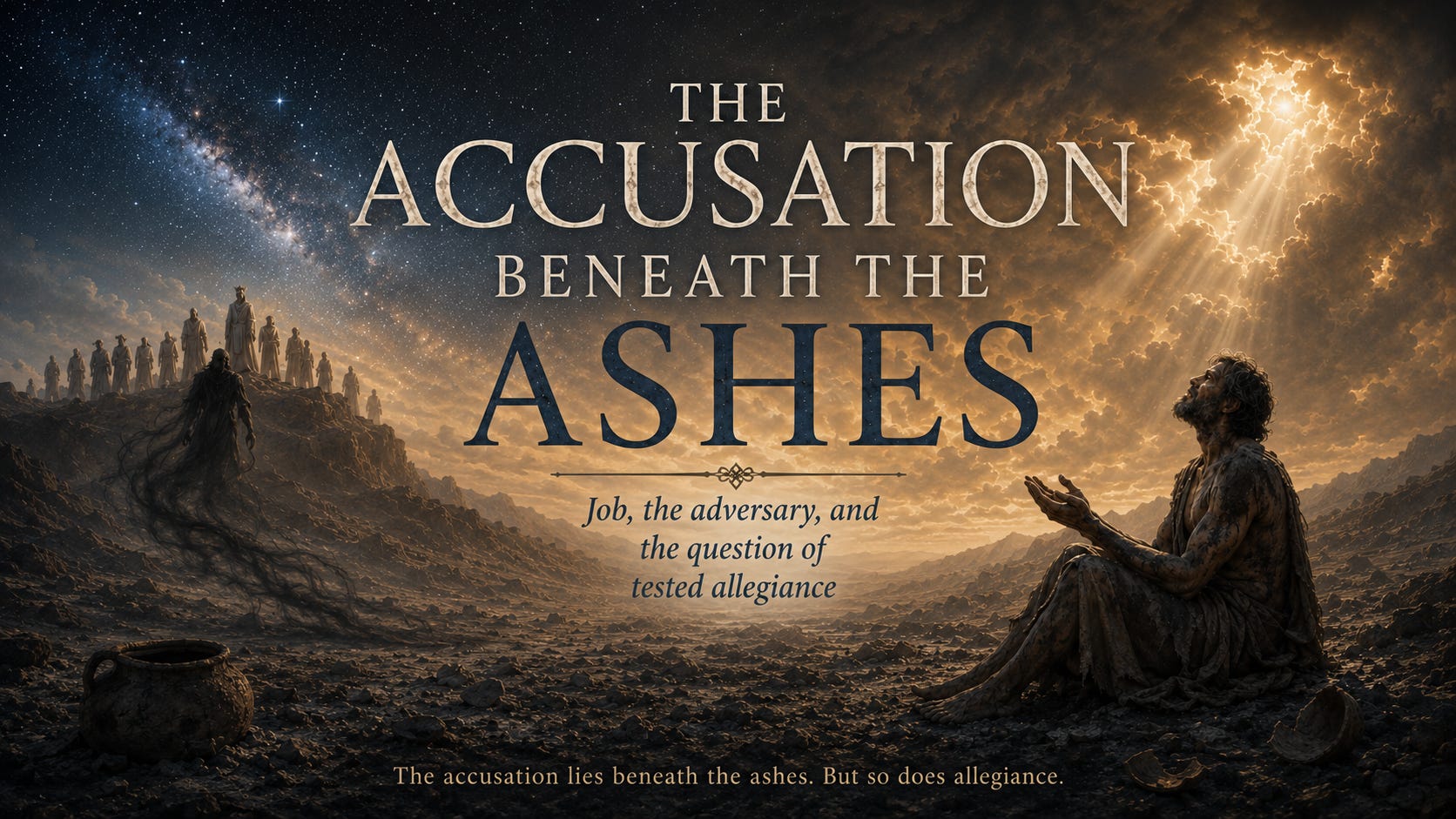
That is the accusation beneath the ashes.
The opening chapters of Job are often treated as though their main purpose is to give us a map of an unseen realm.
Readers ask:
Who are the sons of God?
Where are they gathered?
Is this a divine council?
What rank does the adversary hold?
How did he gain access?
What kind of heavenly structure are we being shown?
Those questions may be interesting, but they pull us away from the question the text itself places at the center:
Does Job fear God for nothing?
The adversary accuses Job’s faithfulness of being transactional.
In other words the adversary is claiming that Job’s allegiance isn’t real. That his righteousness isn’t rooted in love, trust, or reverence. It’s the expected response of a man whose life has gone well.
The test that follows is severe because the accusation is severe. If Job’s righteousness exists only because of blessing, then suffering will expose it the adversary claims. But if Job’s allegiance remains when blessing is stripped away, then the accusation by the adversary to God is false.
The reader is shown the accusation while Job is not shown it. That distinction matters enormously here. Job doesn’t know that his allegiance has been challenged.
He doesn’t know why his children have died.
He doesn’t know why his possessions are gone.
He doesn’t know why his body is afflicted.
He doesn’t know why his wife tells him to curse God.
He doesn’t know why his friends become prosecutors.
He doesn’t know why heaven seems silent.
The reader knows that Job’s suffering is not punishment for hidden wickedness, and again, Job doesn’t know that either.
This means the reader is given a guardrail before the poetic arguments ever begin. It tells us that not even his friends know why he is suffering. It tells us from the beginning that he is blameless, upright, one who fears God and turns away from evil. Yet suffering comes. And because Job doesn’t know why, his trust isn’t sustained by an explanation that he is made aware of.
That is where the book of Job becomes uncomfortable. Why?
We often say that we trust God.
We say He knows what we don’t know.
We say He sees what we can’t see.
We say He may test us.
We say we will remain faithful even when we don’t understand.
We often speak of trusting God as though trust means confidence that He will soon explain Himself. Job shows us a harder trust. One of allegiance that remains even when the explanation never comes.
Job shows us what those words look like when the floor collapses beneath the profession. The book of Job is where professed trust becomes tested trust and then proven trust.
Job 1:6 tells us that the “sons of God” came to present themselves before YHWH, and the adversary also came among them. The scene is repeated in Job 2:1.
Many readers understand the sons of God here as heavenly beings or angels gathered before God. That’s the familiar reading, and there are reasons people hold it. But the passage itself gives us fewer details than many later frameworks supply.
We aren’t given an exact location or an explanation of who the sons of God are or why they are presenting themselves. No throne room is described nor a divine council identified. And it doesn’t tell us that the adversary is one of the sons of God gathered there.
It says the sons of God came to present themselves before YHWH, and the adversary also came among them.
I lean toward understanding the sons of God in Job 1-2 as human beings who belong to God, perhaps representatives, priests, or rulers presenting themselves before Him in some context that the writer did not find necessary to explain for the reader. My reason isn’t that the phrase can never refer to heavenly beings. Job 38:7 likely uses similar language in creation poetry, where the context naturally points toward heavenly beings rejoicing when the earth was founded. But because sonship language throughout Scripture frequently applies to humans.
Israel is called God’s son.
The king is spoken of as God’s son.
Those who belong to God are called His children.
Sonship can describe covenant relationship, allegiance, representation, and belonging.
So I do not think “sons of God” automatically settles the question in favor of heavenly beings. But neither do I think the article must stand or fall on proving they are human.
There are at least two possible readings. I do not dispute this possibility.
The sons of God may be human rulers, priests, or representatives belonging to YHWH who have come to present themselves before Him. Or they may be heavenly servants presenting themselves before Him.
Readers may weigh those possibilities. But let me point out that neither possibility requires mythology to be overlaid here.
Human beings belonging to God are a concrete Scriptural category.
Heavenly messengers and servants of God are also a concrete Scriptural category.
The uncertainty of the phrase doesn’t give us permission to build an elaborate pagan divine-world system around it that God has continuely separated Himself from in Scripture. The identity of the sons of God may be debated, but the accusation against Job’s allegiance is not.
The wording is worth noticing. The adversary comes among them. So it doesn’t necessarily mean he is one of them. The text tells us where the adversary appears, but it doesn’t clearly classify him as one of the sons of God.
This matters because many readings quietly make that move for us. The adversary comes among the sons of God, therefore he must be a member of the same heavenly order. But that conclusion is not stated.
In Job 1:6, the sons of God come to present themselves before YHWH, and the adversary also comes among them.
In Job 2:1, the wording is repeated, but the text adds that the adversary also came to present himself before YHWH.
That small addition may be significant.
In the first scene, the adversary is among them, and YHWH addresses him.
In the second scene, the adversary is again among them, and the text explicitly says that he also presents himself before YHWH.
We should be careful not to make more of that distinction than the text allows, but we should also pay attention to it. The writer has chosen the wording carefully.
Whatever the setting may be, the adversary is not hidden from YHWH.
YHWH sees him, knows he is there, and He addresses him.
YHWH asks the adversary: “From where have you come?”
The adversary answers that he’s been roaming through the earth and walking about upon it. That detail deserves more attention than it often receives.
He is described as one who moves through the earth.
He roams.
He observes.
He accuses.
And perhaps he searches for the kind of allegiance he can challenge.
This raises a different way of seeing the scene. If the sons of God are human presenting themselves before YHWH, then the adversary who roams the earth has come among those whose allegiance belongs to God.
That would be an effective place for an accuser to stand.
If the sons of God are heavenly servants, the same central truth remains: the adversary has come from roaming the earth, and YHWH knows exactly where he has been and what he is doing. Either way, He is not caught unaware.
When YHWH asks where the adversary has been, He isn’t seeking information He lacks, but drawing the adversary’s activity into the open.
Then YHWH asks: “Have you considered My servant Job?”
That question can sound troubling when it’s read as though God is casually bragging about Job and inviting cruelty. But perhaps we should hear it differently.
YHWH knows what the adversary does. He knows the accusation behind the adversary’s roaming. He knows the claim that human allegiance is shallow, purchased, and easily broken. And He knows Job.
Job is not brought forward because YHWH is careless with him.
Job is brought forward because YHWH knows the truth of his allegiance.
The adversary claims Job fears God only because of blessing.
YHWH knows otherwise.
The suffering permitted in Job is severe, and the text doesn’t ask us to pretend otherwise. Job loses children, security, possessions, standing, and health.
The reader shouldn’t rush past that pain simply because it’s uncomfortable.
The book itself does not rush past it.
Job grieves.
Job tears his robe.
Job sits in ashes.
Job laments the day of his birth.
Job argues.
Job protests.
Job aches.
Scripture gives his suffering room to speak. But the opening scenes also make something clear. The adversary does not act without boundaries.
YHWH sets the limits.
At first, Job himself may not be touched. Then, when further testing is permitted, Job’s life must be spared.
That doesn’t answer every emotional or moral question a reader may have about the passage. Job is a difficult book because suffering is difficult.
But it does show that the adversary is not an equal power acting beyond YHWH’s reach.
He doesn’t set the terms.
He doesn’t define the limits.
The adversary roams, accuses, and strikes within boundaries set forth by God.
Job doesn’t hear the accusation. He only experiences what follows.
That is one of the deepest truths in the book.
Job isn’t given the comfort of knowing that his suffering has become the setting in which the sincerity of his allegiance will be revealed. He doesn’t know why this suffering has come upon him and all around him. And that is exactly where the book presses the reader about allegiance.
We often teach that we must trust God in everything.
We say, “He is in control.”
We say, “He knows what is happening.”
We say, “He may test us.”
We say, “Walk faithfully even when you do not understand.”
But when Scripture gives us a man whose trust is tested to its deepest point, we become uncomfortable. We want Job to receive an explanation, and to know why the suffering is happening before we agree that trust should remain.
But Job does not receive that explanation.
Not from the ash heap.
Not from his wife.
Not from his friends.
And not even when YHWH finally answers him.
Job’s friends believe suffering must prove guilt. He believes his suffering cannot be reconciled with what he knows about his own integrity.
The adversary believes suffering will destroy Job’s allegiance to God.
All of them are operating from what they can see, but YHWH sees what they don’t.
Job’s allegiance is not perfect silence.
It’s not emotionless submission.
It’s not pretending the suffering does not hurt.
Job grieves.
Job questions.
Job protests.
Job demands to be heard.
But Job keeps turning toward YHWH. Even his argument is directed toward the God he refuses to abandon. That is the depth of his trust.
Trust isn’t the absence of grief or the absence of questions.
Trust isn’t the ability to explain everything that has happened.
Trust is allegiance that continues reaching toward YHWH when the reasons are hidden.
The adversary predicts that Job will curse God when the blessings are removed.
Job does not. He mourns. He speaks words shaped by shock and grief. He later says things that YHWH will correct.
But the central accusation fails.
Job’s allegiance cannot be reduced to prosperity. His trust isn’t merely a response to protection. His righteousness isn’t proven false by suffering.
The adversary assumes that if a man loses everything, he will also abandon God.
Job shows otherwise.
Not easily or painlessly. Not without lament. But truly.
Here is a righteous man who not only professes allegiance to YHWH when life is full, but clings to Him when his life is emptied.
That is why the opening question matters so much.
“Does Job fear God for nothing?”
The book answers through Job’s suffering that His allegiance was never merely for sale.
Job 1-2 gives us enough to understand what is at stake, but it does not give us enough to build an entire mythology.
We aren’t told the exact location of the gathering.
We aren’t given a full definition of the sons of God.
We aren’t given the adversary’s origin story.
We aren’t shown a divine war between rival powers.
We are shown an adversary who roams the earth, comes among those presenting themselves before YHWH, and accuses the sincerity of Job’s allegiance to God.
We are shown YHWH, who sees the adversary, knows His servant, and sets the limits.
And we are shown Job, who never hears the accusation, lives through the test still loyal to YHWH.
Whether the sons of God are understood as human servants or heavenly servants, the passage remains within categories already known in Scripture. It doesn’t need mythology to make sense. The identity of the sons of God may remain open to discussion.
The heart of the passage does not.
The adversary says Job’s trust is purchased. And YHWH knows Job’s allegiance is real.
And Job, without knowing why his world has collapsed, continues to turn toward the One he cannot yet understand.
The accusation lies beneath the ashes.
But so does Job’s allegiance to the One he trusts.
No posts
Comments
Nothing yet. Say the first thing.
Sign in to join the conversation.