
Friends & Neighbors,
Two things happened at City Hall last week that look unrelated on the surface: a charter amendment died on the floor, and two council factions filed competing claims to a surprise $4.7 million. Here’s why either should matter to you even if you never watch a council meeting: that $4.7 million is your money, a correction that means Austinites are on track to pay the city more than originally projected, not less, and eleven people are about to decide where it goes without you in the room. Knowing how to read that decision before it’s made is the difference between finding out what happened to your tax dollars after the fact and actually seeing it coming.
Both of these developments are the same exercise, the one I ran constantly when I was on the dais and still run every time I want to know where a vote is actually headed. So instead of just telling you what happened, I want to show you how I got there, because it’s math you can do too, and it starts with understanding a piece of process almost nobody outside City Hall thinks about: the Texas Open Meetings Act.
Here’s the thing people don’t realize about how a council actually works: members can’t just call each other up and whip votes the way a state legislator can. TOMA prohibits a quorum of the body, and in practice any chain of communication that adds up to a quorum, from deliberating on city business outside of a posted, public meeting. That’s the “walking quorum” problem: if enough members talk to enough other members privately, even one-on-one, in a way that functionally reaches a majority, it’s a violation, whether or not anyone intended it that way.
What that means in practice is that public sponsor lists, floor statements, forum posts, and recorded votes aren’t just the record, they’re the only legitimate evidence anyone, including a sitting council member deciding whether to file something, has to work with. When I was drafting something I wanted to pass, I couldn’t just ask around. I had to read the same public tea leaves you can read: who’s publicly attached their name to what, who said what during a work session, who voted which way on the last thing that resembles this thing. That’s not political theater, it’s the legally required paper trail, and it’s genuinely useful if you know how to read it.
Quick terminology note, since I’ll use both terms below: an IFC (Item for Council Consideration) is the mechanism a member uses to direct the City Manager on a policy question outside the budget cycle, it doesn’t move money on its own. What Watson’s office and Council Member Fuentes each filed last week for the $4.7 million are budget amendments, a separate mechanism specific to the budget adoption calendar, filed by August 4, discussed August 6, voted August 12–14. Both of the forum posts announcing them use the informal shorthand “budget IFC,” which is common enough at City Hall, but they’re procedurally budget amendments, and that’s what I’ll call them from here on. Filing one publicly, with co-sponsors attached, is itself a vote-counting signal either way, because a member who files alone when they need six votes is either confident they’ll pick up support in the room or setting up a symbolic vote they know will fail. Which one it is is exactly the kind of thing this piece is about figuring out.
This past Tuesday, council heard public comment on a proposal to raise the threshold to certify a recall petition from 10% of registered voters in a district to 15%, a 50% increase in signatures required. It came out of the 2024 Charter Review Commission, sponsored originally by Council Members Ellis and Ryan Alter.
Public comment was close to a pile-on: Betsy Greenberg walked through the math: in Ryan Alter’s own District 5, with 61,442 qualified voters, a 15% threshold would require over 9,000 signatures, more than the fewer-than-8,000 votes that got him elected in the first place. David Weinberg was blunter: “Nobody’s asking for this... get out the black sharpie and delete this one.” Jeff Dickerson made the accountability case, asking where the evidence of recall abuse actually was. Nobody spoke in favor.
Following that, on Thursday, Mayor Watson filed his own floor amendment stripping the 15% back to the existing 10%, plus some clean-up language. That amendment passed 10-1, with only Natasha Harper-Madison opposed, and for a reason that cuts against the “incumbent protection” framing everyone else used: she argued a lower threshold makes it easier to target a Black council member in a low-turnout district for reasons that have nothing to do with performance.
Then, with the controversial number gone, the underlying item, essentially a clean-up bill at that point, still failed. Final vote: 4 in favor (Duchen, Watson, Velásquez, Ellis), 7 opposed (Fuentes, Harper-Madison, Siegel, Qadri, Alter, Laine, Vela). It won’t be on the November ballot in any form.
The lesson for vote-counting purposes: a lopsided 10-1 vote on cleaning up the language told you almost nothing about whether the underlying item would survive. Watching only the popular, easy vote would have gotten you the wrong answer. You need at least two data points from the same session to see the real fault line.
Separately, the city found $4.7 million in additional General Fund revenue it didn’t originally project, from a revised certified tax roll, not a new tax or fee. Two competing budget amendments claimed it within five minutes of each other Thursday evening.
Amendment A, filed at 7:00 pm by Mayor Watson’s office with Mayor Pro Tem Vela, Council Member Velásquez, and Council Member Laine, targets the money at children and youth specifically: food access, physical and mental health, and closing a gap where Austin ranks 50th of the 50 largest U.S. cities on enrolling eligible kids in CHIP and SNAP. It’s the only one of the two that requires a performance measure as a condition of the money.
Amendment B, filed five minutes later by Council Member Fuentes with Harper-Madison, Siegel, Ellis, and Qadri, restores the social services net more broadly, arguing that after last year’s 10% cut, this is a floor issue for the whole system, not one category.
Both landed against a backdrop of testimony two days earlier that was effectively nonprofits litigating an audit I’ve written about before: Integral Care’s Ryan Poppy pushed back directly on any read that the audit justified funding cuts, and Family Eldercare’s Aaron Alarcon said providers are hearing about reductions “with no clear rationale.” The unresolved question from that audit, money without a mechanism to verify results, is still unresolved. Amendment A at least gestures at it, asking the City Manager to create a performance measure “where it’s practical.” Amendment B doesn’t ask for anything on that front at all.
Then Thursday added a wrinkle neither amendment anticipated: staff’s own recommendation for the $4.7 million doesn’t go to either amendment’s target, it goes to the local housing voucher program, getting that line to within $1 million of its long-term funding goal. Fuentes pushed back on the dais, still wants it for the social safety net, Qadri backed her. And a third option showed up that doesn’t touch the $4.7 million at all: Council Member Siegel wants to fund $5.3 million in social services restoration by cutting general and professional consulting contracts instead, citing rates like $3,600/hour for “ad hoc course creation” and a nearly half-million-dollar city logo rebrand.
Budget amendments are due August 4, discussed August 6, voted August 12–14. So none of this is settled. But you can still count the votes as they stand today.
I’ll say plainly where I’d land if I still had a vote on this dais: my first inclination is no on both.
“Where it’s practical” is a request, not a mechanism, and a request is exactly what the City already had before the audit ever ran. Measuring performance was never the missing piece, the audit found the City was collecting the numbers just fine. What’s missing is anything that happens when a contract misses its goals, and neither amendment answers that as written. Amendment B doesn’t even ask the question. That said, I’d move off a no if either amendment came back with real assurance that the actual KPIs and outcomes get verified before the money goes out the door, staged funding tied to hitting the metric, not just a metric attached to a lump sum that gets paid regardless. That’s the difference between a performance measure and a performance requirement, and it’s a fixable problem if anyone wants to fix it before August 12. As filed right now, neither does, and the timing makes that harder to wave off, not easier. That report is barely two weeks old.
I won’t pretend that’s an easy position to hold publicly, though. A no vote on Amendment A reads, in a headline, as a no vote on food access and health care enrollment for kids. That’s the bind these votes are built to create, and it’s worth naming plainly: the harder thing to defend isn’t usually the wrong vote, it’s the right vote that sounds bad out loud.
I know this one from the inside, not just in theory. A version of this exact dynamic showed up against me in my own re-election. The vote itself wasn’t about kids at all, it was about something else entirely, but it got flattened into a mailer that recast it as if I didn’t care about vulnerable people, with none of the actual reasoning attached. It’s a lot easier to print a line like that and put it in a mailbox than it is to fight back with a paragraph explaining what the vote was actually about. The mailer wins that fight by default, because nuance doesn’t fit on a postcard and a vote record does.
Eleven votes on the dais, Mayor plus ten district members. Six is a majority.
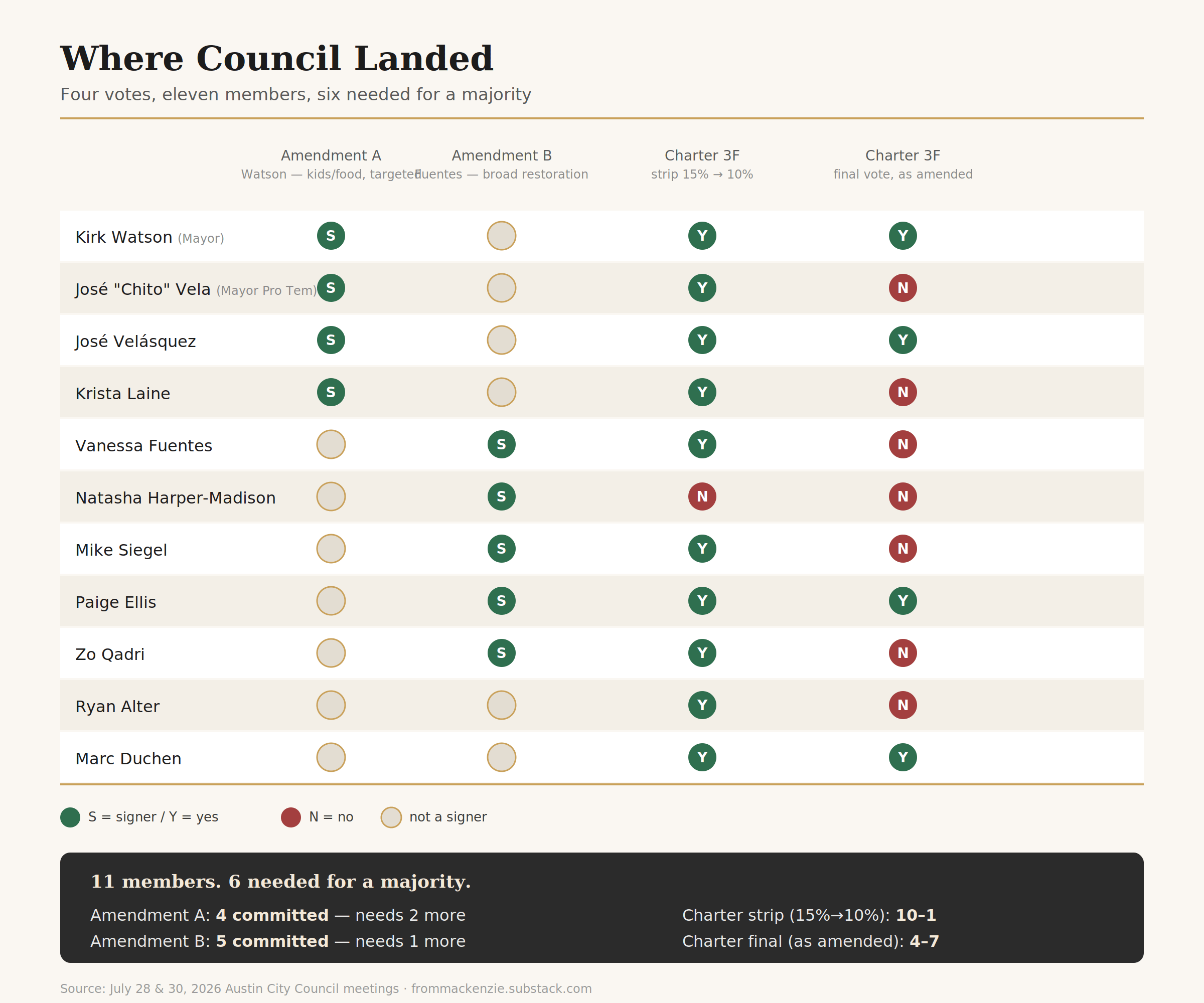
Amendment A: 4 committed, needs 2 more. Amendment B: 5 committed, needs 1 more.
On paper, B is closer. But before going further, it’s worth being honest about why the charter vote is even in this piece, because a recall-petition threshold and a social services budget fight have nothing to do with each other substantively. A member’s view on one tells you nothing directly about the other. The reason it’s here isn’t that the charter vote predicts the budget vote. It’s that the charter vote is the freshest hard evidence we have this cycle that sponsor lists don’t hold. Ellis and Duchen both broke from where you’d expect them to sit, based purely on who signed which budget amendment, within 48 hours of that sponsorship going public. That’s not a coincidence I’m reading into the budget fight, it’s proof, from this same week all of this came to light, that treating a forum post’s signer list as the final coalition is a mistake. That’s the entire reason to look at it: not to forecast this specific vote, but to calibrate how much weight to put on the sponsor lists at all.
With that caveat in place, here’s what actually complicates a simple read of the table. Laine and Vela both backed Watson on the budget but voted against him two days earlier on the charter item, more evidence in the same direction: don’t assume the budget coalition will hold just because it held on a forum post.
There’s a second factor worth building into your own read of any mayor’s vote count, separate from the charter comparison: a seasoned mayor who whips votes well doesn’t usually file something publicly until the math is mostly done privately. Watson is sharper at this than his recent predecessors, sharper than many of his current colleagues, too, and the tell isn’t the sponsor list itself, it’s whether he’s putting real floor time behind something, the way he did Thursday when he personally brought his own charter amendment rather than leaving it to someone else.
It’s also worth remembering that Ryan Alter worked for Watson back when Watson was a state senator. If anyone on this dais already has a read on how Alter is likely to vote, it’s probably Watson, and he doesn’t need to spend a co-sponsorship slot finding out.
That’s the difference between a mayor who’s actually good at this and one who’s just going through the motions: he’s not spending his effort lining up the people he already knows will back him. He’s out talking to the people he doesn’t already have a read on, which is a much better use of a mayor’s time than working the room he’s already won. His Mayor Pro Tem is already attached to Amendment A, which is usually the first domino in a mayor’s count, not a coincidence.
Watson was in the losing four on Thursday on the charter vote, and that’s worth naming rather than skipping past. But “usually” was the operative word, not “always.” A mayor who’s genuinely skilled at counting votes still loses sometimes, especially on an item he inherited rather than authored. The recall language came out of Ellis and Alter’s 2024 process, not his own office. One loss on someone else’s item doesn’t tell you much either way. What would actually be informative is if he started losing on things he personally originated and fought for, like the children’s budget amendment. That hasn’t happened yet, so I’d still weigh Amendment A more heavily than “4 of 6” suggests, on the theory that he doesn’t usually put his own name on something he expects to lose, not on the theory that he never loses at all.
The two members actually worth watching: Marc Duchen, who isn’t a signer on either amendment and floated his own idea of funding this through reallocation rather than new spending, which lines up closer to Siegel’s consulting-cuts approach than to A or B as written. And Ryan Alter, the hardest to predict on the current record, since he already showed Thursday he’ll vote no on a watered-down compromise rather than take half of what he originally wanted.
Whether a new co-sponsor gets added to Amendment A before the August 4 filing deadline. That’s the real tell that Watson’s private vote count is finished, not the four names on it today.
Whether Marc Duchen files his own reallocation-based amendment instead of signing onto either existing one. That would pull votes from both camps rather than add to either, and could stall both short of six.
How Ryan Alter votes once he’s not being offered a partial compromise. He’s already shown once this week he’d rather kill an item outright than accept half of what he wanted.
Whether Ellis and Laine land the same way on the actual budget vote as they did on the two forum amendments, or break the way they did on the charter vote. Either answer tells you something real about how much a signer list is worth this cycle.
Until Next Time,
Mackenzie
P.S. If you want to do this math yourself before I write it up, the meeting agendas, backup documents, and the Council Message Board are all public. The only thing standing between you and the same read I got is time spent watching the tape.
Sources: public comment and floor discussion drawn from the July 28 and July 30, 2026 council meetings. Meeting agendas and video are on the City Council meeting information page; the full charter amendment package and August 6 vote details are on the proposed charter amendments page; council members post directly on the Austin City Council Message Board; the July 30 social services grant reductions memo is here.
No posts
Comments
Nothing yet. Say the first thing.
Sign in to join the conversation.