
Friends & Neighbors,
I’ve been sitting on this one for a few days, trying to find the right way to bring it to you, because it’s the kind of news that’s equal parts proud and heavy, and I wanted to get it right.
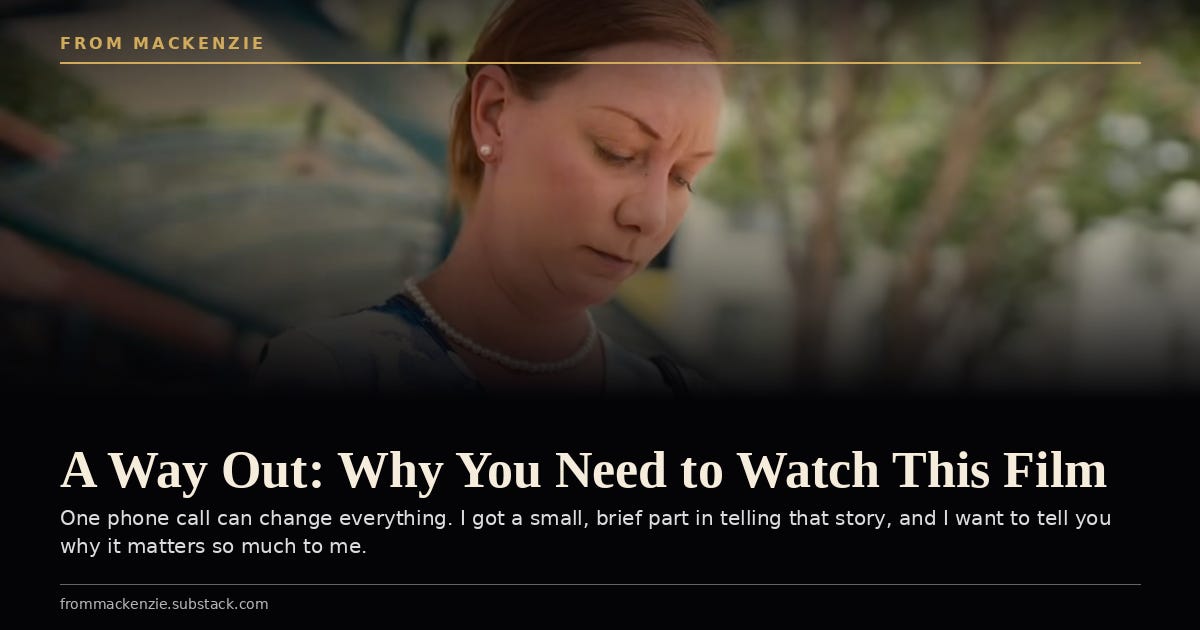
A documentary called A Way Out came out on July 30, and it’s streaming now on Apple TV, Prime Video, and YouTube. I have a tiny, blink-and-you’ll-miss-it part in it. I’m not going to oversell my role, I promise you I am not the star, but somewhere in that film is a small piece of me, sitting alongside a story I have cared about for years, and I wanted to be the one to tell you about it myself before you stumbled on it on your own.
One more reason to watch for you specifically, if you’re local: parts of this film were shot right here in Austin back in 2025, and you’re going to recognize the skyline and more than a few street corners. My own scene was filmed at Plaza Saltillo Station, the CapMetro rail stop out in East Austin. So when downtown pops up on your screen, or that platform does, that’s not a backlot standing in for somewhere else. That’s home.
You might also spot me somewhere else entirely: Safe House Project has been running a campaign for Simply Report, their app that lets anyone quickly and confidentially report suspected trafficking, and I show up in a couple of those posts too, including this one on Instagram and this one on X, also filmed during that same 2025 shoot.
Here’s the part that made the whole thing feel like more than a coincidence to me: when the production team first asked me to be part of this on behalf of Safe House Project, I’m pretty sure they had no idea about my history with this issue, the resolutions, the ride-out, any of it. They simply asked, and I said yes because the cause mattered to me. Finding out later that I’d been carrying this fight for years the entire time, without them ever knowing, made being part of it feel less like a favor I was doing them and more like something that was always going to find its way to me.
The film follows Safe House Project, the national anti-trafficking nonprofit founded by Kristi Wells, as they respond to the reality of human trafficking in this country and build what the title promises: a way out. It centers on a survivor making a single call for help, and then follows what happens next: the rapid response, the advocates, the law enforcement partners, the whole quiet network of people who show up so that one phone call can turn into an actual exit from captivity. It’s already been named an Official Selection at the International New York Film Festival, it’s picked up other award recognition on the festival circuit, and even before its release, it played on Delta flights, so that passengers, some of the very people trafficking travels through airports and hotels to reach, could see it too.
I am so proud of Safe House Project and everyone who poured themselves into this film. And selfishly, I’m proud to have a really tiny thread in it, because this issue found me a long time before this documentary did, and it has never really let go. So today I want to use this space to tell you why this film matters to me, what I actually did about this while I held elected office, and why, underneath all the awareness campaigns and proclamations, this crime should still make every single one of us furious.
I didn’t come to this issue through a briefing book, and I definitely didn’t come to it because it seemed like good politics. I came to it through a ride-out, on a day I still think about.
While I was on Council, I decided to go on yet another field trip. This was a ride-along with a Travis County constable’s sergeant into a homeless encampment, one with more than 100 people living in it. Fox 7 did a story that same day about it, but outside of the story they did, I met a woman in one encampment who was in visible distress. When I asked the sergeant about her, he told me she was being sex trafficked, inside the camp, by someone else living there. I remember standing there and just feeling the bottom drop out of my stomach. That conversation is the reason I authored my first resolution on this issue. It broke my heart to realize she almost certainly wasn’t the only one, and that our city had no real system built to even notice.
That resolution, passed unanimously by the Austin City Council, directed the city to get trafficking-awareness training and resources to any vendor or nonprofit that contracts with the city on homelessness or housing, required educational materials on the signs of exploitation to be posted in shelters and city buildings, asked the city to work with the Austin Chamber of Commerce on business participation, and put the city on record supporting state legislation to end trafficking. You can read more about it in Texas Public Policy Foundation’s coverage, KVUE’s report on the unanimous vote, and Austin Journal’s interview with me at the time.
A couple of years later, that same ache pulled me back in, and I authored a second resolution, this one aimed at festival season. Austin hosts SXSW and a string of other major events every year that draw hundreds of thousands of visitors, and large gatherings like that are documented magnets for trafficking activity. That resolution directed the city manager to run an awareness campaign and pushed to get the Austin Police Department’s trafficking unit more of the practical tools they told me they were missing, things as basic as being able to pay for a rideshare so a rescued victim could get somewhere safe, since officers told me they couldn’t use Uber or Lyft for that. It also had me reaching out to the Texas Lodging Association about hotel rooms for victims in the immediate aftermath of a rescue. What pushed me to write it was hearing about a 16-year-old girl trafficked from Kansas to Austin and sexually assaulted here. KVUE covered the resolution, and KXAN told her story and mine in more detail.
I want to tell you more about her, because I learned the details of her case while working with APD, and it has stuck with me ever since. She had been groomed online for over a year by a man in Austin before he finally moved to take her. He drove his mother’s car all the way up to Kansas, and the two of them drove that same car back down to Austin together. She was recovered because Wichita police were able to track that vehicle using license plate reader cameras as it crossed state lines and rolled back into Austin, and once it was here, APD found it. That is not an accident. Austin’s license plate reader program is something I championed on Council, over real public pushback and real privacy concerns, because I believed the tradeoff was worth it. I will never be able to prove exactly how many people it has helped, but I know it helped find her. That’s the kind of thing that doesn’t show up in a headline, but it is the entire reason I think unglamorous, boring-sounding infrastructure decisions matter as much as any resolution I ever authored.
I also worked directly with the Austin Police Department’s Human Trafficking Unit throughout my time in office, the detectives and team who do the actual work of finding and recovering victims, often with a fraction of the resources the scale of this crime demands.
Since leaving office, I wrote an op-ed for The Hill making the case that we’re still getting this wrong. Good intentions and press releases are not a strategy. What actually moves the needle is funding for housing, health care, legal advocacy for survivors, and holding the systems that are supposed to protect people accountable when they fail. Awareness campaigns are a start, not a finish line.
Here are the numbers, and I want you to sit with them instead of skimming past them.
An estimated 25 million people are trapped in human trafficking worldwide right now, roughly the population of the entire state of Texas. Human trafficking is estimated to be a $99 billion criminal enterprise in this country alone, and one of the largest criminal industries on the planet. Texas ranks No. 2 in the nation for human trafficking cases, according to the Texas Attorney General’s office, and Austin, my city, is not exempt from that.
Now here’s the part that should make you angry: Safe House Project estimates that only about 1 percent of trafficking victims are ever identified. Not rescued. Not helped. Identified. Ninety-nine percent of the people trapped in this stay invisible to the systems that exist to help them. That’s not because the crime is rare. It’s because most victims don’t know they’re victims, most of them know their trafficker personally rather than being snatched by a stranger, and roughly 90 percent of trafficking victims experience pregnancy at some point during their exploitation. This isn’t happening in some distant place. It’s happening in encampments, hotels, festival crowds, and neighborhoods in cities like ours, hidden in plain sight because we’ve spent decades treating it as somebody else’s problem.
That’s the perversion at the center of this: a crime this large, this profitable, and this well documented, and we still identify almost none of the people trapped inside it. Every single one of those 99 percent is a person a call, a training, a resource, or a rideshare voucher might have reached in time. That’s not an abstraction. That’s the woman I met in that encampment.
Watch the film. It’s free on YouTube right now, and also available on Apple TV and Prime Video.
Support Safe House Project directly. They run a national network of safe homes for survivors, train hundreds of thousands of people every year to recognize the signs of trafficking, and cover the real, unglamorous costs of getting someone out, the Uber ride, the plane ticket, the hotel room, the groceries.
Learn the signs, and if you see something, call the National Human Trafficking Hotline at 1-888-373-7888.
Push your own local officials to fund this work like they mean it, not just proclaim awareness months and move on.
This is a solvable problem. It’s not being solved because we keep treating it like a headline instead of an infrastructure problem. I’m proud of the very small role I played in this film, and I’m so much prouder of the survivors and advocates whose actual work it documents, the people doing this quietly, every day, long after the cameras leave.
So tonight, or this weekend, whenever you have an hour to give it, pour yourself something warm, gather whoever you love most on the couch next to you, and watch it together. I have a feeling it’ll stay with you the way it has stayed with me. And if you feel even a fraction of what I feel about this, go do something with it.
Thank you, as always, for reading this far and for caring about the things I care about. It means more than you know.
Until Next Time,
Mackenzie
P.S. If you blink at the wrong second, you will miss me completely, so consider this your official permission to use the pause button. I promise I'm not that good an actress anyway.
No posts
Comments
Nothing yet. Say the first thing.
Sign in to join the conversation.