
Friends & Neighbors,
Some of you may remember the memo I wrote back in August 2023: I asked the City Manager for a comprehensive review and audit of homeless services and spending within our city. I didn’t have the votes to make it policy, so I sent it as a memo instead, which meant it went on the public record but didn’t obligate anyone to act on it. As best I can tell, nobody did.
Friday of last week, a routine budget memo landed that I think proves my point better than I could have three years ago.
$845,831 eliminated. $329,200 of it is the part that matters.
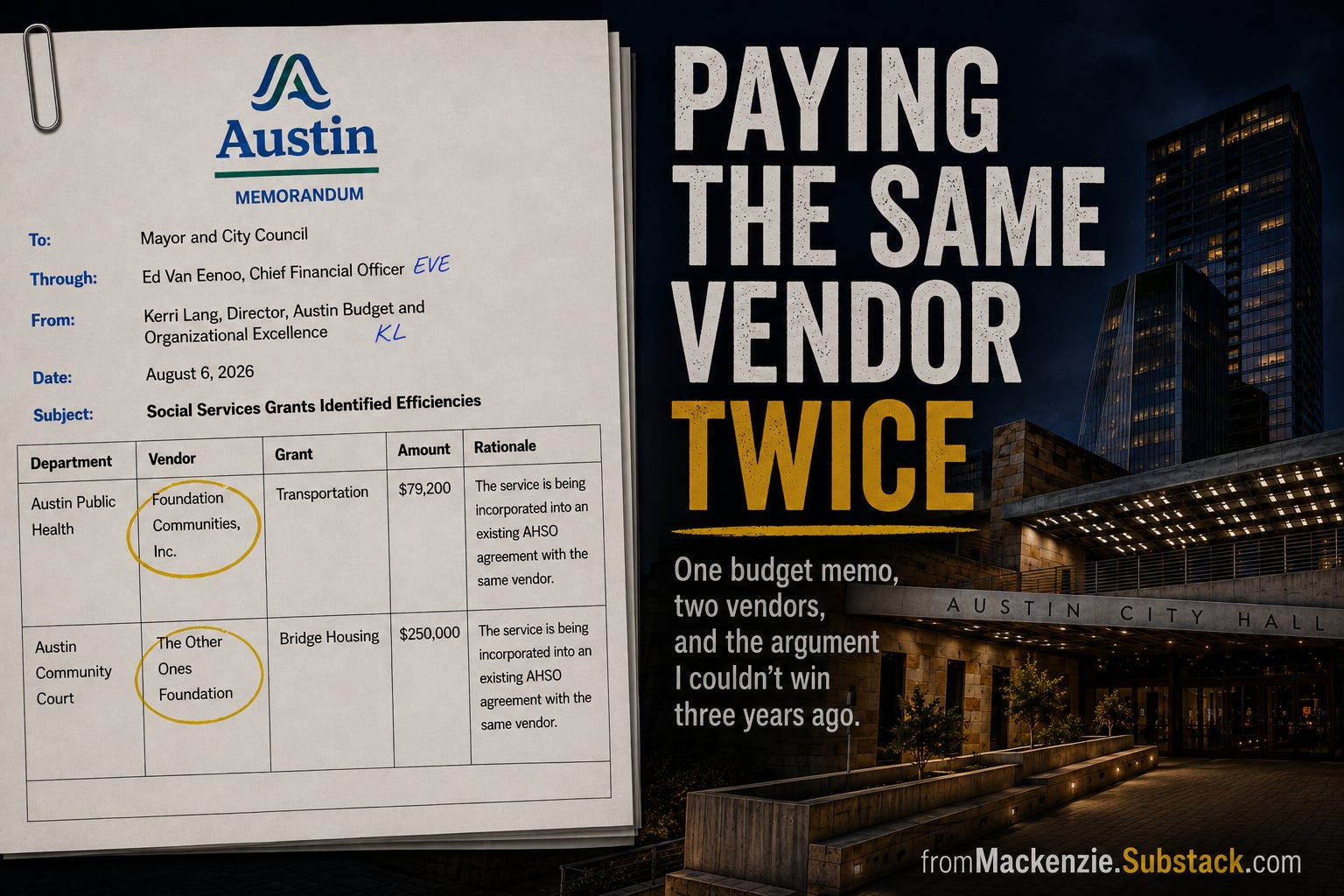
On August 6, Kerri Lang, the city’s Director of Budget and Organizational Excellence, sent Council a memo identifying nine social services grants being sunset, consolidated, or folded into other programs. Cutting them eliminates $845,831 in funding, and the memo states plainly that doing so “will not impact existing service levels.”
I want to be precise about what that $845,831 actually is, because it’s not one thing. Most of it is unused contingency money, programs already scheduled to wind down, and a few things city staff had already decided were lower priority. None of that is “savings” in the sense of the city recovering money it shouldn’t have spent. It’s mostly money that was never going to be spent the way it was budgeted, or that staff had already decided to stop funding for other reasons.
There’s also a fourth category worth flagging on its own, because it’s not really a cut at all. $150,000 for the Sunrise Community Church’s Mobile Outreach and Housing Navigation Program isn’t being eliminated. It’s being moved off recurring city funding and onto one-time HOPE Fund money tied to the new South Austin Housing Navigation Center. That’s not a redundancy and it’s not unused money. It’s a funding swap, and swapping a recurring source for a one-time source on an active homelessness outreach program is worth watching, not filing away as “no impact.” One-time money runs out. If nobody replaces it next year, that’s a real service actually at risk, just delayed a budget cycle.
Two line items are different, and they’re the ones that caught my attention, because of how they’re worded:
Transportation, Foundation Communities, Inc., $79,200: being folded into an existing agreement with the same vendor
Bridge Housing, The Other Ones Foundation, $250,000: being folded into an existing agreement with the same vendor
That’s $329,200 where the city was running two separate funding streams to the same vendor for related work, and someone eventually noticed. That’s the real finding here. Not a priority call, not unused contingency money. The city had been paying for overlap it didn’t need to pay for, and caught it.
**[Correction, added August 12]:** I described the $329,200 in Foundation Communities and The Other Ones Foundation line items above as the city “running two separate funding streams to the same vendor for related work.” I want to soften that. The memo’s actual language for both line items is the same: “The service is being incorporated into an existing AHSO agreement with the same vendor.” That’s consolidation, not overlap. After Chris Baker at The Other Ones Foundation reached out with context that wasn’t in the memo, it’s clear TOOF’s $250,000 Bridge Housing contract served a distinct, high-acuity client population with its own referral pathway, a different service than their standard shelter contract, not an overlapping one. Based on that same conversation, it sounds like Foundation Communities’ $79,200 transportation line works similarly, covering vans, drivers, and rideshare across their Single Room Occupancy properties, separate from their property-by-property service contracts, though I haven’t confirmed that detail directly with Foundation Communities and will update again if that changes. I read more into that line item than the memo said, and I’m glad Chris reached out so I could get closer to it. I also want to be clear this newsletter isn’t, and isn’t going to become, a witch hunt against the nonprofits doing this work. The problem I keep coming back to sits with the City’s own systems, not with organizations trying to serve people with the resources they’re given. I plan to visit both organizations in the coming weeks to see their work firsthand. The broader point of this piece still stands. I just wanted this particular figure to be right.
Why $329,200 matters more than $845,831
I want to be honest about scale here. $329,200 is a rounding error in a multi-billion dollar city budget. Nobody should read this and think the city just found its big fiscal problem.
But that’s exactly why I think it matters. This wasn’t found by a comprehensive audit. It was found by routine budget staff doing routine budget work, across a handful of departments’ grant portfolios, nine grants total. If routine review at that scale turns up a real, documented case of double-paying the same vendor, the obvious question is what a genuine, systemic, department-by-department audit would find if it went looking on purpose instead of stumbling into it.
That’s the exact case I was trying to make in 2023. I didn’t have $329,200 in hand back then. I had a hunch, built on watching individual contracts and individual votes up close, that nobody had really gone looking. I still think that hunch has held up.
The fight happening right now over exactly this
Here’s where it gets timely. Austin voters are going to decide this November whether the city has to do this kind of scrutiny as a matter of law, not just when a budget staffer happens to catch something.
In February 2026, Council unanimously passed its own ordinance setting up a recurring systemic audit of city departments, directing the City Auditor’s Office to bring in outside experts to look at management, contracting, and cost-saving opportunities, with the first audit required to launch within a year. Separately, the PAC Save Austin Now spent six months gathering more than 20,000 signatures to force a charter amendment onto the ballot requiring the same basic idea, recurring external audits of city spending, utilities, and vendors, every five years, written permanently into the city charter instead of sitting in an ordinance Council could later undo. Council voted July 30 to add that petitioned amendment to the November ballot alongside its own slate of charter proposals.
The city’s position is that the ordinance already covers this. Save Austin Now’s position is that a charter amendment can’t quietly get repealed by a future Council the way an ordinance can. I’m not going to pretend that’s a small distinction. It’s the entire argument. An ordinance is only as durable as the Council that keeps it. A charter amendment belongs to voters.
If you want the fuller background on how this fight connects to last November’s failed Prop Q, KUT’s coverage is worth a read.
I don’t think this week’s memo settles that argument. But I do think it’s a small, real, dollar-denominated example of the thing both sides claim to want: someone actually checking whether the money is doing what it’s supposed to. The disagreement is about who should be required to keep checking, and how hard it should be to stop.
And yet, Council still spends freely
Here’s the part that I think is worth sitting with, and it’s the part that keeps this from being a simple “see, audits work” story. The same city that just found $329,200 in documented vendor overlap also, in the same stretch of weeks, put a $295 million parks and libraries bond on the ballot and built a tax rate increase into this year’s budget projected to bring in 3.5 percent more revenue. Finding real overlap in one grant portfolio and asking taxpayers for hundreds of millions more in the same season are not contradictory acts, exactly. But they don’t sit easily next to each other either.
Someone once told me the definition of insanity is doing the same thing over and over and expecting a different result. I’d argue Austin has that backwards. The city keeps finding the same kind of overlap and waste, memo after memo, year after year, and keeps expecting the next ask for more money to land differently anyway.
Here’s the part I actually want to give credit for: the instinct to look for savings is real, and when it shows up, it works. Kerri Lang’s team found $329,200 of documented overlap in this one memo. That’s not nothing, and it’s not the only example. Council passed its own resolution in August 2024 explicitly aimed at “identifying and eliminating redundant technologies and overlapping solutions” in city cybersecurity systems. This year’s budget cites $5.8 million in savings from consolidating overlapping IT applications and centralizing technology that had been duplicated across departments. And the $845,831 memo itself is only a slice of a larger effort: budget staff separately recommended eliminating 24 social service contracts and reducing 53 more, cutting $5.35 million total, after Council asked staff in a July 22 work session to review contracts individually instead of applying an across-the-board cut.
So the instinct is there, and it clearly produces real findings when someone actually applies it. My complaint isn’t that the instinct is missing. It’s that it seems to only fully show up either quietly, in memos nobody outside City Hall was going to read, or loudly, after an internal audit becomes headline news and enough people are outraged that Council has no choice but to act on it. And even in a budget cycle that found all of the above, the city still landed on a $6.6 billion budget with a property tax increase and a net 225 new positions. What I haven’t seen much of is that same instinct showing up on its own, before a scandal forces it, at the same scale and with the same seriousness the city brings to asking for more money. A city that is serious about efficiency looks for it as a matter of routine, not just after the memo leaks or the audit makes the news.
That’s the same standard I’ve been applying to the parks bond, and it’s the same one I’d apply here: show me the overlap gets found because someone was actually looking, not by accident on the way to the next ask.
Until Next Time,
Mackenzie
P.S.: If you want the fuller story on my 2023 memo and how it connects to last month’s nonprofit contract performance audit, including the ARCH story and the McKinsey contract saga, I wrote about all of it here: The Audit I Didn’t Want to Write About.
No posts
Comments
Nothing yet. Say the first thing.
Sign in to join the conversation.