
A quick correction: Monday's post described a city budget memo as showing two nonprofits, Foundation Communities and The Other Ones Foundation, being paid twice for the same service. That wasn't quite right, and I've corrected it on the original post. After Chris Baker at The Other Ones Foundation reached out to me directly with context not in the memo, I learned something different from what I had published. TOOF's contract turned out to fund a distinct service being consolidated, not overlapping payment. Based on that same conversation, it sounds like Foundation Communities' contract works similarly, though I haven't confirmed that directly with them yet. The rest of my post still stands. I appreciated the chance to get closer to it, and I always welcome that opportunity. That's it, that's the correction. On to today's piece:
Friends & Neighbors,
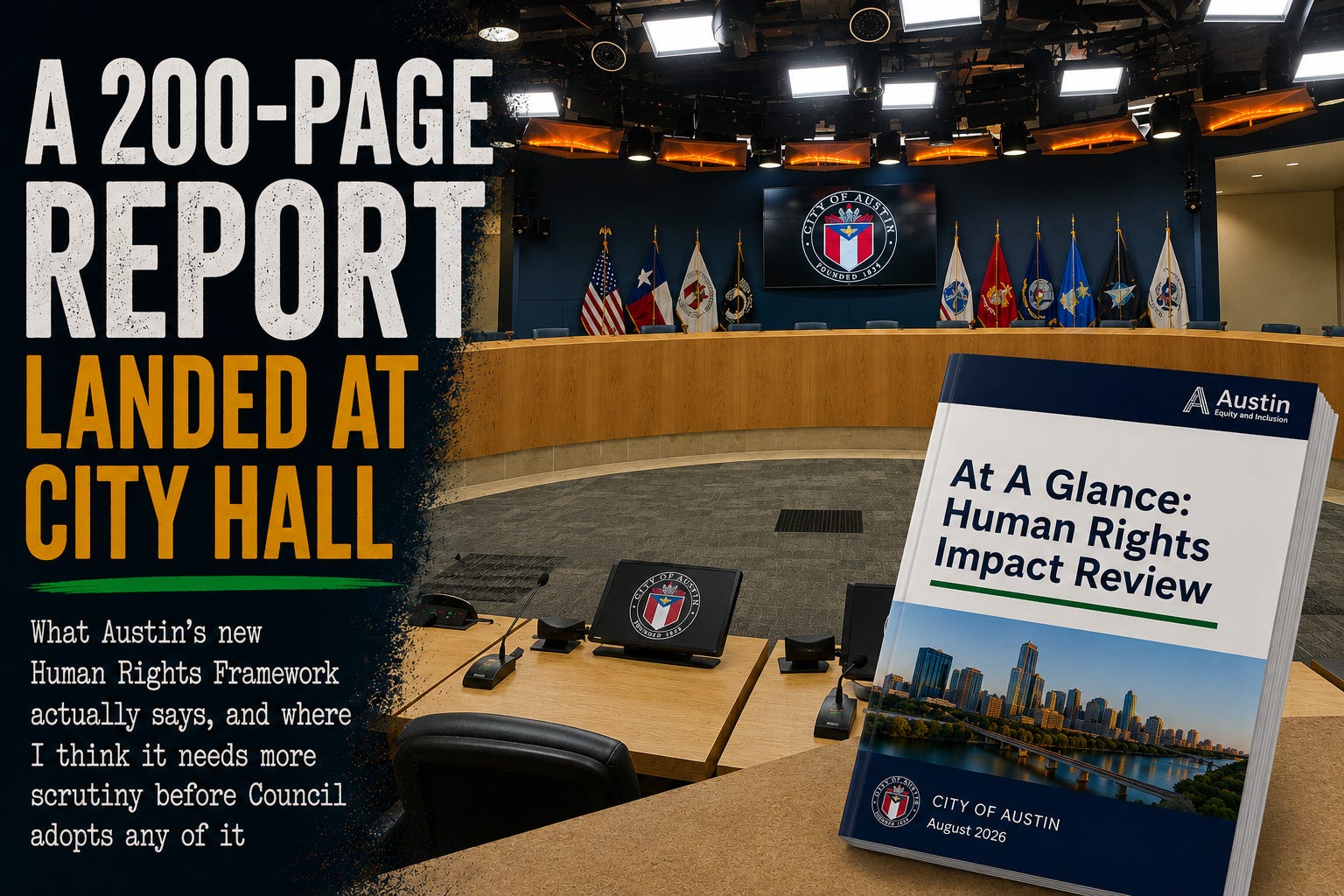
Regular readers know I’ve spent real time on human trafficking specifically, the resolutions I authored on Council, the ride-out that started it all, and the film I recently told you about. So when a 200-plus-page report called the Human Rights Impact Review landed at City Hall earlier this month, with an entire section devoted to trafficking, I read the whole thing instead of skimming the summary. I want to walk you through what’s actually in it, because some of it is good, some of it needs a harder look, and almost none of it deserves the version of this story that just screams and moves on.
What this actually is
In 2025, City Manager T.C. Broadnax set a goal of building a “Human Rights Framework” for evaluating city services and hired an outside firm, Henekom Group, to run the process. Over the past several months, Henekom reviewed more than 160 sources, engaged over 300 stakeholders, and ran a workshop where 120 community members sorted issues and possible fixes into a scoring grid across twelve topic areas: accessibility, aging, economic mobility, hate crimes, homelessness, human trafficking, immigration, LGBTQIA+ issues, public safety, reentry, veterans, and worker rights. The result is 69 recommended “mitigations” that Council will be briefed on August 25.
Where I think this lands well
Most of what’s actually in this report is not what you’d expect from the framing. It’s things like: senior transportation registration drives, better bus stop shade near senior housing, a document recovery program for homeless residents who’ve lost their ID, and closing loopholes that let illicit massage businesses dodge licensing. That’s boring, practical, good-government stuff, and a fair amount of it is stuff I’d have supported on the dais.
The trafficking section specifically is the one I can speak to with the most confidence, and it’s honest about something I’ve said in this substack before: Austin’s institutional response to trafficking has been thinner than people assume. The report says plainly that Austin has never had a citywide trafficking strategic plan, Austin-specific data on the scale of the problem, or a formal training mandate across departments. That matches what I found when I was in office. If Council actually funds a real strategic plan and better data collection here, I think that’s a genuine step forward, not a symbolic one.
Where I think this needs a much harder look
The international framing. This report doesn’t just recommend policy changes, it explicitly grounds municipal decision-making in international human rights treaties, including some the United States has never even ratified. It cites the UN Convention on the Rights of Persons with Disabilities and quotes Barcelona’s city government approvingly as a model for governance. The consultant’s own cover letter states Austin is “one of only two cities in the United States” attempting this kind of review. I don’t think citing an international framework automatically makes a policy bad. What I do think is that Austin voters deserve a plain answer to a plain question: Is a UN framework, one our own federal government hasn’t adopted, now the stated basis for how city departments are supposed to evaluate themselves? That’s worth Council saying out loud, not burying in a footnote.
The immigration enforcement language. One mitigation directs a “Safe to Call Working Group” to codify the distinction between local police and federal immigration enforcement. This builds on Austin’s existing 2018 Freedom City resolutions, so it’s not new territory, but given how charged immigration enforcement is right now nationally, I think this deserves its own separate, standalone conversation at Council, not a single line item buried inside a 69-item list that’s being presented as a package.
The prostitution and trafficking policy. This is the one I have the most complicated feelings about, because I understand exactly why it’s in there. The report recommends APD adopt a policy that assumes victimization for anyone found selling commercial sex and prioritizes diversion to services over arrest. The reasoning is sound on its face: an arrest record for prostitution could permanently block a trafficking survivor from housing and employment, deepening the exact vulnerability that got them trafficked in the first place. I don’t dismiss that. But “assume victimization, prioritize diversion over arrest” is, in practice, a form of non-enforcement, and I think Council owes the public a direct conversation about that tradeoff rather than adopting it as one bullet point among many. My own work on this issue taught me that the details of how you protect victims matter enormously, and this is exactly the kind of detail that deserves its own hearing, not a rubber stamp.
The price tag nobody’s said out loud. Here’s my biggest process objection, and it’s the same one I’ve raised about other city initiatives all year. This report does not disclose what the city paid Henekom Group for this engagement, what the new Human Rights Division costs annually, or what all 69 mitigations would cost if Council tried to fund even half of them. Each mitigation is individually flagged for whether it requires new money, but there’s no total anywhere.
I went looking for myself. On Monday, August 10, I searched Austin Finance Online, the city’s own public payment database, for “Henekom.” Nothing came up. No payee record, no dollar amount, no year. That doesn’t mean the city didn’t pay them; it likely means the payment hasn’t posted yet, is filed under a different vendor name, or is sitting in a purchase order that hasn’t been fully processed.
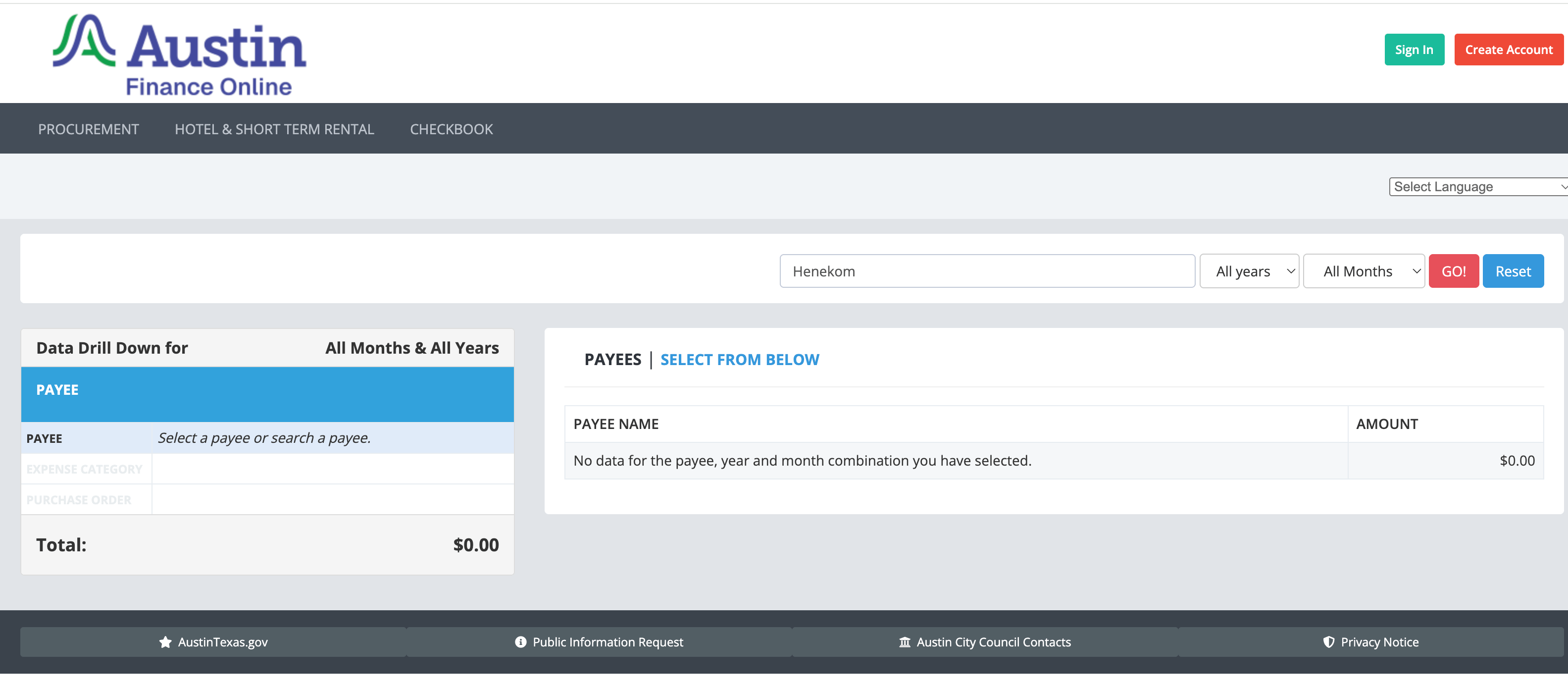
Getting a real answer would mean filing a public information request, which can take anywhere from days to months, depending on how the city responds. If I were still on the dais, that’s the first thing I’d ask for before voting on anything in this report: show me the number before I say yes to the list, and show it to me somewhere a resident can actually find it.
Where I land
I’m not going to tell you this report is secretly radical, because most of it isn’t. I’m also not going to tell you it’s just a routine efficiency memo, because parts of it clearly aren’t. It’s a mixed document: real, useful groundwork on an issue I care about deeply, sitting next to a governing framework and a couple of specific policy calls that deserve a much more public, much more standalone debate than a single line in a 69-item list. Council gets briefed on this later this month. If you have a view on any of this, that’s the moment to show up and say so.
Until Next Time,
Mackenzie
No posts
Comments
Nothing yet. Say the first thing.
Sign in to join the conversation.