
The great challenges of our time can be symbolised in 4 Cs: climate, capitalism, conflicts and computers (AI). The challenges are systemically intertwined and one of the interconnectors is that there are limits to further economic growth. I’ve discussed the reasons in my most widely read post on Substack to date. Today I’m writing (again) about economic growth, ie GDP growth and, more specifically, about the „Limits to Growth“ that are becoming increasingly noticeable.
With this post, and with my posts here in general, I am trying to explain without oversimplifying such concepts in a way that is understandable even to non-economists. I hope this works out. And I’d like to ask my readers to send me any questions, comments, or disagreement you may have, which I’ll be happy to answer in future posts.
We use GDP to measure in monetary units the sum of goods and services the a region, a country or the world is producing and consuming. Empirically we are seeing that growth rates are slowing down all over the world. Even the Chinese economy is growing at less than 5 per cent a year now, which is only half the rate it was a few decades ago. Why is that so?
One reason is purely mathematical. Economic growth appears to be linear than exponential. Linear growth of GDP means production/consumption is growing approximately by the same amount every year. If that is the case, then the percentage increase gets smaller year on year, because the constant increase is relative to an ever-larger pie.
In my article, I presented economic arguments beyond sheer mathematics that explain why and how not only natural resources limit the growth of GDP. The „growth drivers“, supply and demand, which used to work so “well” over the last seven decades, aren‘t driving any more: employment, capital, natural resources, consumption, exports, investment and government expenditure for various reasons are growing at a slower rate than they grew in an exceptional historical phase of the second half of the 20th century.
Economists agree that GDP does not measure the wellbeing of those who produce or consume the goods and services. In fact, the relation between GDP and wellbeing is quite loose and, moreover, it depends very much on how they are distributed.
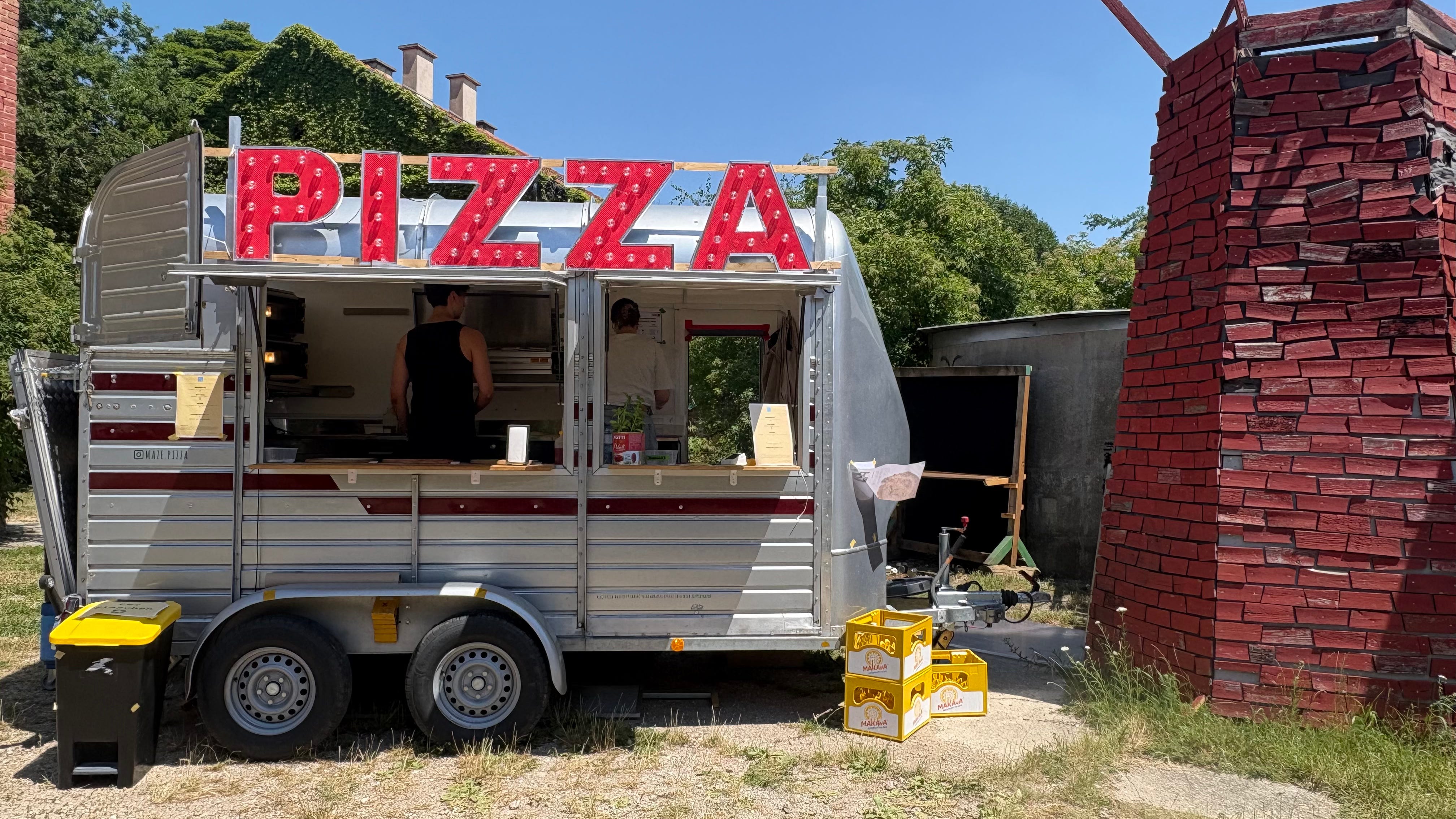
The pizza truck on my photo from the second life market at Vienna’s Zukunftshof last weekend may serve as a symbol for what it is all about: good food and high quality satisfaction of other needs for all. (I remember Mathis Wackernagel frequently speaking about Italy and especially Italian food as a good example of living a good life on a relatively small ecological footprint.)
And if we consider products that last for more than a year, such as cars, furniture, musical instruments or computers, the physical stock of products on earth can grow even if GDP would not grow at all. (This is where the comparison of a pie or a pizza ends.) I wrote a more than 350 pages book on this with my friend and colleague Christine Ax, entitled “Wachstumswahn, was uns in die Krise führt und wie wir wieder heraus kommen” (“Growth mania: what is leading us into the crisis and how we can get out of it”, still available as a used book in German language only).
Let me come back to the interconnected challenges of our time. In my article I wrote: “In a limited world … the drive for growth becomes a source of even more conflicts over access to natural resources. Higher growth in some parts of the world makes it more difficult for other regions to grow and, hence, economic competition increases, since economic growth requires a steady inflow of raw materials.”
Conflicts arise at many levels: within companies; in regions where raw materials are ‘extracted’ (though not everyone benefits); between industries, countries and major economic powers. In a world of limited growth the huge AI related investments aremade at the expense of other uses. For me it is obvious that the way capitalism drives economic development is not so much based on people’s needs than on the capital owners’ fantasies of growth backed by governments’ support. In this world, environmental degradation is a consequence and may be limiting further economic development in the future.
Today AI seems to make human labour abundant which could increase the world economy’s potential to grow. But at the same time it increases the world’s hunger for natural resources, especially for its excessive energy demand, which in turn fuels the climate crisis, biodiversity loss, and reduces the potential to produce other things that are closer related to human flourishing such as growing food for everybody.
Certainly, investment in future capacities to produce and consume is an alternative to immediate consumption and may improve the situation of future generations. Security is another topic that may require allocating today’s resources (capital, labour and nature) for the sake of future opportunities. But again the question is: who decides? And who benefits?
The situation with national security appears to be much the same with regard to the global increase in AI. When governments show themselves willing (at whatever the cost) to spend huge sums on armaments, the financial markets will react accordingly and finance the necessary investment. Once again, these investments are at the expense of consumption and investment in the civilian sector, including the investments needed to slow down the climate crisis. At the same time, alternative contributions to conflict resolutions are strongly underfunded.
“Earth provides enough to satisfy every man’s need, but not every man’s greed.” This quote is frequently attributed to the Indian lawyer, anti-colonial nationalist and civil rights activist Mahatma Gandhi, for which, however, no source seems to be available. Nevertheless, I can only agree (with whoever). “Greed” is certainly a negative word for what people want (for whatever reason). Who is entiteled to satisfy his/her/their need/greed to what extent: the fittest, the strongest, the richest…? But who actually asks us what our needs really are? And enough of what? How much food of which quality, how many mobile phones, cars and roads, yachts, rockets, drones, missiles…everything ?
I’m suddenly reminded of a 60 year old song by the The Kinks, which was one of my favourite bands when I was young(er). Their “follower of fashion” presents himself not as an active part of development but simply tries to follow.
But whom do we follow? Each other, the crowd, some influencers or the industry that provides us with so many opportunities.
In 1987 – almost 40 years ago now – the World Commission on Environment and Development’s so-called Brundtland Report, ‘Our Common Future’, defined sustainability as ‘development that meets the needs of the present without compromising the ability of future generations to meet their own needs’.
‘We want our children to have a better life’ seems to me to be a widespread aspiration in many societies. But the report does not go that far. Future generations should simply be able to meet their own needs. The climate crisis, for example, and environmental degradation in general, reduces our and future generations’ abilities to meet their needs.
In 2008 we launched the Austrian “Growth in Transition” initiative hosted by the Ministry of the Environment uniting over 30 institutional partners from the worlds of politics, civil society, science and business. It has its origins during the Austrian Presidency of the European Council in 2006, when Austria was responsible for finalising the European Sustainability Strategy, in which “prosperity” and “wellbeing” were set out as a key objectives instead of “competitiveness” and “growth”. The initiative was set up as a stakeholder dialogue including several ministries and regional governments, the Austrian National Bank, WWF, and the Austrian Chapter of the Club of Rome. Our speakers at 4 major conferences included Enrico Giovannini, who was Chief Statistician of the OECD at the time, Tim Jackson, the author of the pathbreaking book “Prosperity without growth”, or Kate Raworth, who launched the concept of doughnut economics.
Although the initiative made its last major appearance at its large conference held to mark the 2018 Council Presidency and is not hosted by the Austrian ministry of the environment any more we are still active. This year, together with several other organisations of similar interest, we initiated a national hub of the Wellbeing Economy Alliance to both learn from and contribute more to the international debate on these issues. The hub will be launched in September this year.
Despite differing perspectives on growth issues we have been working together to chart a course towards a positive future and a good life, asking questions to which I will definitely come back in the coming weeks and months such as
• What constitutes a good life?
• What should grow, and what should not,
what must grow?• Environmental impact? Quality of life?
• How shall costs and benefits be distributed?
Strongly connected with the other mentioned aspects, distribution of wealth, income, opportunities and wellbeing is definitely a decisive issue and again linking the multiple challenges symbolised by the four Cs, climate, capitalism, conflicts and computers (AI) in times of strong limits to growth.
Four years ago, the Club of Rome published “Earth4All - A Survival Guide for Humanity”, which presents a vision of a world where wellbeing and prosperity are achieved for all on a stable planet. The report identified “five extraordinary turnarounds needed to create wellbeing for all on a (relatively) stable planet … Five turnarounds to rethink economic growth as a measure of progress and set our societies on a safe pathway to wellbeing for all” (quote from the Earth4All website) in the fields of poverty, inequality, energy, food, and empowerment.
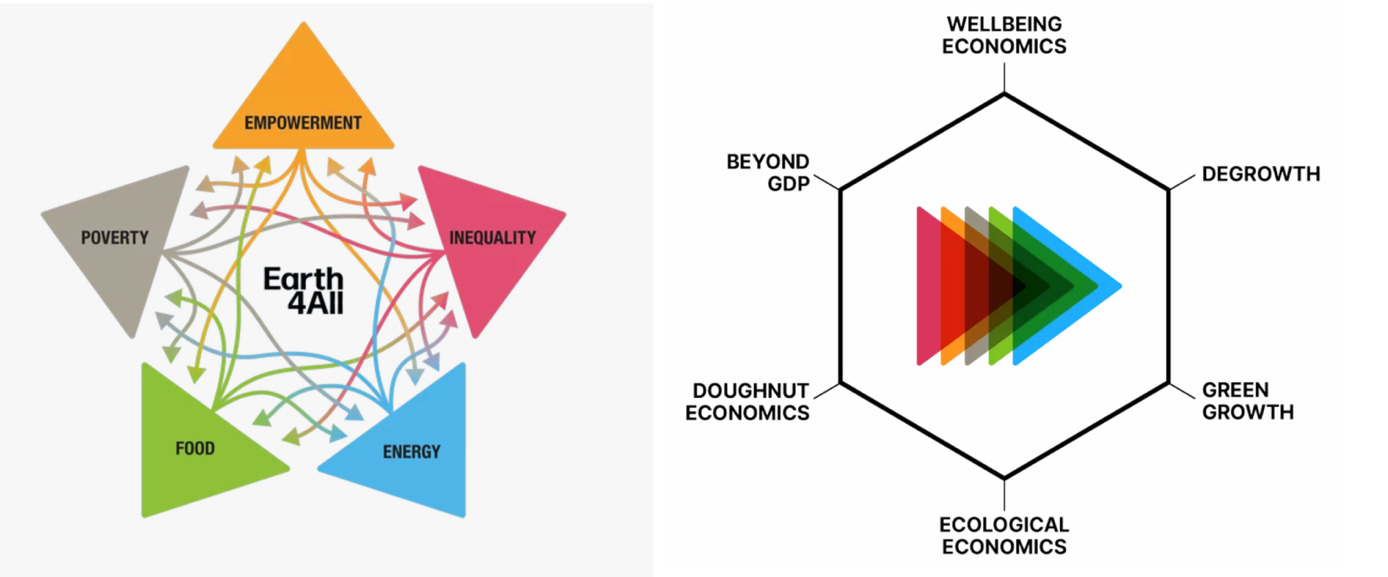
“We economists have done the maths: ‘growth’ is a doomed strategy – there is a better way” wrote Olivier De Schutter, Joseph Stiglitz, Jayati Ghosh, Thomas Piketty, Kate Raworth and Jason Hickel in a recent op-ed for the Guardian newspaper als well as Le Monde and El País. The authors regard poverty and environmental disasters “not (as) separate crises. They are symptoms of an economic model that has reached the end of the road.” While stating that “if governments can manufacture poverty, they can also dismantle it” they support the “roadmap for eradicating poverty beyond growth”, which has been supported by more than 1200 experts around the globe.
In another op-ed for the same newspaper entitled: “A good life for the 99% isn’t a pipe dream: it can be done. Here’s how”, Thomas Piketty, Lucas Chancel, Cornelia Mohren, Rowaida Moshrif, Moritz Odersky and Anmol Somanchi write” Our plan is radical – but by transforming how we live on a finite planet, nearly everyone gains”
According to them, “A world in which the bottom half of humanity sees its share of global wealth rise from just 2% today to 30%” is possible. A world “where we consume enough, but nobody over-consumes. And imagine achieving this on a planet that can comfortably sustain human life without its climate breaking down.”
This, too, is backed up by a detailed report which sets out the scientific basis for it. Among other things, the report proposes convergence between the poorest (€290 a month in sub-Saharan Africa) and richest (€4,590 in North America/Oceania) regions of the world “towards a common level of about €5,000 a month in all countries by 2100”.
According to my calculations, to achieve this, incomes in the poorest countries would have to rise by 3.8 per cent every year year, whilst those in the richest countries would have to rise by only 0.1 per cent. Otherwise, the richest would continue to ‘pull further and further ahead’ of the poorer countries. And what is even worse: high growth rates in rich countries reduce the chances of poor countries to grow.
Another issue of that report is that annual working hours per employed person would fall from roughly 2,100 to about 1,000. “Women and men would converge on equal pay and on an equal share of economic and domestic labour”, the authors say.
Both options were discussed in detail over the last two decades as part of the Austrian ‘Growth in Transition’ stakeholder dialogue as well as the UniNEtZ project, an innovative alliance of scientists and artists from 23 Austrian universities and other scientific institutions to contribute to the implementation of the Sustainable Development Goals, in which I have been coordinating the work on SDG8 to “promote sustained, inclusive and sustainable economic growth, full and productive employment and decent work for all” as formulated by the UN.
In one of 5 “options” I suggested for Austrian policy was “Reducing lifetime full-time working hours to 50,000 hours as a basis for the redistribution of work (including care work)”, which I intend to present in detail here on a later occasion. It was triggered by a discussion we hat at one of the first “Growth in Transition” conferences with Christer Sanne, who had published a book entiteled “Keynes barnbarn: en bättre framtid med arbete och välfärd” (Keynes’s Grandchild: A Better Future with Work and Welfare) thinking further the ideas presented by John Maynard Keynes in his famous article on the “Economic Possibilities of our Grandchildren” almost 100 years ago in 1930. Keynes, who was one of the most influential economists of the last century, did not foresee the enormous growth dynamics of the second half of the 20th century and therefore thought that later generations will have the chance to substantially reduce their (paid) working time of 15 hours a week and wondered how we would spend our time then.
Thanks for reading Blogposts by Fritz! This post is public so feel free to share it.
Of course, many questions follow from the explanations and statements made in this article. For example, how can we measure wellbeing if GDP is not an option, what are our chances, as a society, of agreeing on such a transition, what are political opportunities or challenges in a socio-economic system that is created as so much depending on an ever growing economy? And you, my followers who have managed to read this far, will certainly have more. I invite you to get in touch and discuss those questions which can help us all to imagine and create a better future for us and all.
No posts
Comments
Nothing yet. Say the first thing.
Sign in to join the conversation.