
„We connect people, knowledge, and action to catalyse systemic change, always following our guiding star: global equity for a peaceful and healthy planet“ writes the Club of Rome on its website under ‘What we do’. Just recently we launched another “call for global action” – this time on the global food crisis. I’m often asked how I manage to motivate myself for a fight that seems so desperate and hopeless. And I must say that I don’t really know where my hope of being able to do something to make the world a better place actually comes from. The roots are probably in my genes, in my socialization and in my education.
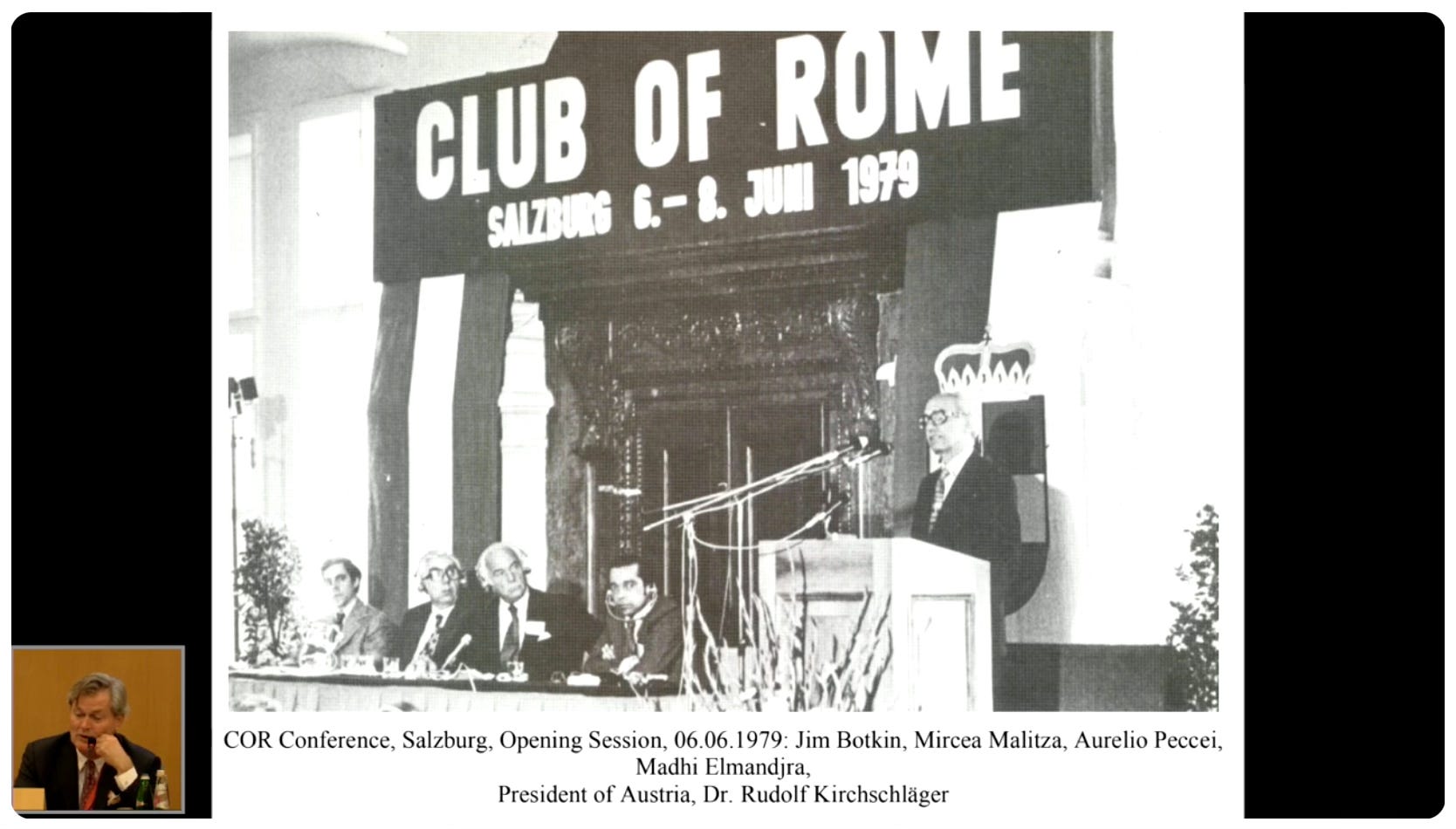
The Club of Rome’s report „No Limits to Learning“, published in 1979, is of similar significance as the “The Limits to Growth”, published seven years earlier, which I have discussed here previously. I admit that I that I hadn’t heard anything about No Limits to Learning before the 50th Anniversary of the Club of Rome celebrated in Rome, when Gunter Pauli reminded us of its impact. And interestingly enough the report was launched in Salzburg, Austria - opened by Federal President Rudolf Kirchschläger, Provincial Governor Wilfried Haslauer and Mayor Heinrich Salfenauer.
The report refers to the gap between systemic complexity and human capacity as the ‘human gap’. ‘Learning’ must bridge this gap and requires anticipatory and participatory learning – and it must be done collectively. Individual learning is too slow to keep pace with the speed of change. What is needed is ‘societal’ anticipation, which not only foresees the future but also ‘co-creates’ it. An important objective is to preserve the autonomy of parts of the system whilst integrating them. This strikes me as particularly important when we talk about ‘conflicts’.
To mark the 45th anniversary, Gianfranco Bologna gave this interview. You may also want to watch this video. The Club of Rome’s ‘No Limits to Hope’ initiative is now taking these ideas a step further (just as Earth4All built on the ideas in “Limits to Growth”). It is the focus of the conference ‘No Limits to Hope: Sense-making for alternative futures’, which the Club of Rome is organising in Bucharest in November.
Why does this almost 50 years old report trigger my interest? Thinking (and feeling) in systems in anticipatory and participatory ways has been on my mind in many of my activities, even though I could not really connect those three aspects and, hence, would not have been able to put it that way. Some thirty years ago I had the chance to to contribute to the work towards a Sustainable Europe and a Zukunftsfähiges Deutschland. (Macroeconomic) scenarios for a better future were consequently at the heart of our work of the Sustainable Europe Research Institute (SERI) both in Austria and Germany from 2000 until 2020.
Later, I developed these ideas further as part of two research projects at the University of Applied Arts Vienna, in collaboration with colleagues from the University of Salzburg and the University of Natural Resources and Life Sciences, Vienna. Together with a group of local residents campaigning for a biosphere reserve in the Austrian Salzkammergut and with a group of Austrian stakeholders from academia and industry, public administration and civil society we used artistic practices, systems thinking and participatory indicator development to develop concrete steps into the future. Furthermore, I worked with companies and finally developed the national engagement for The Club of Rome’s Earth4All in such an anticipatory and participatory way.
(I published an overview of this work in a book edited by Marisa Mühlböck on Sustainable Transformation and Well-being of which I can send a copy on request.)
At a recent ‘Growth in Transition’ breakfast meeting, we returned to the topic of ‘visions’ – positive images of our future. How can we work together to create the future we want? Suddenly, the question popped into my mind: But who is ‘we’? And why focus on the future and not the present?
Those are my questions today concerning anticipatory and participatory learning. Who is “we” and why wait for the future? This article is part of my own dealing with those issues and I invite my readers to participate in a conversation with me. Let me start with the latter question: do we have to wait for a better future?
A simple answer would be: it just takes time! But how long do we have to wait? It sounds a bit proto-religious: salvation comes in the Kingdom of Heaven. Even more it sounds like an economic calculation: the present must be sacrificed for the sake of the future actually. Of course, there are cases where this is true. I can either eat the cake or save it for a cup of tea together with some friends. Or eat it and bake a new one. There may be limits to this, however: a lack of resources, a lack of time… Who knows whether the cake will even still be there tomorrow – or whether I’ll still be here tomorrow?
It’s clear where the phrasing in the Brundtland Report of sustainability as ‘development that meets the needs of the present without compromising the ability of future generations to meet their own needs’ comes from: the ‘current generation’ at that time – that is, my generation and that of our parents – certainly managed affairs and lived in such a way that there was a risk that future generations – that is, today’s young people and their children – would no longer be able to satisfy their needs to the same extent. And this risk has become more and more certainty by now.
At our recent workshop at the University Future Festival in Graz, too, this was the question we were asked most frequently after so much talk about a better future: what can we do? What can we do now? What do we want to do now? Perhaps the very fact that we draw a distinction between today and tomorrow is actually an obstacle to change. But do we really have to sacrifice the presence? Maybe the task should be to develop a vision for the present? Even if we strive for a better future.
But to what extent have ‘we’ actually been able to meet our needs through our excessive consumption of resources? We in the Global North live in an imperial manner. Our wealth is based to a large extent on the resources and labour of people in parts of the world who can only dream of such wealth. And this wealth continues to grow, even though here at home it has long since ceased to be available to everyone. For me, this means that alongside the struggle for a fairer distribution of income and wealth, we must now ask: what do we need for a better life – today?
There are a great many initiatives in Austria that spread hope by making very practical steps into a better present. I am currently involved in some of them myself, from WaLeWi, a co-housing project with currently 80 adult members, to MILA, the participatory super market with more than 1400.
Another point that is always important to me in this context is that the goals we set ourselves in this way must be measurable – and, above all, using indicators developed by the people who are ‘anticipating’ their own future. ‘How can I tell if I’m getting closer to my goals?’ In his book ‘The Subtle Art of not Giving a F*uck”, Mark Manson points out, amongst other things, that you should pay close attention to what you use to measure the success or failure of your own behaviour. His example: he wants a closer relationship with his brother and measures this by how often his brother calls him. But perhaps that isn’t actually a good indicator of the relationship between the two brothers that he’s hoping for. Indicators must always be derived from precisely defined goals – and not the other way round. Your own goals, mind you.
For a group or community, this means bringing the different goals that its members have into a common framework and then ‘measuring’ how far they are from achieving them (both as individuals and as a group). Participatory, anticipatory and systemic thinking and feelings of those involved must be actively incorporated into the process. In this way, ‘hope’ can be turned into a better present – and future.
That reminds me of the work and practical implementation activities carried out by Alexander Kaiser, who heads the Department of Knowledge Management at the Vienna University of Economics and Business. With his WaVe - Zentrum für Wachstum und Veränderung (Centre for Growth and Change) he invented and developed the concept of vocation coaching - not only for individuals but also for groups and communities. With our Sustainable Europe Research Institute (SERI) we were one of the first to apply these methods under his guidance.
It was also from Alexander that I first heard about Otto Scharmers „Theory U“ about 20 years ago. Scharmer is a Senior Lecturer in the MIT Sloan School of Management and co-founder of the Presencing Institute. As a member of the Club of Rome, he also drew a connection with the Earth4All report: “Transforming our economies from ego to eco” lautet der Titel seines Deep dive-Papers.
In the autumn of 1971 – 55 years ago – John Lennon released the song “Imagine”, which, as he later admitted, was heavily influenced by his partner Yoko Ono. At least, that’s what it says on Wikipedia. Today, she is recognised as the official co-writer. And rightly so! “I hope someday you'll join us. And the world will be as one”, they wrote more than 50 years ago. Maybe this future is now!
Coming back to the notion of “learning”, I’m reminded of the song “What did you learn in School today” written by Tom Braxton and made famous by Pete Seeger, which I often sang and played with my friends back in the 1980ies. It ends with the verse:
I learned that wars are not so bad,
I learned of the great ones we have had.
We fought in Germany and in France,
And someday I might get my chance.
And that’s what I learned in school today, that’s what I learned in school.
We can definitely do better. Let us do better together!
No posts
Comments
Nothing yet. Say the first thing.
Sign in to join the conversation.